Introduction
Imagine heating a piece of metal until it glows. First it turns red, then orange, then yellow-white. Classical physics in the late 1800s could not explain this. Its equations predicted that as you approached shorter wavelengths — the ultraviolet end of the spectrum — the emitted energy should shoot toward infinity. That is physically impossible, yet the maths insisted on it. Scientists called this the Ultraviolet Catastrophe, and it became one of the most embarrassing failures in the history of physics.
The solution came from Max Planck, who discovered that inserting a specific fixed quantity — now called the Planck constant (h) — into the equations made them match experiment perfectly. This single act launched quantum theory. Yet over 120 years later, no one has been able to explain why that particular value exists. This article re-examines the Rayleigh-Jeans calculation from the perspective of musical harmonics — and in doing so, finally unravels that mystery.
Key takeaways
- The Rayleigh-Jeans failure came from applying the additive harmonic series to black body radiation — the same mathematical move that produces discordance when transposing music through many keys, because it adds equal frequency steps rather than using ratio-based division.
- The Planck constant is not proof that light consists of discrete energy packets; it is a geometric expression of the musical fourth and fifth, derivable from the cube of space as (√3³ ÷ √4³) × π².
- The visible light spectrum divides into two distinct colour waves — the Red-Green wave (divided into three) and the Yellow-Blue wave (divided into two) — mirroring the musical fifth and fourth, which means apparent light quantisation is a consequence of harmonic ratio, not of photon particles.
The Ultraviolet Catastrophe
The realisation that reality is quantised into discrete packets originates with what scientists term the Ultraviolet Catastrophe. When an object is heated up, it will begin to glow red. As it gets hotter, so it will change colour turning yellow (white), and at extreme temperatures blue. Quite clearly, this colour order is directly related to the visible spectrum of light. The hotter an object gets, the higher the frequency of light that is emitted. However, if we try to calculate the exact relationship between temperature and light using classical electromagnetic theory, we find that the correlation does not meet with experimental result. As this is much more pronounced at the ultraviolet level, the term Ultraviolet Catastrophe was used to express this anomaly.
Standing Waves
Through these black body experiments, scientists were able to gather a vast amount of data regarding the spectral emissions of different objects at different temperatures. However, what was missing were the mathematics that would emulate these results. Whilst the relationship between spectral radiance had already been successfully produced by Wilhelm Wien in 1893, these calculations were based in the field of thermodynamics, not electromagnetism. What was needed was a mathematical interpretation that would unify the experimental results with classical wave theory.
It was Rayleigh and Jeans that took on the challenge. The mathematics they used are quite complicated, involving lots of trigonometry, which for most people is beyond their scope of understanding.
We can massively simplify the maths by understanding the basics of how waves work. A wave is expressed on a line which represents its direction of travel. A half arc forms the first part of the wave, which inverts in the second part. Together, they create a single wave, which then repeats. The distance between two peaks is called the wavelength, and the number of times the wave produces its peaks is called its frequency. The shorter the wavelength, the higher the frequency.
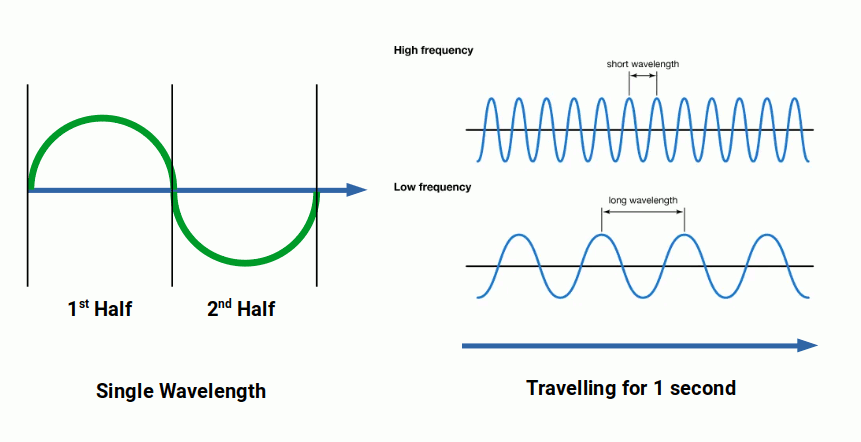
The wavelength and frequency of an electromagnetic wave is unified by the speed of light. When the frequency is multiplied by the wavelength, it always produces the speed of light (c). It is interesting to note that wavelengths are spatial whereas frequency is temporal. This means that all waveforms have both a space and a time component.
When Rayleigh and Jeans calculated the spectral radiance of the black body experiment, they used whole number integers of wavelength, which produce standing waves between the two sides of the box. A standing wave is formed of half wavelength numbers. This is called the harmonic series, and is a natural phenomenon found in nature. For example, a wavelength of 1/2 produces what is called the fundamental of that particular key. The second harmonic is formed of a wavelength that is exactly half the first. Then the third harmonic creates the musical fifth, and the fourth harmonic the musical fourth.
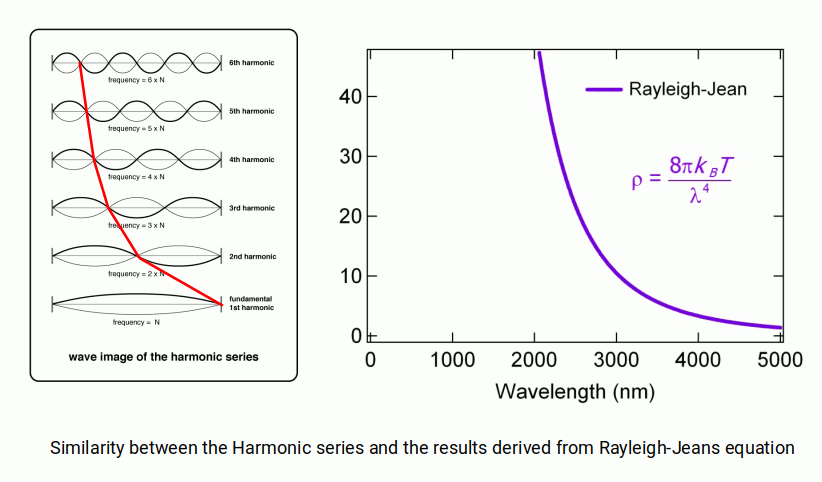
The above image shows the first six steps of the harmonic series. Notice that as the wave gets divided into smaller and smaller parts, so the wavelength gets exponentially shorter. This in turn creates a logarithmic curvature similar to the Rayleigh-Jeans expression. As no limitation was placed on the number of times the wave can be divided, so the wave will curve towards infinity. This simple expression helps us to understand the fundamental problem with the Ultraviolet Catastrophe.
Musical Tuning
A string under tension when struck will produce a particular frequency based on its length and width. In the example of a guitar, each string is the same length, but the tension and width of the string produces different tones. Each note needs to be tuned correctly, otherwise the music produced becomes discordant. Only when the frequencies fall into a specific ratio is the instrument tuned.
As noted previously, a string that is halved produces the octave, the 2nd in the harmonic series. When the string is quartered, it forms the musical fourth, and when divided into three, the musical fifth is produced. From the difference between the musical fourth and fifth, the tone is created. In between the tone, we find the semitone, which is often found as the black note in between two white notes on a piano keyboard. The octave is formed of 12 semitones, from which 7 notes are selected to form a musical scale. There are 7 types of musical scales, called modes, which are Ionian, Dorian, Phrygian, Lydian, Mixolydian, Aeolian and Locrian.
Music is based on a specific key, which is expressed by the first harmonic of the scale. In modern music we employ the tempered scale which dispenses with the need for musical exactness, by slightly detuning the note. This is how instruments such as the piano can avoid being retuned each time the musical key is transposed. However, it means that instruments tuned to the tempered scale are never perfectly in tune — this atonality is small enough to be discounted. You can find out more about this in our theory of Harmonic Chemistry, that unifies these musical concepts into the structure of the periodic table.
When we consider the problem of musical tuning moving toward discordance as the number of divisions increases, we can begin to recognise the similarity between this and the concept of quantised electromagnetic waves. In the harmonic series, the 7th harmonic seems to be where the problem of musical tuning first arises. By way of example, we can consider the idea of musical cents. This concept divides the octave into 1200 tiny lengths. Notice that the numbers 1, 2, 3 and 4, that form the first 4 harmonics, will all divide perfectly into the number 12. The 5th harmonic creates the first problem: when divided by 1200 it should be found at 240 cents, which should be the major third. However, in music, this is not the case. Instead, it is the ratio 4:5 that creates the major third. The number 6, although it can be divided perfectly into 12, does not create the Pythagorean minor 2nd, or whole tone, which is found by the ratio 8:9 or 3³:2². Instead of the equal-tempered 200 cents, this equates to 203.91 cents. Between the tone, we find the semitone. You might think this should be the 7th harmonic at 171.42 cents. However, the perfect semitone is actually found to be the ratio 25:24, which is only 70.67 cents — over 100 cents out.
What we see is that the division of a line (string) creates drastically different results from equal temperament made of a single unit of equal spacing. Just like the error in the Rayleigh-Jeans calculations, at smaller wavelengths the calculations fall into catastrophe.
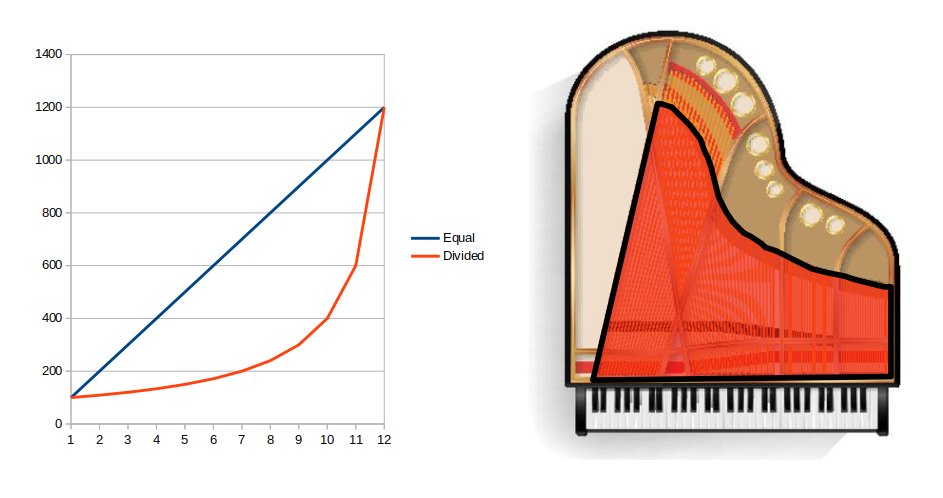
This concept is most clearly demonstrated by examining the construction of the piano. Notice that the keys all fall in a straight line, whereas the internal strings form a curvature that is not uniform. The diagram above shows the difference between the string divided (red line) and the equal division of a line (blue).
This notion of infinitely smaller division is covered in great detail in our solution to the Continuum hypothesis, which resolves the Russell Paradox, offering new insight into the true structure of numbers and the nature of infinity. When considering our mathematical discovery of Aleph 0.5, bear in mind that the concept of a standing wave is incremented by half-wavelength steps.
The Geometry of Music
The structure of music is derived from the Circle of Fourths and Circle of Fifths, which in turn is derived from the division of a string into two and three. Previously, we saw that the first four steps in the harmonic series correlate nicely with the 12 notes found in the chromatic scale. Based on the 1st harmonic (the fundamental), the octave arises perfectly by dividing the string into two. The division into 4 (4th harmonic) creates the musical fourth. By resetting the fourth as the fundamental, the next set of notes in the circle of fourths is defined, and the process is repeated until all 12 notes complete the circle. The same applies to the division into three, which forms the circle of fifths. The difference between the fourth and the fifth creates the tone.
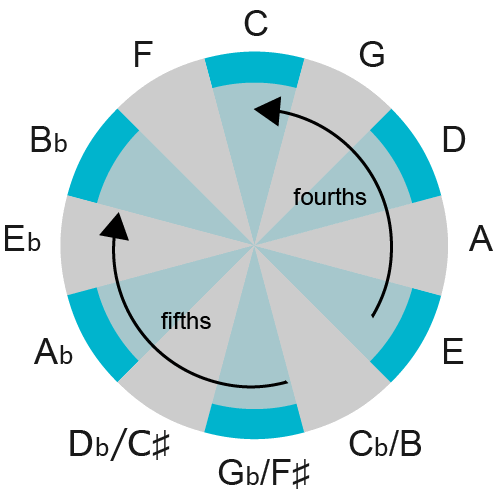
It is a curious fact that both the circle of fourths and fifths can be placed on a single circle, expressing intervals in either a clockwise or anticlockwise direction. Some notes are expressed as sharps (#) and others as flats, relating to the seven different musical modes. This means that the entire structure of music is derived from these two types of simple division.
This concept is also found in fractal geometry. A fractal creates a self-similar pattern at different scales. The triangle and the square are the two simplest 2D shapes that can be constructed. By dividing each side length into two, a smaller version of each shape fits perfectly inside. The inner triangle becomes rotated 180°, whereas the inner square is only rotated 45°. If the process is repeated, both shapes return to the original orientation after 3 steps.
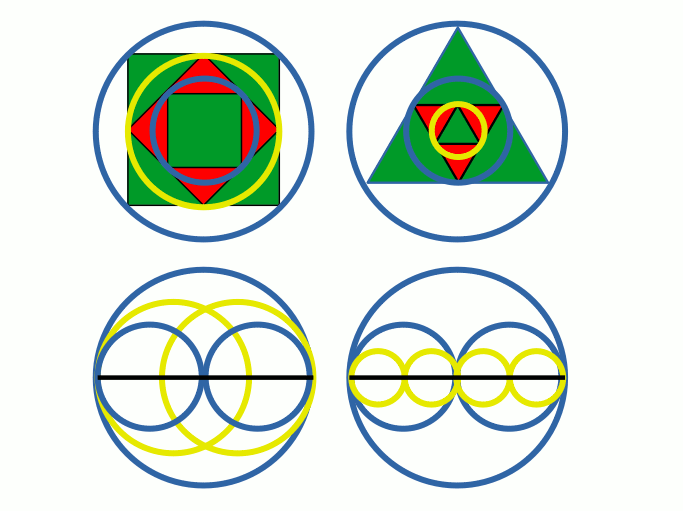
Notice that the square divides the line into three sections, forming the musical fifth. The second iteration creates the octave. However, the triangle immediately creates the octave, which on the second iteration becomes the musical fourth. The unification of all musical structure is therefore contained within the fractal geometry of these two basic shapes. In both cases, only three iterations are needed before the internal shape returns to its original orientation — which is why we say "there are only three steps to infinity." The musical fifth of the square is unique, as the two circles overlap in perfect proportion. This is called the Vesica Piscis.
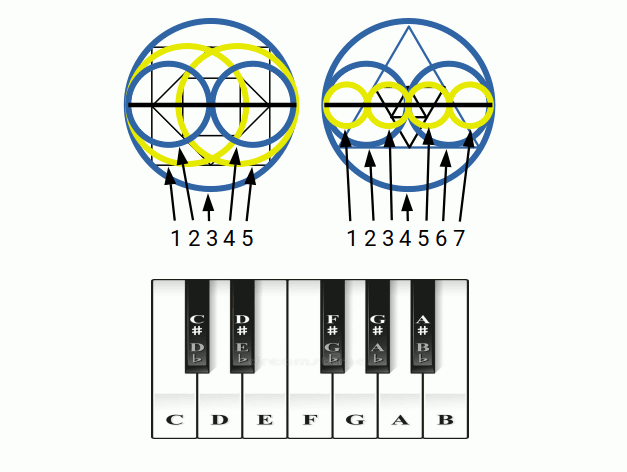
What this demonstrates is that the two types of division creating the musical fourth and fifth are based in different types of geometry. The triangle only divides space through an even number series, whereas the square divides the line into 3. When we add 3 and 4 we get 7 — the number of notes in a musical scale. Furthermore, if you count the total number of circles it equals 12 — the number of notes in the chromatic scale. Five are derived from the square and seven from the triangle, which is exactly the same ratio as the number of white and black notes on a piano keyboard.
The geometric relationship between the musical fourth and fifth also surfaces in the ratio between the speed of sound and the speed of light — an idea explored in detail in our article on the speed of sound and light ratio. The square and triangle are also unique in being the only regular shapes that can tile a 2D plane perfectly using just two colours. The 90° angle of the square is also found within the structure of electromagnetic waves. Without recognising this fundamental nature, the comprehension of how light functions becomes quite difficult. Yet with this background in place, we can begin to understand why Newton originally proposed there were seven colours in the rainbow, and begin to unveil the mystery of how the visible light spectrum actually works.
The Structure of Light
To understand why the Rayleigh-Jeans calculation fails, we first need to understand something surprising about how visible light itself is structured. The importance of the musical third and fourth when considering the nature of light cannot be underestimated. The visible colours of light are constructed from two types of wave. Whilst you may have been told that light comprises only three prime colours (RGB), there is strong evidence that this is not the case. The Yellow-Blue wave is divided into two parts, just like the octave of a string. The second is the Red-Green wave, divided into 3.
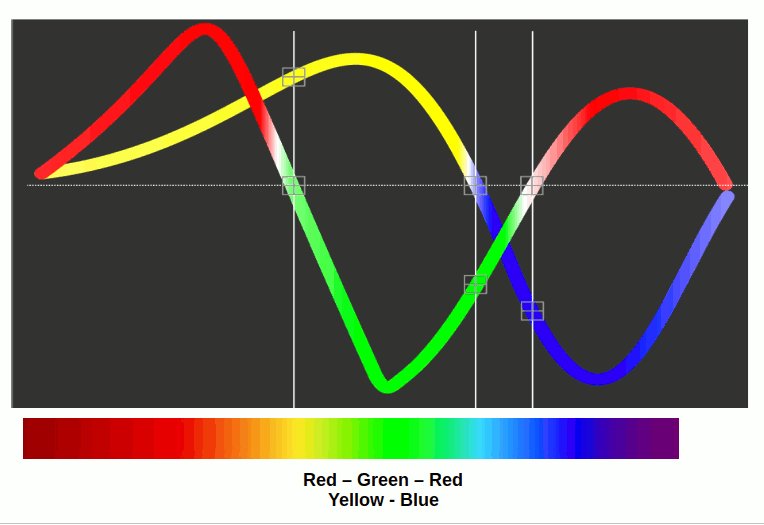
This theory of visible light is derived from the nature of impossible colours. Certain colours, such as red and blue, can be mixed, whereas others, such as red and green, cannot. This leads to the conclusion that the visible spectrum is formed of two distinct types of colour wave. This explains why yellow and cyan occupy such a small portion of the visible light spectrum compared to red, green, and blue. Those who paint are aware that red, yellow, and blue are considered prime, as green is produced from mixing yellow with blue. In the case of light, colour is subtractive, meaning the wavelengths cancel out. More information on the nature of light can be found in our theory of Geo-optics.
Outside the discipline of human optics, this interpretation of electromagnetic light is rarely referred to. However, from this view, we can immediately see an interesting correlation to the musical fourth and fifth. Red peaks in two places, at both the bottom and top end of the frequency spectrum. The mid-section of the wave contains green. The second wave starts with yellow at the bottom end of the spectrum, which increases in intensity up to the midpoint before receding and turning blue, just like a musical octave.
This nature of the visible spectrum begins to resolve why the Rayleigh-Jeans law fails to predict observed phenomena. Their calculations were based on the harmonic series — the successive addition of frequencies to the 1st harmonic, counted as whole numbers into infinity. The result is a premature curvature of the plot on the graph that tends toward infinity without limit.
Musical harmony, by contrast, is derived from the ratio of waves — the fundamental divided into two and then three. After this, these ratios go on to create the circle of fourths and fifths. If the fundamental changes, then so does the ratio of fourth and fifth. This limits the tuning of the wave. This is exactly what the Planck constant does: it provides a specific limitation of light at specific temperatures. In terms of spectral radiance, the fundamental is the peak of the radiant energy. The same spectral signature is visible today in the Cosmic Microwave Background — the fossil light of the early universe, whose peak frequency is governed by the same harmonic principles. The frequencies either side of the peak show where the harmonic series dissipates into incoherence. We can examine this nature by plotting the wavelength peaks for different temperatures.
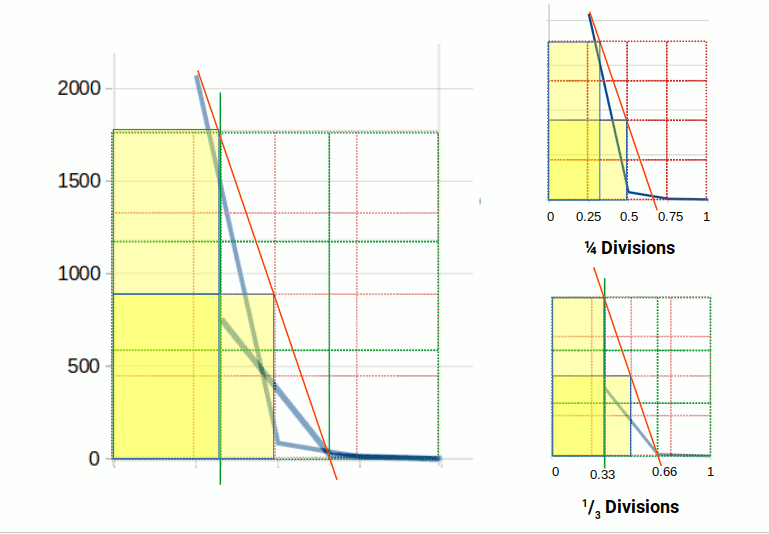
Here we can see the spectral radiance calculated for a wavelength of 1, divided into quarters and thirds. Notice that the peak rises dramatically between the 0.5 and 0.25 region (top right). Whilst not as prominent, there is also a sharp upward turn between the two-thirds and one-third wavelength values (bottom right). When superimposed, the two graphs form a curvature that matches the spectral radiance found at the quarter wavelength of temperature.
Unlike a physical string, the fundamental of light (the peak of spectral radiance) descends away from the peak towards both higher and lower frequency ranges. The fact that the slope is slightly longer towards the lower frequencies is due to the increased wavelength of light.
In terms of music, it is the distinction of the musical fourth and fifth that defines the 12 notes of the chromatic scale, which in turn limits the tunings of the musical scale. What we are beginning to show is that it is the same principle responsible for the quantisation of the electromagnetic wave.
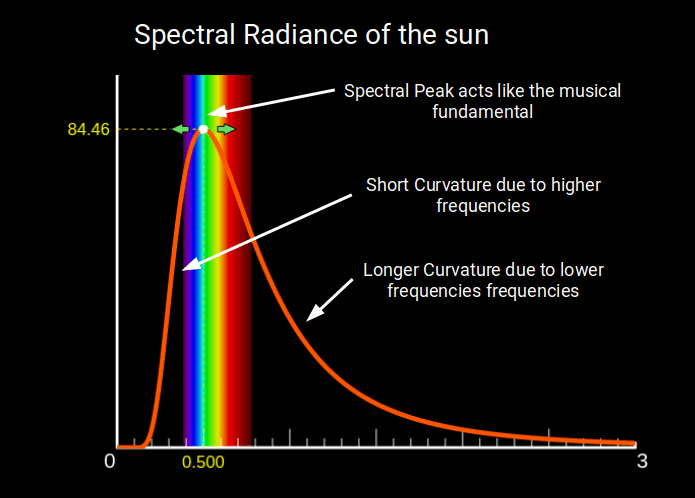
In essence, this means that the idea that light is quantised into discrete energy packets is not the correct description of the Planck constant. It is the structure of harmonic ratio that is the root cause of the phenomenon. This actually makes perfect sense, as spherical harmonics are at the heart of quantised phenomena in modern quantum theory. The notion of quantisation is quite simply a consequence of ratio — which divides a line — rather than the harmonic series, which adds successive frequencies in equal measure. This is akin to the idea that light is produced in tiny wave packets, or photons. Whilst the wavelike nature of the photon cannot be discarded, the idea that it is a particle can. This is explored in depth in is there an alternative to wave-particle duality? and a 4D geometric wave model of matter. You can find out more about this in our post on the photoelectric effect. Armed with this knowledge we are now able for the first time to glean a simple understanding of light, based on music theory, powerful enough to decode the exact nature of the Planck constant.
The Planck Constant
The Planck constant (h) resolved the Ultraviolet Catastrophe, and it is now so fundamental that the entire SI unit system has been defined around its experimental value. Armed with the harmonic model above, we can now derive exactly why that value takes the form it does.
In our system of Dimensionless Science, we have translated 40 scientific constants into simple geometric ratio, by setting the speed of light to an integer, 3. Based on this, we are able to examine various scientific equations to produce exact values for other constants to an infinite degree of accuracy. In Dimensionless Science, the Planck constant (h) is defined by the formula:
This gives the exact value of the Planck constant as 6.4104, which can now be calculated to an infinite degree. Whilst this value deviates from the accepted value of h (6.626 × 10⁻³⁴) by 0.215, this is due to the fact that traditionally light is ascribed the value of 299,792,458 m/s instead of 300,000,000 m/s. To explain why the Planck constant has this particular value, we can start by considering a cube of space.
The expression of h contains the value π². The equation that transforms the radius of a circle into its surface area is π × r². By setting the radius to 1, the resultant surface area becomes π. As electromagnetism expresses two waves offset by 90°, we need to create another circle of the same dimension. This sets up a single standing wave in a cube with a side length of 2. The expression π² simply represents the surface area of an electromagnetic wave as a musical fundamental.
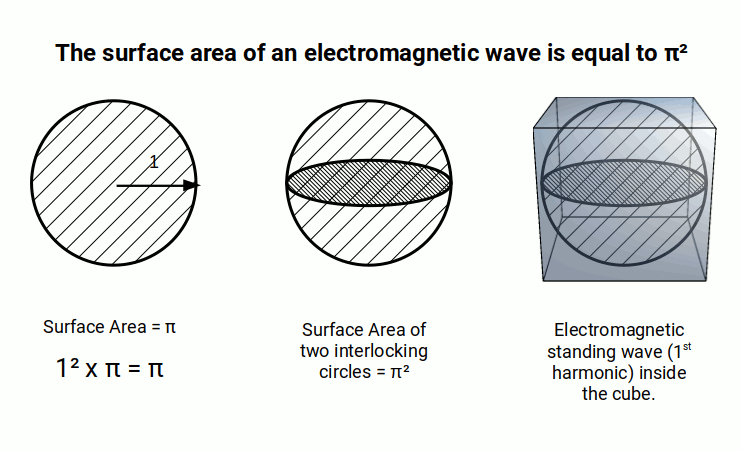
Now that we have our standing wave, the next step is to examine the remaining part of the equation: √(3³/4³). There are only 8 notes in a musical octave, so the number 1 is divided into 8. The cube with a side length of 2 (as the circle radius is only 1) measures √3 from its centre to its corner point. We can take the value of a single note (1/8) and multiply it three times by the value √3. The result is √(3³/4³), which when multiplied by the surface area π² yields the value for the Planck constant.
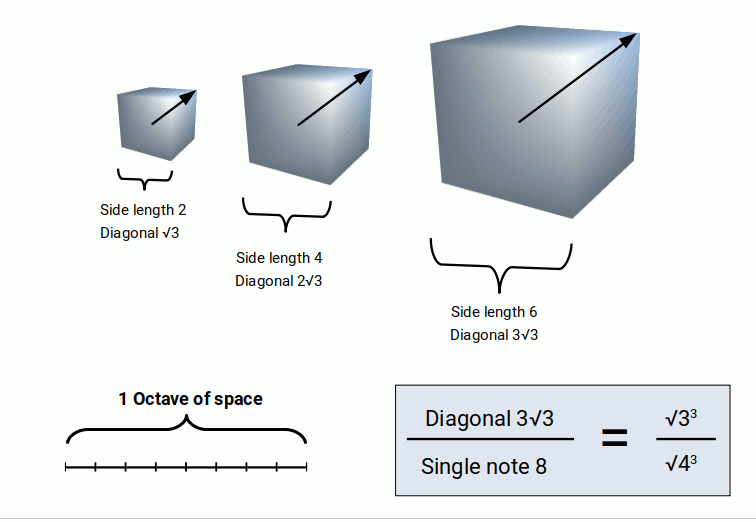
Here we can see another expression for the value √(3³/4³), which is a standing electromagnetic wave expanding from diameter 1 to diameter 3. The value equals (3√3)/8. Notice that the cube expands through three stages: side lengths 2, then 4, then 6. The reason for this is that a spherical light wave expands up to the speed of light, details of which can be found in our geometric interpretation of the speed of light (c). The sphere expands in three stages, just as our fractal geometry example that forms the musical fourth and fifth in the triangle and square goes through three iterations to form all the required musical ratios. Just as the value 3 appears for the speed of light in Dimensionless Science, so that same value limits the formation of all musical harmony.
So does this mean that energy is not quantised? Not exactly. The fact that the speed of light is limited to an expansion of three is due to the hyper-cubic nature of space. The energy in the vacuum is believed to be teeming with tiny virtual particles — a Quantum Foam — that pervades the whole universe. In our theory of the 4D Aether, we explain how this mysterious substance functions from the perspective of 4D geometry.
In our post that explains the reason for the photoelectric effect, we find that it is the nature of space that causes the apparent quantisation of an electromagnetic wave — not the concept of a photon as a particle. Similarly, in our explanation of the Planck constant above, there are three types of cube that expand from a radius of 1 to 3: the speed of light. These three cubes act in 4D space as a hypercube, which is why electromagnetic waves are offset by 90°. What we have explained in this article is that energy, a wave, is not quantised in the manner traditionally believed. It is the disharmony of the harmonic series that limits the infinite nature of reality.
Conclusion
Why did classical electromagnetism fail experimental predictions?
The reason for the Ultraviolet Catastrophe is not that light energy is quantised into packets. Rather, Rayleigh and Jeans did not employ the notion of musical ratio in their calculation. Instead, they tried to explain the phenomena using the infinite harmonic series. Just as this produces discordance in music once transposed through higher or lower scales, so the same is seen in the predicted outcomes. The Planck constant, which resolves this inequality, does not imply that light is quantised into discrete energy units. It implies that light is structured through the integration of the musical fourth and fifth. Whereas the harmonic series adds equal quantities to a particular frequency, musical ratios are derived from the division of a string. This creates a logarithmic curvature that explains the error found in the Ultraviolet Catastrophe.
What does this mean for modern science?
This is the first time that any theory has been able to express a logical explanation as to why the Planck constant (h) exists. As h is considered by quantum mechanics to be one of the most important constants in science, an explanation for its appearance provides clarification as to why spherical harmonics are suggested to form the various types of orbital shell (S, P, D and F) — see our articles on S orbital geometry and P orbital geometry. As the concept of the photon was also derived from the notion of wave-packet particles of light, the resolution of h begins to shed a large shadow of doubt on the validity of this claim. For a deeper look at why light carries energy without mass, see why does light not have any mass?. The Planck constant is also directly connected to the structure of the vacuum itself — see our article on Quantum Foam for a 4D perspective on why space appears granular at the Planck scale.
FAQ
What is the ultraviolet catastrophe?
The ultraviolet catastrophe refers to the breakdown of classical electromagnetic theory when applied to black body radiation. Classical calculations predicted that a heated object should emit infinite energy at ultraviolet frequencies, which clearly does not happen in reality. The gap between prediction and experiment was most pronounced at ultraviolet wavelengths, hence the name.
What is the Planck constant?
The Planck constant (h) is a fundamental value in physics that describes the relationship between the energy of a photon and its frequency. Max Planck introduced it in 1900 to fix the equations of black body radiation. Its value is approximately 6.626 x 10⁻³⁴ joule-seconds. Despite being central to all of quantum mechanics, the reason this specific value exists has never been explained — until now.
What is the harmonic series and how does it differ from musical ratio?
The harmonic series adds successive whole-number multiples of a base frequency: 1, 2, 3, 4... extending without limit. Musical ratio, by contrast, is based on division — splitting a vibrating string into two or three parts to produce the octave, the musical fourth, and the fifth. The harmonic series grows infinitely and produces discord at higher steps; musical ratio is bounded and self-consistent. Rayleigh and Jeans used the harmonic series, which is why their law diverged to infinity.
If light is made of four colours, then why do RGB monitors work?
There is no such colour as a reddy-green or a greeny-red. When these frequencies are mixed, they cancel out, leaving only yellow. Similarly, we do not see green-coloured stars. The spectral radiance of our sun peaks at cyan, but it also includes a lot of green and red, which cancel each other out. Objects glow red, then yellow, but green does not appear because the existing red light removes it from the spectrum. Instead, the light shifts from yellow to blue as the red-green wave is no longer perceptible.
If the Planck constant can be defined with 3√3 / 8 then why define it as √(3³/4³)?
The term √(3³/4³) refers to a square root of a cube with side length 3, divided by a cube with side length 4. This interpretation is used when examining the four-dimensional nature of the constant. In terms of musical ratio, 3√3/8 can also be used. Just as the square and the triangle define geometric ratios in music — which is also a spherical wave in space — both expressions are valid perspectives on the same underlying structure.