Introduction
Light is the most familiar phenomenon in nature and one of the least geometrically understood. The speed of light is measured with extraordinary precision but not derived from first principles. The Planck constant governs quantum behaviour but is treated as an empirical value. Wave-particle duality — the paradox at the heart of quantum optics — remains unresolved.
Geo-Optics proposes that these difficulties share a common source: light has not been understood as a geometric phenomenon. When the electromagnetic spectrum is examined through the framework of geometric ratios — the same ratios that underlie music, atomic structure, and the Flower of Life — a coherent picture emerges. The structure of visible light mirrors the musical scale. The transition points in the spectrum correspond to atomic numbers on the periodic table. The range of human visual perception is encoded in the geometry of the Flower of Life. And the speed of light, rather than being an arbitrary constant, is a geometric property of the 4D Aether — the geometric medium through which electromagnetic waves propagate.
This page explores each of these connections in turn.
Key Takeaways
- The visible spectrum is structured by two geometric colour waves — a 2-part blue-yellow wave (the octave) and a 3-part red-green-red wave (the fifth) — producing the seven colours of the rainbow from the same 2:3 ratio that generates the musical scale
- Impossible colours — reddish-green and yellowish-blue — reveal the two-wave structure of light and cannot be explained by conventional colour mixing
- The Flower of Life consists of 37 circles; the human eye's peak sensitivity is at ~555nm (37 × 5) and the visible spectrum spans ~370nm — connecting sacred geometry directly to human visual perception
- The wavelength and frequency transition points of the colour waves correspond to the atomic numbers of technetium (43) and promethium (61) — the two anomalous radioactive elements with no stable isotopes
- The speed of light is proposed as a geometric property of the 4D Aether — derivable from electromagnetic constants expressed as dimensionless geometric ratios, not an arbitrary measured value
- All five human senses translate external reality through hexagonal carbon rings — the same hexagonal geometry produced by the Flower of Life tapestry
Light as a Geometric Wave
In conventional physics, the relationship between frequency (f) and wavelength (λ) is given by:
c = f × λ
This is a statement of inverse proportionality: as frequency increases, wavelength decreases at the same rate, their product always equalling c. From a geometric standpoint this is the same relationship as the dot and circle in Inverse Geometry — two reciprocal forms whose product is constant, each expanding as the other contracts.
The speed of light c is not treated in Geo-Optics as an arbitrary physical constant. 4D Aether Theory proposes that c is a geometric property of the vacuum medium — determined by the electromagnetic constants μ₀ (magnetic permeability) and ε₀ (electric permittivity), which Dimensionless Science expresses as exact geometric ratios rather than experimentally measured values. The implication is that light does not travel through empty space; it propagates through a structured geometric medium, and its speed is as fixed and derivable as the ratio of a circle's circumference to its diameter.
This reframing resolves one half of the wave-particle duality problem: if light is a wave in a geometric medium, the "particle" interpretation is an artefact of how energy is exchanged at geometric thresholds — not a property of light itself. The photoelectric effect and the ultraviolet catastrophe are explored in detail in their respective articles.
The Musical Structure of Visible Light
Within the electromagnetic spectrum, a narrow band of frequencies — from approximately 380 THz to 750 THz — constitutes visible light. When this band is examined carefully, a geometric structure emerges that mirrors the musical scale precisely.
Two distinct types of colour wave divide the visible spectrum:
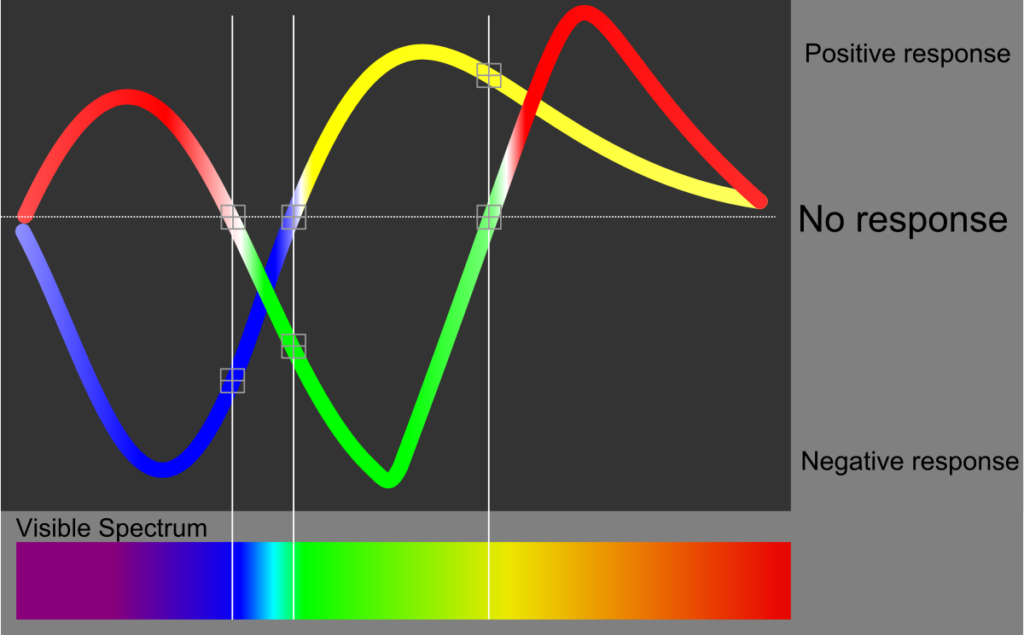
- The blue-yellow wave — divides the spectrum into two parts, proportionally equivalent to the musical octave (a 2:1 division of a string)
- The red-green-red wave — divides the spectrum into three parts, proportionally equivalent to the musical fifth (a 3:2 ratio)
The seven colours of the rainbow — red, orange, yellow, green, blue, indigo, violet — arise from the interplay of these two waves. This is not an analogy to music; it is the same geometric ratio structure, expressed in light frequencies rather than string lengths. The division of a line into 2 and 3 lies at the foundation of both.
Impossible Colours
The two-wave model makes a testable prediction: if red-green and blue-yellow are geometrically distinct wave types rather than simply different frequency regions, then mixing a colour from one wave with the opposing colour from the same wave should be impossible — the visual system cannot process the combination.
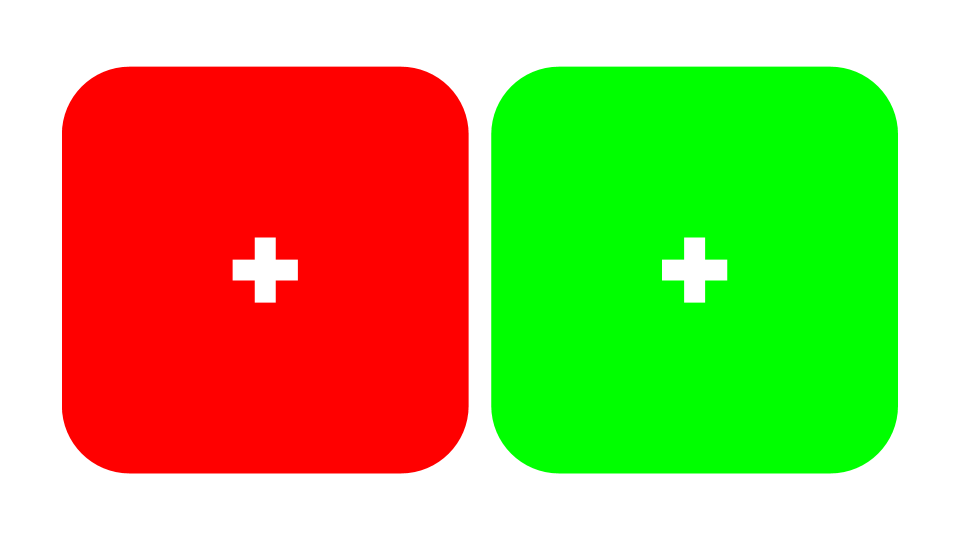
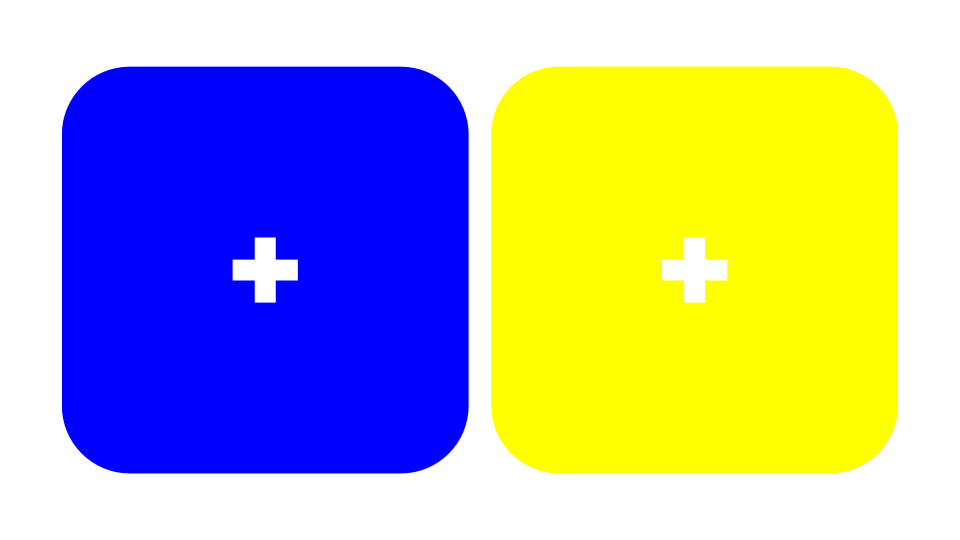
This is exactly what is observed. Reddish-green and yellowish-blue — the impossible colours — cannot be produced by any combination of wavelengths. They cannot normally be seen. But they can be induced experimentally: by holding two adjacent squares of an impossible colour pair at a certain distance and allowing focus to drift so that the central cross markers superimpose, the impossible colour briefly appears.
The Human Eye and the Flower of Life
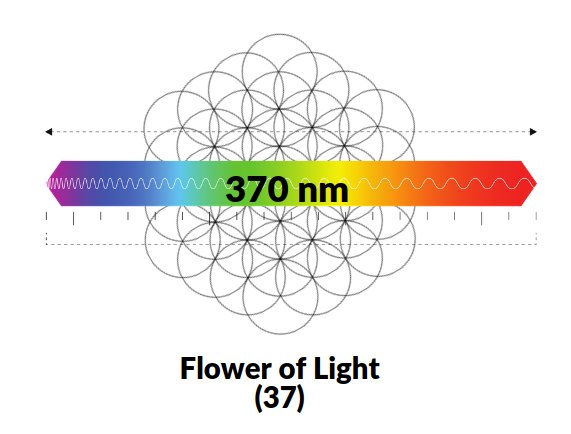
The human eye's sensitivity range spans from approximately 380 THz to 750 THz — a total width of approximately 370 nm. Its peak sensitivity occurs at approximately 555 nm.
555 = 37 × 5. And 370 = 37 × 10.
The Flower of Life — formed by extending the Flower of Life tapestry outward — consists of exactly 37 circles. This numerical correspondence connects the geometry of the Flower of Life directly to the dimensions of human visual perception.
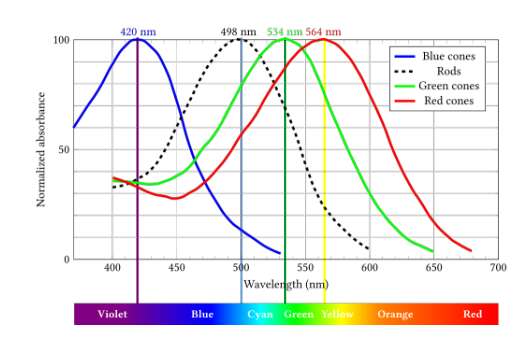
Within the eye itself, the geometric structure continues. Long rod receptors — responsible for 3D spatial awareness — are sensitive to 498 nm light (where cyan transitions to blue). Surrounding these are three classes of cone receptors (L, M, S) arranged in a hexagonal matrix, responding to wavelengths of 420 nm, 534 nm, and 564 nm — each at a transition point between colour regions rather than at a colour's centre.
Light and the Elements
The periodic table contains 81 stable elements (elements 1 to 83, excluding technetium at 43 and promethium at 61, which have no stable isotopes). The reason these two specific elements are radioactive has not been satisfactorily explained by conventional atomic theory.
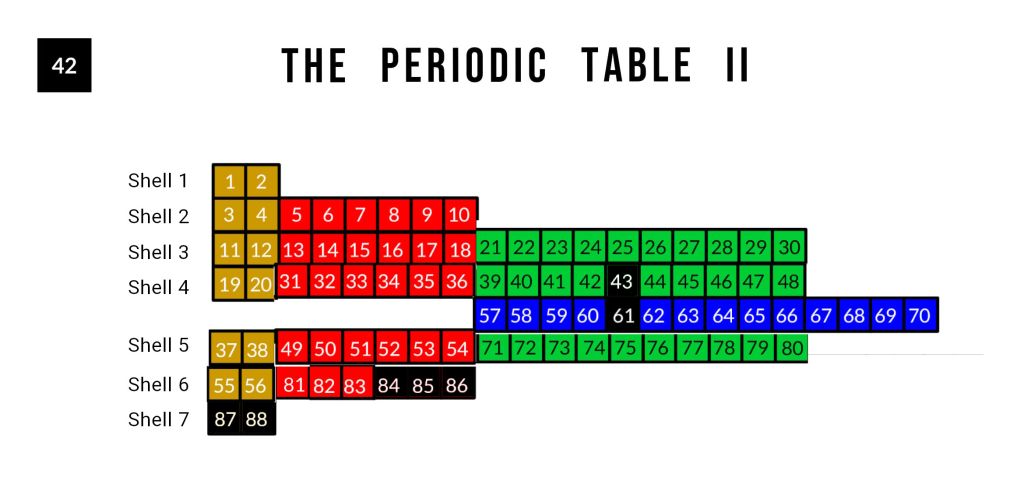
Geo-Optics identifies a precise correspondence between these atomic numbers and the transition points of the two colour waves:
- A wavelength of ~430 nm marks the transition from blue into violet (where the blue-yellow wave ends and red begins to mix). The atomic number 43 — technetium — corresponds to this transition.
- A frequency of ~610 THz marks the transition from green to blue, producing cyan. The atomic number 61 — promethium — corresponds to this transition.
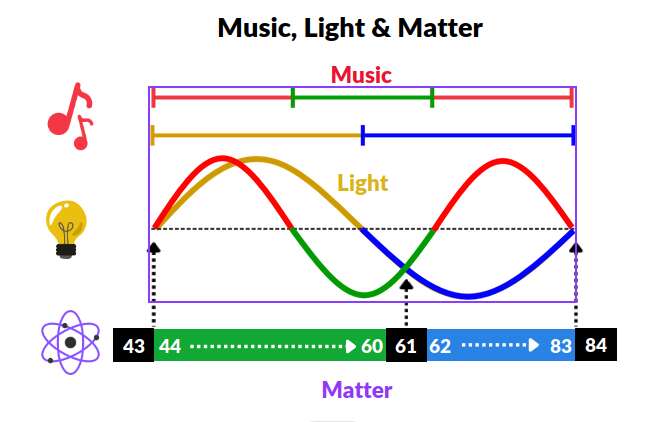
Furthermore, the atomic number of promethium (61) is related to the Golden Ratio: its reciprocal is ≈ 0.618. Dividing 0.618 by √2 gives ≈ 0.437 — the atomic number of technetium (43). The two anomalous elements are geometrically related through the same ratio that governs the pentagonal geometry of the Icosahedron and Dodecahedron.
Crossing the Boundary: Light, Hexagons, and Perception
Electromagnetic waves consist of two components orientated at 90° to each other, forming a cross. The four quadrants of this cross correspond to the two impossible colour pairs — connecting the structure of electromagnetism directly to the two-wave model of visible light.
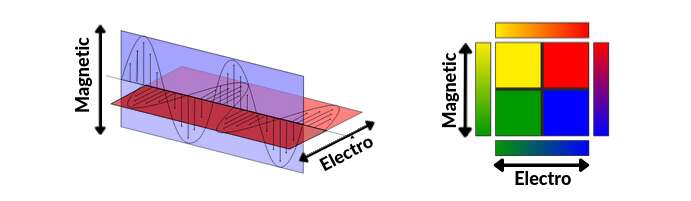
This transformation — from the square geometry of electromagnetic waves to the hexagonal geometry of the eye's receptor matrix — is not unique to vision. All five human senses translate external reality into conscious experience through hexagonal carbon rings. DNA (four bases) transitions into RNA (three bases), which converts three bases into a single amino acid — a progression from square to triangular geometry. The hexagon is the structural interface between outer reality and inner experience.
The hexagonal structure is itself a product of the Flower of Life — the same pattern that nests the Platonic Solids and encodes atomic geometry. Geo-Optics proposes that this is not coincidental: the geometry of perception, the geometry of matter, and the geometry of light all arise from the same underlying structure.
Conclusion
Geo-Optics reveals light as a geometric phenomenon. The visible spectrum is structured by the same 2:3 ratio that generates the musical scale. The transition points of its two colour waves correspond to the atomic numbers of the periodic table's two anomalous elements. The range of human visual perception is encoded in the 37-circle geometry of the Flower of Life. And the square geometry of electromagnetic waves transforms into the hexagonal geometry of biological perception — a transformation whose blueprint is written in the same sacred geometry that structures the atom.
Taken together, these correspondences point toward a unified geometric picture in which light, matter, and perception are not three separate domains but three expressions of the same underlying structure. The full geometric account of light's propagation — including the speed of light as a geometric constant and the resolution of wave-particle duality — is developed in 4D Aether Theory and in the articles on the secret of lasers, why light has no mass, and why the speed of light is constant.
FAQ
What is Geo-Optics?
Geo-Optics is the study of light through the lens of geometry. It proposes that the electromagnetic spectrum — and visible light in particular — is structured by the same geometric ratios found in music, atomic structure, and the Flower of Life. Rather than treating the speed of light and Planck's constant as arbitrary measured values, Geo-Optics derives them from geometric relationships, placing light within the unified framework of the Geometric Universe theory.
What is the connection between light and music?
The visible spectrum is divided by two distinct colour waves: a red-green-red wave that divides into three parts (mirroring the musical fifth) and a blue-yellow wave that divides into two (mirroring the octave). The seven colours of the rainbow emerge from the interplay of these two waves — the same 2:3 ratio structure that produces the musical scale. This is not an analogy: it reflects the same geometric division of a line that underlies both harmonic sound and harmonic light.
What are impossible colours and why do they matter?
Impossible colours are pairs of colours — reddish-green and yellowish-blue — that cannot be mixed by combining their component wavelengths. They cannot be seen in ordinary experience but can be induced by superimposing the two colour channels. Their existence reveals the underlying two-wave structure of visible light: red-green and blue-yellow are not just colour pairs but two geometrically distinct wave types, each following different division ratios.
How does the Flower of Life relate to the visible spectrum?
The Flower of Life pattern — formed by extending the Flower of Life tapestry — consists of 37 circles. The human eye's peak sensitivity occurs at approximately 555nm (37 × 5), and the total width of the visible spectrum spans approximately 370nm. This numerical correspondence connects the geometry of the Flower of Life directly to the range of electromagnetic frequencies that the human visual system can detect.
What is the connection between light and the periodic table?
The wavelength and frequency transition points in the visible spectrum correspond to the atomic numbers of specific elements — including the two anomalous radioactive elements technetium (43) and promethium (61). These two elements have no stable isotopes, and their atomic numbers match the transition frequencies of the colour waves with a precision that conventional atomic theory does not explain. Geo-Optics proposes this reflects a deep connection between the geometry of light and the structure of matter.
How does Geo-Optics relate to the Aether?
The speed of light in conventional physics is a measured constant with no geometric derivation. Geo-Optics, grounded in 4D Aether Theory, proposes that the speed of light is a geometric property of the 4D medium — determined by the same electromagnetic constants (μ₀ and ε₀) that Dimensionless Science expresses as dimensionless geometric ratios. Light does not travel through empty space; it propagates through a geometric medium whose structure determines its speed.