Introduction
Science is built on measurement. But measurement always depends on a choice of units — metres, kilograms, seconds — and the universe does not care which units humans use. The deeper structure of reality must be expressible in terms that require no such choice.
Dimensionless Science is founded on this idea. By expressing scientific constants as pure ratios — relationships between quantities rather than quantities themselves — it becomes possible to define over 40 fundamental constants with exact values, express them as simple geometric forms, and unify phenomena from the quantum scale to the cosmic without changing the underlying framework.
The result is a system that is simultaneously more accurate than conventional notation and more accessible: complex formulas collapse into geometric images that can be drawn with a compass and understood without years of mathematical training.
Key Takeaways
- Over 40 scientific constants can be expressed as exact geometric ratios — no units required
- Dimensionless constants are more fundamental than dimensional ones: they are the same in every measurement system in the universe
- Setting the [speed of light](/why-is-the-speed-of-light-constant/) to 3 and μ₀ to 4π yields exact values for Z₀, ε₀, and dozens of other constants
- The ratios 1:√2:√3 — encoded in the geometry of the Cube — appear throughout fundamental physics
- The system is scalable from quantum to cosmic scales without modification
- Complex scientific concepts can be expressed as compass constructions, making them accessible at any level
What Are Dimensionless Constants?
When we measure a quantity in science, we attach a unit — metres, kilograms, seconds. These units are human conventions. Change from metres to feet and the number changes; the physical reality does not. Constants that carry units — like the speed of light (c = 299,792,458 m/s) — are called dimensional constants. Their numerical value depends on the measurement system.
Dimensionless constants have no units. The fine structure constant (α ≈ 1/137) is the same number whether you measure in SI units, CGS units, or any other system. It is a pure ratio — a fact about the universe, not about our rulers. Dimensionless Science reserves the term fundamental for constants of this type.
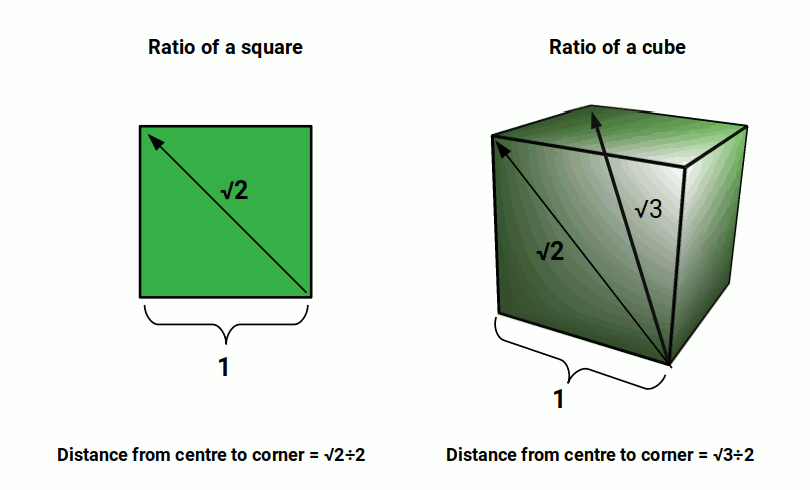
The most familiar dimensionless constants come from geometry: π is the ratio of a circle's circumference to its diameter. √2 is the ratio of a square's diagonal to its side. These are not approximations — they are exact values that can be calculated to any desired precision. Dimensionless Science applies the same geometric precision to physical constants.
Standard Model Constants
Over 40 constants from the Standard Model can be expressed as exact geometric ratios using two seed values: c = 3 (the speed of light) and μ₀ = 4π (the magnetic constant). All other values follow from these through dimensional analysis and cubic geometry. The table below groups constants by domain and gives their dimensionless geometric form.
| Constant | Symbol | Geometric Expression |
|---|---|---|
| Electromagnetic Constants | ||
| Speed of Light | c | 3 |
| Magnetic Constant | μ₀ | 4π |
| Electric Constant | ε₀ | 1 / 36π |
| Vacuum Impedance | Z₀ | 12π |
| Coulomb's Constant | k | 1 / (4π · (1/36π)) |
| Gravitational Constant | G | 2/3 |
| Quantum Constants | ||
| Planck Constant | h | √(3³/4³) / π² |
| Planck Constant (eV) | h | (√(3³/4³) / π²) / (5/π) |
| Reduced Planck Constant | ħ | (√3/4) / (4/3) / π³ |
| Reduced Planck (eV) | ħ | ((√3/4) / (4/3) / π³) / (5/π) |
| Elementary Charge | e | 5 / π |
| Charge / Planck Ratio | e/h | (5/π) / (√(3³/4³) / π²) |
| Magnetic Flux Quantum | Φ₀ | h / 2e |
| Conductance Quantum | G₀ | 2e²/h |
| Inv. Conductance Quantum | G₀⁻¹ | (2e²/h)⁻¹ |
| Josephson Constant | K_J | 2e/h |
| von Klitzing Constant | R_K | 3√3 / 2 |
| Fine Structure Constant | α | 4π / √3 |
| Inverse Fine Structure | 1/α | √3 / 4π |
| Planck Units | ||
| Planck Mass | M_p | (((√3/4)/(4/3)/π³) × 3) / (2/3)^(1/2) |
| Planck Length | L_p | (√3/4)/(4/3)/π³ / (m_p × 3) |
| Planck Time | T_p | L_p / c |
| Radiation Constants | ||
| First Radiation Constant | c₁ | 2π × h × c² |
| First Rad. Const. (spectral) | c₁L | 2hc² |
| Electron Constants | ||
| Electron Mass | m_e | 9 / π² |
| Electron Rest Energy | m_e c² | (9/π²) × 3² |
| Electron Rest Energy (MeV) | m_e c² | (9/π² × 3²) / (5/π) |
| Electron Charge/Mass | −e/m_e | −5 / 9π |
| Rydberg Constant | R∞ | 64√3 |
| Bohr Radius | a₀ | 1 / 192 |
| Bohr Magneton | μ_B | 5√3 / (96π²) |
| Bohr Magneton / h | μ_B/h | 5/36 |
| Bohr Magneton / hc | μ_B/hc | 5/108 |
| Hartree Energy | E_h | 2 × 64√3 × h × c |
| Quantum of Circulation | h/2m_e | (√(3³/4³)/π²) / (2 × (9/π²)) |
| Quantum of Circulation | h/m_e | (√(3³/4³)/π²) / (9/π²) |
| Compton Wavelength | λ_C | (√(3³/4³)/π²) / (9/π² × 3) |
| Classical Electron Radius | r_e | (4π/√3)² × (1/192) |
| Thomson Cross Section | σ_e | (8π/3) × r_e² |
| Fermi Coupling Constant | G_F | (Φ²+1) / (√(3/4)/(4/3)/π³) |
Why the Cube?
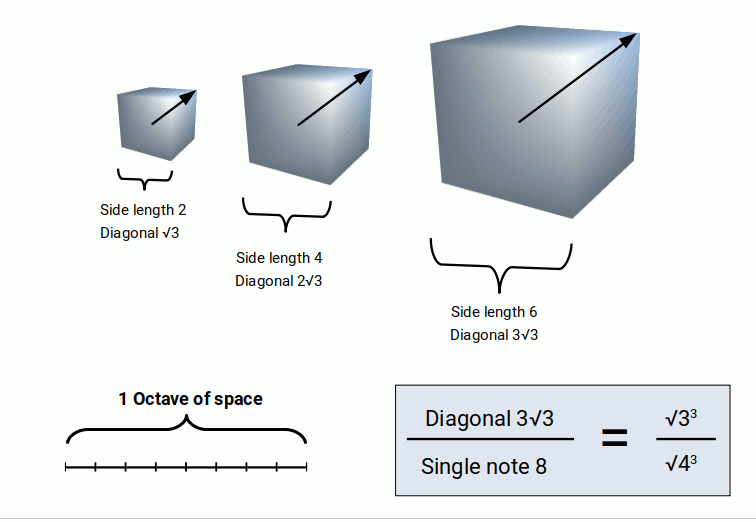
The ratios 1 : √2 : √3 correspond to the edge, face diagonal, and space diagonal of a unit cube. These three lengths appear throughout fundamental physics — in the scaling of EM waves (as explored in 4D Aether Theory), in atomic orbital geometry (see Atomic Geometry), and in the structure of crystal lattices. The Cube is not just a shape; it is the geometric template from which these ratios emerge.
The electromagnetic constants Z₀, ε₀, and μ₀ are related through the cube's geometry — μ₀ = 4π corresponds to the solid angle of a sphere expressed through cubic geometry, while ε₀ = 1/36π inverts this relationship across the face diagonal ratio.
Dimensional Analysis
Dimensional analysis is the formal tool that makes this approach possible. It asserts that only quantities of the same dimension can be added or subtracted meaningfully — you cannot add a length to a mass. But quantities of different dimensions can always be multiplied or divided, and the result is a new quantity whose dimensional character is the product of its components.
Most scientific equations are built on exactly this kind of multiplication and division. The implication is significant: the ratio structure of science — its reliance on multiplication and division — is inherently dimensionless. The units are scaffolding; the ratios are the building.
Dimensionless Science follows this logic to its conclusion: by expressing every constant as a ratio, the scaffolding is removed and the geometric structure underneath becomes visible. The process has three steps:
- Express the calculation using dimensionless values
- Identify the geometric form that the ratio represents
- Adjust for scale if needed to match conventional notation
Everything is Relative
Dimensionless Science reconciles naturally with the relativistic nature of space and time. Length contracts and time dilates at high velocities — which means any measurement system based on fixed units of length and time will produce values that shift with velocity. A system based on ratios does not: the ratio between two quantities in the same reference frame is unchanged by relativistic effects.
The speed of light provides the clearest example: in SI units c = 299,792,458 m/s; in CGS units it is 2.998 × 10¹⁰ cm/s. These are the same physical fact expressed in different unit systems. In Dimensionless Science, c = 3 — a value that is the same in any system, because it is a ratio, not a measurement.
Rather than grounding its base units in metres and seconds, Dimensionless Science derives them from the energy of the vacuum — setting c = 3 and μ₀ = 4π. From these two values, exact expressions for Z₀ and ε₀ follow immediately, and from these, the rest of the constant table is built. The system is therefore consistent at any velocity, in any reference frame, without modification.
A Brief History
The idea of a dimensionless approach to physics is not new. In the 1920s, Arthur Eddington undertook an extensive investigation of scientific constants, attempting to derive them from pure number theory. His prediction of the fine structure constant ultimately proved inaccurate, and the project stalled — but it established the principle that dimensionless constants carry special significance.

More recently, British theoretical physicist Michael Duff has argued forcefully that "varying of dimensional constants is operationally meaningless; variation of dimensionless fundamental constants of nature is operationally well-defined and a legitimate subject of physical enquiry." This view has gained significant traction in theoretical physics, and the Standard Model now incorporates approximately 19 fundamental dimensionless constants.

Despite this, no complete system for expressing all fundamental constants as exact geometric ratios has been produced within mainstream physics. Dimensionless Science fills that gap.
Three Types of Fundamental Constant
Mathematical Constants
The clearest dimensionless constants are geometric: π, √2, √3, φ (the golden ratio), and Euler's number e. These express pure spatial relationships — the ratio of a circumference to its diameter, the ratio of a diagonal to its side — and they appear throughout physics precisely because physical reality is embedded in geometric space. Powers such as 2² and 3³ are also dimensionless: they describe transformations of space rather than measurements within it.
Scientific Constants
Outside mathematics, the most prominent dimensionless scientific constant is the fine structure constant (α ≈ 1/137). It appears across physics — from the structure of the atom to the red shift of distant quasars — without any units attached. In Dimensionless Science, α is expressed exactly as 4π/√3, linking it directly to cubic geometry.
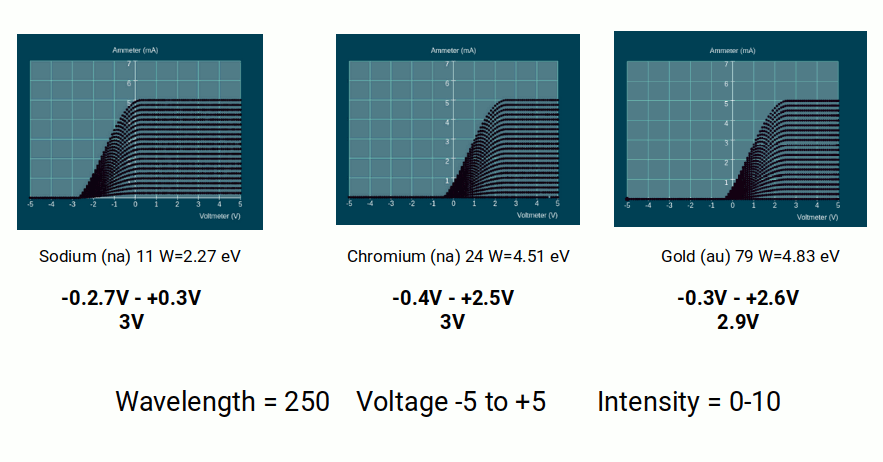
The magnetic constant μ₀ is another key example. In the SI system it has traditionally been given the value 4π (dimensionless in the CGS electromagnetic unit system). In 2019, the International Committee for Weights and Measures altered μ₀ to require experimental determination — a departure from the clean dimensionless value that Dimensionless Science regards as a step backwards.
Mass Constants
The third category of fundamental constants comprises the experimental mass values of elementary particles — electrons, protons, neutrons, quarks, leptons, and bosons. Currently, no theory explains why these masses take the specific values they do. The Standard Model catalogues them; it does not derive them.
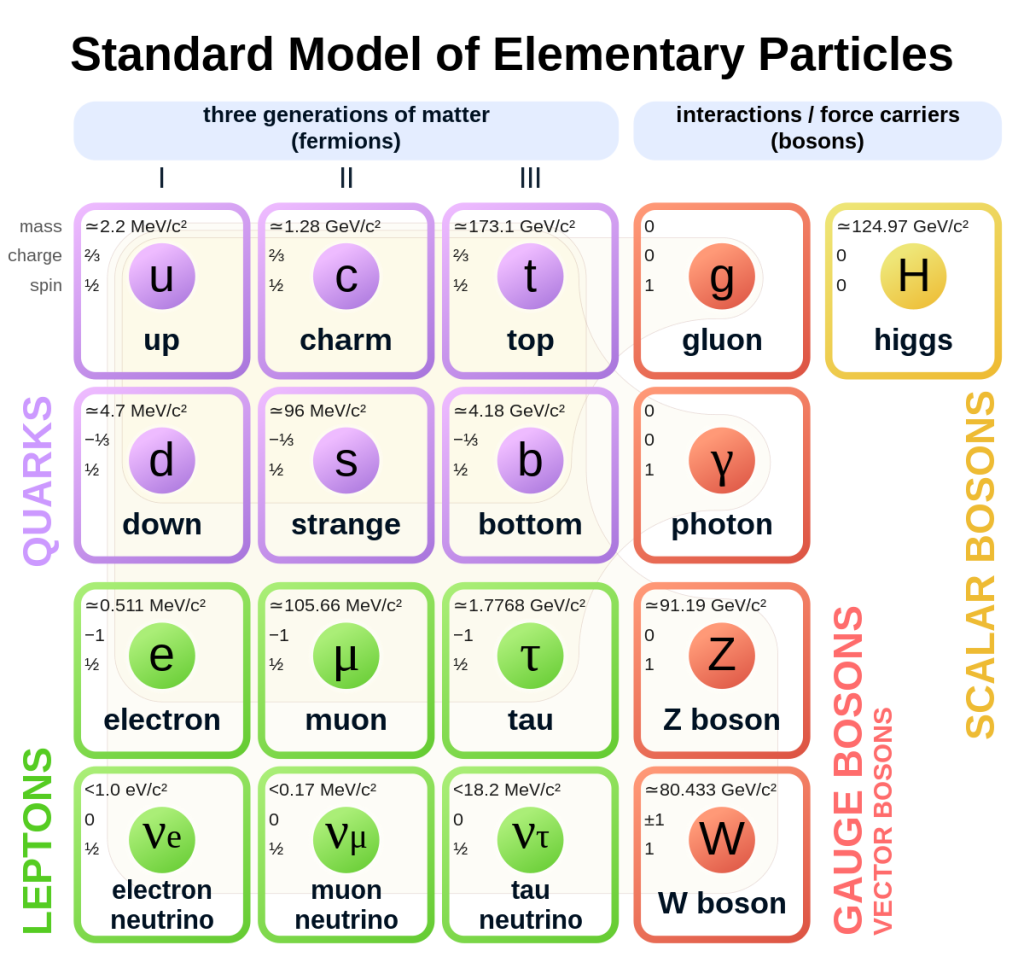
Dimensionless Science proposes that these mass values are not arbitrary — they are geometric ratios arising from the nested polyhedral structure of atomic geometry. The framework for this is developed in Atomic Geometry and Geo-Quantum Mechanics.
Powers and Dimensions
Numbers can behave in geometrically meaningful ways that standard calculators obscure. Take the number 1: squaring it (1²) gives 1; cubing it (1³) gives 1. On a calculator, nothing changes. But geometrically, 1 is a line, 1² is a square, and 1³ is a cube — three fundamentally different spatial objects.
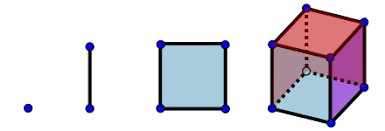
This is why Dimensionless Science must be done geometrically, not just arithmetically. When a constant involves a power of 2 or 3, that power describes a dimensional transformation — a geometric operation, not just a multiplication. The geometry must be considered alongside the number.
This is why the Planck constant, h = √(3³/4³)/π², involves a cube root: it describes a three-dimensional geometric operation, not merely a number. The exponent is not arithmetic shorthand — it is a spatial instruction.
Ratios and Three-Term Progressions
The simplest ratio is a fraction: 3/2 is a line of three units divided in half. But a two-term ratio is static; it describes a relationship between two things. A three-term ratio is dynamic — it has direction, a rate of growth or shrinkage.
Consider the difference between 1 : 3 : 9 and √3 : 3 : 9. Both share the middle and final terms, but they reveal different progressions. The first multiplies by 3 at each step; the sequence continues 27, 81 … The second uses √3 as its base and moves through square powers; the sequence continues 81 … Only when a third term is added does the ratio reveal its true geometric character.
The three electromagnetic constants provide a direct physical example: μ₀ = 4π, Z₀ = 12π, and c = 3 form a three-term progression. Knowing any two does not reveal the third — only the complete triple exposes the geometric relationship: Z₀ = μ₀ × c. This is the three-term structure at work in physics.
This is the foundation of how Dimensionless Science builds its constant table: not by measuring from an external axis, but by establishing ratios between constants and reading the geometric progression they imply.
The Dimensionless Axis
Every conventional scientific measurement system requires a co-ordinate axis — a fixed reference frame from which quantities are measured. But the universe has no preferred axis. Relativity demonstrates that the results of measurement depend on the observer's frame of reference. Any system that is truly fundamental must be independent of such choices.
Dimensionless Science achieves this through compass construction — a method of creating geometric forms that requires no measurement whatsoever. The compass is opened to an arbitrary distance, which sets the scale to ONE. All subsequent constructions are ratios of this initial opening. The two anchor points can be placed anywhere in any orientation; the geometric relationships between the resulting forms remain identical.
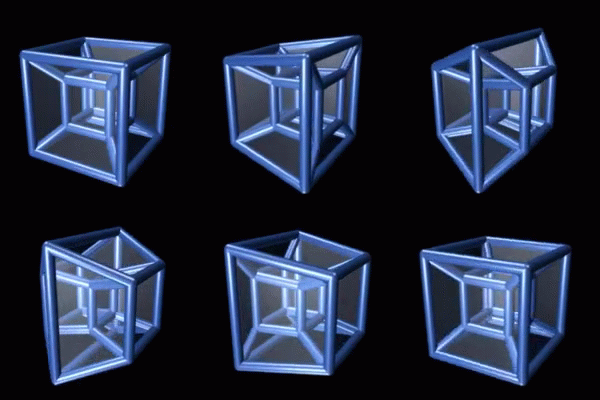
This approach has a practical consequence: higher-dimensional objects, which cannot be measured in 3D space, can be fully described in dimensionless terms and then appropriated to 3D reality for experimental comparison. The 4D Hypercube, the foundation of 4D Aether Theory, is most clearly understood in this dimensionless context first.
Conclusion
Science measures the universe. Dimensionless Science asks what the universe looks like when the measuring stops — when quantities are replaced by relationships, units by geometry, and notation by form.
What emerges is a system in which over 40 fundamental constants are exact, consistent, and expressible as compass constructions. The fine structure constant, the Planck constant, the speed of light — all follow from two seed values and the geometry of the Cube. The system works at every scale and in every reference frame, because it has no scale or frame of its own.
This is the mathematical language of 4D Aether Theory and the quantitative foundation of Atomic Geometry. Together they form a coherent geometric model of the universe — from the structure of the electron to the background radiation of the cosmos.
FAQ
What is Dimensionless Science?
Dimensionless Science is the examination of scientific constants and formulas as ratios expressed through geometry. Rather than measuring quantities in units (metres, kilograms, seconds), it identifies the pure geometric relationships between constants — relationships that hold at any scale and in any measurement system.
Why are dimensionless constants more fundamental than dimensional ones?
Dimensional constants like the speed of light (c) are expressed in units — metres per second — and their numerical value changes if you change the unit system. Dimensionless constants have no units and their value is the same in every measurement system in the universe. They describe the actual structure of reality, not our choice of ruler.
How accurate is Dimensionless Science?
Dimensionless Science has defined exact values for over 40 scientific constants, including the speed of light, the fine structure constant, the Planck constant, and the electromagnetic constants. The values are consistent with conventional scientific notation and can be calculated to an arbitrary number of decimal places using simple geometric ratios.
What are the key geometric ratios used?
The foundational ratios are derived from the geometry of the Cube: the ratio of edge to face diagonal (1:√2) and edge to space diagonal (1:√3). The speed of light is set to 3, the magnetic constant μ₀ to 4π, and all other constants follow from these two seed values through dimensional analysis.
How does this relate to 4D Aether Theory?
Dimensionless Science provides the mathematical language for 4D Aether Theory. The 4D Aether proposes a geometric medium for the vacuum; Dimensionless Science expresses the properties of that medium — its impedance, permittivity, and permeability — as exact geometric ratios without needing units of space or time.
Is this related to existing dimensionless science in physics?
Yes — the approach extends work pioneered by Arthur Eddington in the 1920s and recognised by physicists such as Michael Duff, who argued that only dimensionless constants represent truly fundamental physical quantities. Dimensionless Science provides the complete geometric system that previous attempts lacked.