Introduction
Imagine a small town with a single barber. He has a strict rule: he shaves every man in town who does not shave himself. Simple enough — until you ask whether the barber shaves himself. If he does shave himself, his own rule says he shouldn't. If he doesn't shave himself, his rule says he must. Either way, a contradiction follows. There is no consistent answer.
This is the Russell Paradox, posed by the philosopher and mathematician Bertrand Russell in 1901. In formal terms, Russell asked: what happens when you define a set as containing all sets that do not contain themselves? Such a set cannot exist without breaking the rules of logic — yet nothing in 19th-century mathematics prevented you from defining it.
The paradox is not a curiosity. It demolished the foundations of Gottlob Frege's Grundgesetze der Arithmetik — a landmark attempt to ground all of mathematics in pure logic — and forced mathematicians to rebuild set theory from scratch. Its influence reaches far beyond pure mathematics: Gödel's incompleteness theorems, the halting problem in computer science, and the design of type systems in programming languages all trace back to the same self-referential knot that Russell identified.
This article presents a geometric approach to that knot — one that resolves the paradox not by adding new axioms, but by changing how we visualise number space itself.
Key Takeaways
- The Russell Paradox reveals a structural flaw in flat, one-dimensional set theory — not merely a curiosity, but a challenge that forced mathematicians to rebuild the foundations of mathematics.
- Modelling number space as a folded plane separates whole numbers and fractions onto geometrically distinct layers, so the two infinities never compete for the same ground and the apparent contradiction dissolves.
- Unlike ZF set theory, which bans self-referential sets by axiom without explanation, the geometric approach explains why such sets are problematic — and gives them a coherent home in a richer model of number space.
Historical Context
Russell's letter to Frege in June 1902 is one of the most consequential pieces of correspondence in the history of mathematics. Frege had just completed the second volume of his Grundgesetze der Arithmetik, a monumental attempt to derive all of arithmetic from pure logical axioms. Russell's single observation — that Frege's Basic Law V permitted the construction of a self-contradictory set — brought the entire edifice down.
The subsequent effort to patch set theory produced three major axiomatic frameworks: Zermelo–Fraenkel set theory (ZF), Russell and Whitehead's Principia Mathematica (which introduced a hierarchy of "types" to block self-reference), and von Neumann–Bernays–Gödel set theory. Each avoids the paradox by restriction — by forbidding certain constructions rather than by explaining why they are problematic. The geometric approach presented here takes a different path.
Cantor's Diagonal and the Size of Infinity
The version of the paradox that concerns us here is closely related to Georg Cantor's discovery that the infinity of numbers between zero and one is larger than the infinity of all whole numbers. This seems absurd at first glance: surely the whole numbers go on forever, so how could a tiny interval contain more of them?
Cantor's diagonal argument demonstrates that the two infinities are genuinely different in size — what mathematicians call having different cardinalities. The set of fractions between zero and one is uncountably infinite, meaning no numbered list can ever include all of them.
That difference in size is exactly where the paradox bites. If the interval from zero to one contains more numbers than the entire set of whole numbers, where do those extra numbers fit? Classical number-line thinking has no clean answer.
Cantor's Theorem and the Power Set
Cantor proved something even stronger: for any set S, the power set of S (the set of all subsets of S) is always strictly larger than S itself. Applied to the set of all sets, this creates an immediate problem — the power set must be larger, yet there is nothing larger than the set of all sets. Russell's paradox is one expression of this same structural tension.
The standard response in ZF set theory is simply to ban "the set of all sets" by axiom. No justification is given for why such a set should be impossible — it is forbidden because allowing it causes trouble. The geometric model, by contrast, offers an explanation: the set of all sets cannot exist as a flat object, but it can exist as a folded structure, where self-membership corresponds to a geometric layer rather than a logical loop.
Two Kinds of Infinity
To understand the geometric solution, it helps to recognise that not all infinities grow in the same direction.
The whole numbers — 1, 2, 3, … — march upward without limit. Each step takes you further from zero. Cantor called this cardinality ℵ₀ (Aleph-null) — the smallest infinite cardinal.
The fractions between zero and one — 1/2, 1/3, 1/4, … — move in the opposite direction. As the denominator grows, the fraction shrinks toward zero. Infinity, in this case, extends inward rather than outward. The real numbers (including all irrationals such as √2 and π) form a larger infinity, ℵ₁, which is uncountable.
The Continuum Hypothesis — proposed by Cantor, proved independent of ZF by Gödel (1940) and Cohen (1963) — asks whether any infinity exists strictly between ℵ₀ and ℵ₁. Standard mathematics has no answer either way; both possibilities are consistent with the axioms. In Aleph 0.5, we showed that the infinite sum of unit fractions forms a series precisely half the size of the whole-number series — an intermediate infinity sitting exactly between ℵ₀ and ℵ₁. This 2:1 density ratio between reciprocal number space and whole number space is also the key ratio that explains the critical strip in the Riemann Hypothesis.
Folding Number Space
The geometric approach begins with a thought experiment: take a square piece of paper and fold it once, then open it out again. You now have four regions. Label one corner zero and the opposite corner infinity. The crease marks a boundary, and numbers can be plotted along the fold.
On the first fold, whole numbers occupy the line in the familiar way: each whole number corresponds to a single crossing point — one line, one point.
Now fold the paper along its perpendicular axis. A new number line appears, but the structure of its points is different. Where whole-number points are formed by a single line crossing, fraction points are formed by multiple lines intersecting. They are denser. They cluster in a way that visually matches Cantor's result: more points packed into the same apparent space.

The key insight is that the two infinities are not competing to occupy the same line. They exist on geometrically distinct layers of the same folded space. There is no paradox because there was never a single flat arena for them to contradict each other in.
A Geometric Resolution
This model dissolves the Russell Paradox in a concrete way. The paradox arises because classical set theory treats all sets as if they inhabit a single, flat logical space — like objects on a table. Once you allow the "table" to fold, self-referential sets no longer create a contradiction: a set and the set of sets that don't contain it occupy different geometric layers.
The numbers between zero and one are not more numerous in the sense of counting higher; they are denser in a qualitatively different way, visible only when you examine the structure of the points rather than their position along a line. Representing this as a folded plane rather than a flat line makes the distinction immediate and intuitive.
The Card Analogy
A second illustration makes the same point without any mathematics at all.
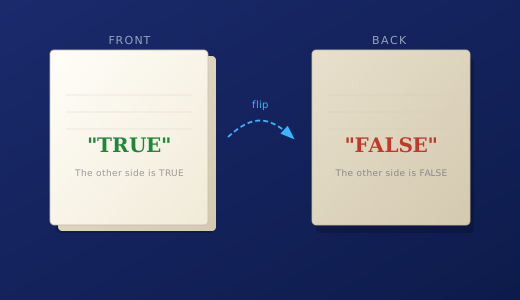
Write "The other side of this card is true" on one face, and "The other side of this card is false" on the other. You have a self-referential loop: neither face can be correct without making the other face incorrect. This is structurally identical to the Russell Paradox.
Now fold the card in half so both faces touch. In that folded state, the contradiction vanishes — both statements become simultaneously satisfied because the apparent separation between them has collapsed.
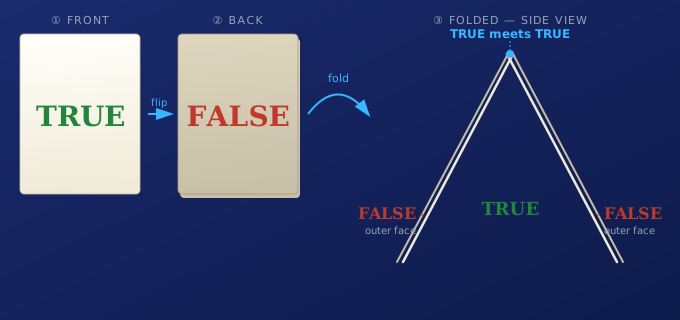
Folding number space achieves the same effect at a mathematical level. The self-reference that creates the paradox only looks like a contradiction when you insist the space must be flat. Allow it to fold, and the loop closes harmlessly.
Conclusion
The Russell Paradox has stood for over a century as a symbol of the limits of naive set theory. Most resolutions rely on restricting the rules — forbidding certain kinds of self-reference by axiom. The geometric approach presented here takes a different path: rather than prohibiting the problematic sets, it relocates them into a richer model of number space where their apparent contradiction is not a contradiction at all.
Whole numbers and fractions are not two rival armies fighting over the same territory. They are two geometrically distinct types of infinity, visible as different qualities of point on a folded plane. When number space is understood in this way, Cantor's result — more numbers between zero and one than all whole numbers combined — becomes not a paradox but a natural consequence of the geometry.
That shift in perspective has implications beyond the Russell Paradox. It suggests that self-referential structures throughout mathematics and logic — the ones that generate Gödel sentences, undecidable programs, and type-theoretic paradoxes — may yield to geometric analysis in similar ways. The resolution is not to ban the loop, but to give it room to fold.
For the background on why infinite sets are so problematic, see What is the Continuum Hypothesis?. For the full 2D geometric solution, see Solving the Russell Paradox: 2D Geometric Solution to the Continuum Hypothesis.
FAQ
What is the Russell Paradox in simple terms?
Imagine a barber who shaves everyone in town who does not shave themselves. Does the barber shave himself? If he does, he shouldn't — but if he doesn't, he must. That circular impossibility is the Russell Paradox: a set defined by the rule 'all sets that do not contain themselves' cannot consistently exist within classical set theory.
Why does the Russell Paradox matter?
It shattered the foundations of 19th-century mathematics, forcing logicians to rebuild set theory from scratch. Its echoes reach into computer science: self-referential statements underlie Gödel's incompleteness theorems, the halting problem in computing, and the design of type systems in programming languages.
How does geometry resolve the paradox?
By modelling number space as a folded plane rather than a flat line, we can represent whole numbers and fractions as geometrically distinct — different qualities of point, not just different quantities. The apparent contradiction dissolves because the two infinite sets never genuinely occupy the same space.
What is Aleph 0.5?
Aleph 0.5 is a proposed cardinality sitting between the countable infinity of whole numbers (ℵ₀) and the uncountable infinity of the real numbers (ℵ₁). The infinite sum of unit fractions forms a set exactly half the size of the whole-number series, suggesting this intermediate infinity is a coherent mathematical object.
What does the card analogy illustrate?
A card reading 'the other side is true' on one face and 'the other side is false' on the other creates a logical loop — neither face can be right. Fold the card in half and both faces touch: the contradiction vanishes. This mirrors how folding number space collapses the apparent paradox between whole numbers and fractions.