Introduction
The Riemann Hypothesis is widely regarded as the most important unsolved problem in mathematics. First proposed by Bernhard Riemann in 1859, it concerns the distribution of prime numbers and asks a precise question: do all non-trivial zeros of the Riemann zeta function lie on a single vertical line in the complex plane, known as the critical line at n = 0.5?
Key Takeaways
- The Riemann Hypothesis asks whether all non-trivial zeros of the zeta function lie on the critical line at n = 0.5.
- A geometric solution using the Golden and Silver Ratios confirms the conjecture by showing how the complex number plane folds around the number one.
- The offset to 0.5 is explained by the infinite density of reciprocal number space, which through Aleph 0.5 exhibits exactly double the density of whole number space.
- The compression of number space is accomplished by the diagonal of the square (√2) and the diagonal of a half-square (√5), unifying the hexagonal and square number planes.
The full paper is available at viXra.org.
What is the Zeta Function?
Before presenting the solution, it helps to understand what the zeta function actually does. The Riemann zeta function is defined as an infinite sum:
ζ(s) = 1 + 1/2ˢ + 1/3ˢ + 1/4ˢ + 1/5ˢ + …
For any input value s, the function adds up the reciprocals of every whole number raised to the power s. When s is a real number greater than 1, this sum converges to a finite value — for example, ζ(2) = 1 + ¼ + ⅑ + 1/16 + … = π²/6. The fact that an infinite sum of reciprocal squares produces a value involving π is already a hint that geometry is at work beneath the surface.
The function becomes truly interesting when s is a complex number — a number with both a real and an imaginary part, written as s = n + it. The function can be extended to all complex numbers (except s = 1) through a process called analytic continuation, which effectively bends the number plane to reach regions where the original sum doesn't converge.
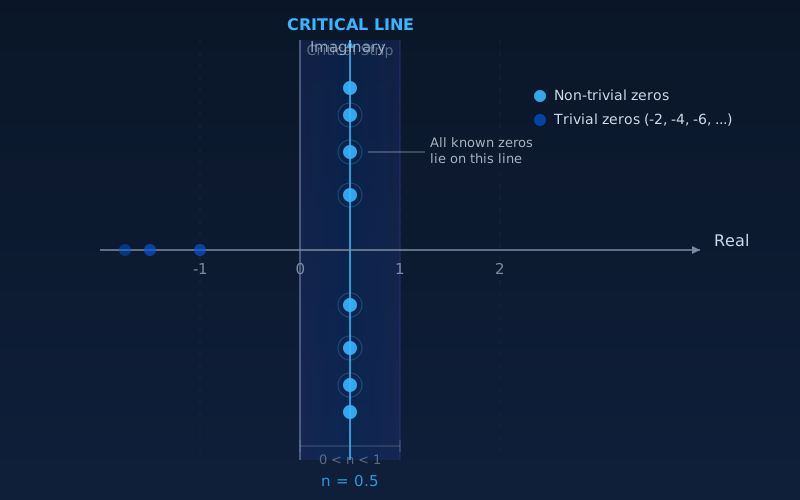
When the output of the zeta function equals zero, that input is called a zero. Some zeros are straightforward — the trivial zeros at negative even integers (−2, −4, −6, …). The interesting ones are the non-trivial zeros, which all fall within a vertical band called the critical strip, between n = 0 and n = 1 on the real axis. Riemann's conjecture is that every single one of these non-trivial zeros lies exactly on the line n = 0.5 — the midpoint of that strip.
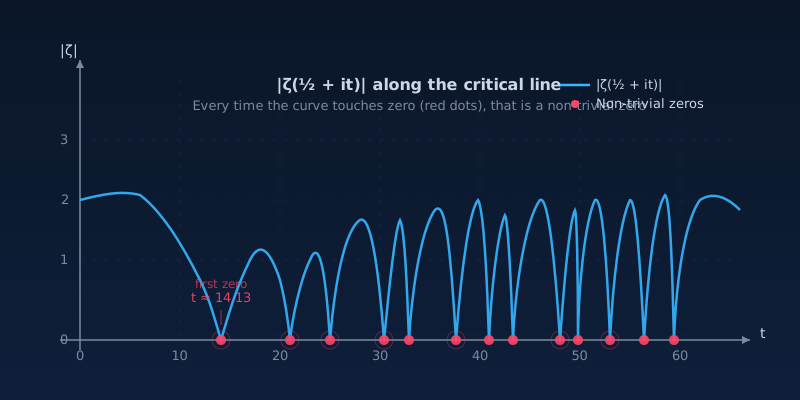
The following chart shows what the zeta function looks like when evaluated along the critical line (at n = 0.5). The curve rises and falls as the imaginary part t increases — and every time it touches zero, that is a non-trivial zero of the function:
The following diagram shows this structure. The shaded band is the critical strip (between n = 0 and n = 1). The bright vertical line at n = 0.5 is the critical line. Every blue dot is a non-trivial zero — and every single one, out of the billions computed, sits on that line.
But no one has been able to prove why they all line up. The question is: what forces them there?
Our answer is geometric. Rather than working within the algebraic framework of analytic number theory — where the problem has resisted proof for over 160 years — we approach it from the perspective of Geometric Maths and 4th Dimensional Mathematics. The result is not a formal proof in the conventional sense, but a geometric demonstration that reveals the structural reason why 0.5 is the only possible position for the critical line. We show that it is a consequence of how number space folds — and that the fold is governed by a density ratio that permits no other outcome.
Why Reciprocal Space is Twice as Dense
Before presenting the geometric solution, we need to establish the key ratio that drives it: the relationship between whole number space and reciprocal number space.
Consider the whole numbers: 1, 2, 3, 4, … They are evenly spaced, stretching to infinity. Now consider the reciprocal of each: 1, ½, ⅓, ¼, … These all fall between 0 and 1 — an infinite set compressed into a finite interval. Where the whole numbers spread out as they grow, the reciprocals crowd together, packing more and more densely as they approach zero.
This is not just an intuition — it is measurable. Between any two whole numbers there is a gap of exactly 1. Between the reciprocals 1/n and 1/(n+1), the gap is 1/(n(n+1)), which shrinks as n grows. The reciprocal number line contains the same count of numbers as the whole number line (both are countably infinite), but it compresses them into a bounded space. In our framework, this compression gives reciprocal space an infinite density we call Aleph 0.5 — exactly double the density of whole number space (Aleph 1).
The ratio 2:1 is not arbitrary. It emerges directly from the reciprocal function itself: for every unit of whole number space that maps into reciprocal space, the density doubles because the reciprocal of n maps the interval [1, ∞) onto (0, 1] — an interval exactly half the length of [0, 2], the first unit square of the complex plane. The factor of 2 is built into the geometry of reciprocals.
This 2:1 density ratio is the foundation of everything that follows.
The Core Argument
The complex number plane is a flat surface — a square grid. On it, the real numbers run left to right, and the imaginary numbers run vertically. To evaluate the zeta function for values where it doesn't naturally converge (to the left of n = 1), mathematicians use a technique called analytic continuation — essentially bending the number plane to extend the function's reach.
In 4th Dimensional Mathematics, we can describe what happens geometrically when this plane is bent. Whole number space (Aleph 1) occupies the region to the right of n = 1. Reciprocal number space (Aleph 0.5) occupies the region between 0 and 1, with double the density. When the complex plane is bent through analytic continuation, whole number space wraps around the number 1 and folds into reciprocal space. But because reciprocal space is twice as dense, the fold doesn't reach zero — it stops at 0.5. This is why the critical strip forms where it does.
The following five diagrams show this process step by step:
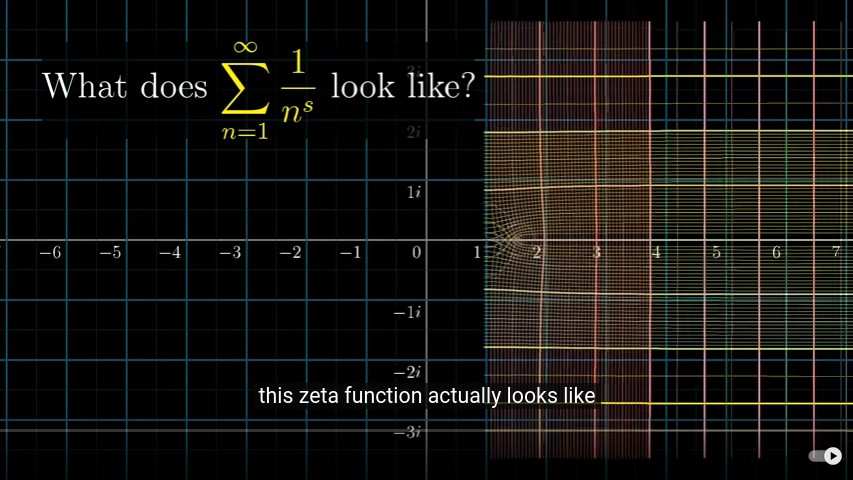
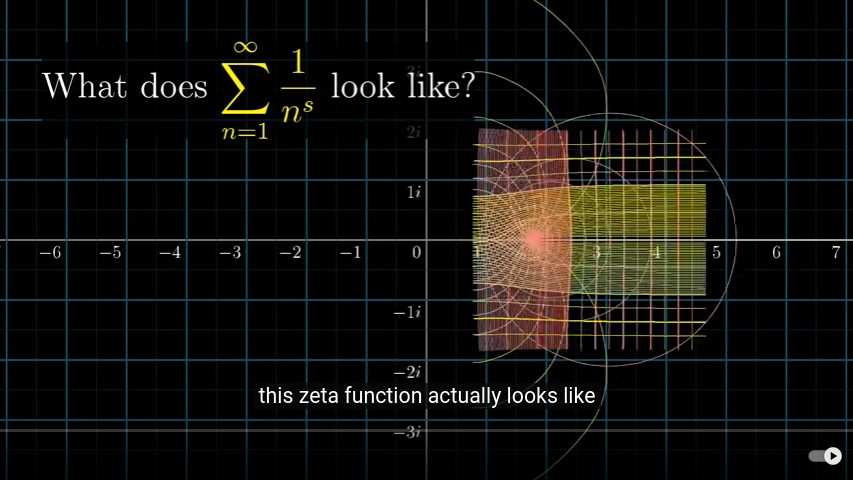
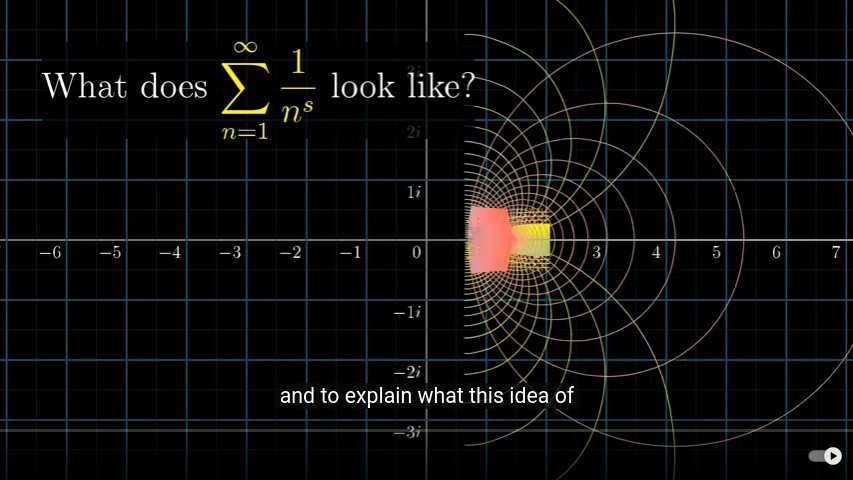
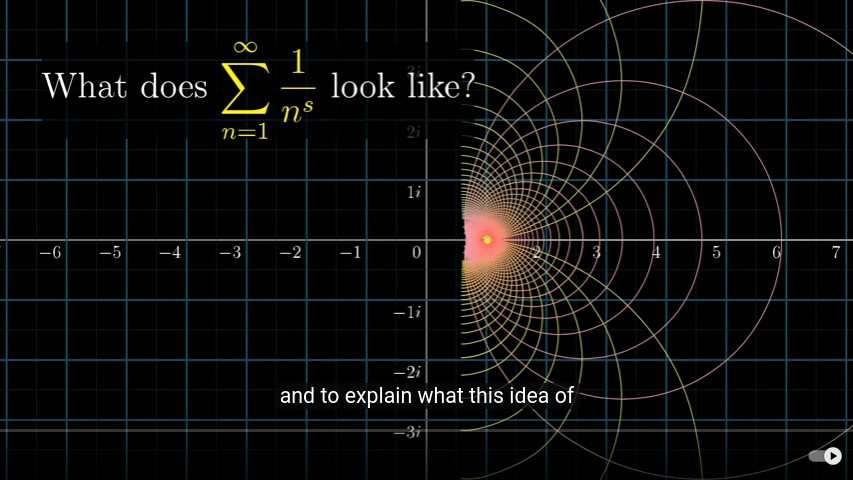
The collapse of Aleph 1 (whole number space) through the bending of numerical space produces the non-trivial zeros along the critical strip, rather than at the zero line. This is achieved by inverting the negative values of i into positive values — which is precisely what the curvature equation expresses. Where N runs from 1 to ∞, the reciprocal of n^s expresses the reciprocal number law n / n² = 1/n on the complex plane.
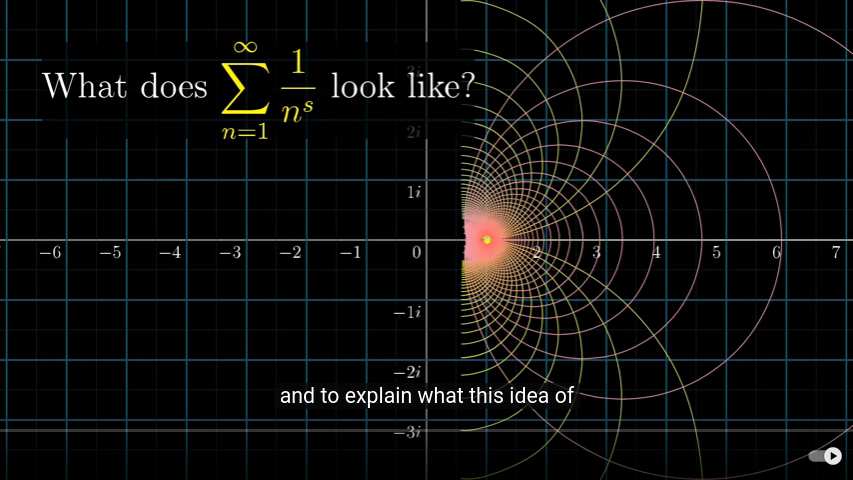
Bending the Square
Why exactly 0.5? The answer lies in the geometry of the square.
The number 2² = 4. On the complex plane, this numerical space is represented as a square divided into four smaller squares. Half lies in the whole number plane; the other half lies in reciprocal space between 0 and 1. These two regions have an infinite density ratio of 1 : 2 — reciprocal space is twice as dense as whole number space.
When this square is folded through the circle, the density of whole numbers wraps around the number 1 and folds into reciprocal space. If the densities were equal, the fold would reach all the way to zero. But because reciprocal space is twice as dense, the fold stops at the halfway point — 0.5 — forming the critical strip.
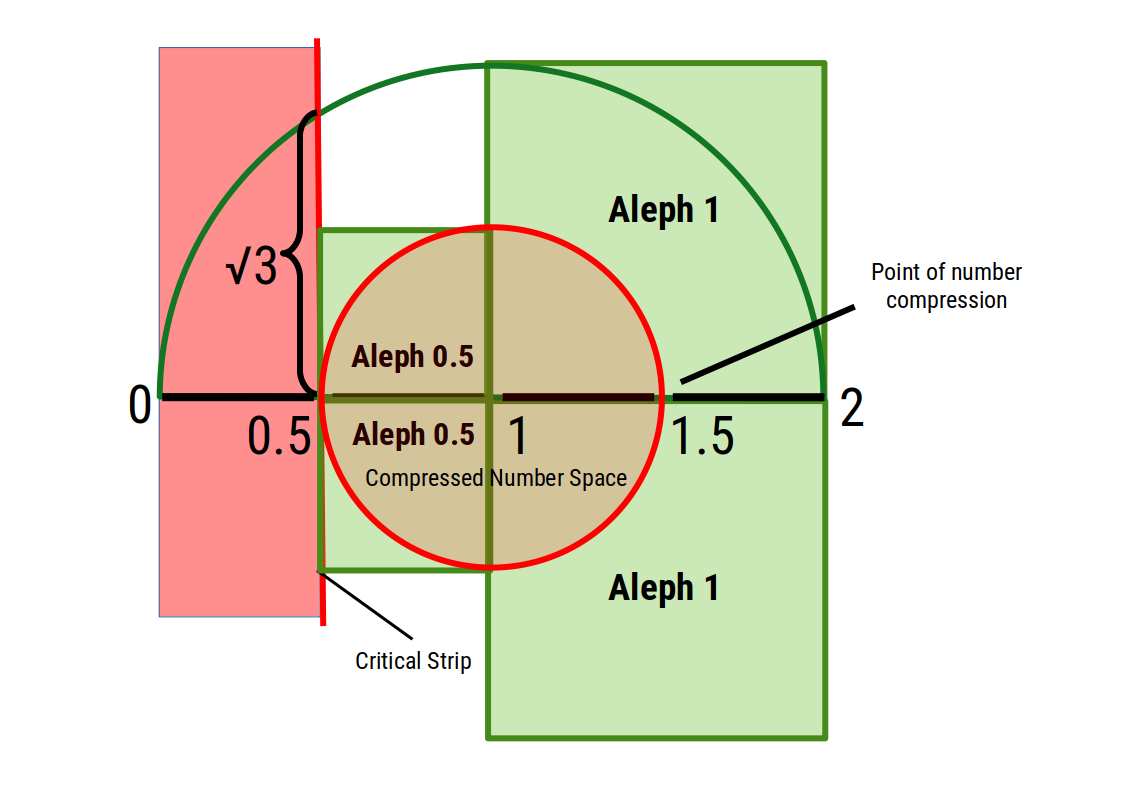
This is the geometric heart of the solution: the 0.5 offset is not arbitrary. It is the inevitable result of the 2:1 density ratio between reciprocal and whole number space.
The Hexagonal Number Plane
The complex plane is based on the square — which in Geometric Maths emerges from the concept of ZERO². But there is a second number plane based on the triangle, represented as ZERO³. These two forms produce the two fundamental regular tilings of a surface.
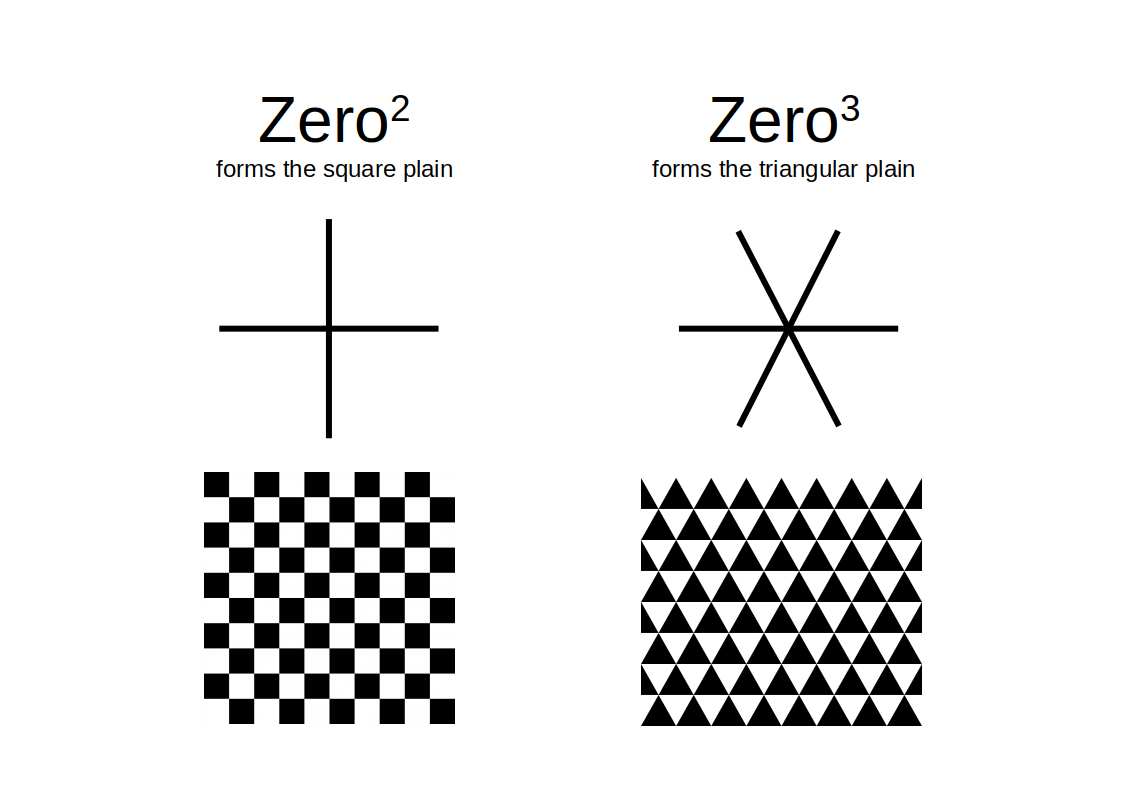
In the hexagonal plane, six triangles join to form a hexagon. This pattern emerges naturally from the Vesica Piscis — the lens shape formed by two overlapping circles of equal diameter. The Vesica Piscis exhibits a ratio of 1:√3, which is reflected throughout the triangular number plane.
The zeta function squares number space using f(s) = s², rotating the x-axis through 180° with a 90° rotation on the imaginary plane. This alters the density relationship between whole numbers (Aleph 1) and reciprocal space (Aleph 0.5). On the triangular plane, lines would cross at √3 — but on the complex plane they cross at i², maintaining the 90° angle of the square grid rather than the 60° of the triangle. The tension between these two geometries is central to understanding why the zeta function behaves as it does.
The Golden and Silver Ratio
The square and hexagonal planes are unified through two fundamental geometric proportions: the Golden Ratio (φ ≈ 1.618), found in the regular pentagon, and the Silver Ratio (≈ 2.414), the analogous proportion for the square.
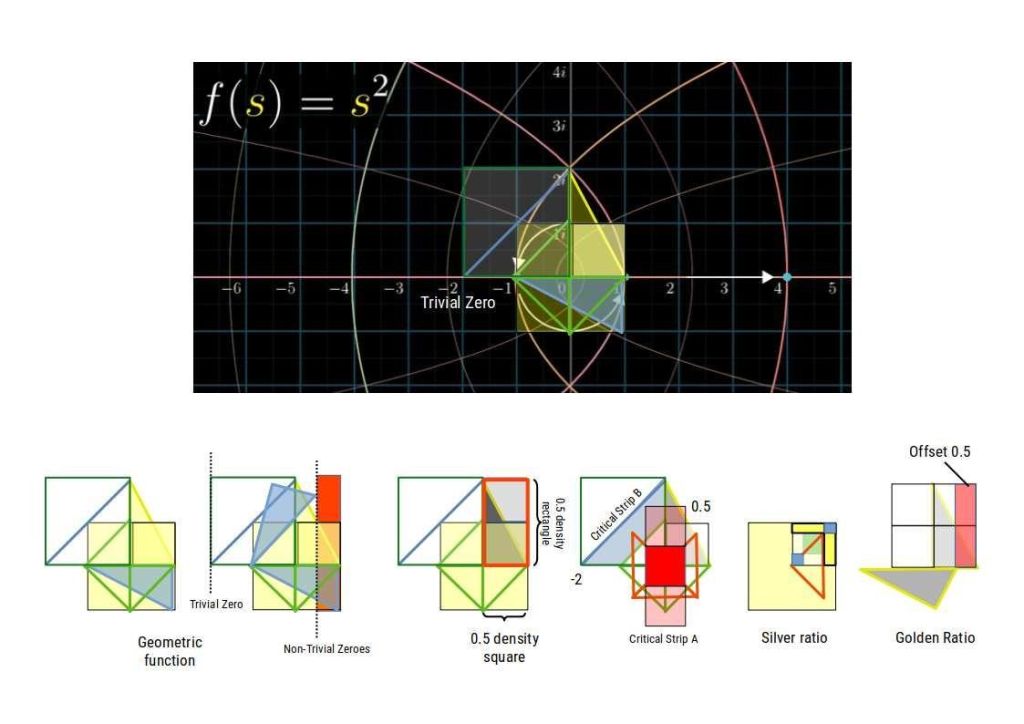
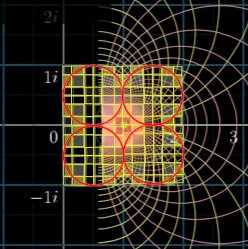
The key relationship is between the diagonal of a square (√2) and the diagonal of a half-square (√5). The square has exactly half the density of the rectangle formed by two squares. When the √5 diagonal rotates to align with √2, its corner falls precisely at the halfway mark between 0 and +1 — defining the critical strip. These two diagonals correspond directly to the Silver and Golden Ratios:
√2 ± 1 = Silver Ratio
(√5 ± 1) / 2 = Golden Ratio
Both equations involve the function ±1. When √2 is replaced by √5, the entire equation must be halved to preserve this relationship. This halving is the geometric mechanism that produces the 0.5 offset — the same offset that defines the critical strip.
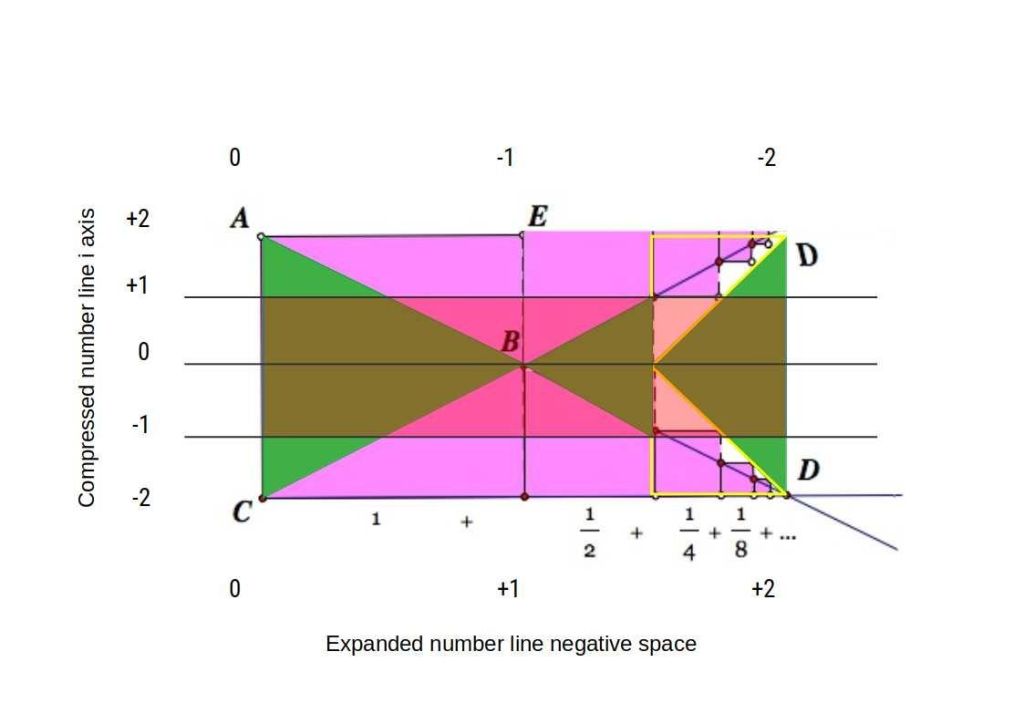
On the negative side of the number plane, +2i arcs through number space to arrive at n = −1, forming a second critical strip (B) through the Silver Ratio (−√2 : √8). On the positive side, the equivalent function operates through the Golden Ratio (√5 : 2). The two metallic ratios govern the two halves of the transformation.
The Role of π and e
The relationship between the square and hexagonal planes is mediated by two constants: π (the ratio of a circle's circumference to its diameter) and e (Euler's number, the base of natural logarithms). In the context of the zeta function, π governs the rotation of the number plane, and e governs its compression.
Why e? Because e is the sum of all reciprocal factorials (1 + 1 + ½ + ⅙ + …) — it is, in a precise sense, the number that describes the accumulation of reciprocal space into a single value. This is exactly what analytic continuation does: it compresses one region of number space into another.
In Geometric Maths, the relationship between the circle and the hexagon — the two fundamental forms of the triangular plane — connects π and e through the following expression:
((2π − 6) × 2.25) × e ≈ √3
Each term has a direct geometric meaning. The value (2π − 6) is the difference between the circumference of a unit circle and the perimeter of its inscribed hexagon — the gap between curved and straight geometry. The value 2.25 is the density constant: it is the area of the square formed by 1.5 (the midpoint between Aleph 1 and Aleph 0.5 density), since 1.5² = 2.25. And e compresses reciprocal space into a point. The result, √3, is the unit distance of the triangular plane — the height of an equilateral triangle with side 2.
This equation is not exact in the conventional sense — the left side yields approximately 1.73198 versus √3 = 1.73205. The discrepancy is vanishingly small (less than 0.004%), and in Geometric Maths this residual reflects the irreducible gap between circular and polygonal geometry — the same gap that makes π transcendental. The equation captures the geometric relationship to a precision that is structurally meaningful.
When rotated 180° — the full rotation of the zeta function — the equation doubles:
((2π − 6) × 4.5) × e ≈ √12
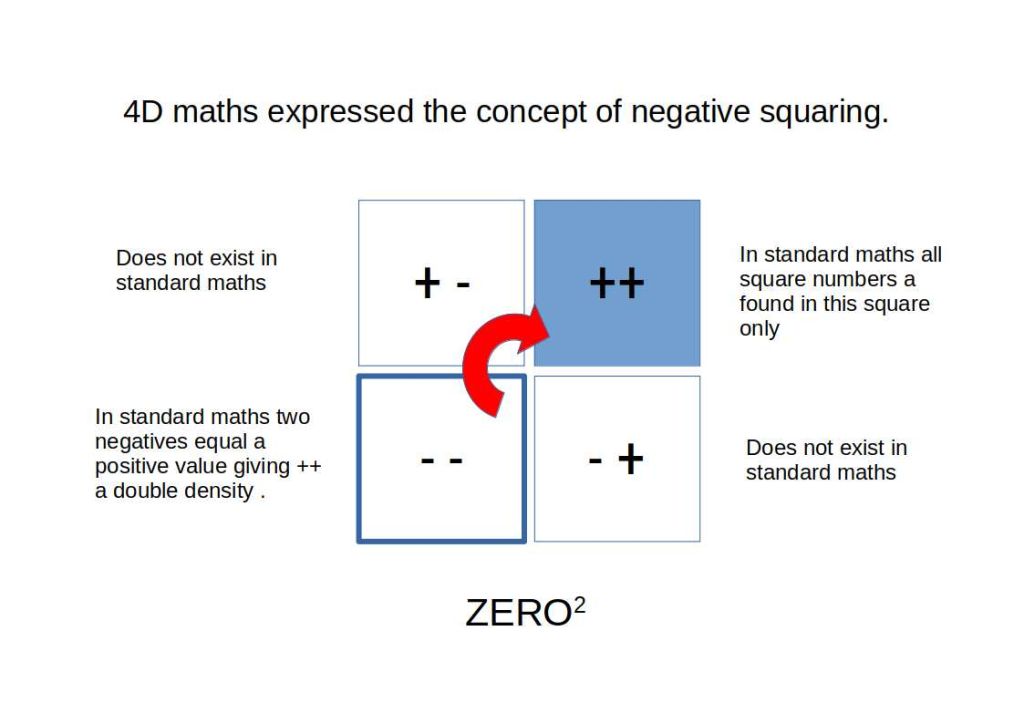
And in 4D Mathematics, which includes all four functions of squaring (++, −−, +−, −+), the complete equation becomes:
((2π − 6) × 9) × e ≈ √24
The scaling pattern is clear: 2.25, 4.5, 9 — each doubling corresponds to one additional dimension of squaring. The complex plane, with only one squaring function, can express only the first. The full 4D equation requires all four.
Number Compression in 4D
The following diagram shows how the density of two squares with a surface area of 1.5 is compressed into the triangular plane through the number e:
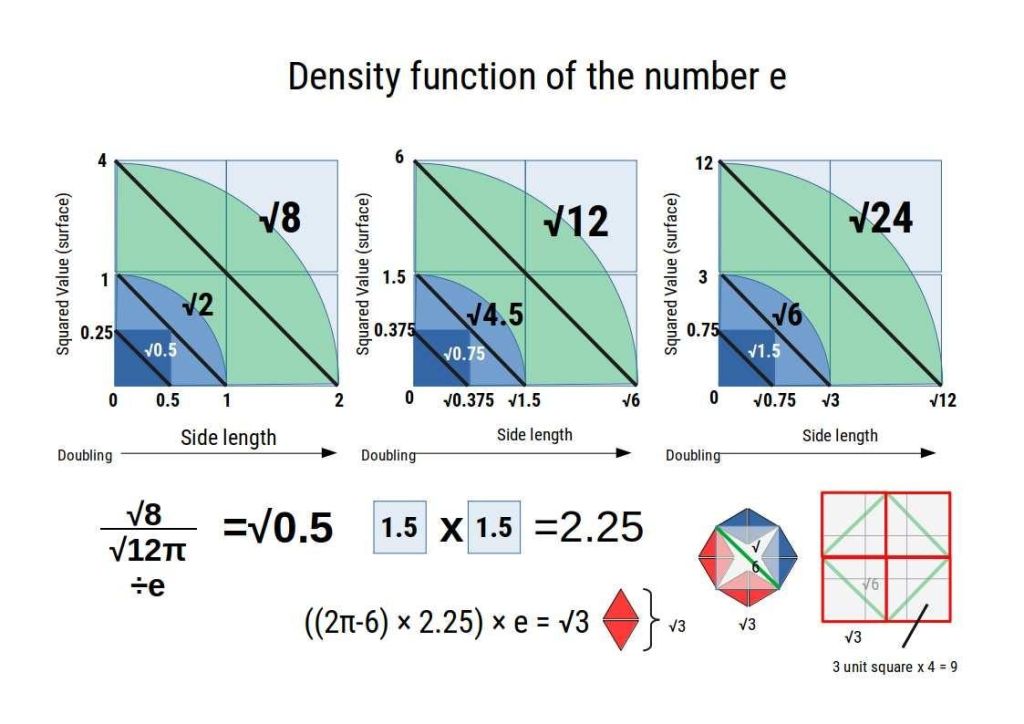
During the analytic transformation of the zeta plane, the "red dot" accumulates first at n = 1.5, then moves towards √3, before collapsing into the number one. This progression tracks the transition from the square plane to the triangular plane — from right-angle geometry to hexagonal geometry. Because the plane is bent rather than folded, numbers are compressed into the triangular plane, which is the geometric origin of the hexagon inscribed in a circle.
Since the zeta function bends the square number plane in both the upward and downward direction from the real number line, the number e is produced at half density:
((2π − 6) × 9) × (e ÷ 2) = √12
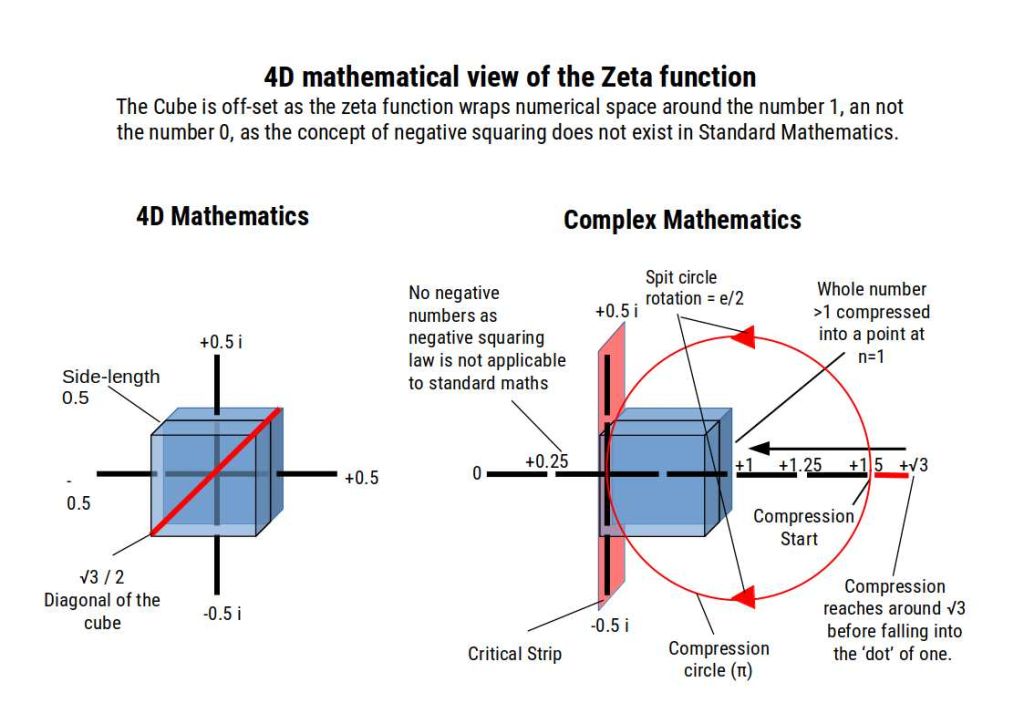
In Geometric Maths, √3/2 is the diagonal of a cube with side length 0.5 — a description of hyper-cubic number space. This concept is beyond the capabilities of the complex plane to express, since it excludes the function of negative squaring. The result is that the bending of number space within the zeta function can only accommodate numbers greater than +1, with no access to negative numbers.
Conclusion
The Riemann Hypothesis asks why all non-trivial zeros of the zeta function fall on the line n = 0.5. The geometric answer is that they have no choice.
The argument rests on three pillars:
-
The density ratio. Reciprocal number space has exactly double the infinite density of whole number space — Aleph 0.5 to Aleph 1. When the complex plane is bent through analytic continuation, whole number space folds around the number 1 and compresses into reciprocal space. Because of the 2:1 density ratio, the fold cannot reach zero. It stops at 0.5.
-
The metallic ratios. The Golden and Silver Ratios — derived from the diagonals √5 and √2 — govern the geometry of the fold on the positive and negative sides of the plane respectively. When √5 rotates to align with √2, the halving inherent in the Golden Ratio equation produces the exact 0.5 offset.
-
The circle-hexagon relationship. The constants π and e mediate the transition from square to hexagonal geometry during compression. The gap between the circumference of a circle and the perimeter of its inscribed hexagon, scaled by the density constant and compressed through e, produces √3 — linking the square and triangular number planes.
This is not a formal proof in the language of analytic number theory. It is a geometric demonstration — an argument that the 0.5 position is structurally inevitable, arising from the density of number space itself. The approach is fundamentally different from conventional attempts to prove the Riemann Hypothesis, which work within the algebraic framework where the problem was originally posed. We work instead from Geometric Maths and 4D Mathematics, which reveal a structure that the complex plane — limited to one of four possible squaring functions — cannot fully express.
The complete picture requires all four dimensions. The critical strip at 0.5 is what remains when a fundamentally four-dimensional structure is projected onto a two-dimensional surface. The zeros line up there because the geometry of number space demands it.
FAQ
What is the Riemann Hypothesis in simple terms?
It asks whether all the 'interesting' zeros of a particular mathematical function (the zeta function) line up on a single vertical line in the complex plane, at the position n = 0.5. If true, it would confirm a deep pattern in how prime numbers are distributed.
How does geometry solve a problem about numbers?
Numbers have geometric properties. The complex plane is itself a geometric object — a flat surface with two axes. Our solution shows that when this plane is folded through a circle, the density relationship between whole numbers and reciprocal numbers forces the fold to stop at exactly 0.5, not at zero. The geometry dictates the result.
What is Aleph 0.5?
In our framework, Aleph 0.5 describes the infinite density of reciprocal number space — the numbers between 0 and 1. This space is exactly twice as dense as whole number space (Aleph 1), which is the key ratio that produces the 0.5 offset of the critical strip.
Some of the mathematics here seems unusual. How can you express infinity as a number?
When working with infinity in Geometric Maths, we subtract infinite sets rather than add numbers in the conventional sense. This is a fundamentally different approach. We recommend first familiarising yourself with the principles outlined in Geometric Maths.