The Sequence
In mathematics there are sequences that are merely interesting, and there are sequences that seem to hold a mirror up to the universe. The Fibonacci sequence belongs firmly in the second category. It is generated by the simplest possible rule — each term is the sum of the two before it — and from this rule alone it produces a pattern that reappears in the spirals of galaxies, the growth of plants, the proportions of the human body, the structure of DNA, and the architecture of ancient civilisations. That a rule so simple should have consequences so widespread is itself a kind of mathematical miracle, and it has made the Fibonacci sequence one of the most studied patterns in the whole of mathematics.
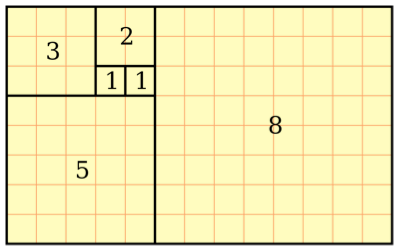
The sequence runs: 0, 1, 1, 2, 3, 5, 8, 13, 21, 34, 55, 89, 144, 233, 377, 610... The rule is complete and simple: start with 0 and 1, and each subsequent term is the sum of the two preceding terms. Every number in the sequence is determined entirely by this rule and the two starting values. There is no arbitrary choice, no free parameter, no tuning to produce the pattern. The pattern is inherent in the rule — and the rule is the simplest possible recursive definition.
In Europe, the sequence is named after Leonardo of Pisa, known as Fibonacci (a contraction of filius Bonacci, "son of Bonacci"), who introduced it to European mathematics in his 1202 work Liber Abaci (Book of Calculation). Fibonacci was one of the great transmitters of Arabic and Indian mathematical knowledge to medieval Europe, and the sequence appears in his book in the context of a puzzle about the growth of a population of rabbits. But the sequence was known to Indian mathematicians many centuries earlier: the scholars Virahanka (around 700 CE), Gopala (around 1135 CE), and Hemachandra (around 1150 CE) all discussed what is now the Fibonacci sequence in the context of Sanskrit prosody — the study of poetic metre — where the sequence naturally arises from counting the number of rhythmic patterns of a given length that can be made from short and long syllables.
Key takeaways
- The Fibonacci sequence (0, 1, 1, 2, 3, 5, 8, 13, 21...) is generated by the simplest recursive rule — each term is the sum of the two before it — and its consecutive ratios converge on the Golden Ratio φ = (1 + √5) / 2 ≈ 1.618.
- φ is the most irrational number (hardest to approximate by fractions), which is precisely why it appears in nature: plants use the Golden Angle to ensure no two leaves, seeds, or petals ever line up exactly, maximising packing efficiency and light capture.
- The Golden Ratio arises geometrically in the pentagon and pentagram, whose five-fold symmetry is common in living organisms (five petals, five fingers) but never in non-living crystals — making it a geometric marker of life itself.
The Golden Ratio
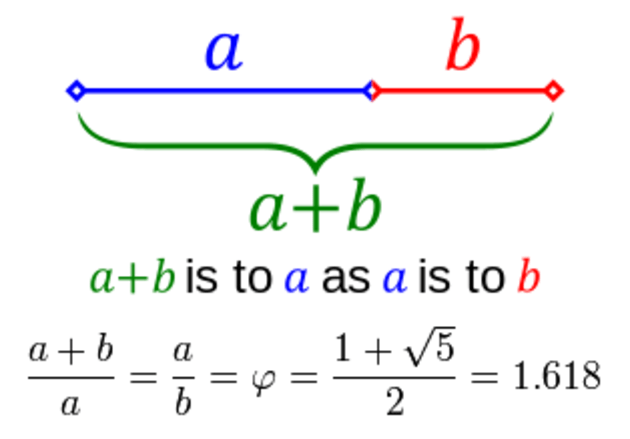
As the Fibonacci sequence progresses, the ratio between consecutive terms converges on a specific number. The ratio 1/1 equals 1.000. The ratio 2/1 equals 2.000. The ratio 3/2 equals 1.500. The ratio 5/3 equals approximately 1.667. The ratio 8/5 equals 1.600. The ratio 13/8 equals 1.625. The ratio 21/13 equals approximately 1.615. As the terms grow larger, the ratios converge ever more tightly on a single value: approximately 1.6180339887... This limiting value is the Golden Ratio, denoted by the Greek letter φ (phi, chosen in honour of the Greek sculptor Phidias, who is believed to have used the proportion in the Parthenon).
The exact value of φ is (1 + √5) / 2. This can be derived from the defining property of the Golden Ratio: it is the only positive number for which φ² = φ + 1. In other words, the square of the Golden Ratio equals itself plus one. This algebraic self-reference — φ defined in terms of φ — is the mathematical signature of the same recursive quality that generates the Fibonacci sequence: each term contains the previous two, just as φ contains both 1 and itself in its defining equation.
The Golden Ratio is irrational — it cannot be expressed as the ratio of two whole numbers — and it is, in a precise mathematical sense, the most irrational of all irrational numbers. It is the hardest number to approximate by simple fractions, which is precisely why φ appears so persistently in nature: natural systems that grow by adding units at a fixed angle use φ because it guarantees that no two units ever line up exactly with each other, maximising the separation between them and therefore maximising efficiency of packing and light capture.
The Pentagon, Pentagram, and Phi
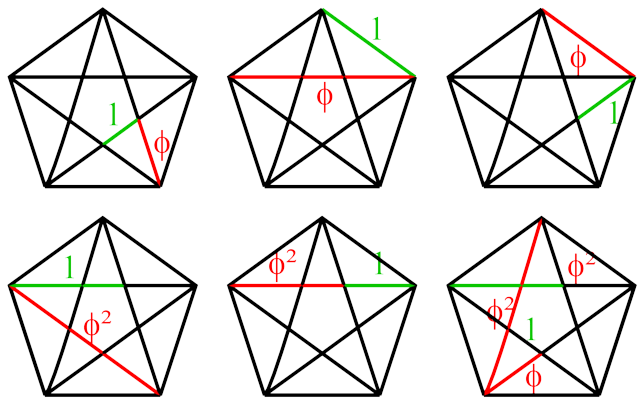
While the Fibonacci sequence provides an arithmetic path to the Golden Ratio, the Golden Ratio has a purely geometric origin that requires no counting at all — only a compass and straightedge. It arises naturally and inevitably in the pentagon and the pentagram, the five-pointed star (for a full treatment of regular polygons and their properties, see the Guide to Geometry: Regular Polygons).
In a regular pentagon, the ratio of the diagonal to the side is exactly φ — not an approximation but an exact geometric equality. Connect the five vertices to form a pentagram, and every line segment is divided by its intersections in the exact ratio φ : 1. The intersection points form a smaller pentagon at the centre, whose diagonals form another pentagram, whose intersections form another smaller pentagon — and so on without limit. The pentagram is a fractal of the Golden Ratio, self-similar at every scale, and this is the geometric heart of why φ appears wherever growth and self-similarity occur in nature.
The Pythagoreans — the mathematical brotherhood founded by Pythagoras in the sixth century BCE — chose the pentagram as their private recognition symbol, calling it the Pentalpha. They associated it with Hygieia (health, wholeness) because the pentagram embodies perfect self-similar harmony: any part relates to any other part by φ. To carry the Pentalpha was to carry the knowledge that the universe is structured by harmonic self-similarity.
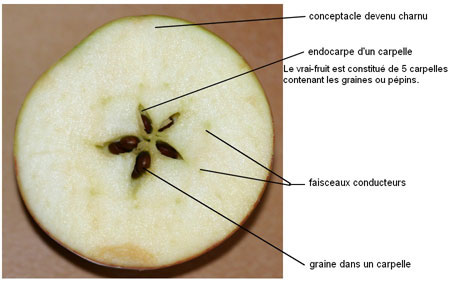
Five-fold symmetry is the symmetry of life itself. Flowers with five petals, sea stars, the five-fingered hand — pentagonal symmetry is everywhere in biology. Non-living crystals, by contrast, never exhibit five-fold symmetry; it is crystallography's "forbidden" symmetry, incompatible with periodic crystal lattices. The pentagon is a geometric marker that distinguishes the living from the non-living, and at its core is the Golden Ratio. Even the humble apple hides a pentagram in its cross-section — five seed chambers arranged in the geometry of φ.
Among the most extraordinary expressions of the pentagram in nature is the path that Venus traces in the sky over eight Earth years. Venus completes almost exactly thirteen orbits in the time Earth completes eight — the ratio 8:13 encoding consecutive Fibonacci numbers. The five conjunctions of Venus and the Sun during those eight years are distributed at nearly equal intervals of 72°, tracing a near-perfect pentagram against the zodiac. The planet associated across every tradition with love and beauty draws a five-pointed star of perfect proportion in its dance with the Sun.
Plants
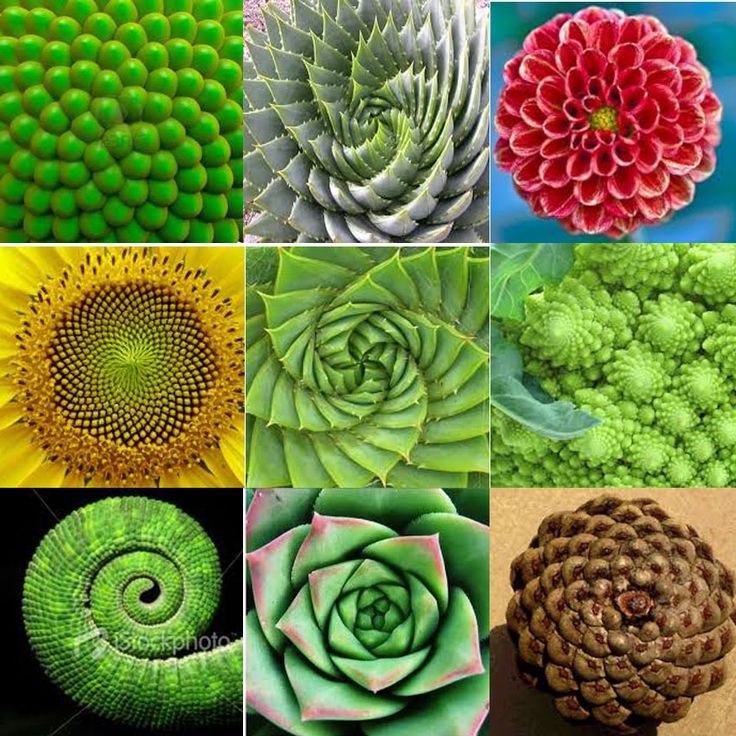
Nowhere does the Fibonacci sequence appear more clearly and more universally than in the growth patterns of plants. The phenomenon, known as phyllotaxis (from the Greek for leaf arrangement), is the subject of extensive mathematical study, and its origins are now well understood: the Fibonacci spiral is the optimal solution to the geometric problem that every plant must solve — how to pack the maximum number of units (seeds, leaves, petals, branches) into a given space with the minimum overlap.
The most celebrated example is the sunflower. The seeds in a sunflower head are arranged in two interlocking sets of spirals, one set curling clockwise and one curling counterclockwise. The two sets of spirals always consist of consecutive Fibonacci numbers: small sunflowers typically have 34 and 55 spirals, medium sunflowers 55 and 89, and large sunflowers 89 and 144. Every seed sits at the Golden Angle (137.5°) from the previous seed — and 137.5° is the angle that divides the full circle (360°) in the Golden Ratio. Because the Golden Angle is the most irrational angle (since φ is the most irrational number), seeds placed at successive Golden Angles never align with each other, and the space is packed with maximum efficiency.
Pine cones and pineapples exhibit the same pattern, with their scales arranged in spirals that number consecutive Fibonacci values: 8 and 13 in many pine cones, 13 and 21 in many pineapples. Cauliflower and Romanesco broccoli show the pattern even more dramatically: the spiralling florets of the Romanesco broccoli head are arranged in Fibonacci spirals, and each floret is itself a smaller version of the whole head — a natural fractal with Fibonacci geometry at every scale.
Tree branching also follows Fibonacci patterns. The number of branches on many trees at successive levels of branching follows the Fibonacci sequence: one trunk, one main branch, two secondary branches, three tertiary branches, five quaternary branches, and so on. This is not a perfect rule that every tree follows rigidly, but a statistical tendency that reflects the underlying efficiency of Fibonacci growth dynamics. The branching pattern of blood vessels, river deltas, and neural dendrites follows similar rules — not because these systems "know" the Fibonacci sequence, but because they are all optimising the same kind of space-filling, resource-distributing, branching growth problem, and the Fibonacci sequence is the optimal solution.
The Spiral
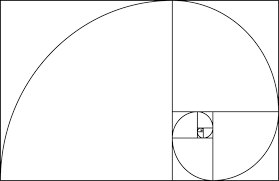
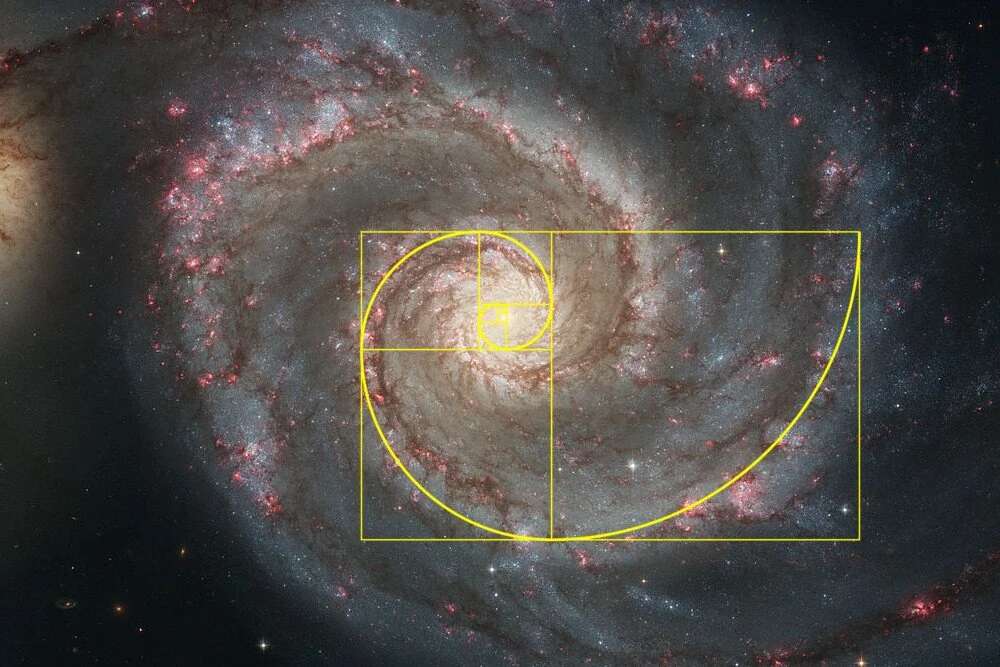
The Fibonacci spiral is the visual expression of the golden ratio in motion. It is constructed by drawing quarter-circle arcs through a series of golden rectangles, each one nested inside the previous, each one smaller by a factor of φ. The spiral that results never reaches its centre — it curves inward forever, approaching but never arriving at the point of infinite convergence. This self-similar, endlessly deepening curve is the shape that appears wherever growth and proportion meet in nature: in the unfurling of a fern frond, the curve of a nautilus shell, the sweep of a hurricane, and the arms of a spiral galaxy.
What makes the Fibonacci spiral different from other mathematical spirals is that it is equiangular — the angle between the curve and any radius drawn from the centre is always the same, approximately 72.97°. This means the spiral looks identical at every scale: zoom in and the curve is the same shape, just smaller. This property of scale-invariance is why the golden spiral appears at every level of the natural world, from microscopic to cosmic — it is the only spiral that preserves its form as it grows.
The Human Body
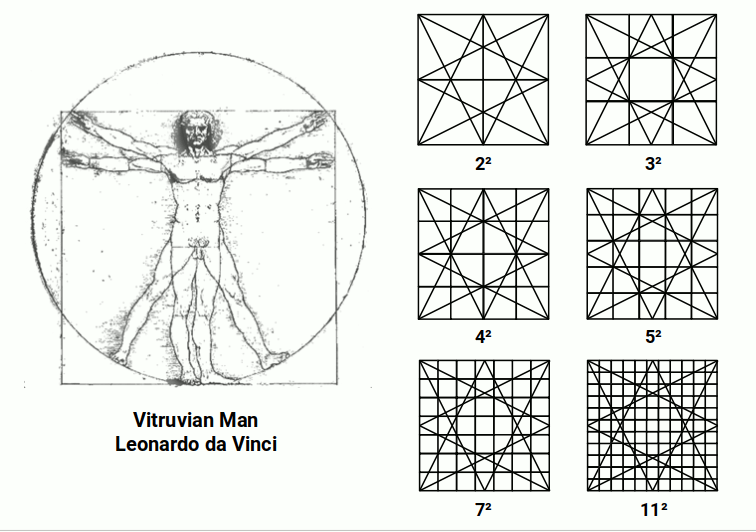
The claim that the human body is proportioned according to the Golden Ratio is one of the most popular topics in popular science and design — and one of the most frequently exaggerated. The reality is more nuanced and more interesting than either the enthusiastic claims or the debunking critiques suggest.
It is genuinely true that the proportions of the human body approximate the Golden Ratio in many places. The ratio of the total height to the height of the navel is approximately φ in most people. The ratio of the forearm to the hand is approximately φ. The ratio of the upper arm to the forearm is approximately φ. The bones of the finger are in approximate Fibonacci proportions. The ratio of the width of two front teeth to their height is approximately φ in dentitions considered most aesthetically pleasing. The facial proportions most universally judged as beautiful — the ratio of the width of the face to its height, of the width of the nose to the width between the eyes — approximate φ.
The word "approximately" in all these cases is important. The human body is not a mathematical instrument; it is a biological organism shaped by millions of years of evolution, and its proportions vary considerably between individuals, between sexes, between ages, and between ethnic groups. No human body is exactly φ-proportioned. But the statistical tendency toward Golden Ratio proportions is real and has been measured repeatedly, and it is most plausibly explained by the same argument that explains the Fibonacci sequence in plants: the Golden Ratio proportions are the optimal proportions for the branching, scaling, and growth processes that generate the human body during development.
The most famous artistic expression of this understanding is Leonardo da Vinci's Vitruvian Man (around 1490), a drawing of a male figure simultaneously inscribed in a circle and a square, based on the architectural writings of the Roman engineer Vitruvius. Vitruvius had argued that the proportions of the well-formed human body were the basis for the proportions of well-designed architecture, and Leonardo sought to demonstrate this geometrically. The drawing is not a proof of Golden Ratio proportions but a meditation on the idea that the human form encodes a mathematical order — that the body is, itself, a work of sacred geometry.
Art and Architecture
The deliberate use of the Golden Ratio in art and architecture spans several thousand years. The Great Pyramid of Giza encodes φ in the ratio of its slant height to half its base. The Parthenon's facade approximates the golden rectangle. In the Renaissance, Luca Pacioli published De Divina Proportione (1509) with illustrations by Leonardo da Vinci, systematically exploring φ's appearance in the Platonic Solids — particularly the dodecahedron and icosahedron, whose proportions are saturated with φ. Pacioli called it the divine proportion for its uniquely self-referential mathematical properties.
The Dodecahedron — Phi in Three Dimensions
The Golden Ratio extends into three dimensions through the dodecahedron — one of the five Platonic Solids, bounded by twelve regular pentagonal faces. Every face is a pentagon, every diagonal-to-edge ratio is φ, and the coordinates of every vertex involve φ. Its dual, the icosahedron (twenty triangular faces), is equally saturated with the golden ratio — the two forms are φ-reflections of each other.
Plato assigned the dodecahedron to the cosmos itself — the quintessence, the form of the universe. Modern cosmology has given this intuition unexpected support: analysis of the Cosmic Microwave Background has suggested that the universe may have the topology of a dodecahedral space. For the full geometry of the dodecahedron and icosahedron, see the Platonic Solids chapter.
Phi in Physics
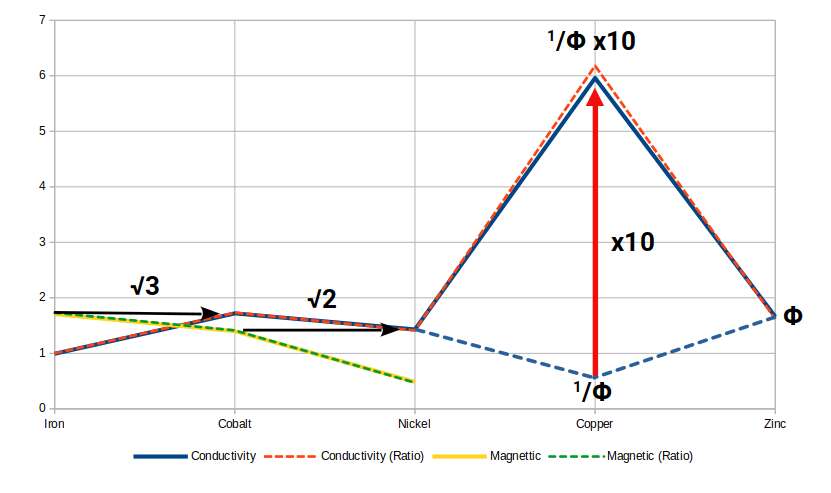 D-orbital elements showing Phi relationships" style="background:#fff; padding:1rem; border-radius:8px;">
In 2010, researchers at Helmholtz-Zentrum Berlin discovered that when cobalt niobate is cooled to near absolute zero and placed in a specific magnetic field, its magnetic spins arrange in patterns with exact Fibonacci spacing — the ratio between successive resonant frequencies was exactly φ to experimental precision. The Golden Ratio is not merely an aesthetic or biological phenomenon — it is written into the quantum fabric of the physical world.
Conclusion
The Golden Ratio is the thread that runs through everything. From the simplest recursive rule — each number the sum of the two before — emerges a ratio that organises sunflower seeds, shapes galaxies, structures the human body, and appears in the quantum mechanics of magnetic materials. It is encoded in the pentagon and the pentagram, built into the dodecahedron and the icosahedron, and traced in the sky by the orbit of Venus.
What makes Phi unique among all numbers is its self-referential quality: it is the ratio that contains itself. Square it and you get itself plus one. Invert it and you get itself minus one. This is the mathematical expression of the sacred geometry principle that the whole and the part mirror each other — "as above, so below" — and it is why the Golden Ratio appears wherever nature builds structures that are the same at every scale. The geometric underpinning of this self-similarity — the formal relationship between similar figures — is explored in the Guide to Geometry: Similarity.
In the next chapter, we explore The Silver Mean — the Golden Ratio's lesser-known sibling, governing eight-fold symmetry and the extraordinary tradition of Islamic geometric art.
FAQ
What is the relationship between the Fibonacci sequence and the Golden Ratio?
As the Fibonacci sequence progresses (0, 1, 1, 2, 3, 5, 8, 13, 21...), the ratio between consecutive terms converges on the Golden Ratio φ ≈ 1.6180339887. The exact value is (1 + √5) / 2. Both arise from the same principle of self-reference: each Fibonacci term contains the two before it, and φ satisfies the equation φ² = φ + 1.
Why does the Golden Ratio appear so often in nature?
The Golden Ratio is the most irrational number — the hardest to approximate by simple fractions. Natural systems that grow by adding units at a fixed angle use φ because it guarantees no two units ever line up exactly, maximising separation and efficiency. This is why sunflower seed heads, pine cones, and leaf arrangements all follow Fibonacci spirals.
What is the connection between the Golden Ratio and the pentagon?
The ratio of a regular pentagon's diagonal to its side is exactly φ. Every diagonal divides every other diagonal in the Golden Ratio. The pentagram (five-pointed star) is a continuous cascade of Golden Ratio divisions — every segment is φ times longer or shorter than the adjacent one. The pentagon is essentially a fractal of the Golden Ratio.
Why is five-fold symmetry associated with life?
Five-fold (pentagonal) symmetry is extremely common in biology — five-petalled flowers, starfish, the five-fingered hand — yet it never occurs in non-living crystals, because five-fold rotational symmetry is incompatible with periodic crystal lattices. This makes five-fold symmetry, governed by the Golden Ratio, a geometric marker distinguishing the living from the non-living.