Cosmology, nature, and the philosophical significance of perfect form. For the mathematical treatment — proofs, formulas, and symmetry groups — see Platonic Solids — The Mathematics.
Only Five
When the flat world of circles and polygons extends into three dimensions, something remarkable happens: only five perfectly regular solids are possible. Not five out of many — five total, proved with finality by Euclid in the final book of his Elements. Three are built from triangles (tetrahedron, octahedron, icosahedron), one from squares (cube), and one from pentagons (dodecahedron). No other regular polygon can form a closed solid — the geometry simply doesn't permit it.
These five forms are not arbitrary. They are the complete set of three-dimensional shapes in which every face is identical, every edge is the same length, and every vertex looks exactly like every other. They are the 3D equivalents of the circle's perfection — forms of maximum symmetry in the world of solid geometry. For a detailed mathematical treatment of why exactly five exist, see the Guide to Geometry: Platonic Solids.
Key takeaways
- Only five perfectly regular solids exist in three dimensions — tetrahedron, cube, octahedron, dodecahedron, icosahedron — organised into three dual groups that mirror each other's geometry (faces ↔ vertices).
- Plato assigned each to a classical element (fire, earth, air, water, aether), anticipating the modern insight that matter is fundamentally geometric — an idea vindicated at the atomic scale by electron orbital geometry.
- These five forms appear throughout nature — in crystals, viral capsids, radiolaria, and molecular bonds — and generate 13 further Archimedean Solids through truncation, explosion, and twisting.
The Five Platonic Solids
For detailed descriptions of each individual solid — their faces, vertices, edges, symmetry groups, and mathematical properties — see the Guide to Geometry: Platonic Solids.
At a Glance
| Platonic Solid | Faces | Face Type | Vertices | Edges | Element (Plato) | Element (In2Infinity) |
|---|---|---|---|---|---|---|
| Tetrahedron | 4 | Triangle | 4 | 6 | Fire | Water |
| Octahedron | 8 | Triangle | 6 | 12 | Air | Fire |
| Cube | 6 | Square | 8 | 12 | Earth | Earth |
| Dodecahedron | 12 | Pentagon | 20 | 30 | Aether | Air |
| Icosahedron | 20 | Triangle | 12 | 30 | Water | Aether |
Tetrahedron
4 triangular faces · 4 vertices · 6 edges
Plato: Fire · In2Infinity: Water
Octahedron
8 triangular faces · 6 vertices · 12 edges
Plato: Air · In2Infinity: Fire
Cube
6 square faces · 8 vertices · 12 edges
Plato: Earth · In2Infinity: Earth
Dodecahedron
12 pentagonal faces · 20 vertices · 30 edges
Plato: Aether · In2Infinity: Air
Icosahedron
20 triangular faces · 12 vertices · 30 edges
Plato: Water · In2Infinity: Aether
For detailed properties — vertex configurations, Euler's formula, symmetry groups, and mathematical proofs — see the Guide to Geometry: Platonic Solids.
Plato's Cosmology: Five Solids, Five Elements
Plato's association of the five solids with the five classical elements is set out in the Timaeus (c. 360 BCE). The Demiurge — the divine craftsman — used the regular solids as the fundamental units of physical reality. This was not merely a poetic metaphor but a genuine physical theory: matter is, at its most basic level, geometric.
Plato's original assignments were based on qualitative resemblance: fire = tetrahedron (the sharpest, most penetrating solid), earth = cube (the most stable — the only solid that fills space), air = octahedron (intermediate in complexity), water = icosahedron (the most fluid, most nearly spherical), and aether = dodecahedron (the most elevated, with golden-ratio pentagonal faces).
Plato also proposed that the triangular-faced solids (tetrahedron, octahedron, icosahedron) could be disassembled and recombined — fire, air, and water transforming into one another by rearranging triangles. The cube, made of squares, stood apart: earth could not be transformed into the other elements. A geometric model of elemental transformation.
A Revised View
In The Geometric Universe, we propose a revision of Plato's elemental assignments based on the nested three-sphere model. When the five Platonic Solids are correctly nested within three concentric spheres (see Nested Platonic Solids below), a different and more physically grounded correspondence emerges:
- Octahedron = Fire — sits in the innermost sphere (radius 1). Fire originates beneath the Earth's crust, where volcanic magma erupts from deep below. Fire and electricity are harmful to living organisms.
- Tetrahedron = Water — sits in the middle sphere (radius √3). The water molecule (H₂O) is tetrahedral in shape, with an oxygen atom at its centre and two hydrogen atoms at two of the four tetrahedral positions.
- Cube = Earth — sits in the middle sphere. Crystal lattices are cubic — the cube is the only Platonic Solid that fills space, exactly as solid matter fills the Earth's crust.
- Dodecahedron = Air — sits in the middle sphere. Earth's atmosphere is roughly ⅕ oxygen and ⅘ nitrogen — a 20:80 ratio that mirrors the dodecahedron's 20 vertices and 12 pentagonal faces.
- Icosahedron = Aether — sits in the outermost sphere (radius √(φ+2)). Its rotatable midsection corresponds to the electromagnetic field of the atmosphere. Lightning flashes in the sky above, not below.
In this revised model, Fire (octahedron) and Aether (icosahedron) each occupy their own sphere — both harmful to living organisms — while Water, Earth, and Air share the middle sphere, the realm that sustains life. The three spheres map directly onto our lived experience of the natural world: fire below, life in the middle, electrical sky above.
The deeper insight — shared by both Plato's original and the revised model — is that the universe is fundamentally geometric. The apparent diversity of material substance reduces to a small number of basic forms whose properties derive from their geometry. Modern quantum mechanics vindicates this commitment: at the deepest level, matter is not made of stuff but of wavefunction patterns with symmetry, structure, and geometric character.
Kepler and the Cosmic Mystery
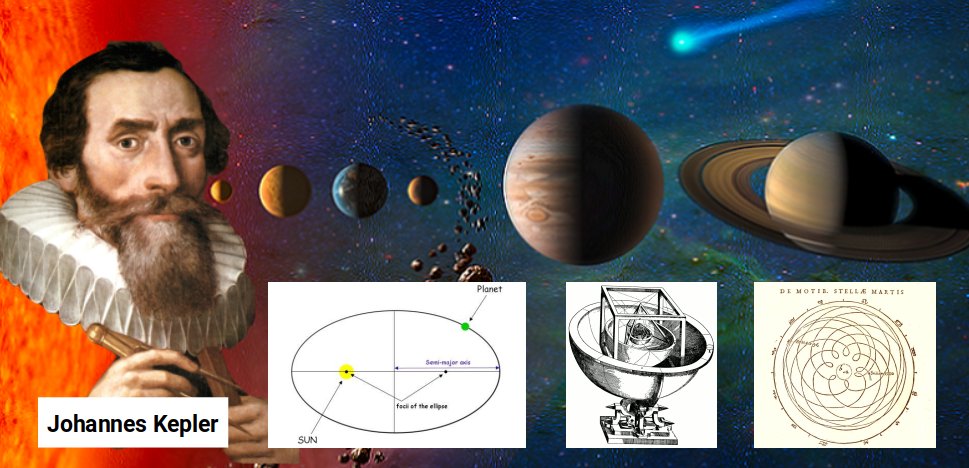
The most ambitious attempt to apply Platonic Solid geometry to the structure of the cosmos came nearly two thousand years after Plato, from the German astronomer Johannes Kepler (1571–1630). Kepler was a Neoplatonist who believed deeply that the universe was organised according to mathematical principles, and he spent much of his early career trying to understand why there were exactly six planets (the number known in his time: Mercury, Venus, Earth, Mars, Jupiter, Saturn) and why their orbits were in the specific ratios that Copernicus had calculated. His answer, published in Mysterium Cosmographicum (The Cosmographic Mystery, 1596), was breathtaking in its ambition: the six planetary orbits correspond to the six spheres defined by inscribing and circumscribing all five Platonic Solids.
Kepler's model was arranged as follows: the outermost sphere (Saturn's orbit) circumscribes a cube, whose inscribed sphere defines Jupiter's orbit. Jupiter's sphere circumscribes a tetrahedron, whose inscribed sphere defines Mars's orbit. Mars's sphere circumscribes a dodecahedron, whose inscribed sphere defines Earth's orbit. Earth's sphere circumscribes an icosahedron, whose inscribed sphere defines Venus's orbit. Venus's sphere circumscribes an octahedron, whose inscribed sphere defines Mercury's orbit. The specific choice of which solid goes between which pair of orbits was constrained by the actual measured orbital ratios, and Kepler found that the match — while not perfect — was close enough to consider striking.
Kepler's Mysterium Cosmographicum was wrong. The planetary orbits are ellipses, not circles, and their ratios do not precisely correspond to the inscribed-circumscribed sphere ratios of the Platonic Solids. Kepler himself knew this — he spent years trying to improve the fit and ultimately abandoned the model when his more precise observations of Mars's orbit forced him to the conclusion that orbits are ellipses. The result of that correction was Kepler's First Law, one of the three laws of planetary motion that transformed astronomy and laid the groundwork for Newton's Principia Mathematica. The wrong geometric model led, through the productive error of trying to make it fit, to a correct physical law. This is one of history's most beautiful examples of inspired speculation leading, through rigorous testing, to genuine discovery.
The significance of Kepler's model in the context of sacred geometry is not its accuracy but its ambition. Kepler was a professional mathematician and astronomer, not an esotericist, and he brought rigorous quantitative methods to a programme of understanding the cosmos through the geometry of the Platonic Solids. His failure demonstrates the limits of the specific model; but his attempt demonstrates that the impulse to see Platonic Solid geometry in the structure of the cosmos is not merely mystical fantasy but a scientific hypothesis that can be tested, refined, and either confirmed or refuted. The fact that it was refuted at this particular scale (planetary orbits) does not rule out its relevance at other scales — and our Atomic Geometry research suggests that the relevant scale is not the solar system but the atom.
Duality
One of the most beautiful relationships in all of geometry is duality. Place a point at the centre of every face of a Platonic Solid, connect adjacent points — and you get another Platonic Solid. Faces become vertices; vertices become faces. The five solids are not five independent forms but three dual groups:
The tetrahedron is self-dual — its dual is another tetrahedron. Two tetrahedra in dual relationship, interpenetrating, form the Star Tetrahedron (Merkaba) — one of the most important forms in sacred geometry.
The cube and octahedron are dual to each other. The cube has 6 faces and 8 vertices; the octahedron has 8 faces and 6 vertices — they exchange these counts exactly. Where the cube's vertices sit, the octahedron's faces appear, and vice versa. Their shared edge midpoints define the Cuboctahedron — the perfect balance point between the two.
The dodecahedron and icosahedron are dual to each other. The dodecahedron has 12 faces and 20 vertices; the icosahedron has 20 faces and 12 vertices. Together they share the highest symmetry of any Platonic pair.
These dual relationships reveal that the five Platonic Solids are deeply interconnected — three groups (self-dual tetrahedron, cube-octahedron pair, dodecahedron-icosahedron pair), each sharing a common symmetry. Duality is not a curiosity but a structural principle: the solids come in complementary pairs, each containing the other within itself.
When nested according to their dual relationships, all five solids fit together in a single structure: the octahedron sits inside the cube (at its face centres), the star tetrahedron connects the cube's vertices, the dodecahedron shares the cube's circumsphere, and the icosahedron encompasses the dodecahedron as its dual.
In Nature
The Platonic Solids are not merely mathematical abstractions — they appear in the natural world wherever the physical processes that generate structure respect the same constraints of symmetry and efficiency that define the solids geometrically.
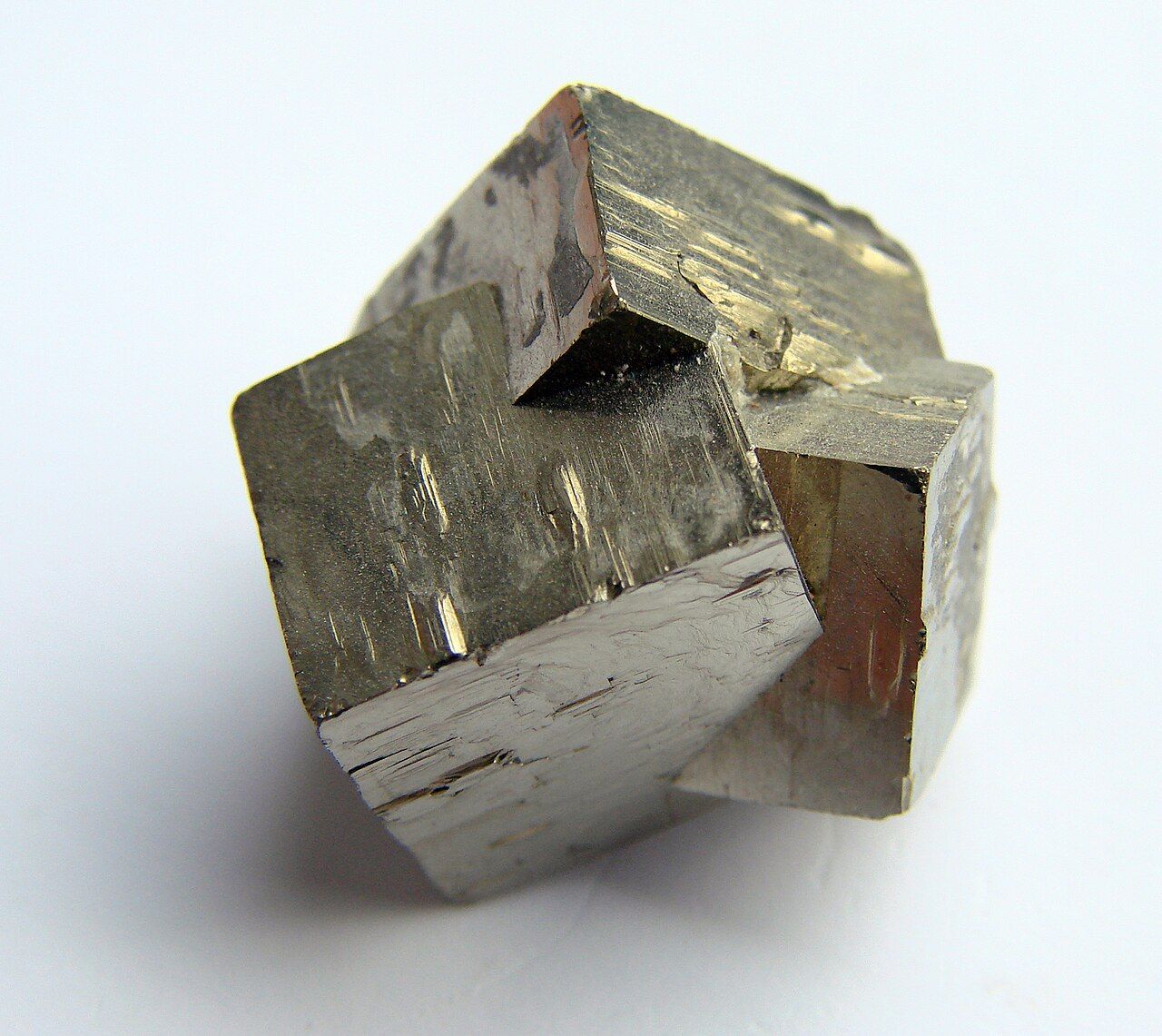
Pyrite (iron sulphide, FeS₂) commonly forms cubic crystals — cubes of striking geometric regularity that were known to ancient metallurgists and natural philosophers. The cubic crystal system, of which pyrite is a famous example, arises because the iron and sulphur atoms arrange themselves in a face-centred cubic lattice whose symmetry is exactly the symmetry group of the cube. The cube is not imposed on the pyrite from outside; it emerges from the requirements of efficient atomic packing under the specific bonding angles of the sulphur-iron compound.
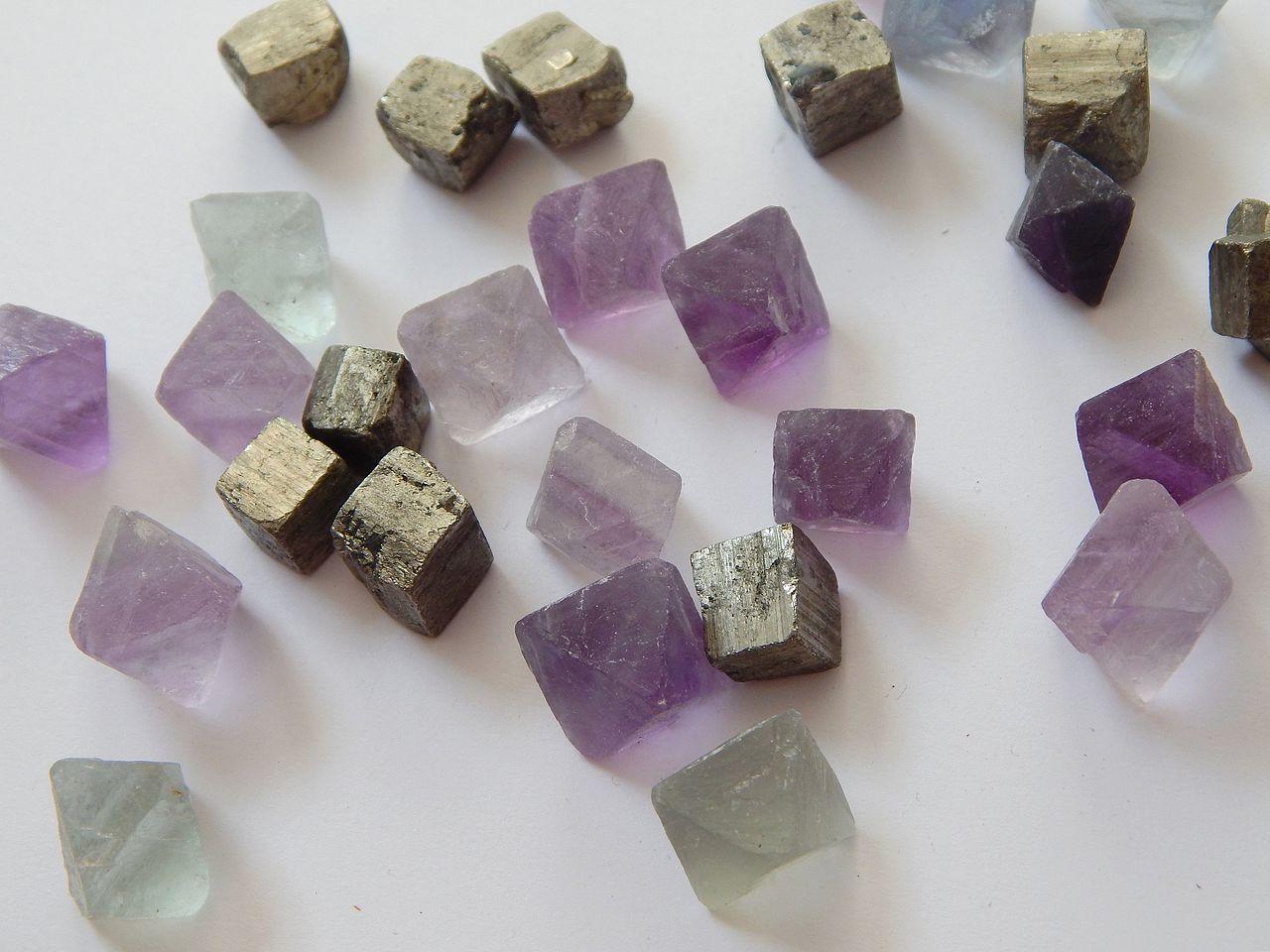
Fluorite (calcium fluoride, CaF₂) commonly forms octahedral crystals — perfect octahedra of such regularity that they were taken by ancient observers as evidence that nature has an inherent tendency toward geometric perfection. Fluorite's octahedral habit arises from the cubic crystal system (like pyrite, fluorite is cubic), but the specific growth conditions favour octahedral faces over cubic faces. The octahedron and the cube are dual to each other, both part of the same cubic symmetry group, and both appear in nature in minerals crystallising from that symmetry.
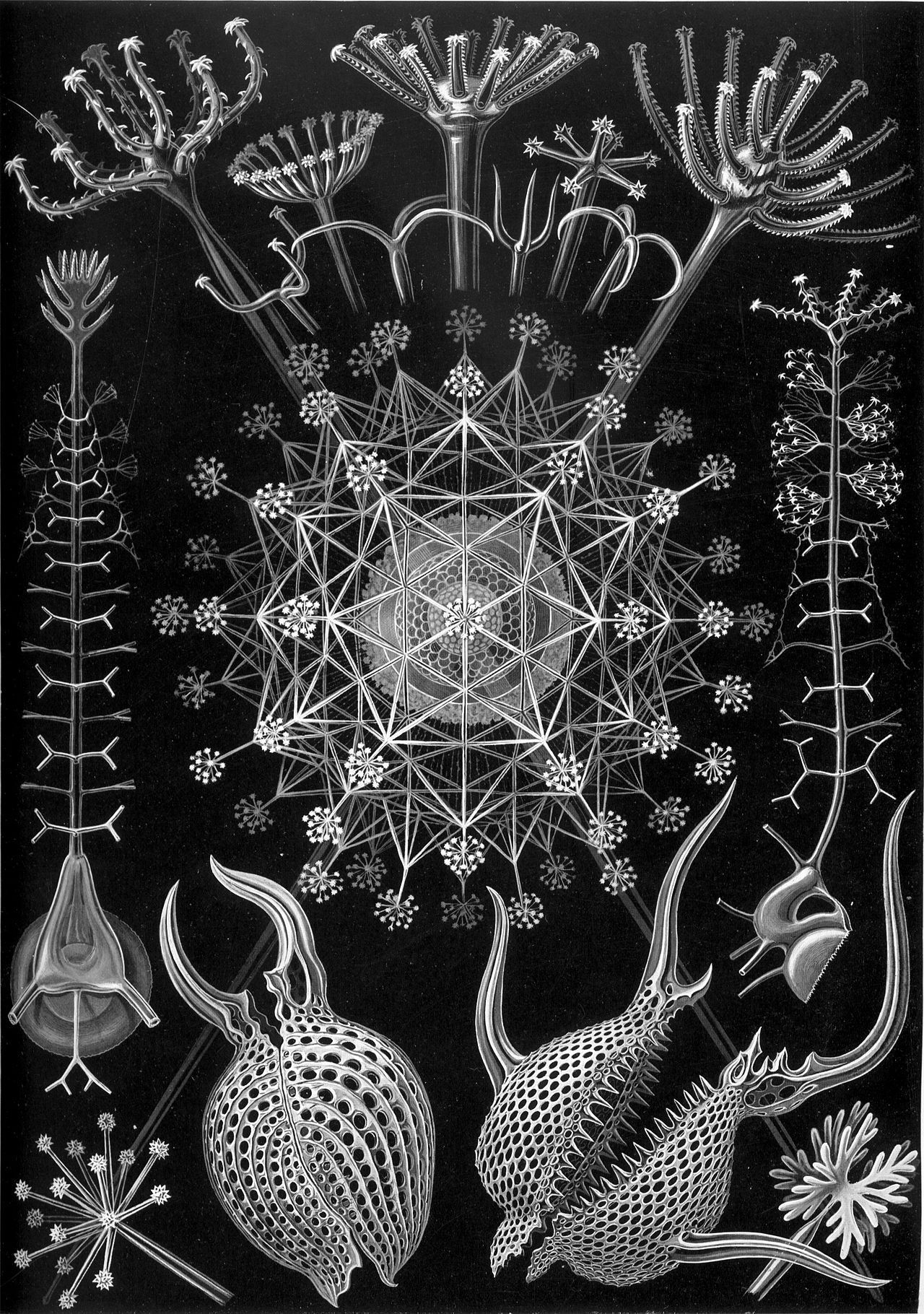
Radiolaria — microscopic marine protozoa whose silica skeletons have been studied since Ernst Haeckel's magnificent illustrations in Kunstformen der Natur (1904) — produce skeletal structures that are precise approximations of all five Platonic Solids and many Archimedean Solids. Icosahedral radiolaria are particularly common. These microorganisms do not plan their geometry; they produce it by the physical process of silica deposition, which naturally minimises surface area for a given volume under the specific chemical conditions of the organism's biology. The icosahedron is the most efficient distribution of twelve equal structural nodes on a sphere — it minimises the maximum distance between adjacent nodes — and so it is the natural solution to the structural problem that the radiolarian's skeleton must solve.
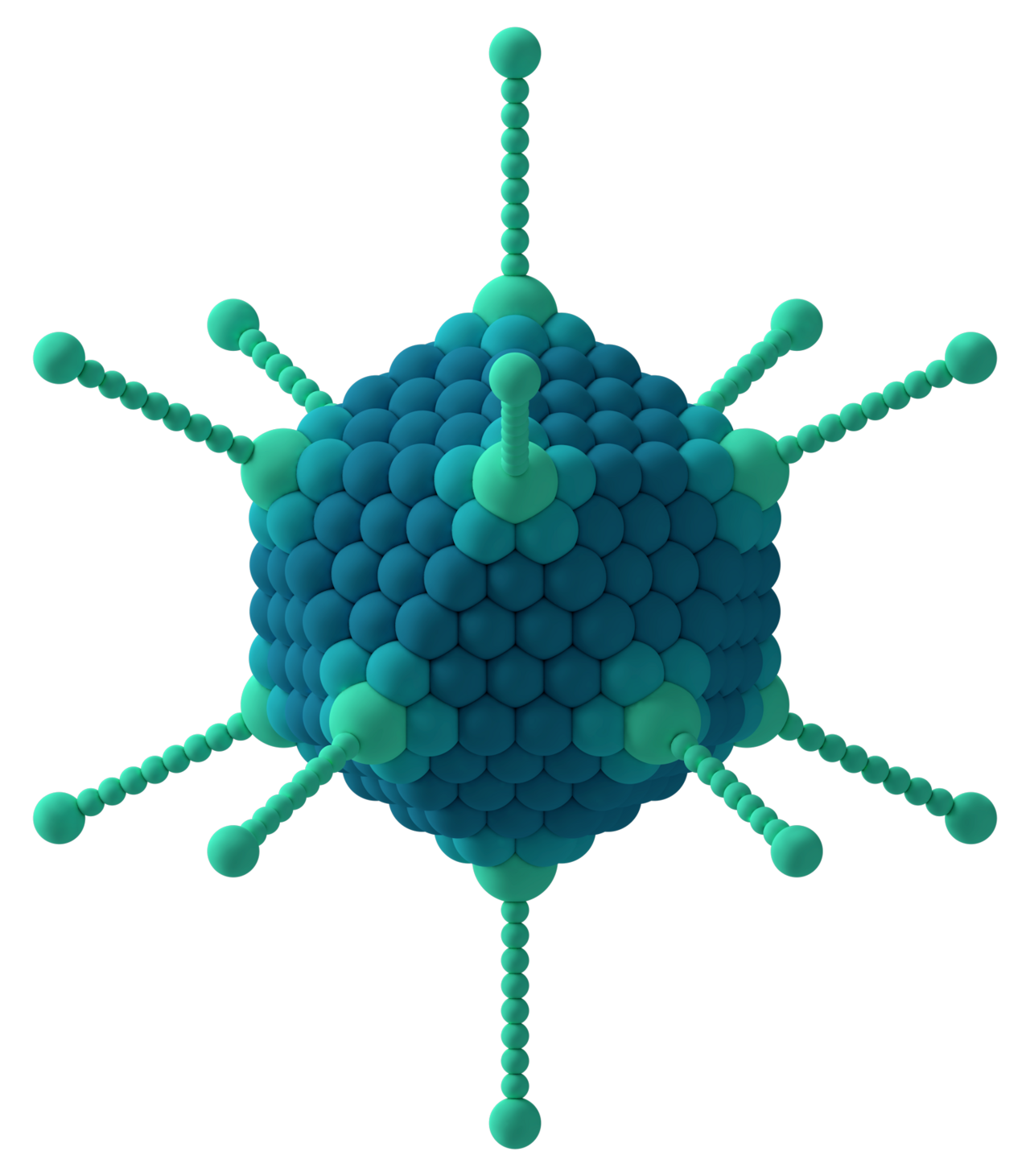
Viruses provide perhaps the most striking natural occurrence of Platonic Solid geometry. Many viruses — including the influenza virus, the herpes virus, and the adenovirus — have protein coats (capsids) that are icosahedral in symmetry. The icosahedron's combination of high symmetry, near-spherical form, and efficient vertex distribution makes it the optimal shape for a protein shell that must enclose a given volume of genetic material with the minimum number of identical protein units. Evolution has discovered the icosahedron independently, as the optimal geometric solution to the biological engineering problem of constructing a minimal protein container.
Into the Atom
Perhaps most remarkably, the Platonic Solids appear at the quantum scale. Our Atomic Geometry research proposes a direct correspondence between the five solids and the structure of electron orbitals — suggesting that the geometry of the atom itself is organised around these same perfect forms.
In the next chapter, we explore The Cuboctahedron — Buckminster Fuller's Vector Equilibrium, the form of perfect balance where twelve spheres surround one.
FAQ
Why do only five Platonic Solids exist?
For a regular polyhedron to form, the interior angles of the faces meeting at each vertex must sum to less than 360°. Only three polygons satisfy this: equilateral triangles (3, 4, or 5 can meet), squares (3 can meet), and pentagons (3 can meet). Hexagons already tile flat at 360°, and higher polygons exceed it. This arithmetic permits exactly five solids — a mathematical theorem, not an empirical observation.
What are the dual relationships between the Platonic Solids?
The tetrahedron is self-dual. The cube (6 faces, 8 vertices) and octahedron (8 faces, 6 vertices) are dual to each other — placing points at face centres of one produces the other. The dodecahedron (12 faces, 20 vertices) and icosahedron (20 faces, 12 vertices) are similarly dual. These pairs share the same symmetry group.
Where do Platonic Solids appear in nature?
Pyrite forms cubic crystals, fluorite forms octahedral crystals. Radiolaria (marine protozoa) produce silica skeletons approximating all five solids. Many viruses — including influenza and adenovirus — have icosahedral protein capsids. Carbon forms tetrahedral bonds in diamond and octahedral arrangements in graphite. These forms arise because they represent optimal geometric solutions to physical constraints.
What are Archimedean Solids and how do they relate to Platonic Solids?
The 13 Archimedean Solids are semi-regular polyhedra derived from Platonic Solids through three geometric processes: truncation (cutting corners), cantellation (exploding faces outward), and snubbing (twisting). Examples include the truncated icosahedron (football/soccer ball pattern) and the cuboctahedron (the midpoint between cube and octahedron).