A Word From Three Traditions
There are few sacred geometry forms with as rich and as ancient a documentary history as the Merkaba. Its name reaches back to three separate civilisations — ancient Egyptian, ancient Hebrew, and the esoteric Jewish tradition of Merkabah mysticism — and in each context it carries a meaning that is simultaneously geometric, cosmological, and experiential. The Merkaba is not merely a shape to be studied; in the traditions that hold it sacred, it is a living field to be inhabited, a vehicle for consciousness, and a map of the relationship between the human body and the structure of space itself.
The Egyptian etymology, as presented in the work of researchers including Drunvalo Melchizedek, breaks the word into three ancient Egyptian components: Mer (a specific type of light rotating in counter-directional fields), Ka (the spirit or double of the human being, the subtle body that survives physical death), and Ba (the soul, the aspect of the human that can move between worlds). Together, Mer-Ka-Ba describes a vehicle made of light, spirit, and soul — or in geometric terms, the counter-rotating field of light that carries spirit and soul across dimensions. This Egyptian reading places the Merkaba at the heart of the ancient Egyptian understanding of the afterlife journey and the nature of consciousness.
In Hebrew, the word merkavah (מֶרְכָּבָה) means simply chariot, and it refers most directly to the divine chariot-throne described in the first chapter of the Book of Ezekiel — one of the most visionary and symbolically complex passages in the entire Hebrew Bible. Ezekiel describes a vehicle of fire emerging from a whirlwind, supported by four living creatures (each with four faces: human, lion, ox, and eagle), with spinning wheels within wheels that move in all four directions simultaneously. Above the creatures is a crystalline firmament, and above that a sapphire throne on which sits the likeness of a human form surrounded by a rainbow-coloured radiance. This vision launched one of the oldest and most secret mystical traditions in Judaism.
Key takeaways
- The Merkaba is a star tetrahedron — two interlocking tetrahedra forming a three-dimensional eight-pointed star — that encodes four of the five Platonic Solids (tetrahedron, cube, octahedron) within a single interlocked structure.
- Its name combines three ancient Egyptian words (Mer-Ka-Ba: counter-rotating light, spirit, soul), and the form has roots in Egyptian, Hebrew, and Kabbalistic traditions as a vehicle of consciousness and a map of the relationship between body and space.
- The Star of David is the 2D projection of the 3D star tetrahedron — a hexagram found across Hindu, Buddhist, Jewish, and Christian traditions as a symbol of the union of complementary principles.
Merkabah Mysticism
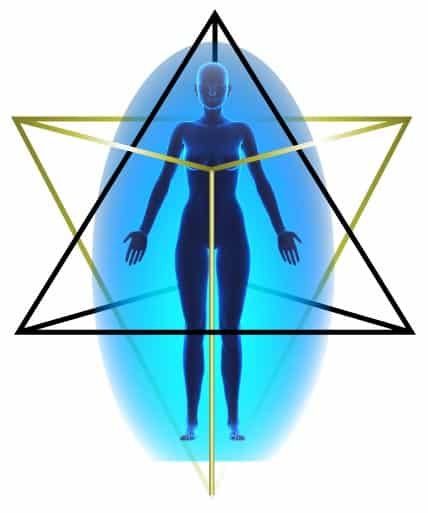
The tradition of Merkabah mysticism (also called Heikhalot literature, "literature of the Palaces") predates the more familiar Kabbalah by many centuries and represents the oldest identifiable strand of Jewish mystical practice. Dating roughly from the third to the seventh centuries of the common era, though drawing on earlier traditions, Merkabah mysticism centred on the practice of yordei merkavah — those who "descend to the chariot" — a group of visionary practitioners who undertook deliberate journeys through the seven celestial palaces (heikhalot) to reach the divine throne-chariot described by Ezekiel.
The Merkabah mystics developed elaborate techniques for inducing altered states of consciousness — extended periods of fasting, rhythmic chanting, breath control, specific postures — that were intended to facilitate the visionary ascent through the celestial halls. The journey was understood as deeply perilous: each celestial palace was guarded by angelic gatekeepers who demanded specific passwords (sacred names and seals) before allowing passage, and those who attempted the journey without proper preparation were said to suffer severe consequences. Only the truly prepared could make the full ascent to the divine chariot.
The relationship between this mystical tradition and the geometric form of the Merkaba is significant. The "descent to the chariot" is a descent into the structure of sacred geometry itself — a journey through the ordered geometric levels of creation, each palace corresponding to a higher level of geometric organisation, each gatekeeper corresponding to a geometric threshold that must be passed. The divine throne at the centre of the vision corresponds to the geometric centre of the Merkabah field — the still point around which all the counter-rotating forms revolve. The mystic's journey is, in geometric terms, a traversal of the nested geometric spaces that compose the field of consciousness.
The Star Tetrahedron
The geometric form of the Merkaba is the star tetrahedron, also known as the stella octangula or the stellated octahedron. It is constructed by taking a regular tetrahedron and placing a second, inverted tetrahedron within it so that the two tetrahedra share the same centre point and the same circumscribed sphere, with one tetrahedron pointing upward (toward the crown) and the other pointing downward (toward the earth).
The result is a three-dimensional eight-pointed star — the three-dimensional analogue of the two-dimensional Star of David formed by two interlocking equilateral triangles. But the three-dimensional form is considerably richer in its geometric content than its two-dimensional projection suggests. The vertices of the two tetrahedra together define the eight vertices of a cube: the four vertices of the upward tetrahedron occupy four of the eight corners of a cube (the four corners of one diagonal cross-section of the cube), while the four vertices of the downward tetrahedron occupy the remaining four corners (the four corners of the other diagonal cross-section). This means that the star tetrahedron encodes the cube directly in the positions of its twelve vertices.
Furthermore, the intersection of the two tetrahedra — the region where the two interlocking forms overlap — is an octahedron. The eight triangular faces of the star tetrahedron's two components define, at their intersections, the eight triangular faces of an octahedron at the centre of the form. And the total assembly — star tetrahedron, the cube defined by its vertices, and the octahedron at its heart — encodes simultaneously four of the five Platonic Solids: the tetrahedron (appearing twice, as the two components), the cube (implied by the vertex positions), and the octahedron (formed by the intersection region). The star tetrahedron is one of the most geometrically rich forms in sacred geometry, containing within its single interlocked structure the essential relationships of the simplest and most fundamental Platonic Solids. For the mathematical properties of the star tetrahedron (stella octangula) — coordinates, symmetry group, and dual relationships — see the Compound Polyhedra chapter in the Guide to Geometry.
The Star of David
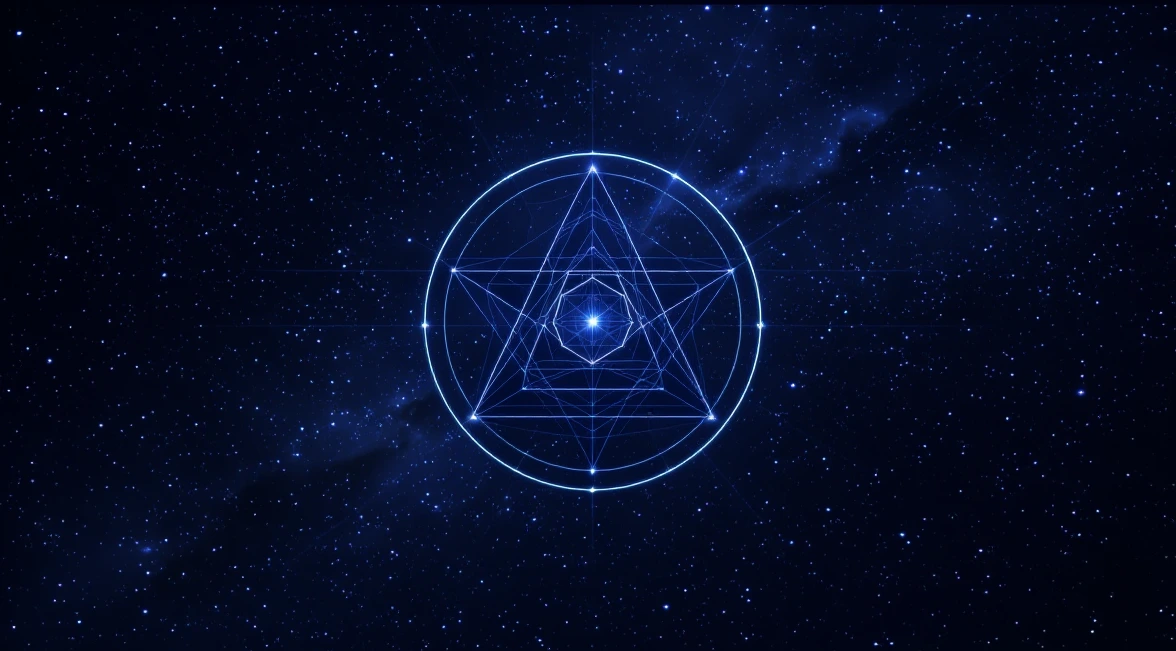
The Star of David — the Magen David, Shield of David — is one of the most universally recognised symbols in the world, serving as the central emblem of Judaism and the flag of the state of Israel. Its geometric form is a hexagram: two equilateral triangles interlocked to form a six-pointed star. The relationship between this two-dimensional symbol and the three-dimensional star tetrahedron of the Merkaba is not merely analogical: the Star of David is literally the orthographic projection (flat shadow) of the star tetrahedron when viewed along one of its three-fold symmetry axes.
But the Star of David predates its association with Judaism by millennia. The six-pointed star appears in Hindu and Buddhist iconography under the name Shatkona (six-pointed figure), where it represents the union of Shiva and Shakti — the masculine and feminine principles of creation, the upward-pointing and downward-pointing triangles representing the complementary forces whose union generates all phenomena. The same symbol appears in Tantric yantra diagrams as a representation of the sacred marriage of heaven and earth, of consciousness and matter, of the spiritual and the physical. In this Tantric context, the six-pointed star is not merely a symbol but an active geometric tool for meditation — a yantra that the practitioner interiorises to achieve the state of consciousness it represents.
The Islamic tradition, too, uses the six-pointed star — the Seal of Solomon — as a magical and protective symbol, appearing in the decor of mosques and the designs of amulets throughout the Islamic world. The Solomonic seal appears in connection with divine wisdom and the power to command spirits, and it was this Islamic appropriation of the symbol that Kabbalistic tradition later transformed into the Shield of David. The six-pointed star is therefore a genuinely pan-traditional symbol, its universality perhaps reflecting the fact that the star tetrahedron it projects is a form of deep geometric significance that any sufficiently developed geometric tradition would encounter.
Counter-Rotation and the Merkaba Meditation
What distinguishes the Merkaba from the static star tetrahedron is rotation. In the sacred geometry tradition, particularly as taught by Drunvalo Melchizedek in his foundational work on the Flower of Life, the Merkaba is not a static form but a dynamic field: the two interlocking tetrahedra rotate in opposite directions around the central vertical axis, generating a field of energy that extends outward from the body.
The full Merkaba meditation involves three star tetrahedra, not two. One remains completely stationary — this is the physical body, the vehicle anchored to the earth. The other two rotate in opposite directions around the vertical axis, one clockwise and one counter-clockwise. These two rotating fields correspond to the two primary channels of energy in the human subtle body — in Tantric terms, the ida and pingala nadis, the lunar and solar channels that spiral around the central sushumna channel of the spine.
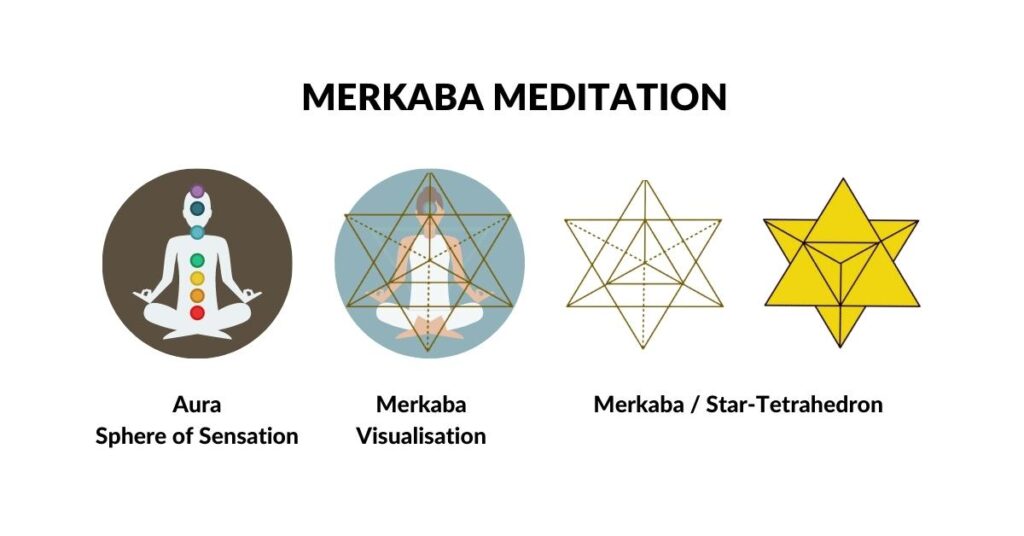
When two equal and opposite rotations are superimposed, they create a standing wave — a region of stable, self-sustaining geometric organisation more stable than either rotation alone. The counter-rotation generates a toroidal field at the intersection of two opposing rotational fields, combining the torus's dynamics of flow with the tetrahedral symmetry of the Platonic Solids. This is why the Merkaba field is described as a vehicle: it is a self-sustaining energy structure, not a transient pattern.
The practitioner activates these counter-rotating fields through a combination of specific mudras (hand positions), pranayama (breath patterns), and visualisation of the star tetrahedra extending outward from the body. At its core, the Merkaba meditation is a practice of geometric self-identification: rather than identifying with the physical body or the stream of thoughts, the practitioner identifies with the geometric field that the body generates and inhabits — the self redefined not as a fixed object but as a dynamic process, a field of awareness rather than a point of consciousness.
This connects the Merkaba practice to the much older tradition of yantra meditation in Hindu and Buddhist Tantra, in which the practitioner internalises the geometry of specific yantras — geometric diagrams such as the Sri Yantra — as a way of aligning the structure of consciousness with the structure of the cosmos. The premise is that consciousness has a geometry, and by meditating on specific forms, the practitioner transforms the geometry of their awareness. The Merkaba is the form that represents the activated, counter-rotating field of enlightened awareness.
Conclusion
The Merkaba is where sacred geometry comes alive. From the static perfection of the Platonic Solids to the dynamic flow of the torus, this guide has traced the journey from simple forms to living fields — and the Merkaba is the culmination of that journey. It takes the oldest and simplest of the Platonic Solids, the tetrahedron, doubles it into a star, and sets it spinning into a vehicle of consciousness.
The star tetrahedron is not only a spiritual form. Our research on Atomic Geometry has identified it in the geometry of the F-orbital electron shell — two interlocking tetrahedra describing the complex lobed geometry of the fourteen F-orbital electrons. Nature itself uses this form at the quantum scale. Explore the mapping in our F-orbital star tetrahedron interactive.
From the Seed of Life to the Merkaba, from the first circle to the counter-rotating field of light — sacred geometry is not a collection of shapes but a single unfolding story. Each form contains the ones before it and points toward the ones that follow. The Merkaba, as the activated star tetrahedron, is the form that sets the whole geometry in motion — the still point and the spinning field, the chariot and the journey, the geometry of awakening.
In the next chapter, we explore Fibonacci & The Golden Ratio — the self-replicating proportion that connects sunflower spirals, planetary orbits, and the geometry of the pentagon.
FAQ
What is the Merkaba?
The Merkaba is a star tetrahedron — two interlocking tetrahedra, one pointing up and one pointing down, sharing the same centre. In sacred geometry traditions, it represents a vehicle of light, spirit, and soul formed by counter-rotating geometric fields. The name derives from three ancient Egyptian words: Mer (counter-rotating light), Ka (spirit), and Ba (soul).
How does the star tetrahedron relate to the Platonic Solids?
The star tetrahedron encodes four of the five Platonic Solids simultaneously: the two tetrahedra (appearing as the two interlocking components), the cube (defined by the eight vertex positions), and the octahedron (formed by the intersection region where the two tetrahedra overlap). It is one of the most geometrically rich forms in sacred geometry.
What is Merkabah mysticism?
Merkabah mysticism is the oldest identifiable strand of Jewish mystical practice, dating from roughly the third to seventh centuries CE. It centres on visionary journeys through seven celestial palaces to reach the divine throne-chariot described in the Book of Ezekiel. Practitioners used fasting, chanting, breath control, and specific postures to induce the visionary ascent.
How is the Merkaba used in meditation?
Merkaba meditation, as taught by Drunvalo Melchizedek and others, involves visualising counter-rotating star tetrahedra around the body, combined with specific breathing patterns and mudras. The geometric fields are visualised as spinning in opposite directions, creating a unified field of light that the practitioner experiences as an expansion of consciousness.