The Shape That Breathes
Of all the forms in sacred geometry, the torus is perhaps the most alive. It does not simply sit in space as the cube or tetrahedron does, holding still and declaring its symmetry. The torus moves. It breathes. It is, at its geometric heart, a form defined not by static position but by continuous flow — and this is precisely why it appears, again and again, wherever life and energy and field-effects manifest in the physical world.
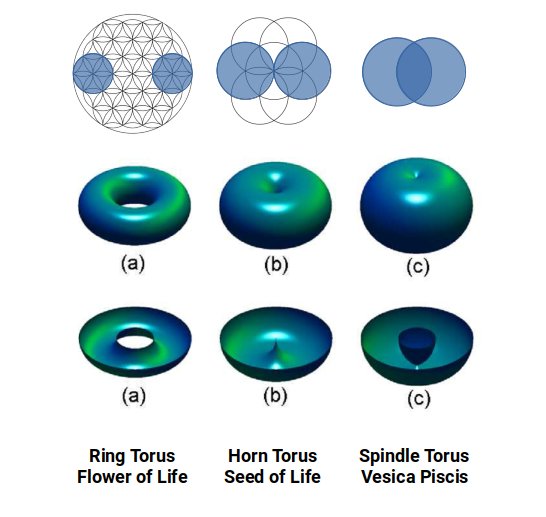
The word torus comes from Latin, where it referred to a cushion or a rounded, swelling form — the same root that gives us the architectural term for the rounded moulding at the base of a classical column. But the mathematical object is far more interesting than a cushion. A torus is the surface swept out when a circle is rotated around an axis that lies in the same plane as the circle but does not pass through it. The result is the donut shape everyone immediately recognises — and yet this casual recognition tends to obscure something profound: the torus is one of the most fundamental topological surfaces that exists, and it is fundamentally different in character from a sphere.
A sphere divides space into inside and outside, and there is no way to get from one to the other without crossing the surface. The torus also divides space into inside and outside, but it does this while maintaining a hole through its centre — a portal, in a sense, that connects one region of the exterior to another. This topological property gives the torus a character that is, geometrically speaking, more complex than the sphere, and far closer to the dynamic behaviour of fields in nature. The genus of a sphere is zero; the genus of a torus is one. In topology, the genus counts the number of "handles" a surface has, and every additional handle adds an entirely new class of possible paths across the surface.
What makes the torus so central to sacred geometry is not merely its beautiful shape but the process by which it is generated — and the inverse process that reveals its deepest meaning. Understanding this generative process transforms the torus from a mere shape into a window onto the behaviour of the universe itself, a form that encodes simultaneously the principles of emanation, expansion, return, and self-containment.
Key takeaways
- The torus is the most dynamic form in sacred geometry — defined not by static position but by continuous flow. It is the inverse of the sphere: where a point expands into a sphere, a circle rotates into a torus.
- It appears at every scale in nature: Earth's magnetic field, the heart's electromagnetic field, vortex rings, the heliosphere, and possibly the universe itself — always as the shape of self-sustaining energy circulation.
- The torus's two independent cycles encode the structure of time — local and cosmic — the same nested cycles described in the Hindu yugas, the Mayan Long Count, and the Hermetic principle "as above, so below".
Inverse Geometry
Sacred geometry has always been concerned not just with forms but with the processes by which forms arise from one another. The most illuminating way to understand the torus is through the framework of inverse geometry — the principle that every geometric transformation has its inverse, and that these inverse pairs reveal deep truths about the structure of reality.
Consider the most fundamental geometric relationship: a point and a circle. A point has no dimension; a circle is one-dimensional in its boundary, enclosing a two-dimensional area. In three-dimensional space, when a point is expanded symmetrically in all directions, it becomes a sphere. The sphere is what you get when you take a point and distribute its presence equally in all directions through 3D space — every point on the sphere is equally distant from the original point, and the sphere is the locus of that equality. This is the most natural, the most symmetric, and the most information-preserving expansion of a point into 3D space.
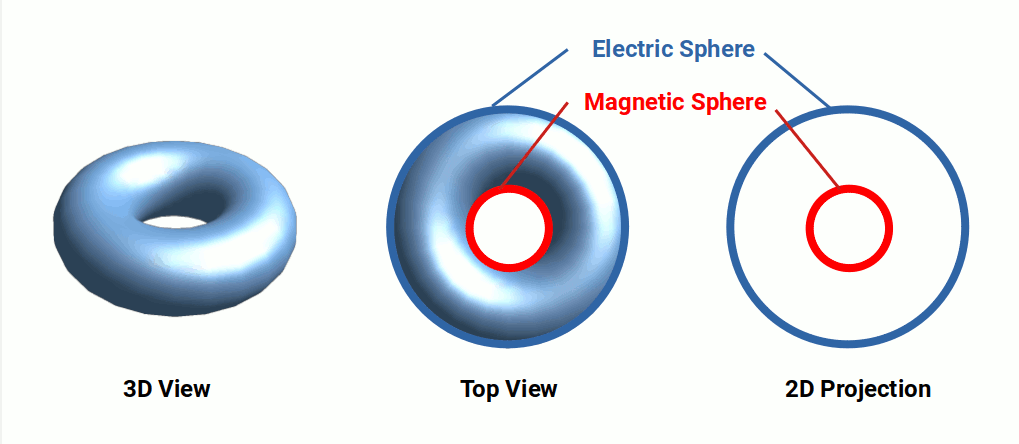
Now consider the inverse operation. Instead of a point becoming a sphere, what happens when a circle becomes a point? More precisely: what happens when we consider the surface swept out by a circle rotating around an external axis — an axis in the same plane as the circle, but outside it? Every point on the circle traces a circular path around the axis. The entirety of all these circular paths sweeps out a surface. That surface is a torus. The circle does not contract to a point; rather, by rotating around an external point, it generates the torus as the natural dual shape to the sphere.
This is the geometric inversion: a point expanding equally in all directions gives a sphere; a circle rotating around an external axis (its natural complementary operation) gives a torus. The sphere and the torus are, in this sense, complementary shapes — and the torus is the more complex, more dynamic form, because it encodes not just a static expansion but a rotation, a direction of flow. The sphere knows only radius; the torus knows radius and the additional dimension of its toroidal angle, the angle of travel around the central hole.
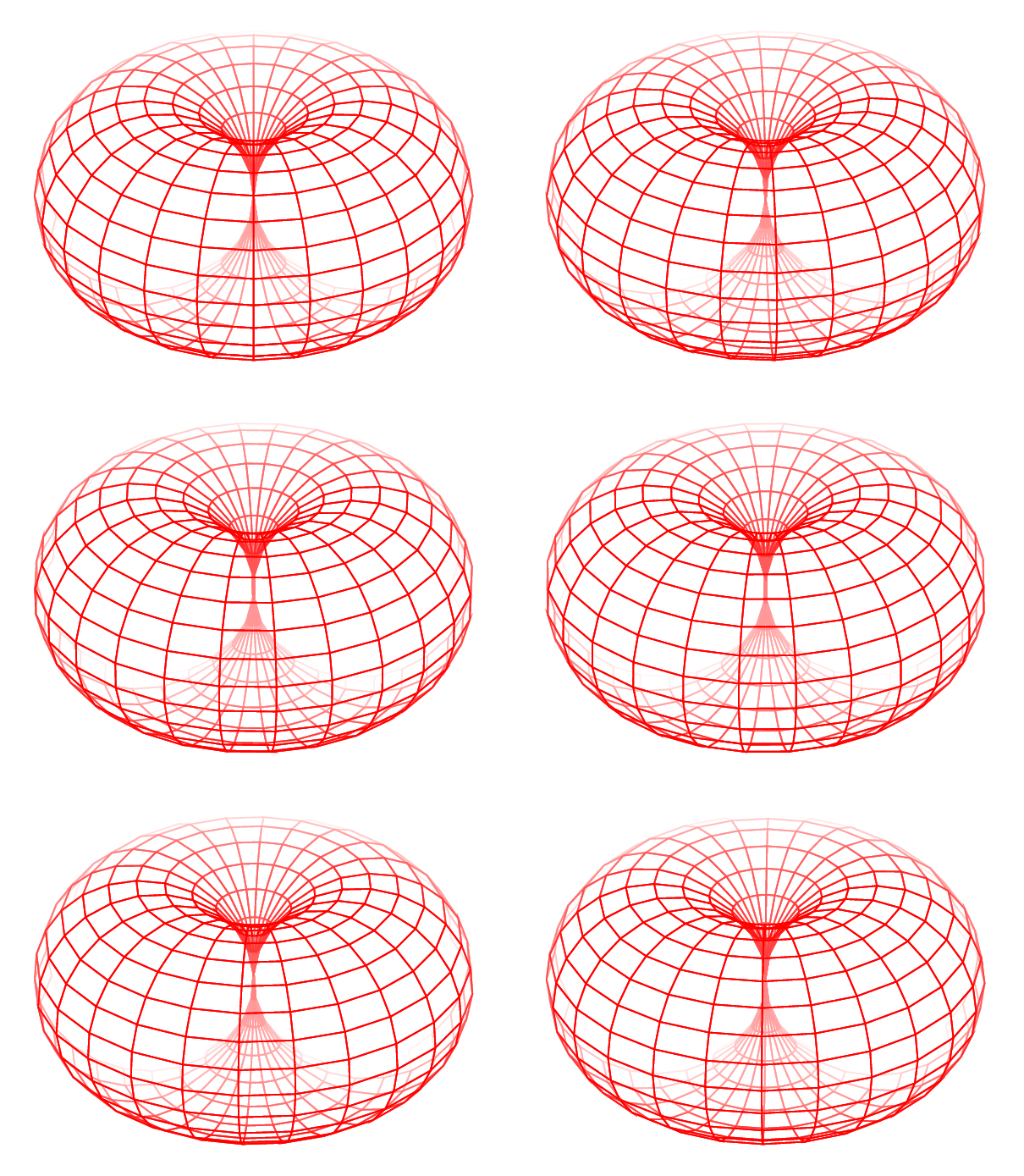
This generative story matters philosophically because it places the torus at the intersection of the one-dimensional (the circle) and the three-dimensional (the volume), mediated by rotation and therefore by time. A torus cannot be fully understood as a static object. It is, inherently, a form that implies movement, direction, and cycle. This is why it appears wherever fields flow through nature: the torus is the geometric shape of cycling, of return, of the energy that leaves a source and comes back to it.
The Apple
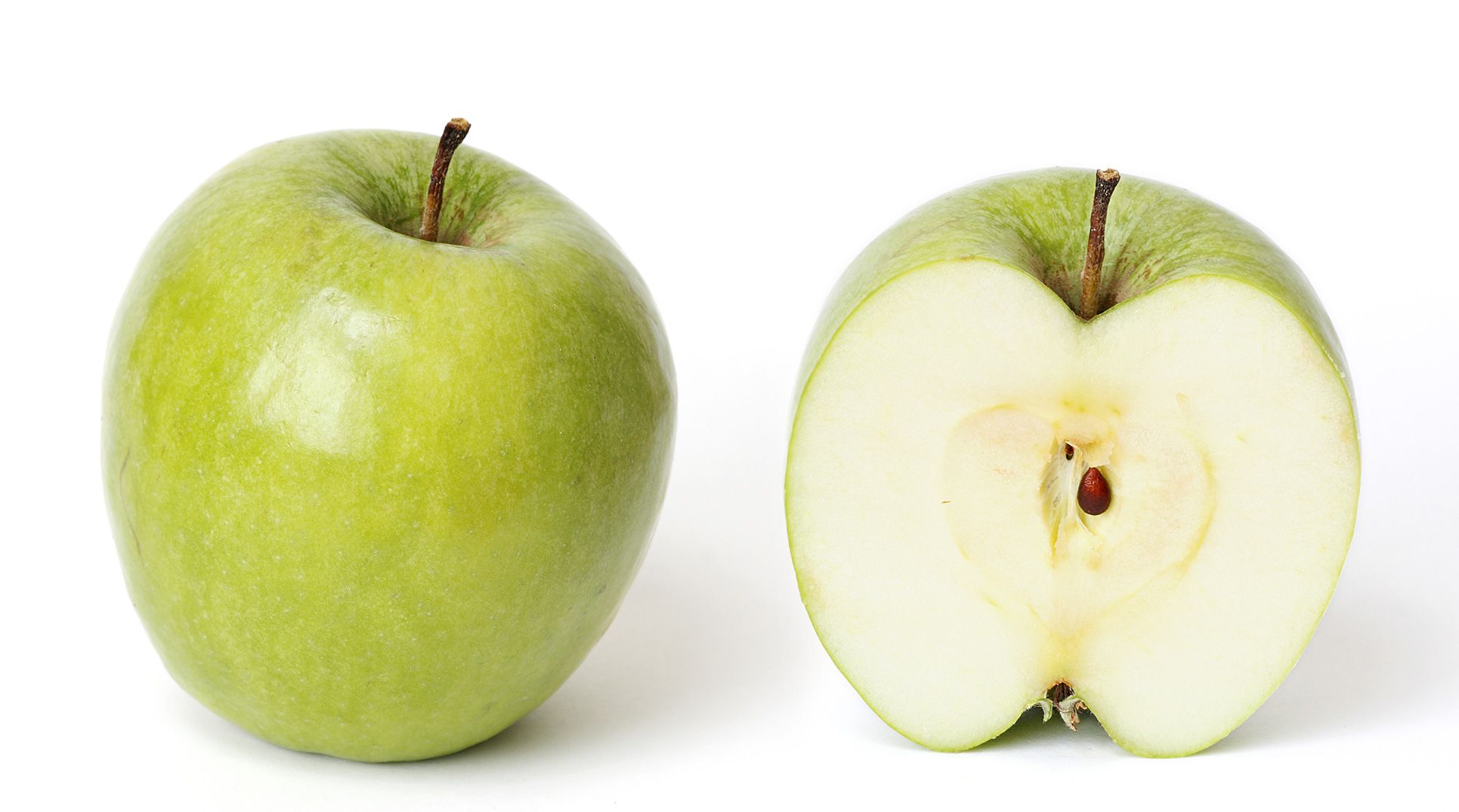
One of the most accessible ways to begin to see the torus in the world around us is to look at something as ordinary as an apple. At first glance the apple appears to be a simple sphere, perhaps slightly flattened. But look more carefully: at its base there is a small dimple, and at its top there is a deeper dimple into which the stem enters. These two indentations correspond precisely to the two poles of a torus — the points where the hole through the middle of the torus is closest to the surface.
Mathematically, an apple is topologically a sphere, not a torus — it does not have a hole through the middle, and its topology is therefore different. But morphologically, in its growth dynamics, the apple is shaped by toroidal processes. The apple develops from a flower whose reproductive structures are arranged in a five-fold pattern, clearly visible in the five petals of the apple blossom and in the five seed chambers arranged in a pentagonal pattern around the core. As the fruit swells, the apple pulls nutritional substance through the stem and distributes it outward through growth — a flow that traces toroidal vectors from the stem-pole outward and back toward the base-pole.
Cut an apple in half horizontally — across the equator, not from stem to base — and another revelation appears: the five seed chambers radiate from the central core in the precise geometry of the five-pointed star, the pentagram. The pentagram and the torus are united in a single fruit — the form that encodes the golden ratio appears inside the form that encodes the geometry of dynamic field-flow.
This connection between the apple and the torus is not merely visual metaphor. It reflects the actual developmental biology of the fruit. Growth hormones and nutrients flow through the apple's vascular system in patterns that follow toroidal vector fields. The shape of the apple is literally sculpted by toroidal dynamics. Sacred traditions in many cultures associated the apple with profound knowledge — from the Norse mythology of the apples of immortality tended by the goddess Iðunn to the apple of the Garden of Eden, whose consumption brings awareness of the structure of reality. Whatever the symbolic layers, there is something geometrically resonant about this: the apple encodes, in its very growth, one of the most fundamental dynamic forms in the universe.
The Torus in Nature
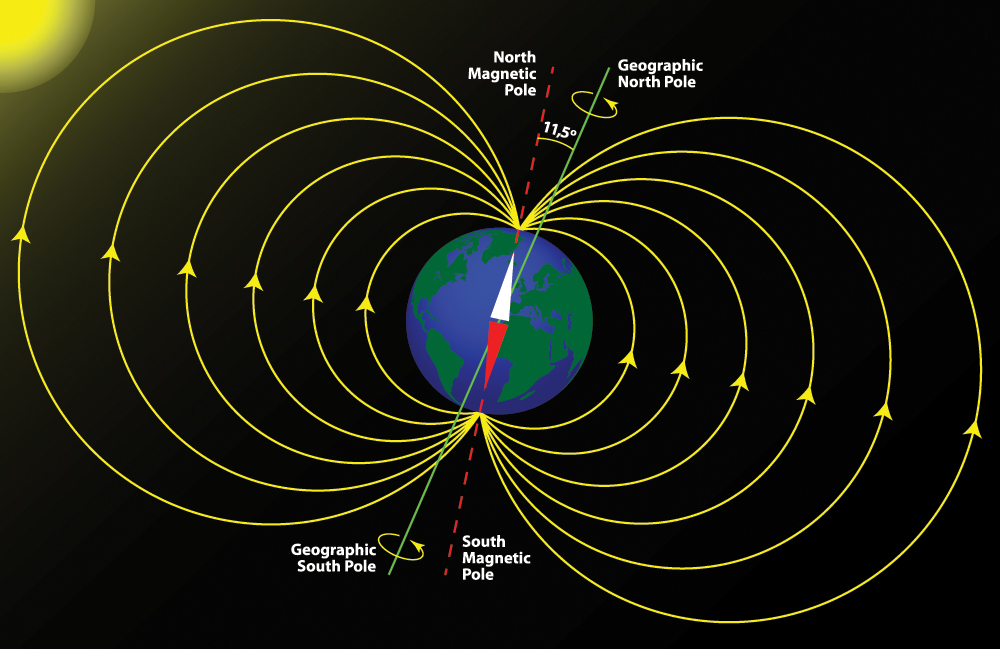
Once you learn to recognise the torus, you find it at every scale in the natural world — from the subatomic to the galactic. Wherever energy organises itself into a self-sustaining field, the torus is the shape of that field. The pattern is consistent because the geometry is consistent: the torus is the form in which energy can circulate indefinitely, sustaining itself by its own motion.
The Earth's magnetic field is the most familiar example. It emerges from the South Pole, arcs outward through space, and converges back into the North Pole — tracing the precise shape of a torus. Every compass needle on Earth responds to this planetary toroidal field. The aurora borealis and australis — the polar lights — are the torus made visible, as charged particles from the Sun spiral down the toroidal field lines into the upper atmosphere.
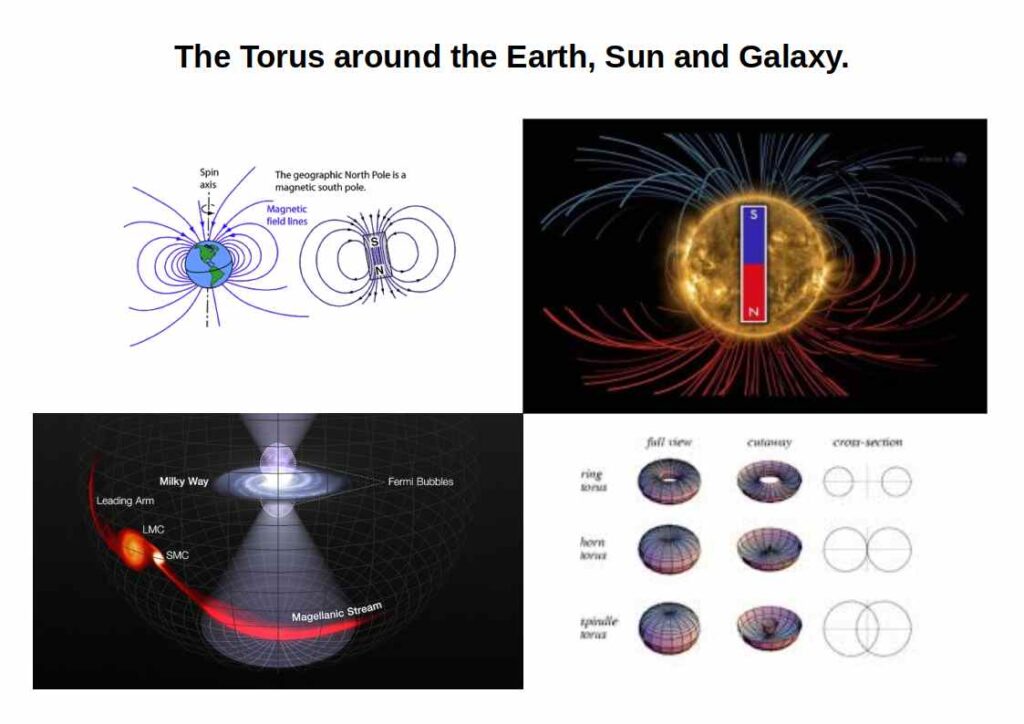
The same geometry appears around the Sun, whose magnetic field spirals outward through the entire solar system in a toroidal helix, and around the Milky Way, where galactic magnetic fields and the Fermi Bubbles trace the same form at an incomprehensibly larger scale. Ancient traditions intuited this: the Norse described the aurora as the Bifröst, the rainbow bridge arcing from one pole to another — the geometry of the toroidal field line, made visible as light.
At the biological scale, the heart generates the largest electromagnetic field in the human body — and its structure is toroidal. Research by the HeartMath Institute has shown that this field extends several feet from the body, emerging from the heart, arcing outward, and returning. Even vortex rings — smoke rings, dolphin bubble rings — are toruses in both shape and internal dynamics, their fluid circulating in a self-sustaining loop.
Two Cycles — The Torus and Time
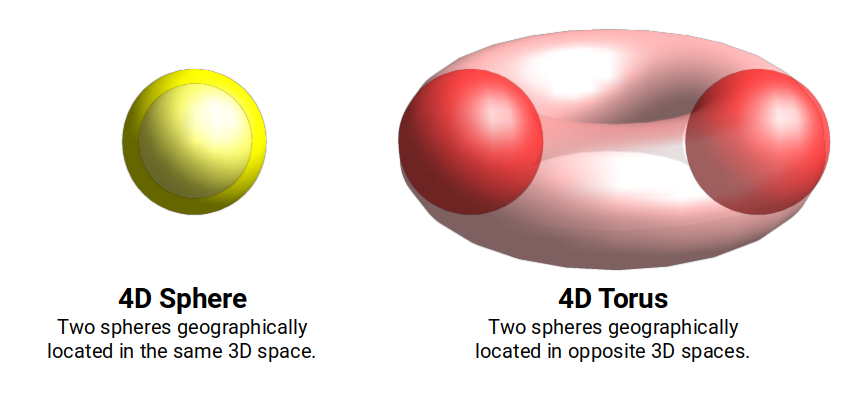
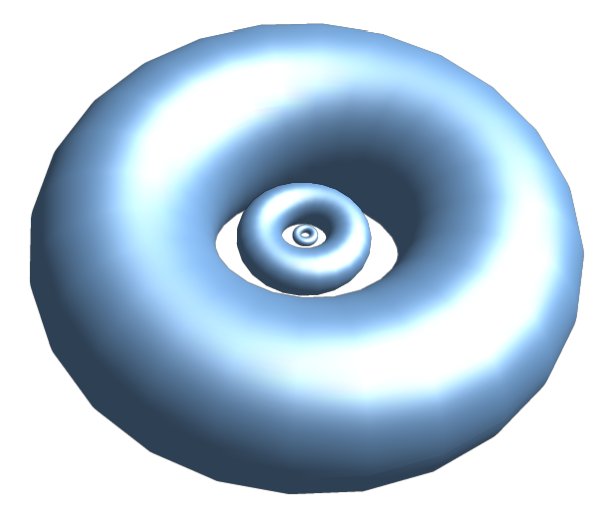
The torus encodes something that purely static 3D shapes do not: the dimension of time, understood as cyclic process. A torus is defined by two independent cycles — the journey around the central hole and the journey around the tube. These two cycles suggest a model of time that is not linear but cyclic: the small circle as local time (the fast cycle of individual moments) and the large circle as cosmic time (the great cycle of ages).
This is the structure of time described in many traditional cosmological systems — from the Hindu system of yugas to the Mayan Long Count calendar. Both encode time as nested cycles within cycles, exactly the geometry of the torus. In our 4D geometry research, we explore how the torus's two-cycle character connects to the nature of four-dimensional spacetime. For the technical mathematics — the Clifford torus, toroidal topology, and cosmological implications — see the 4D Geometry chapter in the Guide to Geometry.
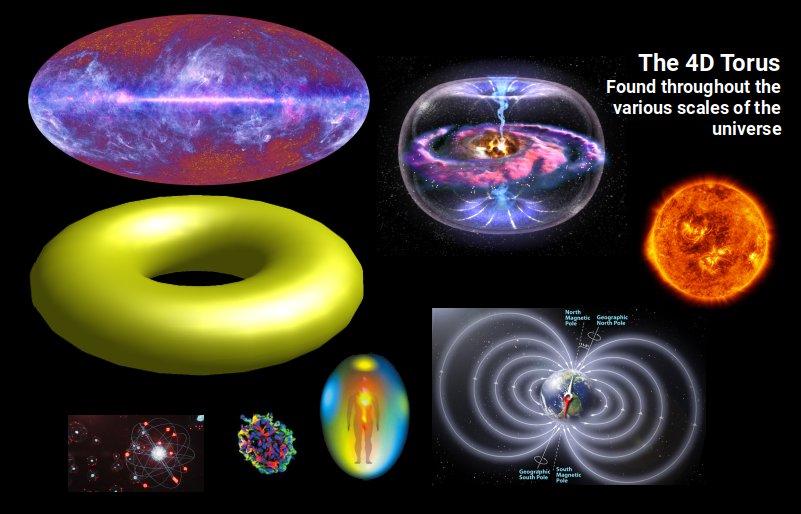 atoms to galaxies">
If the universe itself has toroidal topology — and this remains a genuine scientific possibility — then the cosmos is not a vast emptiness stretching to infinity but a self-contained, self-referential dynamic system. Everything that leaves one side comes back from the other. There is no edge, no boundary at which existence simply stops; there is instead a continuous looping of space and time back into itself — the geometry of the most alive and self-sustaining form in mathematics, applied at the largest possible scale.
Consciousness
The toroidal form appears in spiritual traditions around the world, though rarely identified by that name. Instead, it appears as the mandala — the circular diagram of consciousness used in Hindu, Buddhist, and Christian traditions as a focus for meditation — and as the energy field of the human body described in many healing and contemplative systems.
In Hindu and Buddhist tradition, the chakra system describes the human energy body as a series of spinning vortices aligned along the spine. The word chakra means wheel or spinning disk in Sanskrit, but the full field associated with each chakra is toroidal in structure: spinning outward from the central axis of the spine, arcing out through the body's energetic field, and returning. The combined field of all the chakras is described in some traditions as a single large toroidal field enveloping the entire body, with the crown and root chakras at the poles of the torus. The concept of the kundalini — the serpent power that rises from the root chakra to the crown — describes the movement of energy along the central channel of this toroidal field, from one pole through the interior to the other.
In the Western esoteric tradition, the Hermetic principle "as above, so below" captures the essential quality of the torus: the same form, the same dynamic, repeated at every scale. The Hermetic tradition, drawing on Egyptian, Greek, and later Neoplatonic sources, described the universe as a series of emanations from the One — waves of creative energy flowing outward from the divine source, turning back, and returning. This is precisely the dynamic of the torus: emanation from the centre, expansion through the field, return to the centre. The torus is the shape of the Hermetic cosmos.
The HeartMath Institute's research on the heart's toroidal electromagnetic field has provided one of the most striking modern intersections between ancient intuition and modern measurement. Their work has demonstrated not only that the heart generates a toroidal field extending several feet from the body, but that this field changes in measurable ways according to the emotional state of the person: coherent emotions — genuine care, appreciation, love — produce a smooth, ordered, self-similar toroidal field, while stress and anxiety produce a chaotic, incoherent field. Furthermore, experiments have shown that the electrical activity of one person's heart can influence the brain waves of another person nearby, mediated by the overlap of their toroidal fields. The torus, in this research, is not merely a shape but an information-carrying medium — the physical substrate of the field by which human beings are connected to each other and, by extension, to the electromagnetic environment of the Earth.
Conclusion
The torus is the form that breathes. Where the Platonic Solids hold still and the cuboctahedron balances, the torus moves — it is sacred geometry in motion, the shape of energy that leaves a source and returns to it. From the apple on the branch to the magnetic field of the Earth, from the beating heart to the spiral of the galaxy, the same form repeats at every scale: emanation, expansion, return.
This is the deepest lesson of the torus: there is no true separation between inside and outside, between departure and arrival, between the small cycle and the great one. Everything flows, and everything returns. For the technical mathematics of the torus and its extension into the fourth dimension — the hypercube, the Clifford torus, and higher-dimensional polytopes — see the 4D Geometry chapter in the Guide to Geometry.
In the next chapter, we explore The Hypercube — the four-dimensional extension of the cube, and sacred geometry's gateway into higher-dimensional space.
FAQ
What is the torus and how is it generated?
A torus is the surface swept out when a circle is rotated around an external axis in the same plane. Unlike the sphere (circle rotated around its own diameter), the torus has a hole through its centre, giving it a fundamentally different topology (genus 1 vs genus 0). It is defined by two independent cycles — around the central hole and around the tube — making it mathematically the product of two circles (S¹ × S¹).
Where does the torus appear in nature?
The torus appears at every scale: the Earth's magnetic field is toroidal (emerging from the South Pole, arcing through space, converging at the North Pole), the heart generates a measurable toroidal electromagnetic field, smoke rings and dolphin bubble rings are toroidal vortices, the heliosphere follows toroidal geometry, and the universe itself may have toroidal topology.
What is the difference between a sphere and a torus?
The sphere represents unity, self-containment, and static perfection — it has no preferred direction or through-passage. The torus represents flow, circulation, and dynamic process — it has a hole connecting inside and outside, and implies continuous movement. They are complementary: the sphere is a point expanded equally in all directions; the torus is a circle rotated around an external axis.
What is the 4D torus (Clifford torus)?
The Clifford torus exists in four-dimensional space as a perfectly flat surface — unlike the ordinary 3D torus which curves differently on its inner and outer surfaces. This uniform flatness is impossible in 3D but natural in 4D, suggesting the torus is truly at home in four dimensions. Our research connects the torus's two-cycle character to cyclic time: local time (small circle) and cosmic time (large circle).