Seven Circles
Place a circle. Place a second, so that its circumference passes through the first circle's centre — the Vesica Piscis. Add a third at the upper node — the Trinity. Add a fourth at the lower node — the Trion Re. Now continue the same logic: place a fifth circle of equal radius, its centre at the next intersection point that presents itself as you rotate 60° around the original circle. Then a sixth. Then a seventh.
When the seventh circle is placed, something remarkable happens. You are back where you started. The seventh circle's circumference passes through the centre of the first circle, and its position is exactly 60° from the sixth, exactly as the sixth was from the fifth. The ring has closed. Six circles of equal radius, each centred on the circumference of a seventh central circle, each passing through that central circle's centre, each touching both its neighbours at precisely one point — the Seed of Life is complete.
This is not a pattern you have to force into existence or impose by fiat. It is the pattern that insists on existing once you follow the logic of the circle geometry without deviation. The 60° spacing between successive circles is determined entirely by the radius relationship established in the very first step — by the Vesica Piscis — and once you begin placing circles in that relationship, the pattern closes itself into the Seed of Life with the inevitability of a geometric proof. Six circles fit around one, with perfect mutual tangency and perfect angular spacing, because 6 × 60° = 360° — because six equilateral triangles tessellate to fill a circle exactly. The mathematics permits no other number. You cannot fit five circles of equal radius around a central sixth with this relationship; you cannot fit seven. Six and only six — a fact that the Seed of Life makes visible in one of the most elegant constructions in all of geometry.
The result — seven interlocking circles forming a symmetric rosette — contains within it all the intersection points and proportional relationships needed to construct every subsequent pattern in the sacred geometry tradition. The Seed of Life is not merely a beautiful diagram; it is a generative grammar, a minimum complete set of geometric elements from which enormous complexity can unfold. The Flower of Life, the Fruit of Life, Metatron's Cube, the Platonic solids, the structure of three-dimensional space — all are already encoded in the seven circles of the Seed of Life, waiting to be revealed.
Key takeaways
- Exactly six equal circles fit around a seventh of the same radius — a geometric necessity (6 × 60° = 360°) that produces the Seed of Life, a generative grammar from which the entire vocabulary of sacred geometry unfolds.
- The Seed of Life is the 2D projection of the octahedron, encoding the three perpendicular axes of 3D space.
- The seven circles correspond to the seven days of Genesis, the seven notes of the musical scale, the seven colours of the spectrum, and the seven electron shells of the periodic table — a sevenfold structure that appears across nature, science, and culture.
The Genesis Pattern
The Seed of Life is sometimes called the Genesis Pattern, because the seven circles correspond with remarkable precision to the seven days of creation described in the first chapter of Genesis. The mapping was articulated most fully by the spiritual teacher Drunvalo Melchizedek in the 1990s, in his influential work on the Flower of Life and Merkaba meditation. Whether one accepts the theological framework or not, the geometric correspondence is striking.
On the first day, God creates light and darkness — differentiation, polarity, the Vesica Piscis, the first two circles. On the second day, the firmament is created — the separation of waters above from waters below, suggesting the establishment of the vertical axis, the Trinity node above and the Trion Re node below. On the third day, dry land appears — the first fully material form, the four-circle construction stabilising into the cross and square. On the fourth day, the lights in the firmament — sun, moon, and stars — suggesting the full 60° rotation through five and six circles, each placing a new "light" in the ring. On the fifth day, sea creatures and birds — life, movement, complexity, suggesting the penultimate circle adding richness and variety. On the sixth day, all land creatures including humanity — the sixth circle completing the ring. And on the seventh day, rest — the central circle, the still point around which the six surrounding circles revolve, the point of completion and contemplation.
The geometry of this mapping is satisfying not merely as numerology but because it encodes a real principle about the relationship between process and completion. The six days of creation are the six surrounding circles — the active, outward-moving principle, the six-fold expansion into the plane. The seventh day is the centre — not another outward step but a return to the source, the point from which all six directions radiate and to which all six refer. The Sabbath is not a day of passive inactivity; it is the geometric centre, the place of stillness from which all movement is generated and to which all movement returns. Every rotation passes through the centre; every radius begins there. The seventh circle does not add another element to the periphery; it is the origin of the periphery, the silent ground that makes all the other circles possible.
This understanding of the seventh as the centre resonates with traditions far beyond the Abrahamic. In the Vedic system, the seventh chakra — the crown chakra, Sahasrara — is not another energy centre in sequence with the other six but the transcendent ground in which all six are rooted. In musical theory, the seventh note of the scale (the leading tone, just below the octave) creates the tension that resolves into the first note of the next octave — and the first note of the octave above is, in a sense, the same note as the first note below, elevated. The seventh is the completion that also constitutes a new beginning. The Seed of Life encodes this principle geometrically: the seventh circle is the centre, and from the centre, the pattern begins again, expanding outward into the Flower of Life.
The Number Seven
The association of seven with completion and with the structure of reality runs so deep through human culture that it seems almost impossible to account for it by social convention alone. The number seven appears independently in domains of human experience so different from each other — music, light, time, the cosmos, the body, the atom — that it seems to point toward something structural about the nature of the universe itself.
The seven notes of the musical scale — Do, Re, Mi, Fa, Sol, La, Ti — are the seven distinct pitches within an octave. The eighth note is not a new note but the first note of the next octave, elevated in frequency by the ratio 2:1. Seven notes, then a return at a higher level: the same geometric principle as the Seed of Life. The Pythagoreans, who first systematised the relationships between musical intervals and mathematical ratios, were also the first to formalise the geometry of the circle and the Vesica Piscis. For them, the identity between the sevenfold musical structure and the sevenfold geometric structure of the Seed of Life was not coincidence but confirmation: music and geometry are two expressions of the same underlying mathematical order.
The seven colours of the visible spectrum — red, orange, yellow, green, blue, indigo, violet — are the seven frequency bands that the human eye can distinguish within the narrow slice of electromagnetic radiation to which it is sensitive. Isaac Newton originally distinguished only five colours in the rainbow, but later added orange and indigo to make seven — a decision widely attributed to his desire to match the number of colours to the number of musical notes. Whether or not Newton's classification was artificially imposed, the resonance it points toward is real: the electromagnetic spectrum is continuous, but human perception organises it into discrete bands, and the number seven recurs.
The seven chakras of the Vedic and Tantric tradition are the seven energy centres of the subtle body, arranged along the spinal axis from the base (Muladhara) to the crown (Sahasrara). These seven centres are associated with seven qualities of consciousness, seven developmental stages, seven musical tones, seven colours, and seven planetary energies. The Vedic seven-chakra system is not an arbitrary scheme; it reflects a deep understanding of the way conscious experience organises itself in the human body, and its correspondence with the Seed of Life is part of a broader pattern of sevenfold organisation in both the cosmos and the human being.
The seven days of the week are named after the seven classical celestial bodies visible to the naked eye: Sun (Sunday), Moon (Monday), Mars (Tuesday — Mardi in French), Mercury (Wednesday — Mercredi), Jupiter (Thursday — Jeudi), Venus (Friday — Vendredi), Saturn (Saturday). This naming convention, which runs across European, Indian, and East Asian calendar traditions with remarkable consistency, reflects the ancient conviction that the seven visible wanderers of the sky were the primary organising forces of earthly time. Seven celestial bodies, seven days, seven circles — the same number organising cosmic space, earthly time, and the body of sacred geometry.
In the structure of the atom, the periodic table has seven electron shells (periods), corresponding to the seven principal quantum numbers n = 1 through n = 7. The seventh period includes the actinides and the heaviest synthesised elements. Seven shells, seven days, seven notes, seven colours, seven chakras — the number recurs not as a result of cultural tradition but as a structural feature of the domains being described.
The Rosette
The visual form of the Seed of Life — six circles arranged as a rosette around a central seventh, with their overlapping arcs creating a flower-like pattern — is one of the most widely distributed decorative motifs in human history. It has been found in archaeological contexts from ancient Greece (around 400 BC) and ancient Rome through Byzantium, Islamic geometric art, medieval European cathedral ornament, Renaissance marquetry, and beyond, usually without any specific sacred name attached to it. It is simply the pattern that emerges when a craftsman with a compass draws a circle and then, using the same setting, steps the compass around the circumference of the first circle — an entirely natural and simple process that any skilled craftsperson would discover independently.
The Temple of Osiris at Abydos in Egypt contains what may be the oldest known example of the Flower of Life pattern (of which the Seed of Life is the central module), painted or etched into the granite of the temple structure. Depending on dating, these marks may be over three thousand years old, though the dating is disputed. What is not disputed is that the pattern appears in ancient Egyptian sacred architecture, which suggests that the geometric relationship between seven circles was understood and valued in that tradition.
In ancient Greek temples and sarcophagi, the rosette appears as both a decorative and a symbolic motif — associated with the sun, with Venus, with eternity, and with the cycle of life and death. The rosette on a Greek sarcophagus was not merely decoration; it was a symbol of the ongoing cycle of existence, the flower of life that blooms, seeds, dies, and is reborn. In Roman mosaics and architectural ornament, the six-petalled rosette appears with extraordinary frequency in both civic and sacred contexts, suggesting that it was understood as a universally positive and harmonious form.
Islamic geometric art — one of the greatest traditions of geometric ornament in human history — uses the six-fold rosette as a basic generating module for its complex tilings and star patterns. The great mosques of Persia, Turkey, North Africa, and the Indian subcontinent are covered with geometric patterns that are in many cases elaborations of the Seed of Life geometry, though the specific symbolic interpretation differs from the sacred geometry tradition. Islamic geometric art was a form of worship — by contemplating perfect geometric order, the craftsman and the worshipper were approaching the order of divine creation — and the six-fold rosette was one of the primary instruments of that approach.
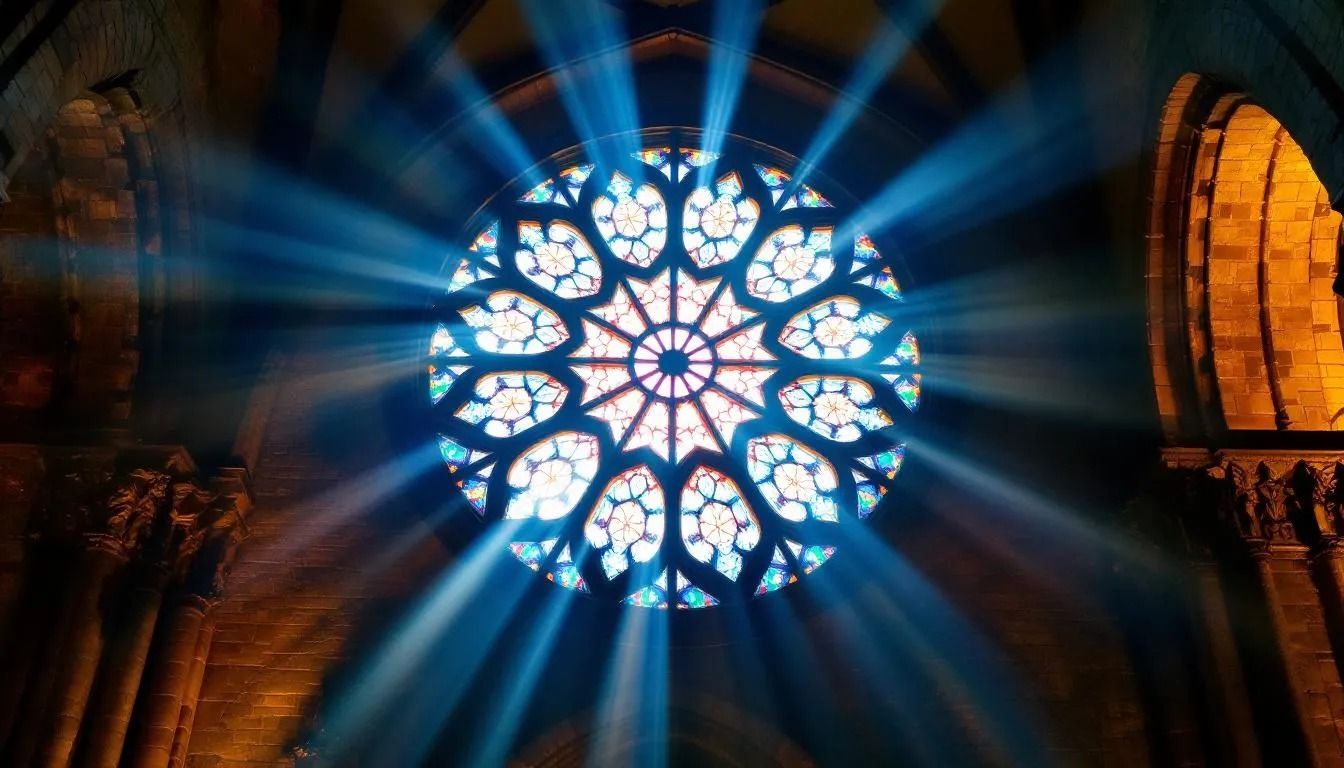
In medieval European cathedral architecture, the rose window — the great circular stained-glass window that appears above the portals of Gothic cathedrals — is in most cases organised on a six-fold or twelve-fold geometry derived from the Seed of Life. The rose window at Notre-Dame de Paris, the north and south transept windows at Chartres, the west rose at Reims — these are among the most celebrated works of art in the Western tradition, and their geometric basis is the same pattern of circles stepping around circles that generates the Seed of Life. The cathedral builders were not working with an esoteric tradition separate from their Christian faith; they were expressing their theology through geometry, and the geometry they used was the geometry of the Seed of Life.
Geometry of the Seed
The Seed of Life is a two-dimensional construction, but it encodes three-dimensional space. This is one of its most profound geometric properties, and it is worth examining in detail.
The seven circles of the Seed of Life have three pairs of opposite circle centres — the centre of the top circle and the centre of the bottom circle, the centre of the upper-right circle and the centre of the lower-left, the centre of the upper-left circle and the centre of the lower-right. These three pairs define three axes that pass through the central circle's centre, each at 60° to the other two in the plane of the construction. But if you take these three axes and interpret them as three-dimensional directions — rotating the plane of each axis out of the flat surface — they define the three axes of three-dimensional Cartesian space: the x-axis, the y-axis, and the z-axis.
In other words, the Seed of Life is the two-dimensional projection of the octahedron — the Platonic solid with six vertices, twelve edges, and eight faces. The six outer circle centres of the Seed of Life correspond to the six vertices of the octahedron: two along each of the three axes of three-dimensional space. The Seed of Life is what the octahedron looks like when flattened into two dimensions along one of its symmetry axes.
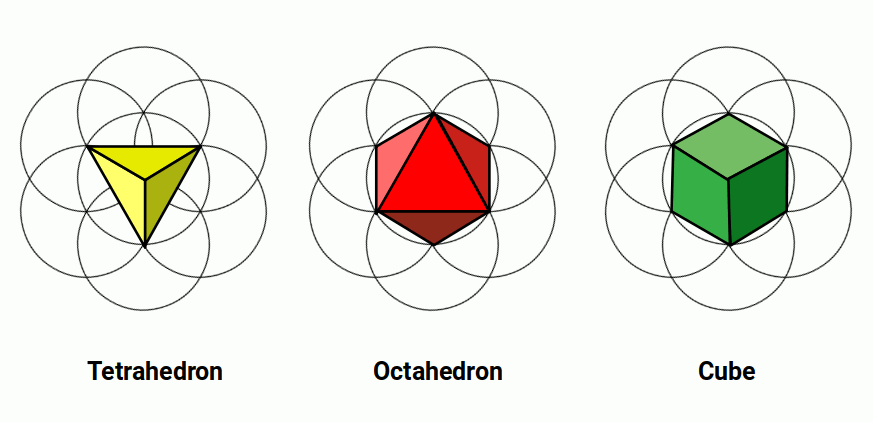
The octahedron is the Platonic solid that most directly encodes the three perpendicular axes of space. It has one vertex above, one below, one to the left, one to the right, one forward, and one backward — a perfect six-directional structure. In Plato's Timaeus the octahedron is assigned to the element of air — the most mobile and interpenetrating of the elements, the one that fills three-dimensional space most freely. If the tetrahedron is fire (the sharpest, most energetic form) and the cube is earth (the most stable and space-filling), then the octahedron is air — the form that expresses the three-dimensional structure of space itself.
The Seed of Life thus encodes in its flat plane the full three-dimensional structure of Euclidean space. Every time you draw the Seed of Life, you are inscribing in two dimensions the three-dimensional world in which you draw it. This is why the construction feels like more than decoration — it is, in the most literal geometric sense, a map of the space in which it exists.
The Still Point
There is one more dimension of the Seed of Life that deserves careful attention: the relationship between the six outer circles and the central seventh. The six surrounding circles are active, outward-moving, peripheral — they are the six directions of extension, the six days of creative work. The central circle is their still point, their origin, their reference.
Every outer circle passes through the centre of the central circle — which means the central circle is not simply surrounded by the outer six but is inhabited by them. Each outer circle's centre lies on the circumference of the central circle, and each outer circle's circumference passes through the central circle's centre. The relationship between centre and periphery is one of complete mutual interpenetration: the centre is present in every outer circle, and every outer circle is present in the centre.
This is a geometric statement of a profound principle: the source is present in every expression, and every expression refers back to its source. The central circle is not separate from the six surrounding circles; it is their common ground, the single point that all of them share. The seventh day of rest is not a withdrawal from creation; it is the presence of the uncreated ground within the created world. In the language of the Hindu tradition: the Atman (the individual soul) is identical to the Brahman (the universal ground) — and this identity is encoded geometrically in the relationship between the central circle and the six circles that surround and penetrate it.
In the meditative tradition that has grown up around the Seed of Life — most fully articulated by Drunvalo Melchizedek but drawing on much older contemplative practices — the practitioner is invited to identify with the central circle, to experience themselves as the still point around which the six directions of space revolve. This is not a passive exercise; the central point is the most energetically active of all, because it is the point from which all radii are drawn, the origin of all the distances and angles in the construction. To be the centre is not to be peripheral to the action; it is to be its source.
The Seventh Step
The Seed of Life is the seventh step in the unfolding of sacred geometry from the first circle — and the seventh step is the one that closes the first ring, that completes the first full rotation, that brings the pattern back to the point from which it began. It is, in the language of music, the resolution of the scale: the pattern started with the tonic, journeyed through the six other notes, and has returned — not to the same note but to the same note an octave higher, the same form at a higher level of complexity.
Everything that follows in the tradition of sacred geometry — the Flower of Life, the Fruit of Life, Metatron's Cube, the Platonic solids, the structure of three-dimensional space, the organisation of the periodic table — is already latent in the seven circles of the Seed of Life, as an oak is latent in the acorn. The seven circles are not a beginning in the sense of a preliminary stage to be passed through and left behind; they are the seed in the most literal sense — the form that contains the complete genetic information of the whole, that will unfold into every subsequent complexity while remaining itself, unchanged, at the heart of every larger pattern.
The Seed of Life is the geometry of genesis — of the moment when just enough structure has come into being for the whole of creation to be possible.
The Star of David
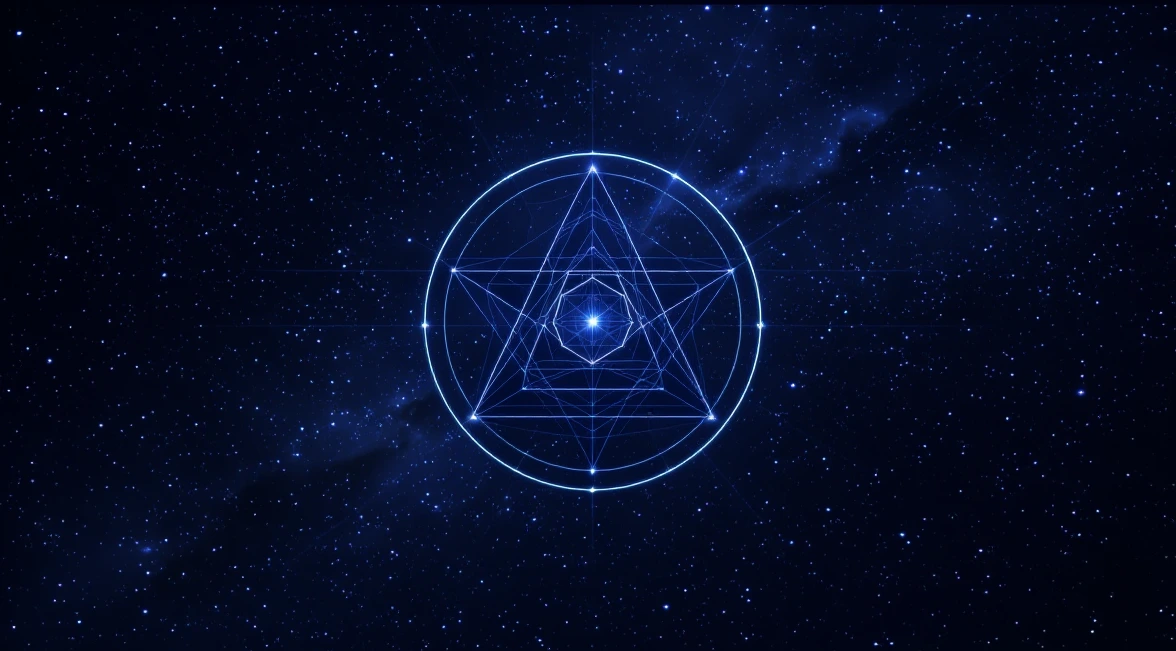
The hexagram — the six-pointed star formed by two interlocking equilateral triangles — is not an independent symbol that happens to resemble the Seed of Life. It is directly inscribed within it, already there, waiting to be seen. Take the six outer circles of the Seed of Life and number their centres 1 through 6 around the ring. Connect centres 1, 3, and 5 — alternate nodes, forming an equilateral triangle pointing upward. Connect centres 2, 4, and 6 — the remaining alternate nodes, forming an equilateral triangle pointing downward. The result is a perfect regular hexagram, its six points coinciding precisely with the six outer circle centres of the Seed of Life, its two interlocking triangles inscribed exactly within the pattern. The hexagram is not constructed from the Seed of Life; it is revealed by it — a form already latent in the geometry, exposed by the simple act of connecting alternate nodes. The Seed of Life contains the hexagram as the acorn contains the oak, as the circle contains all its inscribed polygons: in potential, in the mathematical necessity of the construction, waiting for the connecting lines to make it visible.
The symbol known today primarily as the Star of David or Magen David (Shield of David) has a history considerably more complex and more universal than its current association with Judaism alone might suggest. The hexagram was not adopted as the primary symbol of Judaism until the seventeenth and eighteenth centuries in Central Europe, when it began to appear on synagogues and Jewish communal objects as a distinctive identifier. Prior to this, the hexagram had been used as a general protective symbol across Jewish, Muslim, and Christian communities, appearing on amulets, coins, and architectural decorations without particular denominational specificity. The hexagram had also been known for millennia in the Levantine and Mediterranean worlds as the Seal of Solomon — the magical seal attributed to King Solomon in Arabic, Jewish, and later European occult tradition — which was used to command spirits and protect against evil, and which appears extensively in Islamic magical texts, where it is sometimes called Khatim Sulayman. The symbol's universal protective resonance across traditions reflects something deeper than denominational meaning: the hexagram, as the geometric revelation hidden within the Seed of Life, carries the authority of mathematical necessity.
In the Hindu Tantric tradition, the hexagram is known as the Shatkona and holds an importance fully equivalent to its role in the Abrahamic traditions. The Shatkona is the union of the Shiva yantra (the upward-pointing triangle, representing the masculine principle, consciousness, the ascending fire of the spirit) and the Shakti yantra (the downward-pointing triangle, representing the feminine principle, energy, the descending grace of matter). When these two triangles interpenetrate to form the hexagram, the result is the Sri Yantra in miniature — the union of consciousness and energy, spirit and matter, the transcendent and the immanent, without which neither can exist. The Shatkona appears as a central element in the Sri Yantra, one of the most important ritual diagrams in the Hindu tradition, and its meaning in that context — the creative union of complementary principles — is identical to its meaning in the Kabbalistic tradition and resonant with its meaning in the alchemical tradition of the coniunctio. The hexagram as the union of two triangles, one ascending and one descending, expresses the same philosophical insight across cultures that never made direct contact: opposites do not merely coexist; they interpenetrate, and their interpenetration is the source of all creation.
The geometric meaning of the hexagram resonates with one of the oldest and most widely distributed formulations in the esoteric tradition: as above, so below. The upward triangle points toward the heavens, toward the spiritual, toward the macrocosm; the downward triangle points toward the earth, toward the material, toward the microcosm. Their interlocking says: these two orders are not separate but mirror each other, each containing the other, neither complete without the other. The universe is structured by the same principles at every scale — the cosmic and the atomic, the divine and the human, the eternal and the temporal are reflections of each other in the mirror of geometry. This is why the hexagram appears at the centre of traditions that seek to understand the relationship between heaven and earth, spirit and matter, the sacred and the mundane: it is the geometric statement of their identity, the form that makes the principle visible.
The connection between the hexagram and the material world goes all the way down to the atomic level. Carbon — the element that is the chemical basis of all life on Earth — has six protons, six neutrons, and six electrons in its most common isotope (carbon-12), a coincidence so striking that it drew attention long before its chemical significance was understood. More than its atomic numbers, carbon forms the hexagonal ring structures that are the backbone of organic chemistry. Benzene (C₆H₆) is a hexagonal ring of six carbon atoms — the molecular hexagram. Graphite, the form of carbon used in pencil lead, is composed of flat sheets of carbon atoms arranged in a hexagonal lattice — the Flower of Life pattern, one atom at each circle centre, the bonds between them tracing the hexagram at every node. Graphene — a single layer of that graphite lattice — is among the strongest, most electrically conductive materials ever measured, its extraordinary properties arising directly from the hexagonal geometry. The hexagram, as revealed by the Seed of Life, is not merely the signature of divinity in the philosophical traditions of humanity; it is the structural geometry of the molecule that makes all biological life possible. The Star of David is, in the deepest geometric sense, the star of life.

Conclusion
The Seed of Life is the moment when sacred geometry first becomes a vocabulary. Up to this point we have been making single moves — one circle, two, three, four. With the seventh circle the moves close into a pattern that needs nothing added to it to be complete. Six circles around a centre, each touching its neighbours at a single point, each passing through the heart of the seventh — the form is finished, and yet everything that follows in the tradition is already implicit in it: the hexagram, the Flower of Life, the cell that divides into the body, the carbon atom that links into life, the three perpendicular axes of the space we live in. The geometry has gone from a sequence of constructions to a generative grammar, and from here on the work is no longer to invent but to listen — to follow what the Seed has already begun saying.
In the next chapter, we explore The Egg of Life — the thirteen-circle form that encodes the cube, maps embryonic cell division, and bridges two and three dimensions.
FAQ
Why do exactly six circles fit around one in the Seed of Life?
Because 6 × 60° = 360°. When equal circles are arranged around a central circle of the same radius, each subtends exactly 60° at the centre (forming equilateral triangles). This means exactly six circles fit — no more, no less — a fact of geometric necessity, not design choice.
How does the Seed of Life encode three-dimensional space?
The six outer circle centres form three pairs of opposite points, defining three axes that pass through the central circle's centre at 60° to each other. Interpreted as 3D directions, these define the x, y, and z axes — making the Seed of Life the 2D projection of the octahedron, the Platonic solid that most directly encodes three-dimensional spatial structure.
Why is the Seed of Life called the Genesis Pattern?
Its seven circles correspond to the seven days of creation in Genesis: six days of creative work (six surrounding circles expanding outward) and the seventh day of rest (the central circle — the still point and origin from which all six directions radiate). The same sevenfold structure appears in music (seven notes), light (seven colours), chakras, and electron shells.