Beyond the Seed
The Seed of Life — seven circles, the central circle surrounded by six — is complete in itself. It encodes the structure of three-dimensional space, maps the seven days of genesis, and contains within it all the angular and proportional relationships from which further sacred geometry unfolds. But the pattern does not stop there. The same logic that placed the first six circles around the central seventh — always maintaining the relationship where each new circle's centre lies on an existing circle's circumference — continues outward, adding a second ring of circles beyond the first.
This second ring adds twelve more circles to the Seed of Life's seven, bringing the total to nineteen in the full extension called the Flower of Life. But within those nineteen circles there is a crucial intermediate construction — a selection of thirteen circles that forms the Egg of Life.
In simple terms, the Egg of Life is the Seed of Life plus six new circles, each of them growing outward from one of the outer Seed of Life nodes. Seven circles become thirteen — the Seed completed by the next natural step of the same construction.
The thirteen circles of the Egg of Life map a plane in two dimensions — and within that plane two distinct three-dimensional forms can be read, depending on which circles you highlight. Highlight the central circle together with the six outer ones and the pattern reveals a cube, viewed along its body diagonal. Highlight the twelve circles of the inner and outer rings around the centre and the same pattern reveals a cuboctahedron. The Egg of Life is not itself three-dimensional, but it is the 2D plane in which the projection of these two key 3D forms first becomes visible.
Key takeaways
- The Egg of Life (13 circles) encodes cubic geometry — the 2D projection of the cube/cuboctahedron — representing the transition from the Seed of Life's octahedral axes to the full cubic structure of 3D space.
- It maps the eight-cell stage of embryonic development — the last moment of totipotency before cellular differentiation begins — and corresponds to the d-orbital electron shapes of transition metals.
- The same thirteen-sphere arrangement appears in the face-centred cubic crystal lattice (aluminium, copper, gold), demonstrating that sacred geometry and materials science describe the same optimal packing geometry.
The Eight-Cell Stage
If the Seed of Life encodes the earliest stages of cell division — the single cell, the two, the four — the Egg of Life encodes a specific, identifiable stage of embryonic development with remarkable precision. The eight-cell embryo — at approximately three days after fertilisation — is, in its three-dimensional arrangement, a cube of eight cells.
A fertilised human egg — the zygote — divides by a process called cleavage, in which each cell (called a blastomere) divides into two without growing, so that the total volume remains approximately constant but the number of cells doubles. The first cleavage divides the zygote into two blastomeres arranged in the Vesica Piscis configuration. The second cleavage produces four blastomeres arranged in a roughly tetrahedral or planar configuration. The third cleavage — the one that produces eight blastomeres — is decisive. This cleavage is meridional for the first two divisions but equatorial for the third, which means the third division cuts each of the four existing cells horizontally, producing an upper tier of four cells and a lower tier of four cells.
The result is eight cells arranged at the corners of a cube. This is not an approximation or a poetic comparison; the eight-cell embryo is geometrically a cube of cells, and this cubic arrangement corresponds exactly to the eight vertices of the cube encoded in the Egg of Life's thirteen-circle pattern. The Egg of Life's central circle corresponds to the centre of the cube; its six inner-ring circles correspond to the six face-centres of the cube; its six outer alternating circles correspond to six of the cube's eight vertices. (The remaining two vertices are implicit in the three-dimensional projection.)
This cubic stage of the embryo — three days old, eight cells — is the last moment of perfect geometric order before the biological complexity of differentiation begins. From the eight-cell stage onward, the cells of the embryo begin to specialise: some become the inner cell mass (which will form the embryo proper), some become the trophoblast (which will form the placenta and other extra-embryonic structures). The symmetry breaks, the specialisation begins, the organism starts on the long journey toward the specific complexity of a human being. But for three days, in its most fundamental state, the embryo is a cube — the Egg of Life made flesh.
The eight-cell embryo is also the last moment of totipotency in embryonic development. Each of the eight cells at this stage is still capable of developing into a complete organism on its own — if the cells separate (as happens naturally in the formation of identical twins, or as can be done in the lab), each one can still grow into a whole human being. After this stage, as the cells begin to differentiate, this totipotency is lost: cells commit to specific roles and can no longer generate the whole.
What makes this stage so robust is the cubic geometry itself. Recent embryology research has shown that the precise eight-cell cubic arrangement is not incidental — it is what allows the embryo to hold its configuration during the most fragile moments of early life. The cube is the most stable possible packing of eight equal spheres around a centre: every cell touches the same number of neighbours, every contact angle is equal, and the whole cluster shares its load symmetrically. The geometry is the structural support that lets the embryo survive long enough to reach the next stage.
The Egg of Life is, in this sense, the geometric Eden of biological development — the moment of maximum order, maximum symmetry, and maximum potential, before differentiation breaks the symmetry and the cells begin their long journey toward the specific complexity of a body. In the language of thermodynamics, it is the minimum-entropy state of the developing organism: a perfect crystalline order that contains everything that follows in the form of pure potential, before the geometry has to commit to becoming something specific.
The Cosmic Egg
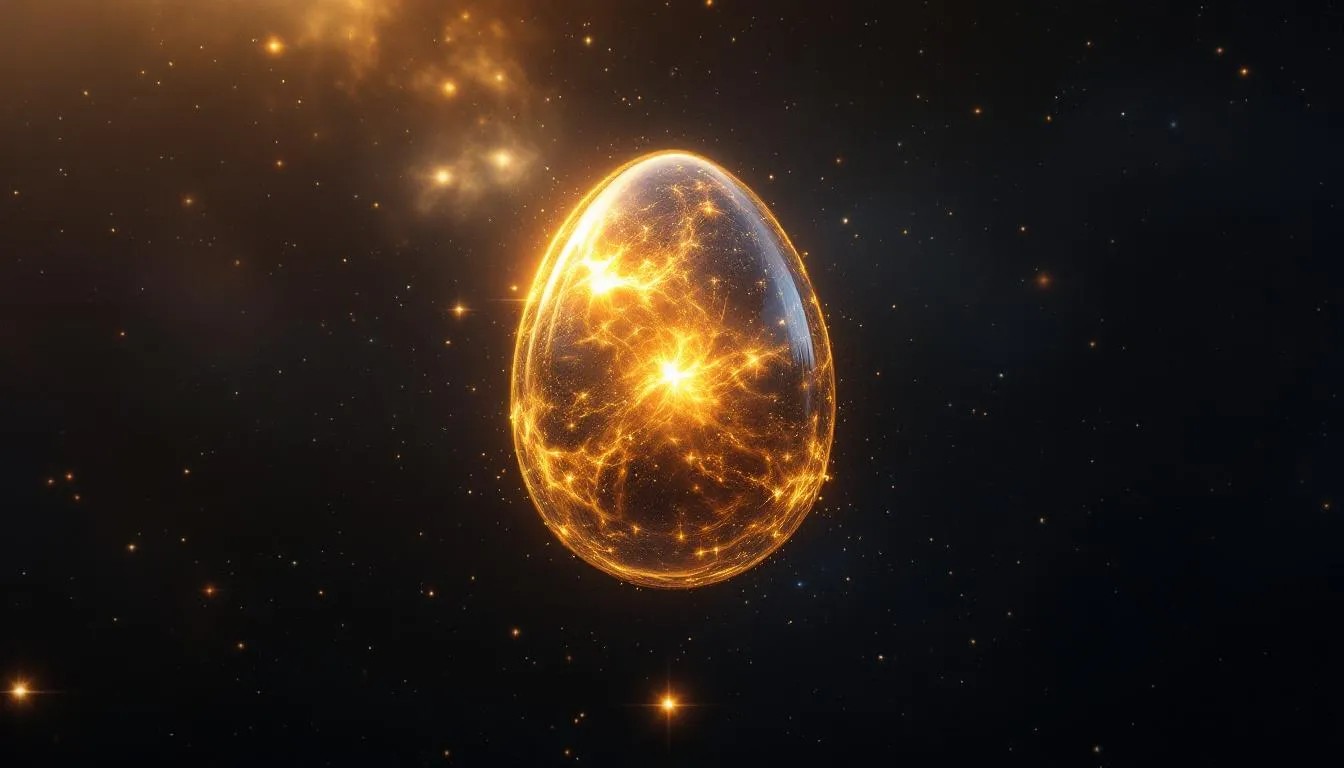
The egg is one of the oldest and most universal symbols in human mythology — the form of contained perfection, the bounded wholeness that holds within itself the entirety of what will unfold from it. In Hindu cosmology the universe begins with the Brahmanda — literally "Brahma's egg" — floating in the primal waters, containing all the worlds that will be created when it hatches. In the Orphic tradition of ancient Greece the world began with a silvery egg wound about with a serpent, from which hatched Phanes, the first principle of light and generation. From Finnish Ilmatar to Egyptian Thoth to the Vedic Hiranyagarbha, the same image recurs across cultures separated by oceans and millennia: the sealed, geometrically perfect container holding all of creation in potential.
The Egg of Life is the mathematical version of this image — and the eight-cell embryo is its biological one. The same form that the world's mythologies named the cosmic egg is the form a human embryo passes through on its third day, in its last moment of perfect symmetry before differentiation begins. The myth and the biology meet in the geometry: thirteen circles, eight cells, one egg — the still moment before creation unfolds.
The Cube and the Cuboctahedron
To understand the Egg of Life, it is necessary to understand what the cube represents geometrically and why it appears here. The cube is the Platonic solid most directly associated with three-dimensional physical space, and its appearance encoded in the Egg of Life is not incidental. It reflects something deep about the relationship between the circle geometry of sacred geometry and the cubic geometry of matter.
The cube has six square faces, twelve edges, and eight vertices. It is the only regular solid that tessellates — that tiles — three-dimensional space perfectly without gaps or overlaps. If you fill a box with cubes, no space is wasted and no gaps appear; every cube fits perfectly against its neighbours. This tiling property makes the cube the fundamental unit of three-dimensional spatial organisation, the form that most directly encodes the idea of filling space. The cube is matter as space-filler, matter as the complete occupation of volume.
This is why Plato, in the Timaeus, assigned the cube to the element of Earth — the most stable, the most resistant to penetration, the most solidly occupying of the elements. Earth does not flow like water, does not dissipate like air, does not combust like fire; it stays, occupies space, resists displacement. The cube shares these properties: it tessellates without gap, its flat faces allow maximum contact with neighbouring cubes, and its right angles give it the maximum possible stability against shear forces. The cube is matter in its most elemental sense — the geometric form of physical occupation.
In crystallography, the cubic crystal system is the highest-symmetry crystal system, containing the simple cubic (SC), body-centred cubic (BCC), and face-centred cubic (FCC) lattice types. Metals such as iron (BCC and FCC), aluminium (FCC), copper (FCC), gold (FCC), and silver (FCC) crystallise in cubic arrangements. Table salt (sodium chloride) forms simple cubic crystals. Diamond forms a cubic lattice (the diamond cubic, a variation of FCC). The cubic crystal system accounts for some of the most important and abundant materials in the world, from the metals of technology to the salts of the ocean to the diamonds of the earth's mantle.
The Egg of Life, by encoding the cubic arrangement of thirteen spheres, is encoding the geometry of some of the most stable and abundant material structures in existence. The thirteen circles of the Egg of Life are the circles of the closest-packed layer in a face-centred cubic or hexagonal close-packed lattice — the arrangement that maximises the density of sphere packing in three dimensions.
Two Ways to Stack: Cubic and Hexagonal
The same thirteen circles of the Egg of Life can be read as two different sphere-stackings, depending on which set of circles you treat as spheres. Highlight the seven of the Seed and you get the cube — eight spheres at the corners with one central, the geometry of face-centred cubic packing. Highlight the twelve outer circles and you get the cuboctahedron — twelve spheres around one central, the geometry of hexagonal close packing. These are the two arrangements nature uses to pack spheres as densely as possible: the same Egg, the same thirteen circles, two complementary ways of seeing them.
Vector Equilibrium and the Jitterbug
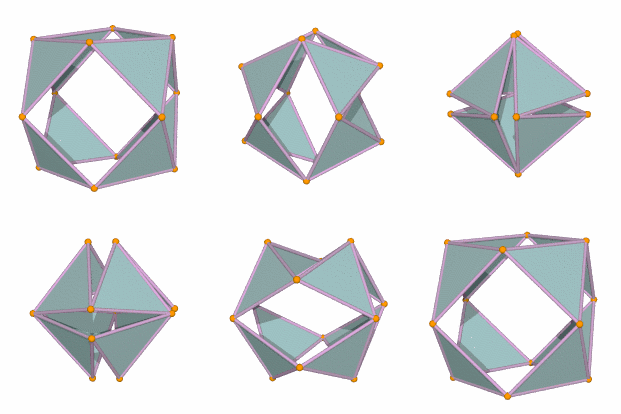
The cuboctahedron is also one of the thirteen Archimedean solids, and it has a special property that sets it apart from every other polyhedron: the distance from its centre to each of its twelve vertices is exactly equal to the length of each of its edges. Buckminster Fuller recognised this and renamed it the Vector Equilibrium — the only form in which all outward-pushing and inward-pulling vectors are perfectly balanced. It is geometry's still point.
Fuller also discovered that the Vector Equilibrium can collapse through a continuous transformation he called the Jitterbug: the cuboctahedron contracts in a smooth dance through the icosahedron down to the octahedron, and back again. The Jitterbug shows that the Egg of Life's hidden cuboctahedron is not a static form but the resting state of a whole family of polyhedra in motion.
An Atomic Echo
One last correspondence is worth flagging before we close. Element 13 in the periodic table is aluminium — and aluminium crystallises in the face-centred cubic lattice, in which each atom has exactly twelve nearest neighbours arranged at the vertices of a cuboctahedron. Thirteen circles, twelve-around-one, cubic close packing: the Egg of Life is the geometry of an aluminium crystal at the scale of a single atom and its neighbours. The same correspondence extends to the d-orbital shapes of the transition metals (iron, copper, gold) and to the broader mapping between sacred geometry and atomic structure — but that is a story for its own page. We unpack it in detail in our research on atomic geometry.
Conclusion
The Egg of Life is the geometry of potential — of the perfect, sealed container in which all subsequent complexity is held before it unfolds. It encodes the cube, the most fundamental structure of three-dimensional physical space, and the cuboctahedron — Buckminster Fuller's Vector Equilibrium, the still point at which all forces balance. It maps the eight-cell stage, the most geometrically perfect stage of embryonic development. It resonates with the cosmic egg myths of traditions from Greece to India to Finland. And in the sequence of sacred geometry, it is the necessary step between the Seed and the Flower — between the first closed ring and the full pattern of creation.
What unites these correspondences is not mystical speculation but geometric fact. The same form that appears in the Egg of Life appears in embryonic development, in crystal structure, in close-packed sphere stackings, and in cosmic mythology because all of these domains are governed by the same underlying geometric principles of optimal packing, maximum symmetry, and minimum energy. The Egg of Life is the name sacred geometry gives to those principles at the scale of thirteen circles. Nature gives the same name, in different languages, at every other scale.
From the Egg of Life, the next step is the full Flower of Life — nineteen circles, the complete first ring plus the second ring, the pattern from which the Platonic solids can be derived and from which Metatron's Cube unfolds. The Egg has hatched. The flower is about to bloom.
FAQ
What is the Egg of Life and how does it differ from the Seed of Life?
The Egg of Life is a selection of thirteen circles — the seven of the Seed of Life plus six alternating circles from the next ring. Where the Seed encodes octahedral (axial) geometry, the Egg encodes cubic geometry — the 2D projection of a cube/cuboctahedron, representing the transition from understanding space as three axes to understanding it as eight corners, six faces, and twelve edges.
How does the Egg of Life relate to embryonic development?
The eight-cell embryo — at approximately three days after fertilisation — arranges its cells at the eight corners of a cube, matching the cubic geometry encoded in the Egg of Life. This is the last moment of totipotency (each cell can still become a complete organism) before differentiation begins — the geometric Eden of embryonic life.
Why is the cube so important in sacred geometry and nature?
The cube is the only regular solid that tessellates 3D space without gaps. Plato assigned it to Earth because it is the most stable and space-filling form. Many of the most important materials — iron, aluminium, copper, gold, silver, diamond, table salt — crystallise in cubic lattice arrangements, making the cube the fundamental geometric unit of physical matter.
How does the Egg of Life relate to the cuboctahedron and Vector Equilibrium?
The twelve outer circles of the Egg of Life are the projection of a cuboctahedron viewed along its three-fold axis — the same form Buckminster Fuller called the Vector Equilibrium, the only polyhedron whose centre-to-vertex distance equals its edge length. It is the resting state of his Jitterbug transformation, in which the cuboctahedron contracts smoothly through the icosahedron down to the octahedron and back. The Egg of Life is the still point from which that whole dance unfolds.
What is the connection between the Egg of Life and the structure of matter?
Element 13 in the periodic table is aluminium, which crystallises in a face-centred cubic lattice where each atom has exactly twelve nearest neighbours arranged at the vertices of a cuboctahedron — the same twelve-around-one geometry the Egg of Life encodes. We explore the broader sacred-geometry-meets-atomic-structure mapping in our research on atomic geometry.