The Second Circle
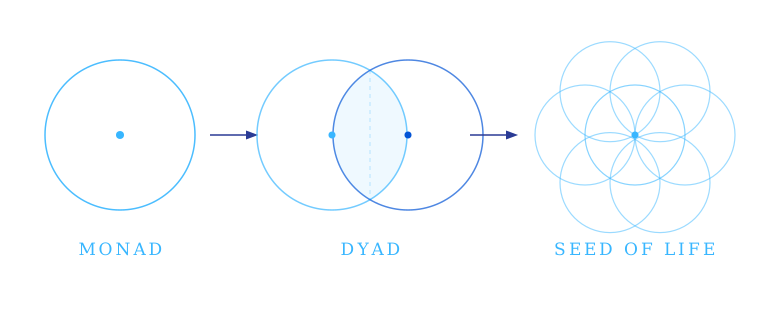
Before the Vesica Piscis, there is only the circle — that primordial symbol of wholeness, of the infinite, of the self-contained. A single circle drawn in space is a statement of unity, of being. It has no beginning and no end. It references nothing outside itself. In many traditions, the first circle represents the Absolute, the Monad, the undivided source from which all things proceed. It is the fundamental gesture of consciousness recognising itself.
But a single circle, however profound, is alone. It cannot produce relationship. It cannot generate difference. And without difference there is no creation, no diversity, no world. The Vesica Piscis is what happens the moment that primordial unity takes its first step toward multiplicity: when a second circle, identical in radius to the first, is drawn so that its circumference passes through the centre of the first — giving two circles, each containing the centre of the other, each acknowledging the other's heart. For the purely mathematical properties of circles and their intersections, see the Guide to Geometry: The Circle.
The lens-shaped region created by their overlap is called the mandorla — Italian for "almond" — and it is this form that has carried such extraordinary symbolic and mathematical weight across civilisations and millennia. In Latin the full construction was named the Vesica Piscis, meaning "fish bladder," a reference to the elongated oval shape of a fish's swim bladder. The name may seem prosaic, but the geometry it names is anything but.
What makes this construction philosophically remarkable is its symmetry: neither circle is primary. Neither is the "original" and neither the "copy." Each circle passes through the other's centre with perfect reciprocity. The relationship between them is one of complete mutual dependence and mutual acknowledgement. This is why the Vesica Piscis became, in so many traditions, a symbol not merely of duality but of the sacred marriage — the union of two equal and complementary principles that together produce something neither could generate alone.
The mandorla itself is the visible offspring of that union. It belongs to both circles and to neither. It is the child of the relationship, the third thing that emerges from the meeting of two. In this sense the Vesica Piscis encodes a profound truth about the nature of emergence: that when two distinct beings truly meet — when they overlap at the level of their centres — a new reality comes into being that was not present in either alone. This principle runs through chemistry, biology, music, and every creative act in human culture.
Key takeaways
- The Vesica Piscis — formed when two equal circles each pass through the other's centre — is the foundational construction of sacred geometry, encoding √3, √2, √5, and the golden ratio φ within a single form.
- It appears across nature at every scale: in cell division, the shape of eyes and leaves, water ripple interference, quantum electron interactions, and bipolar nebulae — always as the geometric signature of two equal things meeting.
- The mandorla fits within a 2 × 3 Fibonacci rectangle, making it the geometric seed of the logarithmic spiral found in shells, galaxies, and plant growth.
A Symbol Across Civilisations
The Vesica Piscis appears with remarkable consistency across cultures and historical periods, so consistently that it would be difficult to explain by diffusion alone. The shape seems to arise wherever human beings observe the natural world carefully — in the overlapping rings of water ripples, in the patterns of cell division, in the shape of eyes and leaves and seeds — and then carry it into their sacred art and architecture.
In ancient Greece the form was associated with the Pythagorean brotherhood, for whom it was known as the vesica or sometimes the ichthys (fish), and was considered a symbol of divine proportion. The Pythagoreans understood that the Vesica Piscis encodes √3, the irrational number that cannot be expressed as a simple fraction, and they regarded irrational numbers with a mixture of reverence and unease — they were numbers that escaped the neat rational order, that pointed toward an infinite and inexpressible depth beneath the surface of mathematics. The √3 was sacred precisely because it could not be captured, only approached.
In ancient Egypt the Vesica Piscis appears as a hieroglyphic element and is woven into the proportions of sacred architecture. The Eye of Horus — one of the most powerful Egyptian symbols — is drawn using the geometry of the Vesica Piscis, and the proportions of many temple entrances encode the 1:√3 ratio. In Mesopotamia the related fish symbol was associated with the goddess Atargatis, later inherited by the Syrian and Phoenician religious traditions. In India the yoni symbol — representing the creative feminine principle — takes the form of the mandorla, and in Buddhist art the mandorla or prabhamandala appears as the almond-shaped halo of flame surrounding enlightened figures.
Across Celtic and Norse traditions the shape was associated with the divine feminine, with the womb, and with the threshold between worlds. Sacred wells and springs — places where the boundary between the earthly and the otherworldly was thin — were often marked with Vesica-shaped enclosures. The interlaced knotwork of Celtic art frequently generates Vesica forms at the intersections of its woven paths, suggesting that the symbol was embedded in the very grammar of Celtic visual language.
In China and Japan the form appears in decorative and architectural traditions, and in pre-Columbian America analogous overlapping-circle motifs appear in both Mesoamerican and Andean cultures, suggesting either independent discovery or a much more ancient common origin. The consistent recurrence of this form across cultures separated by oceans and millennia is itself a kind of argument for the objectivity of sacred geometry: when human beings look carefully at the same mathematical and natural realities, they tend to arrive at the same symbols.
The Mandorla and Ichthys
Perhaps nowhere has the Vesica Piscis been more visibly and persistently employed than in Christian art and symbolism, where it appears in two distinct but related forms: the ichthys fish symbol and the mandorla halo of sacred figures.
The ichthys — the simple outline of a fish formed by two intersecting arcs — was one of the earliest symbols of Christianity, used by the first Christian communities as a secret identification mark during periods of Roman persecution. The Greek word ΙΧΘΥΣ (ichthys, meaning "fish") served as an acronym: Iesous Christos Theou Yios Soter — "Jesus Christ, Son of God, Saviour." But the symbol predates its Christian use by many centuries; what the early Christians were doing was claiming an ancient and widely recognised sacred form and investing it with their specific theological meaning. The fish had been sacred in the ancient Near East for millennia, associated with water, with fertility, with the goddess, and with the depths of the unconscious or the divine. Christianity did not invent the ichthys; it inherited and transformed it.
The mandorla — the full almond or lens shape of the Vesica Piscis rather than just the fish outline — was used extensively in Christian iconography from the early medieval period through the Renaissance. Christ in Majesty (Maiestas Domini) is one of the most iconic images of medieval Christian art: Christ seated in glory, holding the Gospels, his body entirely enclosed within a mandorla of golden light. This image appears above the portals of countless Romanesque and Gothic cathedrals — at Chartres, at Vézelay, at Moissac — and in the illuminated manuscripts of the period. The message is theological: the mandorla marks the boundary between the human and the divine. It is the shape of the divine presence, the form that glory takes when it becomes visible within the world.
The Virgin Mary is similarly depicted within the mandorla, particularly in images of the Assumption and the Immaculate Conception. In the famous image of Our Lady of Guadalupe, the Virgin stands within a radiant mandorla of golden rays — she is the vessel through which the divine enters the world, and the shape that surrounds her is the geometric signature of that role. The mandorla says: here is the place of intersection between two orders of reality. Here is where the eternal and the temporal overlap, where each passes through the other's centre.
In Freemasonry the Vesica Piscis holds a prominent place. The Masonic tradition inherited much of its symbolism from the stonemasons and architects of the medieval cathedral-building guilds, who used the geometry of the Vesica Piscis as a fundamental tool of sacred architecture. The vesica was used to generate proportions, to set out the geometry of floors and windows and arches, and to embed harmonic relationships into the fabric of the building. In Masonic ritual and symbolism the Vesica Piscis represents the portal through which the initiate passes from one state of knowledge or being to another — it is the shape of the threshold, the form of initiation itself. The all-seeing eye — one of the most recognisable Masonic symbols — is geometrically derived from the Vesica Piscis; it is the mandorla oriented horizontally, its pointed ends becoming the corners of an open eye.
The Chalice Well
At Glastonbury in Somerset, England, one of the most ancient and venerated sites in the British Isles, there is a spring whose waters have flowed uninterrupted for at least two thousand years. This is the Chalice Well, whose waters emerge reddish-brown from dissolved iron oxide — a colour that, to the eyes of many centuries of visitors, suggested blood, and that gave the spring its associations with the Holy Grail, with healing, and with the life-force itself. The Chalice Well has been a site of pilgrimage across many centuries, claimed by Arthurian legend, by Celtic tradition, by early Christian missionaries, and by modern spiritual seekers alike.
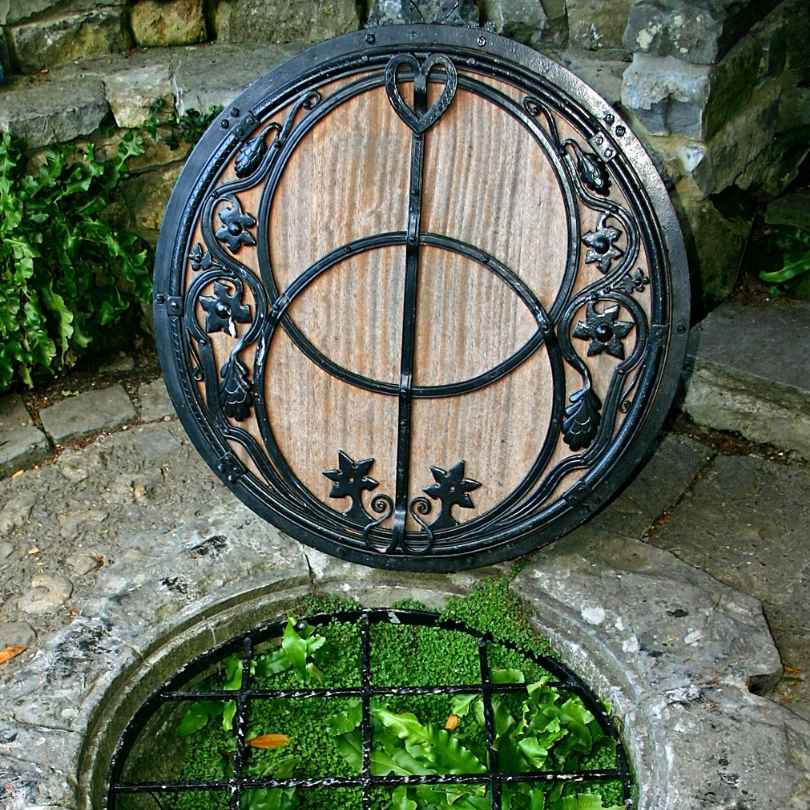
The iron lid that covers the well shaft bears one of the most elegant depictions of the Vesica Piscis in existence. Designed by the artist Frederick Bligh Bond in 1919, the ironwork shows two interlocking circles forming a Vesica Piscis, with a lance or spear passing through the mandorla vertically — a reference to both the Grail legends and to the geometry itself, the vertical axis of the construction. The circles are decorated with blossoming branches, suggesting the marriage of the geometric and the organic, the mathematical and the living.
What makes the Chalice Well symbol particularly resonant is that it is not merely decorative. Glastonbury sits at a confluence of ancient ley lines, those hypothetical lines of earth-energy that geomancers have traced across the British landscape. The Chalice Well itself is fed by an underground stream, and the well's waters have been associated with healing, with the feminine principle, with the depths of the earth, and with the boundary between the seen and unseen worlds. In this context the Vesica Piscis on the well lid is a perfect symbol: it marks the place where two worlds overlap, where what is above meets what is below, where the geometric order of the cosmos is mirrored in the structure of a living spring. The symbol is not imposed on the place; it articulates what the place already is.
The association of the Vesica Piscis with water is itself significant. Water, more than any other element, forms the Vesica pattern spontaneously and continuously. When two raindrops hit the surface of a still pool, the expanding rings of their ripples will intersect and, at the moment of intersection, trace out a perfect Vesica Piscis. The symbol is constantly being drawn and redrawn on the surface of every body of water touched by rain, a continuous natural inscription of the geometric principle.
The Mathematics of √3
The Vesica Piscis is not only a symbol of philosophical and spiritual significance. It is also a precise geometric construction that encodes several of the most important irrational numbers in mathematics — numbers that cannot be expressed as simple fractions but that appear everywhere in nature and in the deep structure of space.
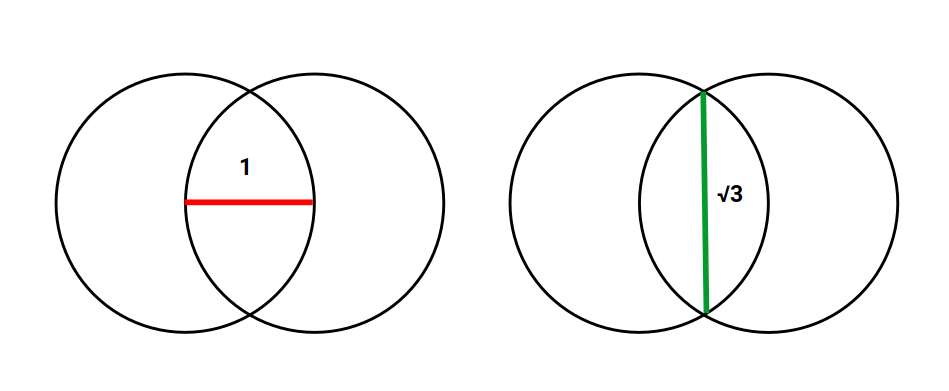
The most immediately apparent of these is √3. If the two circles each have radius 1, then the width of the mandorla (the distance between the two circle centres) is also 1. The height of the mandorla — the distance between its two pointed tips — is exactly √3. This means the height-to-width ratio of the Vesica Piscis is 1 : √3, or equivalently, the diagonal of the mandorla relates to its width in the ratio √3 : 1. This is the same ratio that appears in the diagonal of a rectangle whose sides are in the ratio 1 : 2 — the ratio that generates the perfect equilateral triangle.
Indeed, the equilateral triangle emerges directly and inevitably from the Vesica Piscis. The two circle centres and either of the two tip-points of the mandorla form a triangle whose three sides are all equal to the radius of the circles — a perfect equilateral triangle, with all angles exactly 60°. Two such equilateral triangles can be inscribed in the mandorla simultaneously, pointing in opposite directions, their six vertices marking the tips of the mandorla and the two circle centres. This is the geometry of the Star of David, of the hexagram, of the first step toward the Flower of Life — all emerging from the simple act of drawing a second circle.
The number √3 has deep significance in both mathematics and physics. It appears in the geometry of the hexagonal lattice — the most efficient way to pack circles in a plane — and in the structure of the carbon nanotube, the graphene sheet, and the honeycomb. It appears in the formula for the area of an equilateral triangle, in the geometry of the tetrahedron, in the relationship between the radius and the area of a hexagon. Wherever nature needs to pack efficiently, wherever space needs to be divided with maximum economy, √3 tends to appear.
The construction of the Vesica Piscis also encodes √2 and √5. The diagonal of a square inscribed in one of the circles is √2 times the side length — the Silver Ratio, the ratio that governs the A-series paper proportions used across the world, the ratio embedded in the structure of many Islamic geometric patterns. And √5 appears in the diagonal of a double square (a rectangle with sides 1 and 2) constructed from the Vesica geometry — and from √5 we derive the Golden Ratio: φ = (1 + √5) / 2, the proportion that appears in the nautilus shell, the arrangement of sunflower seeds, the proportions of the human body, and throughout the history of art and architecture.
The Vesica Piscis thus serves as a geometric generator — a single construction from which the most significant irrational ratios in mathematics can be derived. This is why the medieval cathedral architects, working in the tradition of Plato's Timaeus and Euclid's Elements, regarded the Vesica Piscis as the master proportion from which all other sacred proportions unfold. It is not one ratio among many. It is the root from which the others grow.
Womb of Form
One of the most enduring metaphors for the Vesica Piscis — found across many traditions and confirmed by its geometric properties — is that of the womb: the space from which all subsequent forms are born. This is not merely poetic. The Vesica Piscis, as a geometric construction, genuinely is the generative matrix from which the equilateral triangle, the square, the pentagon, and ultimately all the regular polygons can be constructed. It is the first and necessary step in the unfolding pattern of the Flower of Life.
In the Pythagorean tradition, the Monad (the circle, the One) giving rise to the Dyad (two circles, the Vesica Piscis) was understood as the first act of creation — the moment when the undivided absolute polarises into two, and in doing so creates the possibility of a third. The mandorla is that third; it is the child of the duality, the first thing that is genuinely new, that did not exist before the relationship. The Trinity — which emerges geometrically in the next step when a third circle is added — is thus already implicit in the Vesica Piscis. The womb already contains the seed of what will be born from it.
The Tao Te Ching of Laozi offers a strikingly parallel metaphor from a completely different cultural tradition: "The Tao gives birth to One. One gives birth to Two. Two gives birth to Three. Three gives birth to the ten thousand things." The single circle gives birth to two; the two circles give birth to the mandorla, the third; and from that third all further geometry unfolds. The Vesica Piscis is the "Two gives birth to Three" — it is the moment of genuine creation, the first emergence of something qualitatively new.
In alchemical symbolism the Vesica Piscis represents the coniunctio — the sacred marriage or conjunction of opposites, the union of the Solar and Lunar principles, of sulphur and mercury, of the active and passive, the conscious and unconscious. The alchemists were not primarily interested in chemistry; they were interested in transformation, and the Vesica Piscis was for them the symbol of the transformative union. Where two things truly meet at the level of their essence, something new is born. This is the first law of alchemy and the first law of the Vesica Piscis.
In Nature
What gives the Vesica Piscis its claim to universality is not merely its appearance in human culture but its constant, ubiquitous generation by natural processes. Nature draws the Vesica Piscis continuously, across scales, in medium after medium, without any human hand guiding it.
The most fundamental natural occurrence is in cell division. When a single cell divides into two, the process is not a simple splitting. The cell nucleus first elongates, then draws into a figure eight, then pinches off — tracing the exact form of two overlapping circles, the Vesica Piscis, before separating into two daughter cells. The mandorla is the boundary between the parent and the offspring, the zone of transition and separation. The Vesica Piscis is not a symbol of cell division; it is cell division, traced in the living geometry of the process itself.
The human eye is constructed around a Vesica-derived geometry. The pupil is not a simple circle but an ovoid opening whose shape in bright light approximates the mandorla, and the eyelids, when partially closed, trace arcs that intersect at both corners of the eye, generating a form whose proportions closely follow the Vesica Piscis. The iris — the coloured ring surrounding the pupil — is divided into radiating segments whose geometry resonates with the √3 proportions of the construction. This is perhaps why the eye, across so many traditions, is associated with the divine and with perception of the sacred: it is itself a sacred geometric form.
Leaves grow in Vesica proportions. The classic leaf shape — pointed at both ends, widest in the middle — is a mandorla. The ratio of a leaf's length to its width varies by species, but in many of the most common and symmetrical leaf forms the proportions are close to 1 : √3, the ratio of the Vesica Piscis. The leaf is not merely shaped like the mandorla by coincidence; the growth processes that generate it — differential growth rates between tip and centre, the hydraulic pressures of the vascular system, the optimisation of photosynthetic surface area — naturally tend to produce the Vesica proportions because those proportions represent an efficient use of material under those particular growth dynamics.
Water ripples generate Vesica patterns whenever two disturbances occur simultaneously on a still surface. The expanding rings of each ripple intersect the other's, and at the points of intersection a Vesica Piscis is momentarily traced — then the rings pass through each other and new intersections form. A pond surface after a rain shower is covered with continuously forming, overlapping, dissolving Vesica Pisces, an endless natural inscription of the form. This is why the Vesica Piscis was so often associated with water in ancient symbolism: the geometry appears spontaneously on water's surface as if water is drawing it.
At the scale of optics, when two coherent light waves from the same source overlap, they create an interference pattern. The boundaries between regions of constructive and destructive interference trace hyperbolic curves — and the central maximum, the zone where the two waves most perfectly reinforce each other, has the form of a lens, a mandorla. The Vesica Piscis is encoded in the mathematics of wave interference, which is to say it is encoded in the fundamental behaviour of light.
Fibonacci and the Golden Ratio
The Vesica Piscis fits precisely within a 2 × 3 rectangle. This may seem like an incidental observation until you recognise that 2 and 3 are consecutive numbers in the Fibonacci sequence: 1, 1, 2, 3, 5, 8, 13, 21, 34... The ratio of consecutive Fibonacci numbers converges on the Golden Ratio φ ≈ 1.618, and the 2 × 3 rectangle is the first in the sequence of Fibonacci rectangles from which the logarithmic spiral — the spiral of shells, galaxies, and plant growth — can be constructed.
This means that the Vesica Piscis is not merely related to the Golden Ratio; it is the geometric starting point from which the Fibonacci spiral can be constructed. The 2 × 3 rectangle generated by the Vesica Piscis is the seed of the spiral. Add a 3 × 3 square, then a 5 × 5 square, then 8 × 8, and the spiral grows, curving through the corners of each rectangle with ever-increasing grace. This is the nautilus spiral, the galaxy arm, the sunflower head, the arrangement of pine cone scales — all rooted in the 2 × 3 rectangle that the Vesica Piscis inscribes.
The deeper principle at work is that the Fibonacci sequence and the Golden Ratio are both expressions of the same fundamental process: self-similar growth, in which each new term is generated by the relationship between the two preceding terms. This is precisely the structure of the Vesica Piscis: two circles, each defined in relation to the other's centre, generating a third form between them. The Vesica Piscis is the geometric prototype of the additive relationship that generates Fibonacci growth. 1 + 1 = 2; 1 + 2 = 3; 2 + 3 = 5 — each step creates the next by combining the two most recent. The two circles create the mandorla; the mandorla becomes one input for the next step, and so on, generating the spiral of expanding Fibonacci rectangles that underlies so much of organic form.
The Golden Ratio itself — φ = (1 + √5) / 2 — emerges from the geometry of the pentagram, which is itself constructed using the proportions encoded in the Vesica Piscis. The relationship between √3, √5, and the Golden Ratio is not coincidental; they are all members of the same family of irrational numbers generated by the square roots of small integers, and the Vesica Piscis is the geometric construction that brings them into relationship with each other. In this sense, the Vesica Piscis is not just the symbol of sacred geometry — it is the algebraic generator of sacred geometry, the construction from which the key mathematical relationships of the discipline can be derived.
Scientific Significance
The Vesica Piscis is not confined to history and symbol. Its geometry appears at the frontier of contemporary physics, from the quantum scale of electron behaviour to the cosmological scale of the structure of the universe itself.
In the Geometric Universe Theory that we developed, the proportions of the Vesica Piscis appear when physical constants are expressed in dimensionless form. When the speed of light is set to 3 (in dimensionless units), the horizontal dimension of the Vesica Piscis correlates with the maximum speed of sound in an infinitely dense medium — a speed observed in baryonic acoustic oscillations (BAOs) within the cosmic microwave background. BAOs are the fossilised pressure waves from the first 380,000 years after the Big Bang, their pattern preserved in the large-scale distribution of galaxies across the observable universe. The fact that Vesica-derived proportions appear in this relationship hints at a deep geometric order underlying the apparently separate domains of electromagnetism and acoustics.
At the quantum scale, electrons in atomic orbitals form pairs with opposite spins. When an electron transitions from a higher to a lower energy state, it emits a photon — an electromagnetic wave packet. The geometry of this emission, modelled as two overlapping spherical wavefronts interacting around a shared axis, can be represented by the three-dimensional Vesica Piscis: two spheres overlapping so that each passes through the other's centre, their intersection forming a lens-shaped volume of space. The mandorla in this context is the region of quantum interaction, the zone where two quantum states overlap and interfere.
Bipolar nebulae — deep-space objects in which stellar material expelled by a dying star forms two opposing lobes — take on the exact silhouette of the Vesica Piscis at astronomical scale. The hourglass or figure-eight shape of objects like the Twin Jet Nebula (M2-9) and the Cat's Eye Nebula (NGC 6543) arises from the interaction of two distinct outflow zones, each looping outward in the characteristic geometry of the Vesica's twin circles. The universe draws this form at a scale of light-years, in the dying breath of stars, with the same geometric logic that appears in a water ripple or a dividing cell.
The consistent appearance of Vesica geometry across these wildly different scales and contexts — from the quantum mechanical behaviour of electrons to the death throes of stellar systems — points to something deeper than coincidence. It suggests that the geometry itself encodes something about the way two fields, two forces, two centres of energy interact whenever they are brought into proximity. The Vesica Piscis is not a human invention imposed on nature; it is the natural signature of interaction, the form that emergence takes when two equal and complementary things meet.
The Geometry of Meeting
The Vesica Piscis is, at its simplest, the shape made when two equal circles overlap so that each passes through the other's centre. That description takes ten words. The implications of that description have occupied philosophers, architects, artists, theologians, and scientists for at least two and a half thousand years, and show no signs of being exhausted.
What the Vesica Piscis encodes, at every level at which it appears, is the geometry of genuine meeting — the form that relationship takes when it is complete, reciprocal, and equal. Two circles that merely touch do not generate a Vesica Piscis; they must overlap, must penetrate each other's space, must include each other's centre in their own circumference. This is a high standard of relationship. And when it is met, something new comes into being: the mandorla, the third thing, the child of the union, the form that neither circle could have generated alone.
This is why the Vesica Piscis appears at the threshold of sacred spaces — above church portals, around the bodies of divine figures, at the entrance to sacred wells. It is the shape of the threshold itself, the form of the passage between two orders of reality. To pass through the mandorla is to enter the zone of intersection, to participate in the meeting of two worlds, to be held in that generative overlap where creation is always happening.
From this single form — two circles, one overlapping the other — all the riches of sacred geometry unfold. The equilateral triangle is already latent in the Vesica Piscis. The hexagram, the Flower of Life, the Platonic solids, the spiral — all are present as seeds in this first act of relationship. The Vesica Piscis does not merely begin the sequence of sacred geometry. In a very real sense, it contains the whole sequence within itself, as the acorn contains the oak, as the first word of a sentence contains the grammar of the language.
The Ankh
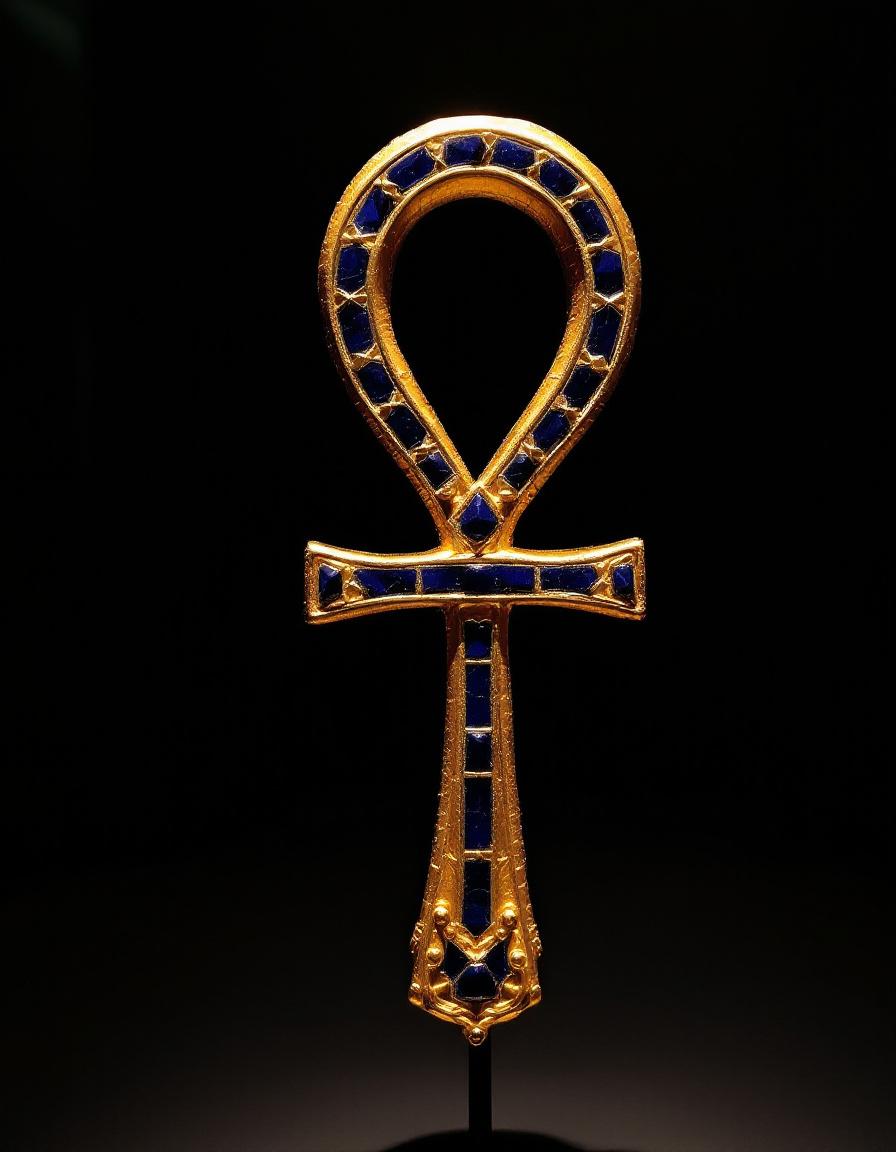
Among the most immediately recognisable symbols in all of human history, the Egyptian Ankh (☥) — the key of life, the crux ansata, the cross of life — carries within its simple form a precise geometric derivation from the Vesica Piscis. The loop at the top of the ankh is not a stylised circle or an arbitrary ornament; it is the Vesica Piscis, the mandorla, placed above a T-cross known in the tradition as the Trion Re. The proportions of the loop, when constructed correctly, are those of the almond-shaped intersection of two equal circles — wider than a circle, narrower than a full ellipse, pointed at the top and opening into the crossbar below. This makes the ankh a complete geometric statement in a single symbol: the Vesica Piscis (the womb, the source of all form, the zone of sacred union, the feminine principle) united with the cross (the material world, the four directions of space, the masculine principle of extension and definition). Life — the ankh's primary meaning — arises from the union of these two principles. The symbol does not merely represent life; it enacts the geometry of how life arises, from the meeting and union of two complementary forms.
Every major deity of the Egyptian pantheon is depicted holding the ankh, and the manner of its use is consistent and theologically precise. The gods hold it by the crossbar, raising the Vesica loop toward the face of the mortal they are blessing, and breathe eternal life into the mortal through the loop — through the Vesica — as though the mandorla were the aperture through which the divine breath passes from one order of reality into another. In Egyptian cosmology, the breath (the ankh itself, since the word for life and the word for the symbol are the same) is what distinguishes the living from the dead, the animated from the inert. The gods possess this animating breath in abundance; it is the divine surplus that they can share. And the geometric form through which it passes — the Vesica loop, the mandorla — is precisely the form we have been examining throughout this chapter as the shape of genuine meeting, of the threshold between two orders of reality, of the space where two things overlap and produce a third. The ankh geometrically encodes the Egyptian theology of life: the divine order (the circle, the Vesica) descending into the material world (the cross) and animating it from above.
The ankh was adopted into early Christian use in Egypt with remarkable ease and surprisingly little theological friction. The Coptic Christian community — the direct descendants of the ancient Egyptian Christians who formed one of the earliest and most theologically sophisticated branches of Christianity — incorporated the ankh into their cross tradition, producing what is known as the Crux Ansata (the "handled cross" or "cross with a handle"). The Coptic cross retains the loop of the ankh above the crossbar, maintaining the Vesica geometry within a Christian theological framework. This adoption was not merely cultural conservatism or artistic inertia; it reflected a genuine theological resonance. The Christian cross, as the instrument of death and resurrection, and the Egyptian ankh, as the symbol of immortal life and divine animation, are addressing the same fundamental question from different cultural vocabularies. The Vesica loop that the Coptic tradition preserved at the top of their cross is the geometric statement that the answer to that question — the source of life beyond death — is the union of the divine and material principles, encoded in the same mandorla that medieval cathedral builders carved above their portals and that the Pythagoreans recognised as the signature of sacred proportion.
In contemporary culture, the ankh has undergone a significant expansion beyond its Egyptian or Christian origins. It has become an important symbol of African heritage and identity, particularly in diasporic communities that trace their descent from the ancient Egyptian civilisation and reclaim its symbols as expressions of cultural depth and dignity. The ankh appears widely in Afrocentric art, jewellery, and body art, where it carries its ancient association with life, immortality, and the divine alongside its newer role as a marker of cultural connection. It appears in New Age spiritual contexts as a symbol of the balance between feminine and masculine, between the eternal and the temporal, between spirit and matter — readings that, as we have seen, are geometrically exact and not merely projected onto the symbol by modern practitioners. Whatever the cultural context, the ankh remains recognisably itself: a T-cross crowned with a Vesica, a geometric statement that life is the product of union, the third thing that arises when two complementary principles truly meet.
The Eye of Horus
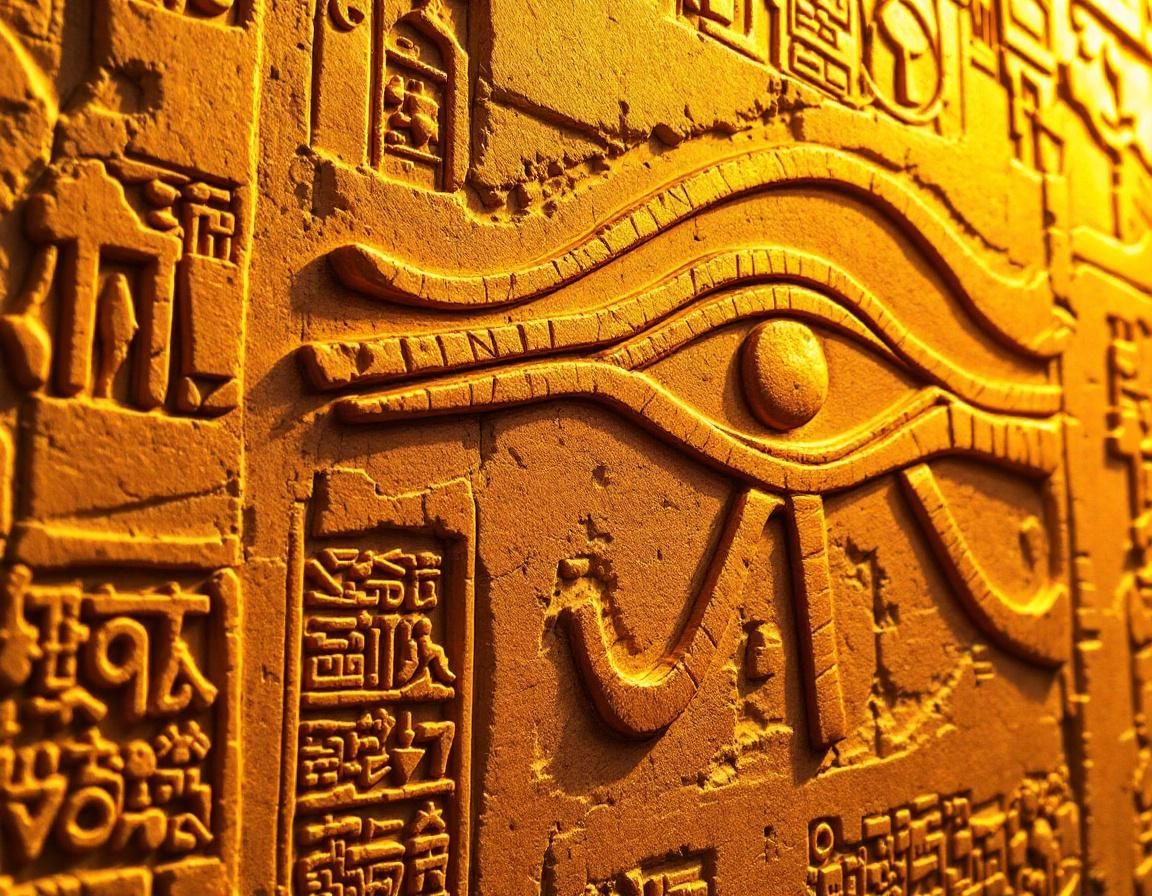
The Wadjet — the Eye of Horus, the "sound eye," the eye of the falcon god — is one of the most powerful protective symbols in the ancient Egyptian tradition, and one of the most geometrically interesting. At its most basic level the Eye of Horus is simply an eye — and every eye, without exception, is a Vesica Piscis. The almond shape of the human eye, open and visible, is formed by two curved lines meeting at points at the inner and outer corners: precisely the construction of the mandorla, two arcs intersecting at their extremities. The eye is the Vesica Piscis oriented horizontally, its pointed ends forming the corners, its widest arc curving above and below to describe the upper and lower eyelids. This is not a loose visual resemblance; the geometry is exact. Every eye — human, animal, divine — is drawn by nature in the form of the Vesica Piscis. The Eye of Horus makes this geometric identity explicit and sacred.
The mythology of the Eye of Horus is one of the most dramatic narratives in all of Egyptian religion. In the primordial conflict between Horus (the legitimate king, son of Osiris) and Set (the usurper who murdered Osiris and claimed the throne), Set tears out or destroys the eye of Horus in combat — an act representing the destruction of order, legitimacy, and right vision. The eye is then restored — in some versions by Thoth, the god of wisdom and mathematics; in others by Hathor, the goddess of love and healing — and this restoration is what makes Horus complete and capable of defeating Set and reclaiming the throne. The restored eye is the Wadjet, the "sound" or "whole" eye, and it becomes one of the most powerful amulets in the Egyptian tradition, worn by the living for protection and placed with the dead to grant safe passage. The eye that was broken and restored is the eye of divine perception — the capacity to see truly, to perceive the real order beneath apparent chaos, to recognise the sacred geometry of existence rather than being deceived by its surface disorder.
The Eye of Horus encodes a remarkable piece of ancient mathematics in its component parts. The stylised Egyptian representation of the eye includes not only the basic almond shape but six specific markings — the pupil, the brow, the inner corner decoration, and three outer markings — each of which represented a specific fraction of the heqat, an Egyptian unit of grain measurement. The six fractions encoded in the Eye of Horus are: ½, ¼, ⅛, 1/16, 1/32, and 1/64. Added together, these six fractions sum to 63/64 — one sixty-fourth short of a complete whole. Ancient Egyptian tradition explained this missing sixty-fourth as the portion that Thoth supplied by his magic to complete the restoration of the eye, and it represents the perpetual incompleteness of any finite system, the remainder that cannot be captured by division, the inexpressible residue that points toward the infinite. This mathematical encoding in a sacred symbol — a series of halving fractions, a geometric progression, built into the component parts of an eye — speaks to the Egyptian tradition's extraordinary capacity to layer theological, mathematical, and protective meaning into a single image.
The Eye of Horus has a direct descendant in the Western esoteric tradition: the Eye of Providence, sometimes called the All-Seeing Eye, most familiar in its modern form from its placement on the reverse of the United States Great Seal and on the dollar bill. Here the eye appears within a triangle — the luminous eye in a radiant triangle, floating above an unfinished pyramid. This image combines two of the most fundamental sacred geometry forms: the Vesica Piscis (the eye) and the equilateral triangle (which, as we have seen throughout this chapter, is the form latent within the Vesica Piscis, generated by its internal geometry). The eye in the triangle is the mandorla within the equilateral triangle — the Vesica Piscis and its geometric offspring combined into a single emblem of divine perception, divine reason, and the completeness of wisdom. The Eye of Providence carries all of these associations — Freemasonry, which used the symbol extensively and through which it entered American political iconography; Hermetic and Rosicrucian traditions in which the all-seeing eye represented divine omniscience; and ultimately the ancient Egyptian and Pythagorean inheritance in which the eye, as Vesica, represented the most fundamental geometric act of perception: seeing the sacred structure of reality as it actually is.
The eye as a symbol of divine or sacred perception runs through virtually every major cultural and religious tradition independently of its Egyptian origins. The Evil Eye of Mediterranean and Middle Eastern tradition — the malocchio in Italian, the nazar in Turkish and Arabic, the ayin hara in Hebrew — is the eye as concentrated intent, the gaze that can transmit harm or blessing by its quality of attention. The Third Eye of Hindu and Buddhist tradition — the ajna chakra, the eye of Shiva, depicted as a vertical eye at the centre of the forehead — is the eye of inner perception, the capacity to see what ordinary vision cannot. The All-Seeing Eye in Freemasonry is the eye of the Great Architect, the divine intelligence that perceives all things and under whose gaze the initiate conducts their moral life. In every tradition, the eye represents not merely physical vision but the deeper capacity to perceive truth — and in every tradition, the shape of that perception is the shape of the Vesica Piscis: the almond, the mandorla, the form made when two equal circles meet at each other's heart.
Conclusion
The Vesica Piscis is the smallest possible act of relationship in geometry — and from that single act, the entire vocabulary of sacred form unfolds. Two equal circles, each holding the other's centre, generate an almond of overlap that becomes the seed of the triangle, the hexagram, the spiral, and ultimately the Flower of Life. It is at once a mathematical object encoding √2, √3, √5 and the Golden Ratio; a biological signature etched into eyes, leaves, and dividing cells; and a theological emblem found above church portals, in the loop of the ankh, and at the heart of the Sri Yantra. What links these scales is not metaphor but geometry: the Vesica Piscis is the form that emerges whenever two complete things meet at depth — and in that meeting, something new is always born. To draw it is to perform, in miniature, the first act of creation that every tradition in this chapter has, in its own language, been pointing toward.
In the next chapter, we explore The Trinity — The Triangle — the first enclosed shape, born from the Vesica Piscis, and the geometric minimum for completeness.
FAQ
What is the Vesica Piscis?
The Vesica Piscis is the almond-shaped (mandorla) region formed when two equal circles overlap so that each passes through the other's centre. It is the foundational construction of sacred geometry — the form from which the equilateral triangle, the square, the pentagon, and ultimately all regular polygons can be derived.
What mathematical proportions does the Vesica Piscis encode?
The Vesica Piscis encodes √3 (its height-to-width ratio), √2 (from the diagonal of a square inscribed in either circle), and √5 (from a double-square construction) — and from √5 the golden ratio φ = (1 + √5) / 2. It is the geometric generator from which the most significant irrational ratios in mathematics can be derived.
Why does the Vesica Piscis appear so often in nature?
The Vesica Piscis is the natural geometric signature of interaction — the form that emerges whenever two equal fields, forces, or centres of energy meet. It appears in cell division, water ripple interference, the shape of leaves and eyes, electron pair interactions, and bipolar nebulae because it encodes the fundamental geometry of how two things combine to produce a third.
What is the connection between the Vesica Piscis and the Fibonacci spiral?
The Vesica Piscis fits precisely within a 2 × 3 rectangle — and 2 and 3 are consecutive Fibonacci numbers. This rectangle is the geometric starting point from which the logarithmic Fibonacci spiral can be constructed by adding successively larger squares (3×3, 5×5, 8×8…), producing the spiral seen in nautilus shells, galaxy arms, and sunflower heads.