The Third Circle
The Vesica Piscis gives us two. It gives us relationship, polarity, the mandorla of sacred intersection — but it does not yet give us a closed form. Two points define a line. Two circles define a relationship. But there is still no enclosed shape, no bounded region, no figure with an interior and an exterior that is complete in itself. For that, geometry requires a third.
The Trinity in sacred geometry is formed by the placement of a third circle of equal radius at one of the two intersection nodes of the Vesica Piscis. That third circle has its centre at one of the two points where the first two circles cross. Its circumference passes through the centres of both existing circles. And now, for the first time, we have three circles arranged in a triangular pattern, their centres forming the vertices of an equilateral triangle, their intersections creating a richly patterned interior space.
The three circle centres, when connected, define an equilateral triangle — a triangle whose three sides are all equal in length and whose three interior angles are all exactly 60°. This is the simplest possible closed two-dimensional form, the minimum structure required to enclose a region of the plane. You cannot enclose space with two sides; three is the minimum. The equilateral triangle is thus the first completed form, the first bounded interior, the first shape that can be said to have an inside distinct from the outside. In this sense it is the geometric birth of the concept of contained space — and with it, the concept of a world that has an inside.
The equilateral triangle is also, in a profound sense, the most perfect of the triangles. Unlike scalene or isosceles triangles, it has no privileged direction — all three vertices are equivalent, all three sides are equivalent, all three angles are equivalent. It possesses the maximum possible symmetry for a triangle: it can be rotated by 120° or 240° and remain unchanged; it can be reflected across any of three axes and remain unchanged. This is what mathematicians call the dihedral group D₃ — a six-element symmetry group that governs the structure of many molecules, crystal faces, and natural forms. For the mathematical treatment of triangle types, angle theorems, and congruence — see the Guide to Geometry: Triangles. The equilateral triangle is not merely one triangle among many; it is the triangle at its most archetypal, the form in which the triangular principle realises itself fully.
The placement of the third circle is not arbitrary. There are only two possible positions — the upper node and the lower node of the Vesica Piscis — and both are equivalent by symmetry. Whichever is chosen, the equilateral triangle that results is perfect. The construction has a quiet directionality, an openness toward further unfolding — but the Trinity itself is already complete. It does not require anything beyond itself to be what it is. Three circles, three centres, three arcs of intersection, and the simplest closed form: the equilateral triangle, the geometric embodiment of the principle of three.
Key takeaways
- The third circle placed at a Vesica Piscis node creates the equilateral triangle — the simplest closed 2D form, the minimum structure for enclosed space, and the most rigid of all polygons.
- The triangle principle generates the tetrahedron (simplest 3D solid, Platonic fire), the Star of David (hexagram of interpenetrating principles), and the Sri Yantra (nine interlocking triangles mapping the cosmos).
- Three is not merely a cultural symbol but a structural minimum — for closure, rigidity, and completeness — explaining why trinities appear independently across every major world tradition.
The Number Three
The number three occupies a unique position in the symbolic architecture of virtually every human culture. It is the number that transforms the static tension of duality into dynamic process. Two is opposition; three is resolution. Two is the question; three is the answer. The movement from Two to Three is not merely an increment; it is the moment at which self-sustaining creation becomes possible, at which the universe has enough structure to generate all further complexity.
The threefold pattern runs through every domain of experience. Time divides into past, present, and future — three aspects that cannot be reduced to two. Space has three dimensions — length, width, and height — the minimum needed for the physical world we inhabit. Matter exists in three states — solid, liquid, and gas. The three primary colours — red, green, and blue — combine to produce every colour the eye can see; no two primaries alone can generate the full spectrum. In music, the triad (three notes sounding together) is the foundation of all harmony. In storytelling, every narrative has a beginning, middle, and end. In the cycle of life: birth, life, and death. In the cycle of the day: dawn, noon, and dusk. The sun itself was understood in many traditions through three aspects — the rising sun (creation, the morning), the midday sun (the full power of being), and the setting sun (dissolution, return) — a threefold solar cycle that maps directly onto the Hindu Trimurti of Brahma, Vishnu, and Shiva.
The Tao Te Ching of Laozi states it plainly: "The Tao gives birth to One. One gives birth to Two. Two gives birth to Three. Three gives birth to the ten thousand things." The sequence is not merely numerical — each step represents a qualitative transformation. The Tao (the undivided source) gives rise to the first differentiation; the first differentiation gives rise to polarity; polarity gives rise to the first genuinely new thing — the third term, the child of the relationship — and from that third term all the ten thousand things of the manifest world become possible. The equilateral triangle, in which three equal elements are held in dynamic balance, is the geometric template of this "ten thousand things" principle: the minimal structure of manifest creation.
In mathematics and logic, three carries a unique generative quality. The discipline of topology classifies surfaces using three fundamental properties: orientability, genus (the number of holes), and boundary. Syllogistic logic — the foundation of Aristotelian reasoning — is built on three terms: the major premise, the minor premise, and the conclusion. The triad in Hegelian philosophy — thesis, antithesis, synthesis — describes how ideas develop through a threefold movement that always exceeds the binary. Even in information theory, ternary logic (with states 0, 1, and an intermediate value) has been shown to be more information-dense and in some respects more efficient than binary logic. Three is not merely a cultural preference; it is a structural minimum for certain kinds of completeness.
The triangle is the most structurally rigid of all polygons. A triangle with fixed side lengths is completely rigid: its shape is uniquely determined by its sides, with no freedom to distort. Every other polygon has degrees of freedom — a quadrilateral can flex into a parallelogram — but a triangle cannot. This is why the truss bridge, the geodesic dome, the space frame, and the triangulated lattice all achieve their extraordinary strength through triangulation. Three is the minimum for closure; it is also the minimum for rigidity.
In Pythagorean numerology, three was called the "first truly odd number" (one and two being considered special cases in ancient Greek number theory) and was associated with harmony, completeness, and the divine proportion. The Pythagoreans found that musical ratios built from the number three — the perfect fifth (3:2), the perfect fourth (4:3), the major third (5:4 in just intonation) — produced the most consonant and pleasing intervals the ear can recognise. That harmony should be rooted in the number three was, for them, not a coincidence but a proof: three is the number of harmony because it is the number at which polarity resolves into a stable configuration. Two strings at 3:2 tension vibrate together without conflict; two views in 3-fold relation find the synthesis that neither alone could achieve.
Across Traditions
The number three occupies a unique place in the symbolic vocabulary of virtually every religious and philosophical tradition, and the forms it takes are remarkably consistent: in each case, three aspects of a single reality, held in mutual relationship, generate something greater than any one of the three could produce alone.
In Christianity, the Trinity — Father, Son, and Holy Spirit — represents the inner relational life of the divine. Theologians have long explored its meaning, but geometrically its significance is clear: the divine is not a monad (isolated unity) nor a dyad (irresolvable polarity) but a trinity — three persons in one nature, each fully expressing the whole while standing in distinct relation to the others. The Father is the source-circle; the Son is the second circle whose circumference passes through the Father's centre; the Spirit is the third circle, the creative emanation that arises from their intersection. The equilateral triangle has therefore been a natural symbol for the Christian Trinity, and the triangular composition of so much Christian art — the triangular arrangement of figures in Renaissance altarpieces, the triangular pediments of Gothic portals with the Trinity explicitly depicted at their apex — is not merely aesthetic but is theological geometry made visible in stone and paint. The triangular halo (or nimbus triangularis) specifically denotes the persons of the Trinity in medieval iconography, distinguishing them from saints depicted with the circular halo of ordinary sanctity.
In Hinduism, the Trimurti — Brahma the Creator, Vishnu the Preserver, and Shiva the Destroyer — represents the three fundamental modes of cosmic activity: creation, maintenance, and dissolution. These are not separate divinities at war with each other but three aspects of a single divine process: the cycle of existence itself. The equilateral triangle, in which no vertex is more important than the others and all three are equally necessary to the form, maps this relationship with geometric precision. Creation without preservation and dissolution would be meaningless accumulation; destruction without creation and preservation would be annihilation; preservation without creation and destruction would be stagnation. The three are in perfect balance, and that balance is the equilateral triangle. The Trimurti is also expressed as a single three-faced deity — three faces sharing one body, looking outward in three directions — a sculptural form that makes the geometric truth visible: three distinct expressions of one underlying nature.
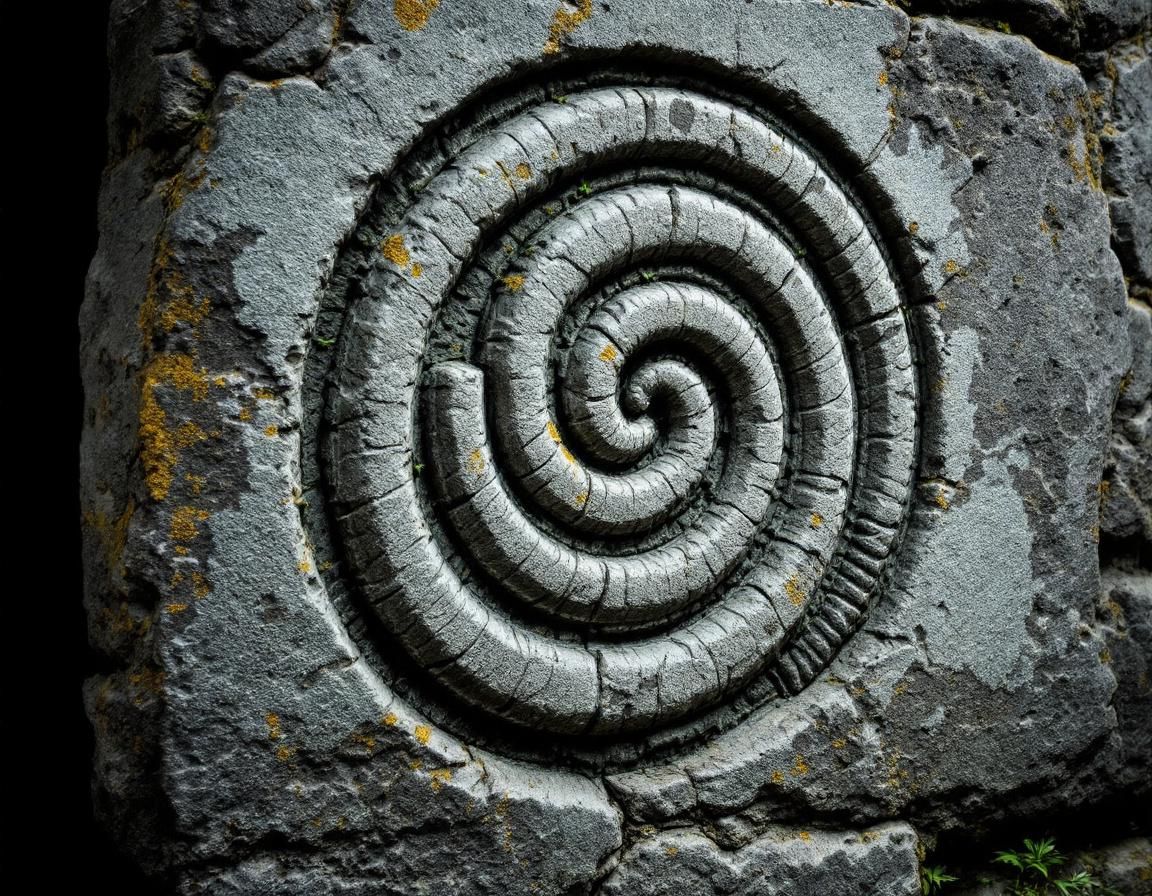
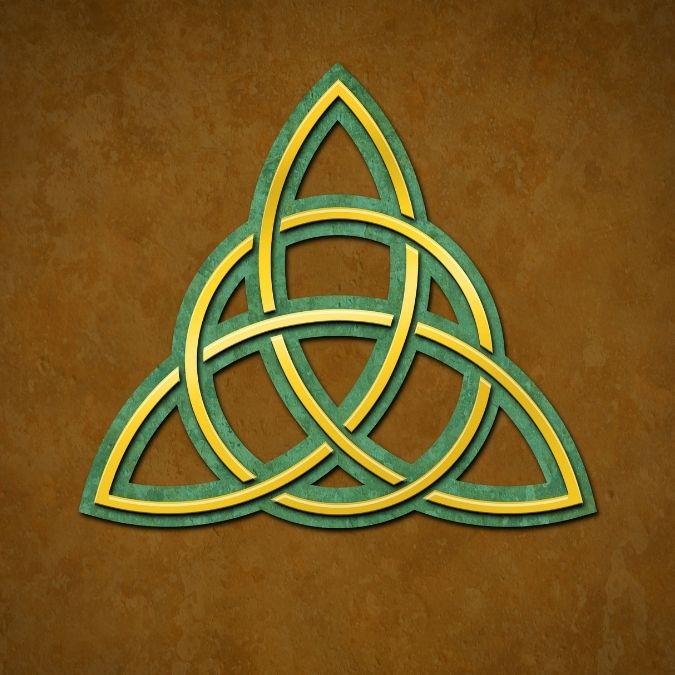
The Celtic tradition reveres the triple goddess — Maiden, Mother, and Crone — as the three faces of the divine feminine, each associated with a phase of the moon (waxing, full, waning) and with a phase of life (youth, maturity, age). The triskele — the triple spiral that appears on the entrance stone of Newgrange, carved over five thousand years ago, and throughout Celtic art — is a geometric expression of this threefold principle: three spirals emanating from a common centre, as three aspects of a single reality. The entrance stone at Newgrange was placed so that the rising sun at the winter solstice illuminates its triple spiral directly, suggesting that the three-in-one principle was understood in Neolithic Ireland not merely as decoration but as a map of cosmic time. The triquetra — three interlocked arcs forming a three-cornered knot — appears in Celtic metalwork and manuscript art as another expression of the same principle: three inseparable elements forming a unified whole greater than any of them individually.
In Norse mythology the three Norns — Urd (what was), Verdandi (what is), and Skuld (what shall be) — weave the threads of fate at the roots of Yggdrasil, representing past, present, and future as three aspects of a single temporal weave. The Norse cosmos itself is arranged in a threefold vertical structure: Asgard (the realm of the gods, above), Midgard (the realm of humanity, in the middle), and Hel/Niflheim (the realm of the dead, below) — three levels of existence arrayed along the vertical axis of Yggdrasil, the World Tree. In Egyptian religion the divine triad of Osiris, Isis, and Horus — the dead father, the creative mother, and the reborn son — encoded the fundamental cycle of death and regeneration that the ancient Egyptians saw as the deep structure of both nature and divinity. In Buddhism the Three Jewels — the Buddha (the enlightened teacher), the Dharma (the teaching), and the Sangha (the community of practitioners) — represent the three essential supports of the path to liberation. The principle of three is so deeply embedded in human symbolic thinking across such radically different cultures that it seems to precede any particular tradition.
In Sufism and Islamic mysticism, the Quranic formula "Bismillah ir-Rahman ir-Rahim" (In the name of God, the Compassionate, the Merciful) names three divine qualities — the divine name, the boundless mercy, and the particular compassion for each creature — and the triangle formed by these three is understood in some Sufi interpretations as the geometric image of divine self-disclosure. In Kabbalistic tradition, the first three sefirot of the Tree of Life — Keter (Crown), Chokhmah (Wisdom), and Binah (Understanding) — form the supernal triangle, the divine triad from which all lower reality emanates. The triangle principle is present at the highest level of the Kabbalistic map, before any material form has come into being, as the irreducible minimum structure of divine self-knowledge.
The Equilateral Triangle
The equilateral triangle is not merely a beautiful abstraction. It is one of the most structurally significant forms in the physical world, and its significance in engineering and materials science flows directly from its geometric properties.
A triangle is the only polygon that is inherently rigid. A square or rectangle, subjected to shear forces, will deform — its right angles will change and the shape will become a parallelogram. A hexagon will flex. A pentagon will distort. But a triangle with fixed side lengths cannot change shape at all; its angles are completely determined by its sides. This is because the triangle is the only polygon in which specifying all side lengths completely determines the form — there is only one possible shape given three side lengths (assuming they satisfy the triangle inequality). Every other polygon can be deformed while keeping side lengths constant.
This is why the triangle — and particularly the equilateral triangle — is the fundamental unit of structural engineering.
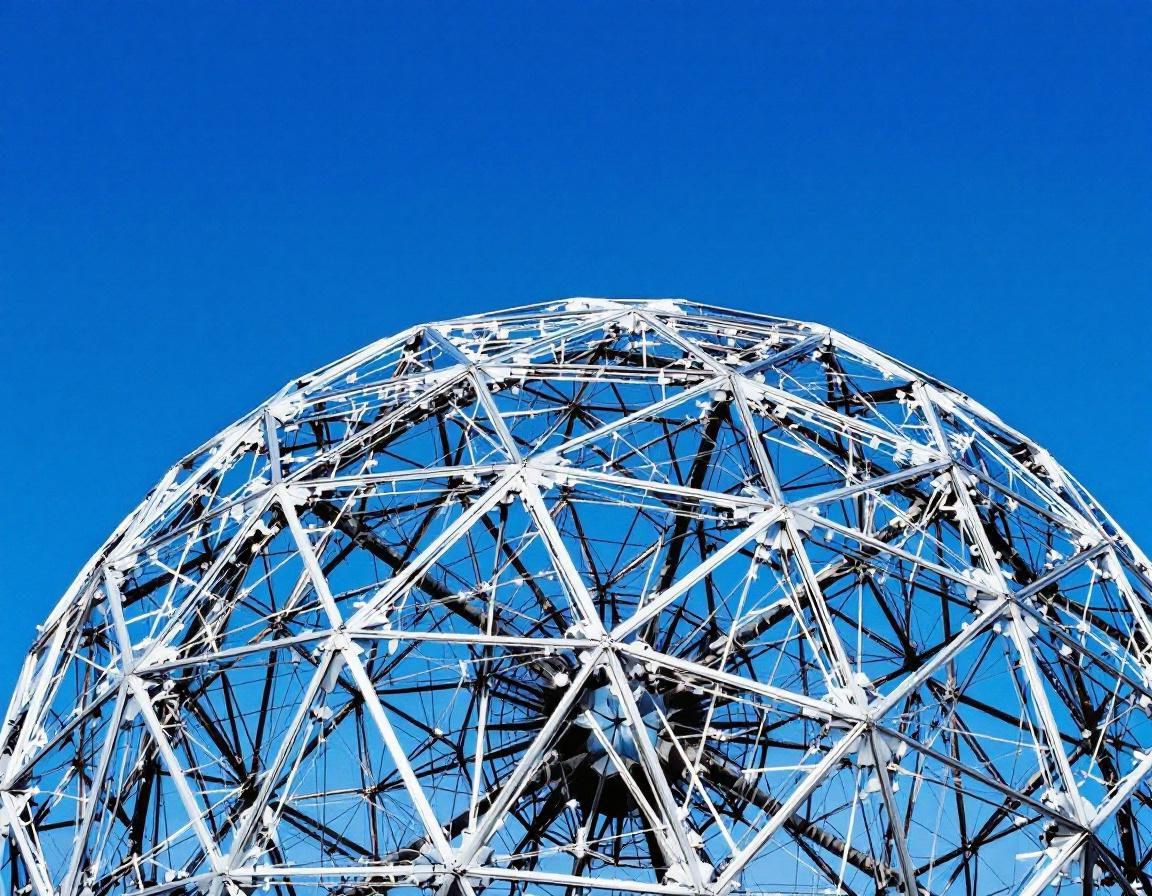
The geodesic dome, pioneered by Buckminster Fuller in the twentieth century, achieves the maximum possible enclosed volume for a given amount of structural material by distributing all forces through a network of triangles. This is not a human invention imposed on materials; it is the discovery of a principle already present in the geometry of the equilateral triangle.
Nature discovered this principle long before human engineers. The graphite allotrope of carbon is built on a hexagonal lattice of carbon atoms — but each hexagon is itself composed of equilateral triangles, and it is the triangular substructure that gives graphene its extraordinary tensile strength and its reputation as the strongest material ever measured. The benzene ring — six carbon atoms in a hexagonal arrangement — achieves its unusual stability through the triangular geometry implicit in its structure. The crystal lattice of many metals is built on close-packed arrangements that generate triangular layers, and the mechanical hardness of such metals depends on the difficulty of shearing through these triangulated planes.
The equilateral triangle is the face of three of the five Platonic solids: the tetrahedron (4 triangular faces), the octahedron (8 triangular faces), and the icosahedron (20 triangular faces). The square is the face of only one Platonic solid (the cube), and the regular pentagon is the face of only one (the dodecahedron). The triangle, by this measure, is the most generative of the polygons in Platonic solid geometry — three of the five perfect forms are built from it. And the tetrahedron, the simplest of all, is built from the minimum possible number of equilateral triangles: four.
At the atomic scale, the equilateral triangle appears in the sp² hybridised bond of carbon — the electron configuration in which three bonding orbitals arrange themselves at 120° to each other in a plane, generating the triangular geometry of graphene, benzene, and the aromatic compounds. The equilateral triangle is not imposed on the atom by any external requirement; it is the natural equilibrium configuration of three mutually repelling electron pairs constrained to a plane. Three equal forces in a plane, each repelling the others, will arrange themselves at 120° and form an equilateral triangle. This is the equilateral triangle as a minimum-energy state — the most stable configuration of three equal elements in a two-dimensional space.
The Tetrahedron
The most direct three-dimensional expression of the equilateral triangle is the tetrahedron — the simplest possible three-dimensional solid, bounded by four equilateral triangular faces. If you take the equilateral triangle as a base and fold three identical equilateral triangles upward from its edges, they meet at a common apex, and the result is the tetrahedron. The equilateral triangle is the 2D template for the tetrahedron in exactly the way that the Vesica Piscis is the 2D template for the equilateral triangle: each form is the previous form seen in one higher dimension.
The tetrahedron requires the minimum number of vertices (4), edges (6), and faces (4) to enclose a volume of three-dimensional space. It is the 3D equivalent of the equilateral triangle: the minimal closed form in its dimension. And like the equilateral triangle, it is inherently rigid — its four triangular faces, once fixed in their proportions, cannot deform. You cannot compress or distort a tetrahedron without breaking it. This is why tetrahedral geometry appears in the stiffest and hardest materials: diamond (the carbon tetrahedron), silicon carbide, titanium nitride — all of these materials achieve their extraordinary hardness through the rigidity of the tetrahedral bond geometry. The silicon-oxygen tetrahedron is the fundamental building block of the entire silicate mineral family — the most abundant minerals in the earth's crust — demonstrating that the tetrahedron is not merely a geometric abstraction but the actual structural unit of the lithosphere, the rocky foundation of the world we walk upon.
In Plato's Timaeus — the foundational text of Western sacred geometry — the tetrahedron is assigned to the element of fire. Plato's reasoning was both aesthetic and structural: fire is the most active and penetrating of the elements, and the tetrahedron is the sharpest and most pointed of the regular solids. Its vertices are acute, its faces minimal; it is the most "energetic" of the Platonic forms. The assignment may seem metaphorical, but it reflects a real geometric intuition: the tetrahedron concentrates its volume into the minimum surface area and the sharpest points, just as fire concentrates energy into heat and light. Plato was not inventing a poetic connection; he was pointing to an isomorphism between geometric and physical properties that reflects a genuine structural relationship.
The tetrahedron also has a remarkable relationship with the sphere. A regular tetrahedron can be inscribed in a sphere so that all four vertices touch the sphere's surface; and a second tetrahedron, inverted relative to the first, can also be inscribed in the same sphere. The two tetrahedra together form the star tetrahedron — also known as the Merkaba in mystical traditions — whose eight vertices mark the corners of a cube. The tetrahedron and the cube are thus geometrically dual in the most literal sense: each can be derived from the other by connecting face-centres. The cube, the tetrahedron, and the sphere containing them form a nested geometric family, a Russian doll of interlocking Platonic forms, all rooted in the equilateral triangle that the Trinity brings into being.
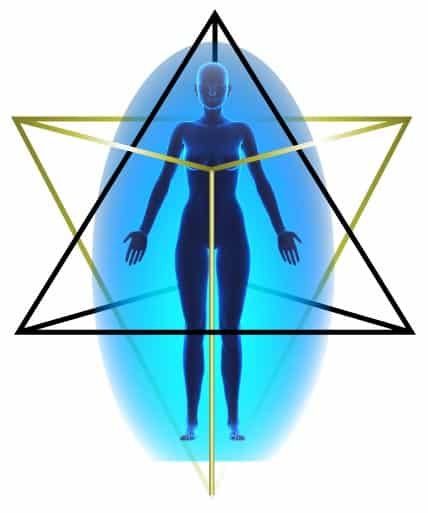
The Merkaba (from Hebrew: mer = light, ka = spirit, ba = body) is understood in certain Kabbalistic and New Age traditions as the geometric form of the light-body — the energetic vehicle of the soul. The star tetrahedron, with its two counter-rotating tetrahedral fields (one pointing upward, representing the divine/masculine principle; one pointing downward, representing the earthly/feminine principle), is taken as a map of the unified energy field that surrounds and interpenetrates the physical body. Whether or not one accepts this interpretation, the geometric observation that underlies it is precise: the upward and downward tetrahedra are exact mirror images, they fit together to produce a perfectly symmetric eight-vertex form, and the six triangular "windows" of each tetrahedron point in the six cardinal spatial directions (front, back, left, right, up, down). The star tetrahedron is one of the most geometrically complete three-dimensional forms that the triangle principle generates.
The Star of David
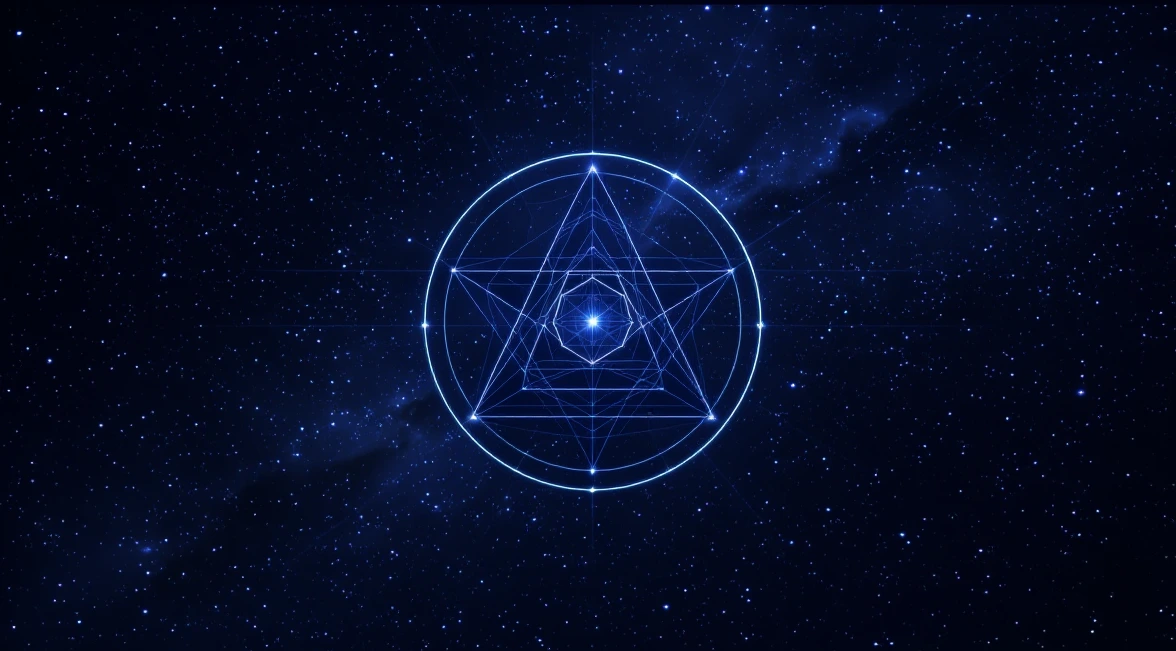
The Star of David (Hebrew: Magen David, "Shield of David") is formed by two equilateral triangles overlapping — one pointing upward, one pointing downward — to create a six-pointed star with a regular hexagon at its centre. It is one of the most widely recognised symbols in the world and the central symbol of Judaism. Yet its geometric origins precede Judaism by centuries and its distribution across cultures is, like the cross, global: six-pointed stars appear in ancient Mesopotamia, in Hinduism (where it is called the Shatkona, representing the union of Shiva and Shakti), in Buddhist mandalas, in Islamic geometric art, in the Seal of Solomon, and in innumerable folk and magical traditions across Europe, the Middle East, and India.
The geometric logic of the hexagram is rooted directly in the Trinity construction. Three circles of equal radius, with the third placed at the upper node of the Vesica Piscis, create an upward-pointing equilateral triangle from their three centres. The lower node of the Vesica Piscis, the mirror point below the central axis, would create a downward-pointing equilateral triangle if occupied. The two triangles — one born of the upper arrangement, one of the lower — together form the hexagram. The upward-pointing triangle represents spirit descending into matter, the divine principle reaching down into the earthly realm. The downward-pointing triangle represents matter ascending toward spirit, the earthly principle reaching up toward the divine. Their intersection — the hexagon at the centre — represents the sacred zone where the two principles meet, interpenetrate, and generate something new that neither alone could produce.
In alchemical symbolism, the upward triangle is the symbol of fire and air (elements that rise); the downward triangle is the symbol of water and earth (elements that descend). The hexagram formed by their union is the alchemical symbol for the hieros gamos — the sacred marriage of opposites — and for the achievement of the coincidentia oppositorum, the coincidence of contraries that is the alchemical goal. The hexagram in alchemy appears on the Seal of Solomon — the magical seal attributed to King Solomon that was believed to bind spirits and command nature — and this association placed the hexagram at the centre of medieval magical practice, from which it passed into numerous esoteric traditions.
The Star of David in the Jewish tradition has a complex and relatively late history as a specifically Jewish symbol — it became the official symbol of the Zionist movement in the nineteenth century and was adopted on the flag of the State of Israel in 1948. But its use in Jewish contexts goes back centuries in synagogue decoration and amulet-making, and its identification with the Kabbalistic Tree of Life and the Seal of Solomon gives it roots in the deepest strata of Jewish mystical thought. In Kabbalistic interpretation, the six points of the star correspond to the six directional sefirot (Chesed, Gevurah, Tiferet, Netzach, Hod, and Yesod), and the central hexagon corresponds to Tiferet — the sefirah of beauty and harmony at the heart of the Tree of Life. The six-pointed star is a map of the structure of existence as understood in Kabbalah, and the equilateral triangle that generates it is the foundational geometric unit of that map.
The Sri Yantra
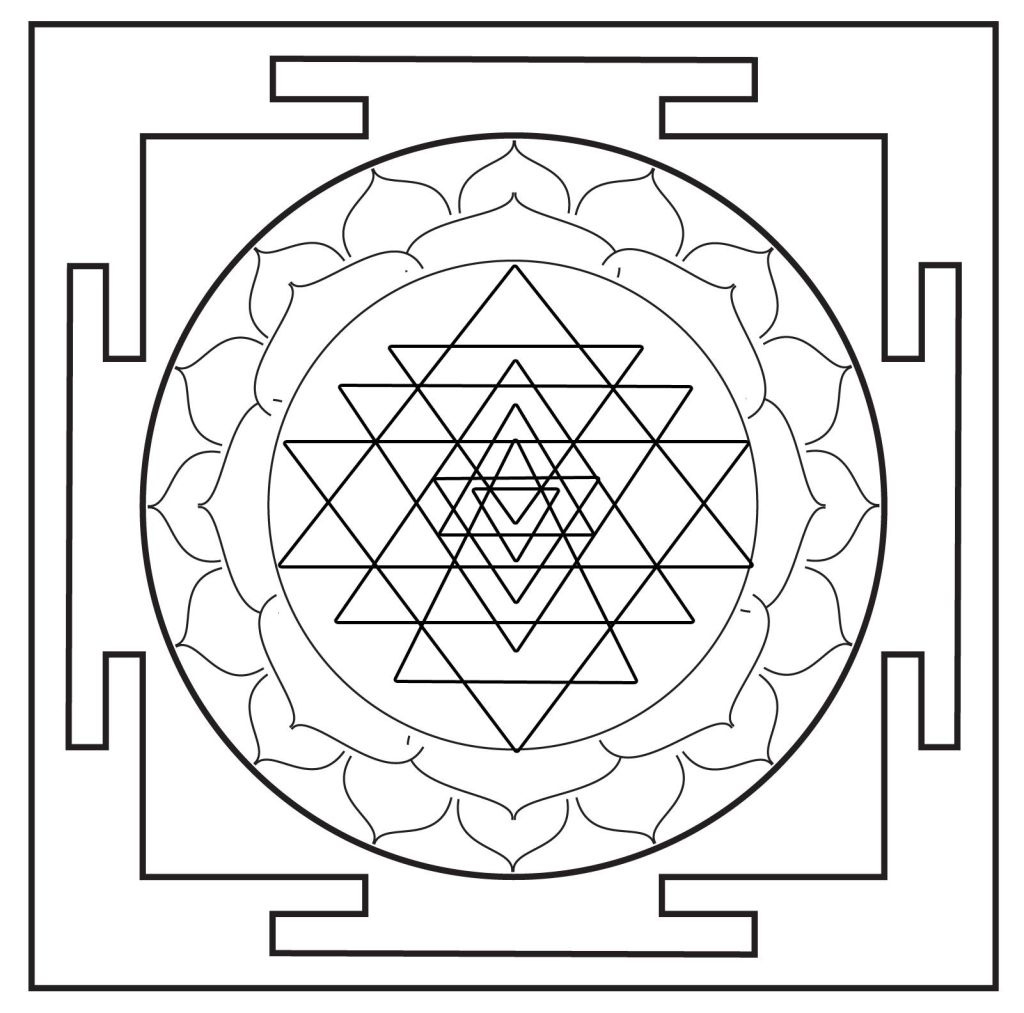
The Sri Yantra — also written Sri Chakra — is the most complex, most sacred, and most revered of all Hindu geometric symbols. It is a diagram of extraordinary beauty and intricate structure, used for thousands of years in Tantric meditation, worship, and ritual, and it is built entirely from the triangle principle. The Sri Yantra is, in the most literal sense, what happens when the triangle unfolds to its fullest possible two-dimensional expression: a system of interlocking triangles of such mathematical precision and symbolic depth that it has occupied mathematicians, artists, philosophers, and meditators across many centuries and civilisations.
The construction of the Sri Yantra begins with a central point, the bindu — the dot, the dimensionless point of pure consciousness, the Absolute before differentiation. From this bindu, through a process of geometric emanation, nine interlocking triangles are constructed: four upward-pointing triangles (representing the masculine principle, Shiva, pure consciousness, the sky) and five downward-pointing triangles (representing the feminine principle, Shakti, creative energy, the earth). The asymmetry — four and five rather than equal numbers — is crucial: it means the feminine slightly predominates, and the resulting geometry is not a static balance of equal forces but a living, dynamic tension that mirrors the creative energy of existence itself. The five Shakti triangles represent the five elements (earth, water, fire, air, ether); the four Shiva triangles represent the four states of consciousness (waking, dreaming, deep sleep, and the fourth state, turiya, of pure awareness).
The nine interlocking triangles generate, through their intersections, 43 smaller triangles arranged in circuits around the central bindu. These 43 triangles are not constructed separately; they arise automatically and inevitably from the precise interlocking of the nine parent triangles. The mathematical challenge of constructing a perfect Sri Yantra — in which all nine triangles intersect at exactly the right points to produce the 43-triangle figure with no gaps, misalignments, or distortions — is a problem of considerable geometric difficulty. In the traditional construction, the nine triangles share a common horizontal base line, and their proportions are determined by a set of rules that have been transmitted in temple-building traditions for millennia. Even small errors in the proportions of any one triangle will propagate through the system and produce visible distortions. A geometrically perfect Sri Yantra is a genuine mathematical achievement.
The 43 smaller triangles of the Sri Yantra are arranged in five concentric circuits (called avaranas, enclosures or sheaths): the innermost circuit around the bindu contains 1 triangle (the central downward triangle of the nine parent figures); the next contains 8 triangles; then 10; then 10 again; then 14 at the outermost level. These circuits correspond, in Tantric metaphysics, to five levels of manifestation — from the subtlest level nearest to pure consciousness (the bindu) outward through increasingly dense levels of material existence to the outermost ring, which corresponds to the most gross and material level of reality. The geometry is not decorative; it is a map of the cosmos, a diagram of the structure of reality from the point of pure awareness at the centre to the manifested material world at the periphery. To meditate on the Sri Yantra is to trace the path from the outermost ring inward toward the bindu, dissolving each level of manifestation in turn until only pure consciousness remains.
Surrounding the triangular circuits, the Sri Yantra is enclosed by two rings of lotus petals — first a ring of eight petals (representing the eight aspects of nature in Samkhya philosophy: earth, water, fire, air, ether, mind, intellect, and ego) and then a ring of sixteen petals (representing the sixteen vowels of Sanskrit, the sixteen phases of the moon, and the sixteen powers of Shakti). Beyond the lotus rings, the yantra is bounded by three concentric squares with T-shaped openings at each of the four cardinal directions — the Bhupura or earth square, representing the outermost boundary between the sacred geometric space and the ordinary world. The complete Sri Yantra thus moves from the infinite dimensionless point at the centre through five levels of triangular complexity, two rings of lotus petals, and three squares — from the Absolute to the earthly, from pure consciousness to solid matter, from the One to the many.
The Sri Yantra has been used in continuous practice in Tantric Shaivism and Shri Vidya traditions for at least two thousand years, and its origins likely predate the written record. It appears in temple sanctuaries as a three-dimensional form — the Meru Yantra (sacred mountain), in which the flat diagram is raised into a pyramid of concentric platforms, each platform corresponding to one of the five circuits — making visible the three-dimensional structure that is implicit in the two-dimensional diagram. The Meru Yantra is itself a sacred mountain, the geometric image of Mount Meru (the cosmic axis mundi of Hindu cosmology) rendered in the language of pure triangular geometry. From the triangle of the Trinity — three circles, three centres, one equilateral triangle — to the 43 interlocking triangles of the Sri Yantra: this is the full range of what the principle of three can produce, from its most elementary expression to its most complex and sublime.
Conclusion
The Trinity — three circles, three centres, the equilateral triangle — is the moment in the sacred geometry sequence when the formless becomes formed, when pure potential becomes the first contained shape, when the universe acquires an inside and an outside, a within and a without. It is the geometric minimum for completeness: you cannot enclose space with fewer than three elements, and the three that the Trinity brings together are equal in every respect, held in perfect balance, each as important as the others.
What the cross-cultural universality of the Trinity principle reveals is that human symbolic thought, working independently across thousands of years and many civilisations, arrived at the same recognition: three is the number at which the infinite expresses itself as something finite and complete, at which the undifferentiated becomes a world with structure and meaning. The Taoist three, the Hindu Trimurti, the Christian Trinity, the Celtic triple goddess, the Norse Norns, the Kabbalistic supernal triad — all are recognitions of the same underlying geometric reality, each expressed in the symbolic vocabulary of its own tradition.
The triangle unfolds from the most abstract expression (the equilateral triangle of pure geometry) through the structural (the tetrahedron, the rigid solid, the Platonic fire) to the symbolic (the Star of David, the hexagram of interpenetrating principles) to the cosmological (the Sri Yantra, the 43-triangle map of the entire structure of reality). At each level, it is the same principle: three equal elements in mutual relationship, generating a completeness that neither one nor two could produce alone. The sacred geometry of the Trinity is not a system imposed on the world from the outside; it is a discovery of the structure the world already has, read in the language of the circle and the triangle.
In the next chapter, we explore The Cross & The Square — the fourth circle's gift of the right angle, the coordinate system, and the geometry of the built world.
FAQ
Why is the equilateral triangle so important in sacred geometry?
The equilateral triangle is the simplest possible closed two-dimensional form — the minimum structure needed to enclose a region of the plane. It has maximum symmetry (D₃ group), is inherently rigid (unlike any other polygon), and is the face of three of the five Platonic solids. It emerges naturally from the Trinity construction of three equal circles.
What is the relationship between the Trinity and the Star of David?
The Trinity construction creates an upward-pointing equilateral triangle from three circle centres. The mirror arrangement at the lower Vesica Piscis node creates a downward-pointing triangle. Overlapping these two triangles produces the hexagram (Star of David) — the geometric expression of interpenetrating principles found across Judaism, Hinduism, alchemy, and many other traditions.
What is the Sri Yantra and how does it relate to the triangle?
The Sri Yantra is a Hindu sacred diagram built from nine interlocking triangles (four upward, five downward) that generate 43 smaller triangles in five concentric circuits around a central point (bindu). It is the most complex expression of the triangle principle in sacred geometry — a geometric map of the entire cosmos used in Tantric meditation for over two thousand years.
Why does the number three appear so consistently across world traditions?
Three is the structural minimum for closure, rigidity, and completeness. Time has three aspects (past, present, future), space has three dimensions, matter has three states, and colour requires three primaries. This structural necessity — not cultural convention — explains why traditions worldwide independently arrived at trinities: the Hindu Trimurti, Christian Trinity, Celtic triple goddess, Norse Norns, and Taoist cosmology all recognise three as the number at which creation becomes self-sustaining.