The Fourth Circle
The Vesica Piscis has two intersection nodes — one above and one below the line connecting the two original circle centres. In the Trinity chapter, we placed a third circle at the upper node, and from that placement the equilateral triangle was born. But the lower node remains unoccupied. The geometry holds an empty place, a vacancy that draws the next circle into being with quiet inevitability. The Trion Re — the name we give to the four-circle arrangement — is formed by placing a fourth circle of identical radius at that lower node, restoring the symmetry that the Trinity temporarily disrupted and completing the fourfold pattern.
The four circles now sit in a diamond configuration: two in the middle (the original Vesica pair), one pointing upward (the Trinity circle), and one pointing downward (the new Trion Re circle). Their four centres form a rhombus assembled from two equilateral triangles sharing a common edge — a precise, elegant form with all four sides equal and interior angles alternating between 60° and 120°. This rhombus is already beautiful in its own right, but the deeper geometric revelation of the Trion Re lies not in the centres but in the outer intersection nodes — the points where non-adjacent circles cross. When you connect these four outer nodes, they form a perfect square.
The square here is not constructed by drawing perpendicular lines or measuring right angles. It arises spontaneously and necessarily from the intersection geometry of four equal circles arranged in this pattern. The right angle — 90° — appears without any explicit act of construction. It is latent in the circle geometry from the very beginning, implicit in the ratios of the arrangement, waiting through the first, second, and third circles to be released by the fourth. This is one of the quiet miracles of sacred geometry: forms that seem to belong to entirely different systems of measurement — the 60° world of the triangle and the 90° world of the square — turn out to be two aspects of a single deeper geometric reality, unfolding together from the simplest possible starting point.
Connecting the four circle centres also produces the horizontal and vertical lines that define the cross. The vertical axis runs from the Trinity circle centre to the Trion Re circle centre; the horizontal axis runs from the centre of the original left circle to the centre of the original right circle. These two lines cross at the exact midpoint of the construction, and they are perpendicular — the right angle appears here too, at the very heart of the figure. The cross emerges not as a symbol imposed from the outside but as the structural skeleton of the four-circle arrangement, the armature upon which the entire Trion Re is built.
The number four, which the Trion Re introduces into the sequence, brings with it a complete change of quality in the geometric unfolding. The four elements of classical philosophy — earth, water, fire, and air — map directly onto the four circle positions: the grounded solidity of the square, the fluidity of the circles, the upward fire of the Trinity point, the downward cool of the Trion Re point. The four cardinal directions (North, South, East, West) are the cross mapped onto the plane of the earth. The four seasons mark the complete annual cycle of solar energy. Four DNA nucleotide bases encode all of biological life. Four fundamental forces of physics — gravity, electromagnetism, the strong nuclear force, and the weak nuclear force — account for every physical interaction in the known universe. The Trion Re and its square are not merely geometric forms; they are the signature of the fourfold structure of the material world.
Key takeaways
- The fourth circle completes the Trion Re, from which the cross and the square emerge spontaneously — the 90° right angle arises without explicit construction, latent in the circle geometry from the beginning.
- The cross is one of the most universal symbols in human history, appearing independently as the Christian cross, Egyptian ankh, Hindu swastika, Buddhist dharma wheel, and Star of Lakshmi — each encoding the fourfold structure of space, elements, and directions.
- The number four marks a qualitative shift in sacred geometry: four elements, four cardinal directions, four seasons, four DNA bases, and four fundamental forces — the signature of material reality's fourfold organisation.
A Universal Symbol
The cross is one of the most ancient and most universal marks that human beings have ever made. It appears in Neolithic cave art across Europe and Asia, in the rock paintings and ceramic designs of the world's earliest settlements, in Bronze Age petroglyphs from Scandinavia to the Indus Valley. It predates Christianity by thousands of years and appears independently across cultures that had no contact with each other, which tells us something important: the cross is not a culturally invented symbol. It is a discovery. It is the natural and inevitable consequence of asking the most fundamental spatial question a conscious being can ask: where am I, and which way is out?
The equal-armed cross divides a plane into four quadrants, four regions of space arranged symmetrically around a central point. The horizontal arm represents extension in the plane of ordinary human experience — left and right, east and west, past and future, the dimension of everyday navigation. The vertical arm represents the axis of transcendence — above and below, sky and earth, the spiritual and the material. Where they meet is the centre, and the centre of the cross is one of the most charged symbols in human symbolic vocabulary: it is the meeting point of two fundamentally different orders of reality, the place where the temporal and the eternal share a single point, where matter and spirit intersect. Every sacred space ever built — every cathedral, every temple, every medicine wheel, every sacred mandala — is oriented around some version of this central point where the axes meet.
The cross appears in ancient Egypt in rich and complex forms. The simple cross appears in Egyptian hieroglyphics, and the more elaborate djed pillar — the backbone of Osiris — is a vertical form expressing the axis of stability that supports both the sky and the underworld. Most significantly, the ankh — treated fully in the next section — is the cross with a loop at the top, one of the most important symbols in Egyptian civilisation. In pre-Columbian America the cross is a central cosmological symbol across multiple independent civilisations: the Maya drew their cosmological diagrams as a cross with a world tree at the centre; the Aztec sun stone is arranged around a fourfold cross; the Andean chakana (the stepped cross) encodes the four regions of the cosmos and the agricultural calendar. In ancient China the character for "ten" (十) is a cross, and the number ten represents completion of the decimal cycle — the cross as the symbol of the full number, the complete count, the fulfilled round.
In Celtic tradition the equal-armed cross predates the Christian cross by millennia, appearing in the solar wheel symbols of the Bronze Age and the quadrant designs of Iron Age metalwork. When Christianity arrived in Ireland, the indigenous cross-circle symbol was not abandoned but embraced: the Celtic cross — a Christian cross with a ring at the intersection of the arms — represents the marriage of the Christian and pre-Christian traditions, and also the deeper geometric truth that the cross emerges from the circle, just as the Trion Re cross emerges from the four overlapping circles that contain it. The ring around the intersection makes visible what the circle geometry already implies: that the cross is the child of the circle, not its opposite.
In ancient India the cross appears in the cosmological diagrams of Vedic ritual, where the yajnashala (sacrificial space) was laid out on a grid oriented to the cardinal directions, with the fire altar at the centre. The mandala form — which appears in Hindu, Buddhist, and Jain art — is fundamentally a cross inscribed within a circle, with the sacred centre at the intersection of the four arms. The Brahmi numerals, the ancestor of all modern number systems, include cross-derived forms. And the tradition that produced the swastika, the dharma wheel, and the Star of Lakshmi was drawing on the cross principle at every level of its symbolic vocabulary.
The Ankh
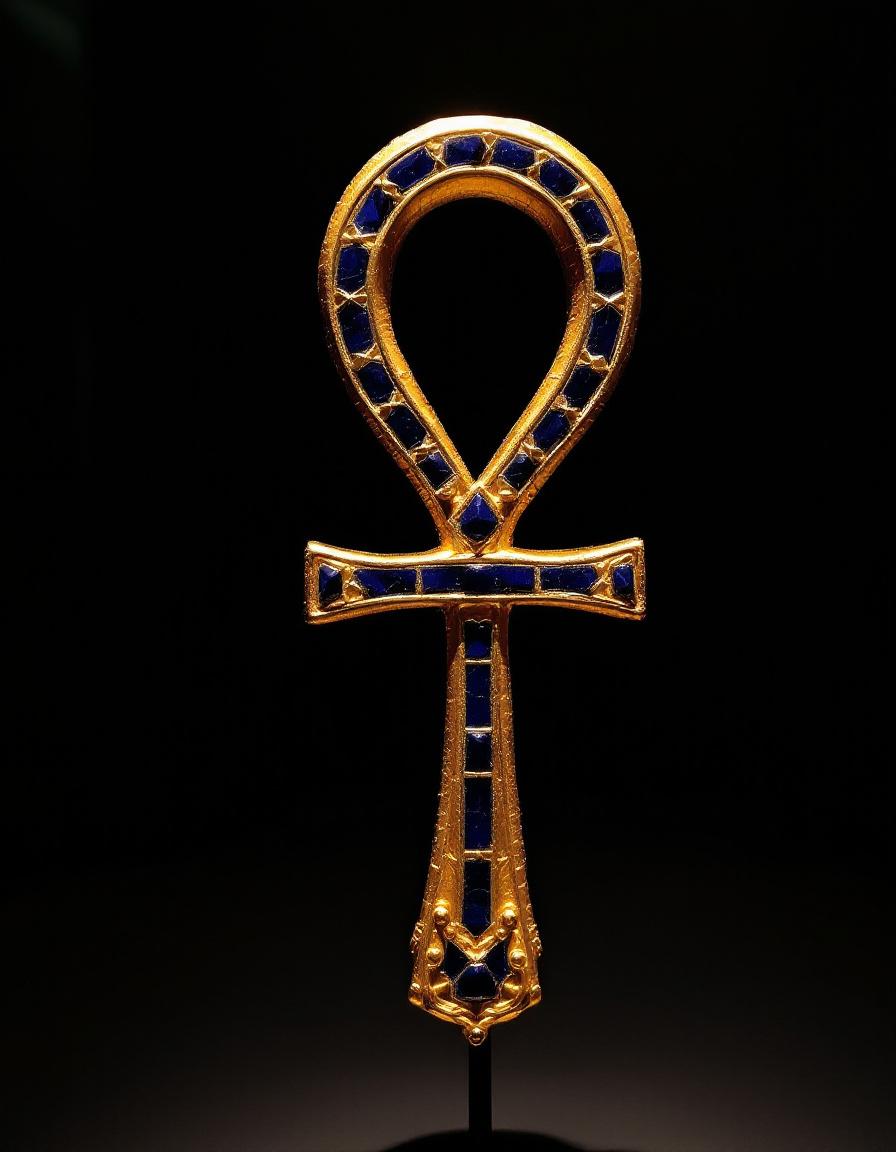
The ankh (Egyptian ☥) is among the most ancient and most elegant sacred symbols ever devised. It is a cross with a loop or teardrop shape replacing the top arm — a form that has fascinated archaeologists, mystics, and designers for centuries and that appears in Egyptian art so consistently and so centrally that it is difficult to overstate its importance. Every significant deity in the Egyptian pantheon is depicted carrying the ankh. Osiris holds it at his chest. Isis extends it to protect the dead. Ra carries it as an attribute of his solar power. The gods are shown pressing the loop of the ankh to the nose of the pharaoh or the nostrils of the dead in the ritual of breathing life — for the ankh is literally the breath of eternal life being conferred from the immortal to the mortal.
The geometry of the ankh encodes a profound symbolic message. The lower portion is a standard equal-armed cross — the Trion Re cross, the symbol of material existence with its four directions, four elements, and four-cornered world. The upper portion is a loop: a closed circular or ovoid form sitting above the intersection of the cross arms. In sacred geometric terms, this loop is a Vesica Piscis or an upright oval — the primordial form of the womb, the egg, the enclosed creative space. The ankh is thus the union of the circle (the eternal, the infinite, the feminine) and the cross (the finite, the directional, the masculine) in a single integrated form. It is the hieros gamos — the sacred marriage of two principles that together generate life itself.
The Egyptians read the ankh as the union of Osiris (the masculine, the cross, the dead-and-resurrected god) and Isis (the feminine, the circle, the creative mother of the world). Their sacred marriage — whose child is Horus, the living pharaoh — is the generative principle of existence itself: not merely the biological generation of offspring but the cosmic principle by which spirit enters matter and matter is elevated toward spirit. The ankh worn as an amulet, the ankh offered by the gods, the ankh inscribed on the walls of tombs — in every context it carries this message: the two principles are not opposed but complementary, and their meeting point is life.
The early Coptic Christians of Egypt did not discard the ankh but transformed it into the Coptic cross (☩), retaining the looped top in modified form and integrating it into their own symbolic vocabulary. This is not a case of cultural appropriation but of recognition: the early Coptic tradition understood that the cross principle it was working with was not new, not exclusively Christian, but ancient — as ancient as Egyptian civilisation, and ancient before that. The Coptic cross carries the thread of meaning forward across the religious boundary, acknowledging that certain geometric truths belong not to any particular faith but to the geometry itself.
In a remarkable parallel, the Venus glyph (♀) — used in astronomy for the planet Venus and in biology for the female sex — is also a circle above a cross. The Venus glyph is the ankh by another name. Venus/Aphrodite in Greek and Roman mythology is the goddess of love and beauty, and the symbol that bears her name is the same symbolic statement as the ankh: the circle of the eternal feminine poised above the cross of material existence, the spiritual principle presiding over the earthly plane. That this symbol was independently associated with femininity, love, and beauty across the ancient Mediterranean world — and that it is still used universally today — suggests that the form carries something in itself, some immediate intuitive recognition that the circle-above-cross encodes the principle it represents.
The Swastika
The swastika is one of the oldest symbols in the human record, with verified archaeological appearances spanning at least twelve thousand years and cultural distributions so geographically scattered — from the Indus Valley to pre-Columbian America, from ancient Greece to Scandinavia, from early Bronze Age Anatolia to Iron Age China — that independent invention in each location is the only plausible explanation. No diffusion model accounts for the swastika's global distribution. Human cultures in every inhabited region of the planet, encountering the cross as the fundamental spatial symbol, have arrived independently at the same energised, dynamic variant: a cross with its arms bent at right angles in the same rotational direction.
The word "swastika" derives from Sanskrit: su (well, good) + asti (it is) + ka (a nominal suffix) — roughly "that which is associated with well-being" or "the symbol of goodness." This etymology is not incidental decoration; it reflects the symbol's original function. In Hinduism and Buddhism, where the swastika has been in continuous unbroken use for thousands of years, it carries meanings of auspiciousness, prosperity, solar energy, and cosmic creative power. It appears on the soles of the Buddha's feet, on Hindu temples, on Jain manuscripts, on Buddhist prayer flags, and on the thresholds of homes across India, Southeast Asia, and East Asia as a symbol of good fortune and divine blessing. These traditions have never abandoned it; for more than a billion people in Asia, the swastika remains what it has always been.
Geometrically, the swastika is the equal-armed cross set in rotation. The four arms are identical in length; the four bends are all at the same angle (90°) in the same rotational direction — either clockwise (the right-facing swastika) or counterclockwise (the left-facing variant, sometimes called the sauwastika). The rotational quality of the swastika expresses something the static cross does not: dynamism. The cross is the static structure of the material world — four directions, four elements, balanced equilibrium. The swastika is that same structure in motion: the wheel turning, the sun moving through the year, the seasons cycling, the galaxies spinning. It is the cross as a process rather than a position, matter as energy rather than matter as form.
In Vedic cosmology the swastika is explicitly a solar symbol — the sun wheel, the spinning disc of the sun as it moves through the heavens. The right-facing swastika corresponds to the clockwise motion of the sun through the northern sky; the left-facing variant to its counterclockwise motion from other perspectives. The swastika appears on the sun chariots of ancient India, on the solar wheels of Bronze Age Scandinavia, on the solar pottery of pre-Columbian cultures in North America. The correspondence is independent across all these cultures, and it points to the same geometric intuition: if the cross is the framework of space, the swastika is the framework of space-in-time, the dynamic cross, the spatial structure caught in the act of turning.
The appropriation of this ancient symbol by the Nazi party of Germany in the twentieth century represents one of the most devastating perversions of a sacred symbol in human history. The choice was deliberate: the Nazi regime sought to associate itself with both Germanic heritage and a sense of cosmic power, and the swastika was selected precisely because of its ancient prestige. The desecration was total and lasting in the Western world — in Europe and the Americas, the swastika cannot be separated from the horror of the Holocaust and the crimes of the Third Reich. And yet the symbol itself is thousands of years older than its modern misuse, and in Asia its original meaning has never been interrupted. The task, perhaps, is to hold both truths simultaneously: to refuse the Nazi appropriation while also refusing to surrender the ancient symbol entirely to the crime done in its name. The geometric form — the cross in motion, the sun wheel, the dynamic fourfold — is innocent of the uses to which it was put, and remains one of the most eloquent expressions of the Trion Re principle.
The Dharma Wheel
The Dharmachakra — the Dharma Wheel — is the central and most ancient symbol of Buddhism, appearing from the earliest Buddhist art of the third century BC (in the reign of Ashoka, who placed it on the pillars marking the sites of the Buddha's life) to the modern flag of India, which bears it at its centre. The wheel form was already sacred before the Buddha: it is the wheel of the sun, the wheel of cosmic time, the wheel of the Hindu concept of samsara (the cycle of birth, death, and rebirth). The Buddha's first teaching after his enlightenment is called the "First Turning of the Dharma Wheel" — the dharma (teaching) is represented as a wheel set in motion, a form that will roll through time and space carrying the force of liberation.
The Dharma Wheel has eight spokes, and the number eight is the key to its geometric significance. Eight arises from the square through the simplest possible operation: take a square, rotate it 45°, and you have a second square; the two squares together produce an eight-pointed star, and their outlines define an octagon. The octagon is the geometric bridge between the square (4-fold symmetry, 90° angles) and the circle (infinite rotational symmetry) — it is the form that arises when you refine the square toward the circle. The eight spokes of the Dharma Wheel are eight because they divide the circle into octagonal segments, and the octagon is the natural development of the fourfold cross principle.
The eight spokes represent the Noble Eightfold Path, the Buddha's prescriptive teaching on the way of life that leads to liberation: right view, right intention, right speech, right action, right livelihood, right effort, right mindfulness, and right concentration. These eight are not arbitrary; they represent the natural octagonal division of human moral, mental, and practical life into its essential dimensions, just as the octagon is the natural geometric division of the circular whole into eight equal parts. The structure of the teaching and the structure of the geometric form mirror each other because they are both expressions of the same underlying principle of eightfold balance.
The wheel as a whole is also a map of the Buddhist path at the structural level. The hub represents discipline (sila) — the still, stable centre around which all else turns, without which the wheel cannot roll. The spokes represent wisdom (prajna) — the radiating lines of insight that connect the hub to the rim, the centre to the circumference. The rim represents meditation (samadhi) — the binding, enclosing, sustaining circle that holds all the spokes together and maintains the integrity of the form. The wheel works only if all three elements are present and integrated: a hub without spokes cannot support a rim; spokes without a hub spin free; a rim without spokes collapses. The Dharma Wheel is a geometric proof that discipline, wisdom, and meditation are not three separate practices but one integrated practice — a wheel that rolls only when all three are present.
The appearance of the Dharma Wheel in the dead centre of the Indian flag (adopted 1947) places it in the most symbolically charged position imaginable: the white field between the saffron (courage) and green (faith) stripes, with the wheel's navy blue spokes radiating outward from the central hub. Prime Minister Nehru, speaking about the flag's design, described the wheel as representing the eternal wheel of law and the dynamic movement of the nation. The ancient sacred geometry of the Trion Re cross, flowing through the Buddhist Dharma Wheel, ended up at the symbolic heart of the world's largest democracy.
The Star of Lakshmi
The Star of Lakshmi, also known as the Ashthalakshmi star or the octagram, is formed by superimposing two squares rotated 45° relative to each other — exactly the operation that produces the octagon from the square, but here the full overlapping squares rather than their outer outline are retained. The result is an eight-pointed star, its eight points alternating between the corners of the two parent squares, with a regular octagon forming in the centre where they overlap. It is one of the most beautiful and harmonious of all geometric figures, and it appears with remarkable consistency across cultures: in Hindu temple floors, in Islamic geometric art, in Byzantine mosaics, in the rose windows of Gothic cathedrals, in the ancient Mesopotamian symbol of Ishtar/Venus, and in Celtic knotwork.
Lakshmi is one of the principal goddesses of Hinduism — the consort of Vishnu, the goddess of wealth, prosperity, beauty, grace, and abundance. She is depicted seated or standing on a lotus flower, gold coins streaming from her upraised hands, flanked by elephants. Her eight-pointed star (the Shri Yantra of Lakshmi, distinct from the more complex Sri Yantra described elsewhere) represents the Ashta Lakshmi — the eight forms or aspects of wealth and abundance. These eight are: Adi Lakshmi (primal abundance, the source of all wealth), Dhana Lakshmi (material prosperity), Dhanya Lakshmi (abundance of grain and food), Gaja Lakshmi (power, royalty, and the abundance of elephants), Santana Lakshmi (the wealth of progeny, family, and continuity), Veera Lakshmi (courage and the victory that comes from it), Vidya Lakshmi (the wealth of knowledge and learning), and Vijaya Lakshmi (the abundance of success and achievement). The eight points of the star hold these eight dimensions of a fully flourishing life.
Geometrically, the Star of Lakshmi arises naturally from the Trion Re construction. The Trion Re produces four outer nodes forming a square. Rotating that square 45° produces a second square. The two squares together generate the eight-pointed star. The entire symbolic vocabulary of the Star of Lakshmi — eight-fold abundance, the octagonal completeness of prosperity — is thus implicit in the fourfold construction of the Trion Re from the moment the fourth circle is placed. One square is the Trion Re at rest; two squares at 45° is the Trion Re in dynamic balance with itself, the fourfold principle doubled and harmonised.
In Islamic geometric art, which developed from the eighth century onward and reached its peak in the architecture of the Alhambra, the Great Mosque of Córdoba, and the Shah Mosque of Isfahan, the eight-pointed star (called khatim, the seal) is one of the fundamental tiles of the infinite geometric patterns that cover walls, ceilings, and floors. Islamic geometric art is perhaps the most sophisticated development of the sacred geometry of the cross and square in any artistic tradition: working from the prohibition on figurative images in a religious context, Muslim artists turned to pure geometric pattern and produced some of the most complex, visually intoxicating, and mathematically interesting art ever made. The eight-pointed star is their basic unit; the Trion Re principle is their foundation.
In ancient Mesopotamia, the eight-pointed star was the symbol of Ishtar (later Astarte, later Aphrodite, later Venus) — the planet Venus, goddess of love, beauty, desire, and war. The planet Venus traces an almost perfect five-pointed star (pentagram) in the sky over an eight-year cycle, and it was observed and tracked with great precision by Babylonian astronomers. The eight-pointed star of Ishtar represents the eight appearances of Venus in that cycle — four as morning star, four as evening star. The goddess of love and the geometry of the Star of Lakshmi share the same form across two entirely independent civilisations, suggesting once again that the geometry carries something intrinsic, that the eight-pointed star really does belong to the principle of abundance, beauty, and completeness in a way that human symbolic intelligence recognises independently wherever it encounters the form.
Architecture and Cosmology
The square — and its three-dimensional extension, the cube — is the geometric form most completely associated with the material world, the earth, the body, and the built environment of human civilisation. From the moment human beings began to construct permanent shelter, cultivate fields, plan cities, and organise territory, the square and the right angle have been their primary tools. This is not merely cultural convention; it is geometric necessity. The right angle is the only angle that can tile the plane without gaps or overlaps using a single tile shape, making the square and rectangle the most efficient forms for covering ground and enclosing space. The right angle is also the angle that allows structures to stand without lateral force: a wall built at 90° to the ground does not push horizontally, does not generate shear forces, does not tend to topple. Every building that has ever stood is a testimony to the right angle. The right angle that emerges from the Trion Re construction is the founding geometric principle of human civilisation's physical dimension.
The Kaaba — the cubic structure at the centre of the Masjid al-Haram in Mecca, which is the holiest site in Islam and the direction toward which every Muslim on earth orients their prayer — is a cube draped in black silk embroidered in gold. Muslim tradition holds that the Kaaba was first built by Adam, rebuilt by Ibrahim (Abraham) and his son Ismail, and has been at the centre of Islamic devotion since the faith's founding in the seventh century. The Kaaba's cubic form is not incidental: the cube represents the most stable, most complete, most self-contained expression of the fourfold principle in three dimensions. The House of God is a cube because the cube is the geometric form of the earth, of matter, of the fully manifest four-dimensional world. To circumambulate the Kaaba — to walk around it in the ritual of tawaf — is to move around the geometric centre of the material world, acknowledging that at the heart of matter there is a sacred stillness.
The New Jerusalem described in the Book of Revelation is a city that "lies foursquare" — a cube of extraordinary size, with walls of jasper, streets of pure gold, and twelve foundations each bearing the name of one of the twelve apostles. The dimensions given (12,000 stadia on each side) produce a perfect cube. The Holy City as a cube is not a coincidence of apocalyptic imagery; it draws on the same ancient understanding that the cube is the form of the perfected material world, the earth raised to its highest expression, the fourfold principle of matter brought to completion and radiance. Similarly, the Holy of Holies in Solomon's Temple — the innermost sanctuary where the Ark of the Covenant was housed and where the presence of God was understood to dwell — was a perfect cube of ten cubits on each side. In the most sacred spaces of the Abrahamic traditions, the divine meets the material world in the form of the cube.
At the atomic scale, the cubic structure is the form of some of the most significant and beautiful minerals on earth. Salt (sodium chloride) crystallises in perfect cubes visible to the naked eye — the geometry is not metaphor but physical reality. Galena (lead sulphide), pyrite ("fool's gold"), fluorite — all crystallise in cubic or related forms. The face-centred cubic lattice (FCC) and body-centred cubic lattice (BCC) are the crystal structures of most metals, including gold, silver, copper, aluminium, iron, and tungsten. The mechanical properties of metals — their ductility, hardness, conductivity — are direct consequences of the cubic lattice geometry at the atomic scale. The cube is not a human choice imposed on the material world; it is the form that matter takes when atoms of similar size pack together under the forces of attraction and repulsion that govern chemical bonding. The fourfold principle of the Trion Re is the geometry of matter at rest.
The Platonic solid corresponding to the element of Earth is the cube (hexahedron) — the solid with six square faces, twelve edges, and eight vertices. Plato assigned the cube to earth in his Timaeus on the grounds that the cube is the most stable and immovable of the regular solids: it rests flat on any of its six faces, it cannot be rolled, and its faces pack perfectly with no wasted space. Where the tetrahedron (fire) is sharp and penetrating, and the icosahedron (water) is round and fluid, the cube is solid, stable, and grounded — the form of the material world that can be walked upon, built upon, and inhabited. The Trion Re, which produces the square, is thus the construction that points toward the cube — the three-dimensional form of the earth, the geometric body of the world.
Conclusion
The cross and the square — the Trion Re and its geometric children — represent something more fundamental than any single cultural tradition can claim. They are the geometry of orientation, the geometry of stability, the geometry of the built world. The right angle that emerges from the fourth circle is the angle upon which every human structure depends: every wall, every room, every city block, every agricultural field, every grid of streets is a testimony to the power of the perpendicular. And the cross that emerges alongside the square is the map of space itself — the two-dimensional diagram of how a conscious being orients itself in the world, choosing a centre and naming the four directions.
What the sacred geometry of the cross adds to the purely structural account is the recognition that the centre — the intersection point, the origin of the coordinate system — is not merely a mathematical convenience but a symbolic reality of the highest order. Every sacred space in every tradition defines a centre. The axis mundi — the world axis, the centre of the world — is the vertical arm of the cosmic cross; the four quarters of the world are its horizontal arms. The Kaaba, the Jerusalem Temple, the Buddhist stupa, the Celtic sacred enclosure, the Aztec sun stone — all organise sacred space around a central point from which the four arms of the cross extend to the four directions. This universal convergence is not cultural accident; it is the response of human symbolic intelligence to the genuine geometric reality of the cross, which really does structure space, really does define a centre and four directions, really does create the coordinate system within which all orientation and all meaning are possible.
The Trion Re — four circles, a diamond of centres, an emergent square, a structural cross — is the geometric moment at which the infinite and undirected space of the plane acquires the structure needed for the material world: four corners, four directions, a centre, a skeleton of right angles. Heaven had the circle. Earth needed the cross. The fourth circle brought them together.
In the next chapter, we explore The Seed of Life — the seven-circle pattern that completes the first ring and reveals the hexagonal geometry of nature.
FAQ
How does the cross emerge from sacred geometry?
The cross arises naturally from the Trion Re — the four-circle arrangement. When a fourth circle is placed at the lower intersection node of the Vesica Piscis (completing the diamond pattern begun by the Trinity), the four circle centres define a vertical and horizontal axis that cross at right angles. The 90° angle is not imposed but emerges spontaneously from the intersection geometry of four equal circles.
What is the relationship between the cross and the square?
Both emerge from the same four-circle construction (the Trion Re). The cross is formed by connecting the four circle centres, while the square is formed by connecting the four outer intersection nodes where non-adjacent circles cross. The 60° geometry of the triangle and the 90° geometry of the square are revealed as two aspects of a single deeper geometric reality.
Why is the cross found in so many cultures?
The cross appears independently across nearly every civilisation — as the Christian cross, the Egyptian ankh, the Hindu swastika, the Buddhist dharma wheel, and the Star of Lakshmi — because it represents the four cardinal directions, four elements, four seasons, and the fundamental fourfold structure of three-dimensional space. Its universality reflects the geometric inevitability of the form itself.
What is the Star of Lakshmi?
The Star of Lakshmi (Ashtalakshmi) is an eight-pointed star formed by overlapping two squares rotated 45° to each other. It appears in Hindu, Islamic, and Christian traditions and represents the union of the four cardinal directions with the four diagonal directions — the complete set of eight compass points, encoding the full symmetry of the square in the plane.