The Monad
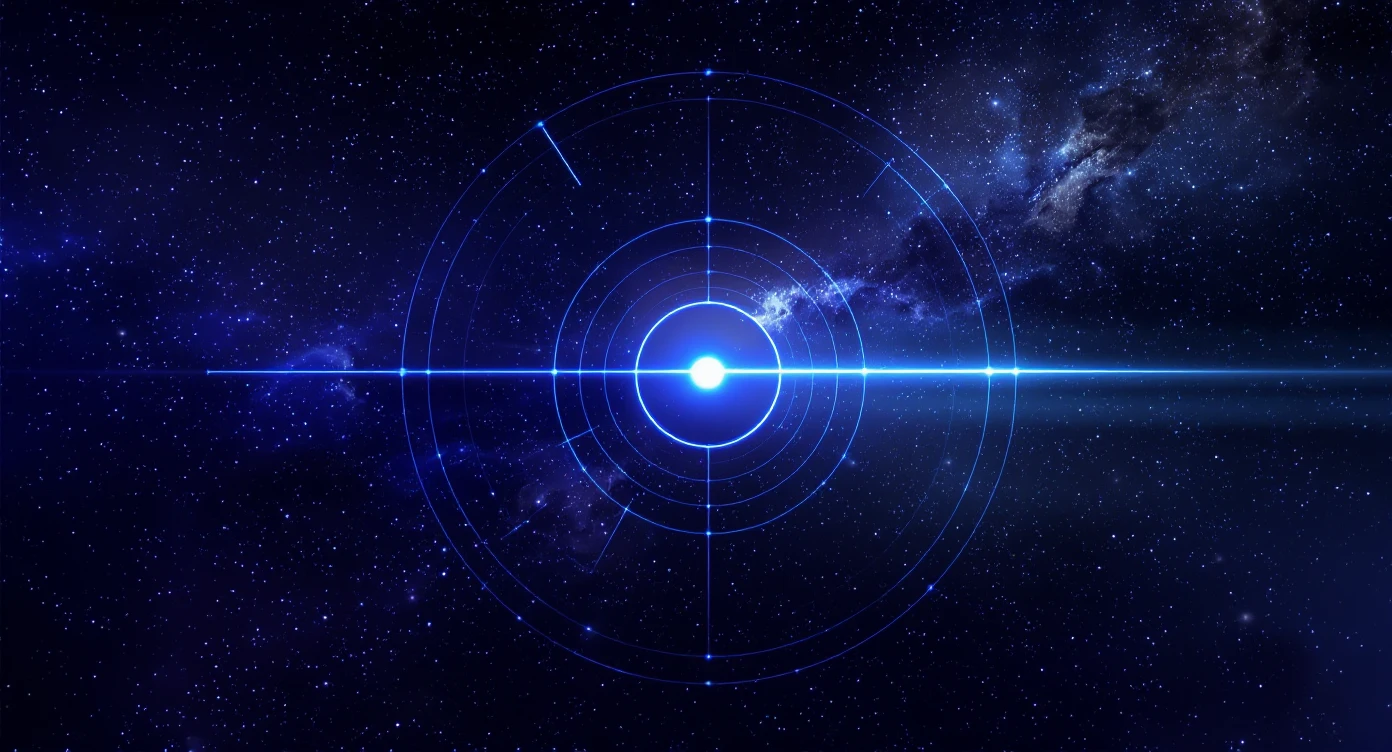
In Pythagorean philosophy, the circle was called the Monad — from the Greek monos, meaning alone, single, undivided. It was not merely a shape. It was the first principle, the source from which all number, all form, and all existence proceeded. The Monad was considered divine not because it was worshipped, but because it was whole — containing everything within itself, lacking nothing, reducible to nothing simpler.
This idea — that the circle represents totality, the absolute, the beginning and end of all things — appears independently in virtually every major civilisation that has ever existed. It is one of the most consistent symbols in the entire history of human thought.
Key takeaways
- The circle is the most symmetrical 2D form, with infinite axes of symmetry — the natural result of a single centre and a single radius. Every other form in sacred geometry is derived from it.
- Every major civilisation independently recognised the circle as the symbol of totality and the divine — from the Egyptian Aten and Ouroboros to the Zen Ensō, the Taoist Taijitu, the Islamic dome, the Hindu mandala, and the Aztec Sun Stone.
- The dot and the circle are inverse principles: the dot is infinite contraction (the infinity within), the circle is infinite expansion (the infinity without) — and together they express the two primal forces of existence.
Across Cultures
In ancient Egypt, the sun disc — the Aten — was the supreme expression of the divine. The Ouroboros, the serpent swallowing its own tail to form a circle, was the symbol of eternity and the self-renewing cosmos, found in the oldest Egyptian funerary texts and later carried into Gnostic, alchemical, and Hermetic traditions across the world.
In ancient Greece, the Pythagoreans taught that the circle was the most perfect of all forms — the form of the cosmos itself, the shape of the celestial spheres, the natural boundary of the divine. Plato, following this tradition, described the universe as a sphere in the Timaeus, and identified the circle with the soul's capacity to return to its own source.
In Zen Buddhism, the Ensō — a circle drawn in a single brushstroke — is one of the most important symbols in the tradition. It expresses the moment of freedom, the universe, emptiness, and wholeness simultaneously. Some Ensō are left open; others closed. Both are correct. The open circle suggests incompleteness and the continuing nature of becoming; the closed circle, perfection and fullness. Together they hold the paradox at the heart of existence.
In Taoism, the circle is implicit in the Tao itself — the way that has no beginning and no end, the undifferentiated ground of being from which all things arise and to which all things return. The Tai Chi symbol, the interplay of yin and yang within a circle, expresses the dynamic wholeness of the cosmos: two forces, opposite and complementary, held within a single, unbroken boundary.
In Islam, the circle is the primary geometric element in all sacred art and architecture. The dome — the three-dimensional expression of the circle — crowns every mosque, drawing the eye upward from the multiplicity of the world to the unity of the divine. The intricate geometric patterns that tile Islamic sacred spaces are all generated from circles: overlapping, interlocking, expanding outward from a centre in an infinite tessellation that symbolises the boundless nature of Allah.
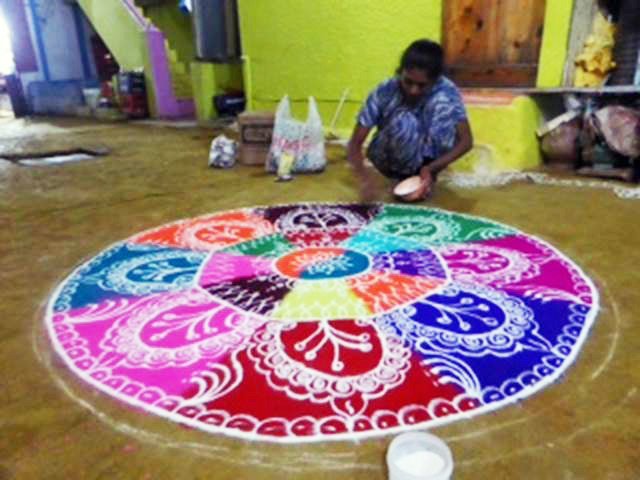
In the Hindu and Buddhist traditions, the mandala — meaning circle in Sanskrit — is the fundamental diagram of the cosmos, a geometric model of the universe used in meditation, ritual, and sacred architecture. The circle of the mandala defines the sacred space at its centre, and the journey from the outer ring to the inner point is understood as the journey from multiplicity back to unity.
In pre-Columbian Mesoamerica, the Aztec Sun Stone — often called the Aztec Calendar — is a vast circular diagram encoding the cycles of time, the cosmos, and the solar deity at its centre. The circle is again the container of all things, the form that holds time itself.
Geometric Meaning
Every point on the circumference of a circle is exactly equidistant from the centre. This single defining property makes the circle the most symmetrical of all two-dimensional forms — it has infinite axes of symmetry, infinite lines of reflection, and perfect rotational symmetry at every angle. No other shape comes close.
This is not a coincidence of design. It is a consequence of the most basic possible act of drawing: fix a point, set a distance, sweep around. The circle is the natural result of a single centre and a single radius. It cannot be anything other than what it is. In this sense the circle is not invented — it is discovered, or rather revealed, by the act of keeping one point still while another moves at a constant distance.
The ratio of any circle's circumference to its diameter is always π — approximately 3.14159 — regardless of the size of the circle. This constant, irrational and transcendental, cannot be expressed as any exact fraction and its decimal expansion never repeats or terminates. It is one of the fundamental constants of the universe, woven into the fabric of mathematics at the deepest level. The ancients who worked with circles did not know π as we define it today, but they sensed its inexhaustibility. The circle contained something that could never be fully captured, only approached. For the mathematical properties of the circle — tangents, secants, and theorems — see the Guide to Geometry: The Circle.
The Circle and the Dot
The dot and the circle are the inverse of each other. The dot is a point — zero dimensions, no extent, pure location. The circle is the expression of that point in space — the boundary created by rotating around it at a fixed distance. Where the dot contracts to nothing, the circle expands to encompass everything.
In sacred geometry this inversion is fundamental. The dot is described as the infinity within — a point of infinite density, like a singularity, drawing everything inward toward a centre that cannot itself be reached. The circle is the infinity without — a boundary that expands outward, that can always be enlarged, that has no natural end. These two movements — inward and outward, contraction and expansion, the particular and the universal — are the two primal forces of existence, and the circle is their first geometric expression.
We see this in physics too. A stone dropped into still water creates a dot of impact — and the response of the water is a circle, expanding outward in all directions equally. The source is a point; the effect is a circle. This pattern — point source, circular expansion — appears everywhere in nature, from the ripples of water to the propagation of light, from the growth rings of a tree to the shockwave of an explosion.
The Womb of Creation
In sacred geometry, the circle is often called the Womb of Creation — not as a metaphor but as a precise description of its generative role. The first circle, drawn from a single point, establishes all the ingredients needed for everything that follows: a centre, a radius, a circumference, and an infinite set of potential new centres along that circumference.
The moment a second circle is drawn — its centre placed on the circumference of the first, its radius equal — the two circles intersect, and something new appears that was not present in either circle alone. Two new points emerge from the intersection, equidistant from both centres. A relationship has been created. Space has been structured. From this first meeting of two equal circles, the entire unfolding of sacred geometry begins.
The circle does not begin as one form among many. It begins as the one form from which all others come.
Yin and Yang
Of all the symbols humanity has drawn within the circle, the Taoist Taijitu — the "diagram of the supreme ultimate," known in the West as the Yin-Yang symbol — may be the most philosophically complete. A circle divided by an S-curve into two equal halves, one dark (Yin) and one light (Yang), each containing a small circle of the opposite colour at its widest point: this deceptively simple image encodes one of the most sophisticated insights in the history of philosophical thought. It is not a statement about two things in opposition. It is a statement about the nature of all apparent opposites — that they are not independent but interdependent, each defined by and containing the seed of the other, perpetually generating and resolving into each other within the unbroken boundary of the circle.
The symbol's geometric construction is more precise than it first appears. The dividing S-curve is not an arbitrary wave but is composed of two semicircles, each of half the radius of the outer circle, their centres placed at the midpoints of the upper and lower halves of the vertical diameter. The result is a construction built from three circles in the exact ratio 1 : ½ : ½ — the outer boundary and two inner semicircles, their total geometry perfectly balanced so that each curved half-region has exactly the same area as the other. The two small inner circles (the seeds of each polarity within the other) are each one quarter the diameter of the outer circle. The entire figure is thus an intricate nested proportion of circles, constructed without any straight line whatsoever — a form generated entirely by the curved logic of the circle itself.
The philosophical tradition that crystallised the Taijitu has deep roots. The concept of Yin and Yang — complementary, mutually arising, dynamic opposites — runs through the I Ching (Book of Changes), one of the oldest texts in the Chinese tradition, dating from at least the Western Zhou dynasty (circa 1046–771 BCE) and drawing on divinatory practices far older still. In the I Ching, the broken line represents Yin and the unbroken line represents Yang, and the sixty-four hexagrams generated by combining six such lines represent every possible configuration of cosmic polarity. The Taijitu gives this philosophical structure a geometric body. Its most celebrated textual articulation came from the Neo-Confucian philosopher Zhou Dunyi (1017–1073 CE), whose cosmological diagram Taijitu shuo ("Explanation of the Diagram of the Supreme Ultimate") described the primordial Wu Ji (the limitless, the empty, the state before differentiation) giving rise to the Tai Ji (the supreme ultimate, the first differentiation), from which Yin and Yang emerge, from which the five phases emerge, from which heaven and earth and all ten thousand things emerge. This is a cosmological account of creation that maps remarkably onto the sacred geometry sequence: Wu Ji is the void before the first circle; Tai Ji is the first circle, the Monad; Yin and Yang are the first polarity, the two complementary arcs of the Vesica Piscis; and the ten thousand things are all the forms that follow from that first geometric differentiation.
What is philosophically radical about the Taijitu — and what distinguishes it from simple dualism — is the principle that each polarity contains within itself the seed of its opposite. The light half contains a dark point at its heart; the dark half contains a light point at its heart. This means that no state is absolute or self-sufficient. Yang at its maximum is already beginning to become Yin; Yin at its fullest is already turning toward Yang. The movement between them is not linear but cyclical, not static but dynamic, not a conflict between two irreconcilable forces but a dance in which each partner is continually generating the other. This principle — that opposites are not binary but cyclical, not fixed but fluid — appears in physics wherever we look carefully at the structure of matter. Matter and antimatter are complementary opposites that define each other and annihilate each other when they meet. Positive and negative electric charges are symmetrically defined — neither more fundamental than the other. North and south magnetic poles cannot be separated; cut a magnet and you create two magnets, each with both poles intact. The Taijitu encodes these physical realities as a geometric truth about the nature of the circle: a boundary that contains all polarities within itself, undivided at the deepest level.
In the language of sacred geometry, the Yin-Yang is the circle expressing the principle of inverse geometry at its most elegant. The dot that becomes a circle, the inside that becomes the outside, the contraction that implies expansion — all of these are expressed in the S-curve that divides the circle while maintaining its wholeness. The boundary between Yin and Yang is itself made of arcs — it is not straight, not linear, not a simple division but a curved path that belongs equally to both sides. This is the geometric statement of the philosophical insight: the boundary between opposites is not a wall but a dynamic curve, a living path of transition through which each polarity flows continuously into the other, and the circle that contains them both is not diminished by their difference but made complete by it.
The Ouroboros
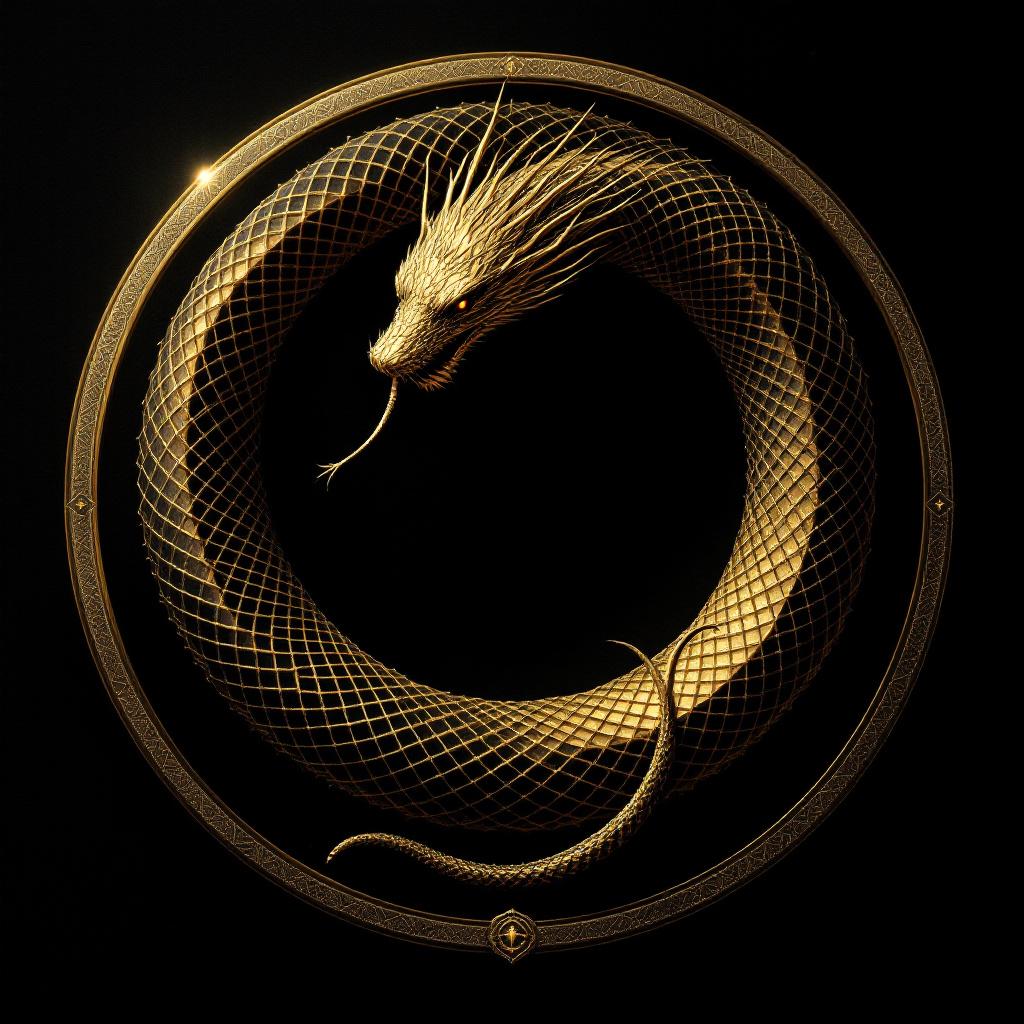
The serpent or dragon devouring its own tail — the Ouroboros, from the Greek oura (tail) and boros (eating) — is one of the oldest symbols in the human record. Its earliest firmly dated appearance is in the Egyptian Enigmatic Book of the Netherworld, inscribed in the tomb of Tutankhamun and related New Kingdom funerary texts dating to approximately 1600–1350 BCE. In these texts, two Ouroboros serpents encircle the body of Ra as he passes through the underworld during the twelve hours of night, their circular forms providing the boundary within which the sun god undergoes his nightly death and rebirth. The Ouroboros here is not merely decoration; it is the cosmological container — the form of eternity that holds even the god of light within its self-completing cycle. The sun must travel through darkness to rise again; the circle must return to its beginning to continue. The serpent that eats its own tail is the geometric signature of that necessity.
From Egypt the symbol travelled with extraordinary persistence across cultures separated by centuries and oceans. In Phoenician tradition, Sanchuniathon records a world-encircling serpent as part of the primordial cosmogony — the circle of being that surrounds and constitutes the material world before differentiation begins. In Norse mythology, the Ouroboros appears as Jörmungandr, the Midgard Serpent, the offspring of Loki so vast that it encircles the entirety of Midgard (the human world) and bites its own tail. Jörmungandr holds the world together by its self-encirclement; when it releases its tail — at Ragnarök, the end of the world — the cosmos dissolves. In Gnostic texts, the Ouroboros appears as the boundary of the material world, the outermost sphere of the demiurge's creation, the limit beyond which lies the Pleroma — the fullness of the divine. The material world is an Ouroboros: self-contained, self-referential, enclosed within its own logic, generating and consuming itself continuously.
The alchemical tradition gave the Ouroboros its most richly developed symbolic life. In manuscripts from Alexandrian Egypt through medieval Europe, the Ouroboros appears consistently as the symbol of the prima materia — the undifferentiated original substance from which all other substances are derived and into which all eventually return. The alchemical motto often accompanying the image — Hen to pan, Greek for "One is the All" or "The All is One" — encapsulates the symbol's philosophical content: the circle is simultaneously the beginning and the end, the cause and the effect, the container and the contained. The philosopher's stone, the goal of the Great Work, is the Ouroboros completed — the cycle of transformation fully closed, matter fully understood in its cyclical self-renewal. When the alchemist achieved the stone, they had not produced something new from without; they had recognised what matter already was — a process of perpetual self-transformation, circular in its deepest nature.
Carl Jung, in his extensive engagement with alchemical symbolism, identified the Ouroboros as one of the most important archetypal images of the unconscious — perhaps the primary image of the unconscious itself. For Jung, the unconscious was the total psyche, containing everything that has been experienced and forgotten, everything repressed or undeveloped, everything that the conscious ego has not yet integrated. Like the Ouroboros, the unconscious contains its own negation — it holds both the light and the shadow, both the known and the unknown, both the drives that propel consciousness forward and the undertow that would dissolve it back into undifferentiated wholeness. The Ouroboros as an image of the unconscious says: this is the container of everything, including the awareness that is doing the containing. The serpent that eats its tail is the image of self-reference made visible — the system that includes itself as an element, the knower that is also the known.
The geometric meaning of the Ouroboros is at once the simplest and the most radical thing that can be said about the circle: the circle has no beginning and no end. This statement is trivially true as a geometric description, but the Ouroboros makes it existentially vivid. The form does not merely represent a closed path; it is a closed path consuming itself, its terminal point coinciding with its point of origin, its end being the mouth from which it began. In sacred geometry, this encodes the principle that the circle is not the drawing of a path but the path that generates itself — that the boundary is simultaneously the process by which the boundary is maintained. Every point on the circumference is equally the beginning and equally the end. Every moment of the circle's existence is both the eating and the being eaten. Time, for the Ouroboros, is not a line with a past at one end and a future at the other; it is a loop in which every moment contains all moments, in which the end already is the beginning, in which the cosmos sustains itself by continuously consuming and regenerating its own substance. The Ouroboros is the circle's secret name for itself: not the Monad at rest, but the Monad in perpetual motion, its stillness and its movement identical, its being and its becoming the same act.
In the next chapter, we explore The Vesica Piscis — the almond-shaped form created when two equal circles overlap, and the womb from which all subsequent geometry is born.
FAQ
Why is the circle considered the most important form in sacred geometry?
The circle is the most symmetrical of all two-dimensional forms — it has infinite axes of symmetry and perfect rotational symmetry at every angle. It is the natural result of a single centre and a single radius, and every other form in sacred geometry is born within it or between circles. The Pythagoreans called it the Monad — the source from which all number, form, and existence proceed.
What is the relationship between π and the circle?
Pi (π ≈ 3.14159) is the ratio of any circle's circumference to its diameter — a constant that is both irrational and transcendental, meaning it cannot be expressed as any exact fraction and its decimal expansion never repeats or terminates. It is one of the fundamental constants of the universe, woven into the fabric of mathematics at the deepest level.
What does the Yin-Yang symbol encode geometrically?
The Taijitu (Yin-Yang) is constructed entirely from circles: the outer boundary and two inner semicircles in the ratio 1:½:½, with the S-curve division composed of two half-circles. It encodes the principle that opposites are not binary but cyclical — each containing the seed of the other — a geometric truth about the circle that mirrors physical realities like matter/antimatter and magnetic polarity.
What is the Ouroboros and why is it associated with the circle?
The Ouroboros — the serpent devouring its own tail — is one of the oldest symbols in human history (dating to c. 1600 BCE in Egypt). It makes the circle's defining property existentially vivid: the form has no beginning and no end, its terminal point coincides with its point of origin. It represents the self-renewing cosmos, eternity, and the principle that creation and dissolution are the same continuous process.