Introduction
All forms in sacred geometry are built with two tools: a compass and a ruler — the curve and the straight line, the female and male principles in a single pair. Beginning with the Monad (a single dot and circle), the pattern unfolds through Vesica Piscis, Trinity, Trion Re, Seed, Egg, Flower of Life, Flower of Light, and Flower of Heaven — a sequence of 61 circles from which thirteen are extracted as the Fruit of Life. Connect their centres and you have Metatron's Cube — the figure that encodes the blueprint of three-dimensional reality.
Key takeaways
- The sacred geometric sequence unfolds from the Monad through Vesica Piscis (2) → Trinity (3) → Trion Re (4) → Seed of Life (7) → Egg of Life (13) → Flower of Life (19) → Flower of Light (37) → Flower of Heaven (61). From those 61 circles, thirteen full adjacent circles are extracted as the Fruit of Life, and connecting their centres produces Metatron's Cube.
- Metatron's Cube encodes the five Platonic Solids: three Simple Solids (tetrahedron, octahedron, cube — built from triangles and squares) and two Higher Solids (dodecahedron, icosahedron — built from pentagons, governed by the golden ratio Φ).
- The Simple Solids form the System of Reality — the spatial structure of objective experience. The Higher Solids form the Ordinance of Reality — the temporal, Φ-governed structure that organises memory and the five-sense experience into sequential moments.
The Sacred Geometric Sequence
All forms in sacred geometry are built with a compass and a ruler — the curve and the straight line, the female and male principles in a single pair of tools. Everything begins with a single dot and circle: the Monad, the seed image of the universe's origin and totality. Set the compass radius to 1 and every subsequent ratio in the pattern is fixed relative to that first distance.
Centre the compass on any point of the circle's edge and draw a second circle of the same radius — the Vesica Piscis is formed. The two overlapping circles create two intersection points — nodes — and from each node a new circle can begin. With every new circle the pattern unfolds:
- Vesica Piscis — 2 circles
- Trinity — 3 circles
- Trion Re — 4 circles, the first petal of the Flower of Life
- Seed of Life — 7 circles
- Egg of Life — 13 circles
- Flower of Life — 19 circles
- Flower of Light — 37 circles
- Flower of Heaven — 61 circles
From the 61 circles of the Flower of Heaven the Fruit of Life can be extracted: thirteen full, adjacent circles that touch but never overlap, lying along the three hexagonal axes through the centre. Connecting all thirteen centres with straight lines produces Metatron's Cube — the final stage of the sequence, the figure believed to encode the blueprint of the multidimensional universe.


Whatever you set the initial compass opening to, the sequence produces exactly the same ratios. The pattern is scale-invariant — a property that lets it exist at every scale, from atomic to cosmic. At each stage more information is encoded as more nodes emerge, and these nodes can be connected in many ways to generate the regular forms — triangles, squares, pentagons, hexagons. Some forms — the heptagon (7-sided), for example — cannot be constructed precisely with compass and ruler, illustrating a natural limitation of form within reality.
The pattern of overlapping circles can be read as the feminine aspect of reality — the curve, the womb, the origin — from which all the masculine straight-edged forms emerge. The Flower is the process; the Fruit is the result; the Cube is the full articulation of what the pattern always contained.
The Number Thirteen
The number thirteen is deeply embedded in the Fruit of Life's geometric significance, and its cultural resonances are worth exploring carefully. In the Western tradition, thirteen has an unfortunate reputation — it is considered unlucky, it is the number that breaks the established order of twelve (twelve apostles, twelve months, twelve signs of the zodiac, twelve Olympians). But this negative association is largely a late development, and it reflects not the intrinsic quality of the number but the anxiety of a system built around twelve when confronted with something that exceeds it. Thirteen is not the destroyer of twelve but its completion: it is twelve plus the centre, the twelve surrounding a one, the group and its organising principle.
In the geometry of sphere packing, thirteen is the number of contact: one sphere at the centre surrounded by twelve touching it, all centres equidistant from the centre sphere. This is the first kissing number — the maximum number of non-overlapping spheres of equal radius that can simultaneously touch a central sphere of the same radius. Twelve spheres touching one has been known since Kepler's time and was rigorously proved to be the maximum in 1953. The arrangement of twelve touching spheres around one is precisely the arrangement of a cuboctahedron — twelve vertices equidistant from the centre, corresponding to twelve sphere centres touching one. Thirteen spheres: the Fruit of Life in three dimensions.
In Mesoamerican traditions, thirteen was a highly significant number — the Maya long count calendar uses thirteen as one of its primary cycles, and the Aztec ritual calendar (the tonalpohualli) has thirteen twenty-day periods, producing a 260-day cycle. In Kabbalistic tradition, thirteen is the value of the Hebrew word for love (ahavah) and also of the word for one (echad) — the two are not distinguished in this counting system, suggesting a deep identification between the principle of unity and the principle of love. The thirteen circles of the Fruit of Life as the concentrated essence of the Flower can be read through this Kabbalistic lens: they are the point at which the many circles of the Flower become, through their specific arrangement, most completely and lovingly one.
The structural significance of thirteen extends into chemistry and atomic physics, with implications that our research takes seriously. Element 13 is aluminium — the first element in the third period to fill a P orbital, and the first element with a stable outer-electron configuration that is not simply a noble gas or an alkali metal but a true metallic structure built on the hexagonal P orbital geometry. More striking are the elements at positions 43 and 61 in the periodic table: technetium (43) and promethium (61). Both are radioactively unstable and do not occur naturally on Earth in any significant quantity — the only two elements below bismuth (83) with no stable isotopes. Our atomic geometry research suggests a connection: if the periodic table is structured according to the expanding Flower of Life geometry, then the gaps at positions 43 and 61 correspond to incomplete geometric configurations — positions in the overall pattern where no stable arrangement of electrons is possible because the required geometric structure cannot be sustained. The missing elements are the missing circles.
Construction
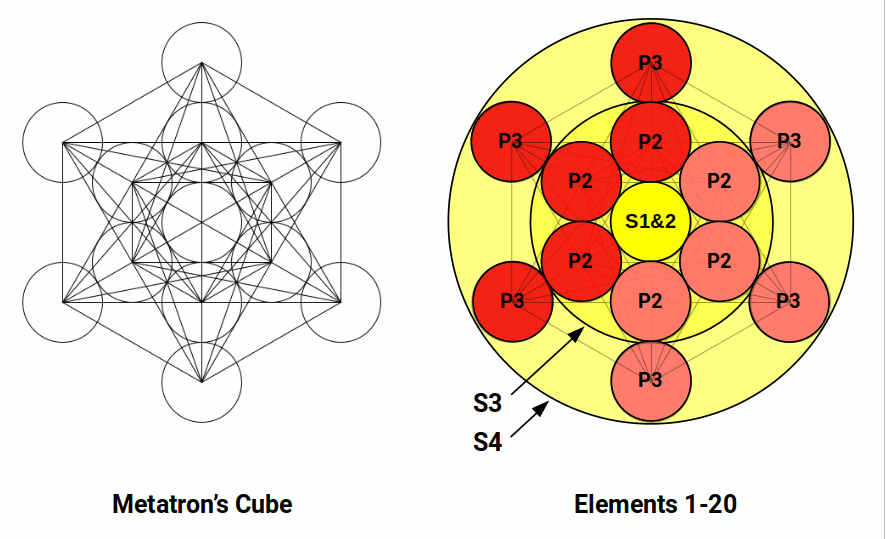
Metatron's Cube is constructed from the Fruit of Life by a single, decisive geometric act: draw a straight line connecting every circle centre to every other circle centre. With thirteen centres, this produces 78 line segments. These lines cross and overlap to create a figure of extraordinary complexity and beauty — a web of straight lines embedded within the circular matrix of the Fruit of Life, making explicit every geometric relationship that was implicit in the arrangement of the circles. The act of construction is itself philosophically significant: the circles contained potential, the lines actuate it. What was possible becomes definite. What was implicit becomes explicit. The connective act of drawing line-of-sight between every point and every other point is the geometric equivalent of perfect mutual awareness: every part of the system is in direct, unmediated relationship with every other part.
The resulting figure, when examined carefully, reveals that within its 78 crossing lines are embedded the two-dimensional projections — the shadow outlines — of all five Platonic Solids. The tetrahedron (four equilateral triangular faces) can be found in the overlapping triangles formed by specific subsets of the 78 lines. The cube appears in the square and rectangular shapes visible in the pattern. The octahedron, the dodecahedron, and the icosahedron are also present — not all at the same scale or orientation, but each identifiable in its characteristic outline within the larger figure. In addition, Metatron's Cube contains the two-dimensional projection of the Star Tetrahedron (two tetrahedra interpenetrating, also called the Merkaba), and the outline of the Cuboctahedron, which is the most energetically balanced of all three-dimensional forms.
The fact that a figure derived solely from connecting the centres of the thirteen circles of the Fruit of Life contains all five Platonic Solids is not a coincidence or a case of creative pattern-finding. It is a geometric theorem: the specific arrangement of the thirteen circle centres creates an underlying lattice that is the same lattice in which all five Platonic Solids can be embedded. The Fruit of Life arrangement was the key; Metatron's Cube is the lock opened. When we draw all the connecting lines, we are not adding external information to the pattern — we are reading the information that the pattern already contained, making visible the architecture that was always present in the arrangement of the circles. The Flower of Life contained the Fruit of Life; the Fruit of Life contains Metatron's Cube; Metatron's Cube contains all five Platonic Solids. It is a succession of revelations, each one already implicit in the first.
The 78 lines of Metatron's Cube also correspond numerologically to significant structures in other traditions. In the Tarot, the traditional deck has 78 cards — 22 Major Arcana and 56 Minor Arcana. Whether this correspondence is coincidental or reflects a deeper common root in esoteric geometric symbolism is a question that cannot be definitively resolved, but it is one that practitioners of both traditions find thought-provoking. The number 78 appears also in triangular number theory: it is the twelfth triangular number (1+2+3+...+12 = 78), connecting Metatron's Cube to the geometry of triangular numbers and the twelve-part structures that appear throughout sacred geometry.
The Angel Metatron
The figure takes its name from Metatron, the archangel of Jewish tradition who led the people of Israel through the wilderness after their exodus from Egypt — a guide through unknown territory, the angel of orientation. The attribution is fitting: just as Metatron orients the wandering, Metatron's Cube orients reality. By connecting every centre of the Fruit of Life to every other, the figure becomes a complete record of every relationship within the pattern — the geometric scaffolding from which the five Platonic Solids and all higher forms emerge.
The Five Platonic Solids
The five Platonic Solids — tetrahedron, cube, octahedron, dodecahedron, and icosahedron — are the only regular polyhedra in existence. Each is built from a single face shape, and each fits perfectly inside a sphere. This is astonishing: in two dimensions an infinite number of regular polygons can be drawn within a circle, but in three dimensions reality becomes limited to five.
These five correspond to the five elements of ancient Greece — fire, water, earth, air, and aether — which today map roughly to the three states of matter (solid, liquid, gas) plus electricity and plasma. We perceive the world through five senses, within five realms; the earth is powered by five ecological cycles; the expansion of the Flower of Life produces five shells. The number five is the deep limit of regular three-dimensional form.
- The tetrahedron — assigned to fire, the most penetrating element
- The cube — assigned to earth, the most stable and space-filling
- The octahedron — assigned to air
- The icosahedron — assigned to water, twenty faces and a form close to spherical
- The dodecahedron — reserved for the aether, the substance of the heavens, its pentagonal faces governed by the golden ratio
Simple Solids and Higher Solids
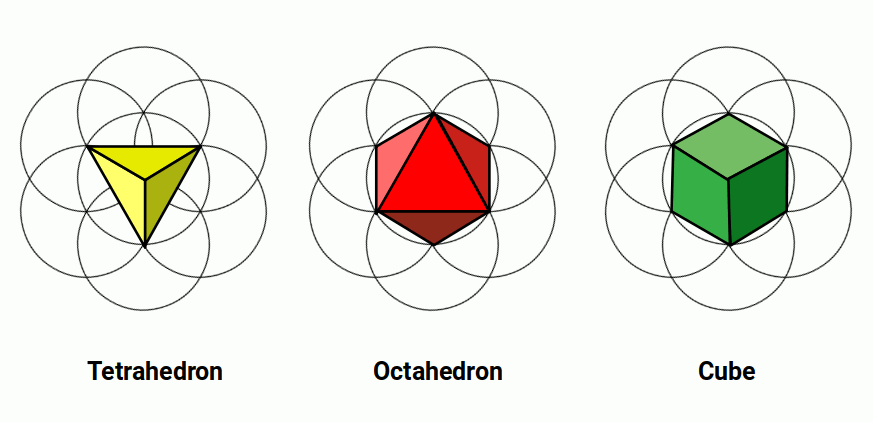
The five solids do not all appear at the same stage of the sacred geometric sequence. The three Simple Solids — the tetrahedron, octahedron, and cube — appear already in the Seed of Life, before the pattern has fully unfolded. The two Higher Solids — the dodecahedron and icosahedron — only emerge at the level of the Fruit of Life. The Simple Solids are built from triangles and squares; the Higher Solids are built from pentagons, governed by the golden ratio (Φ).
The System of Reality
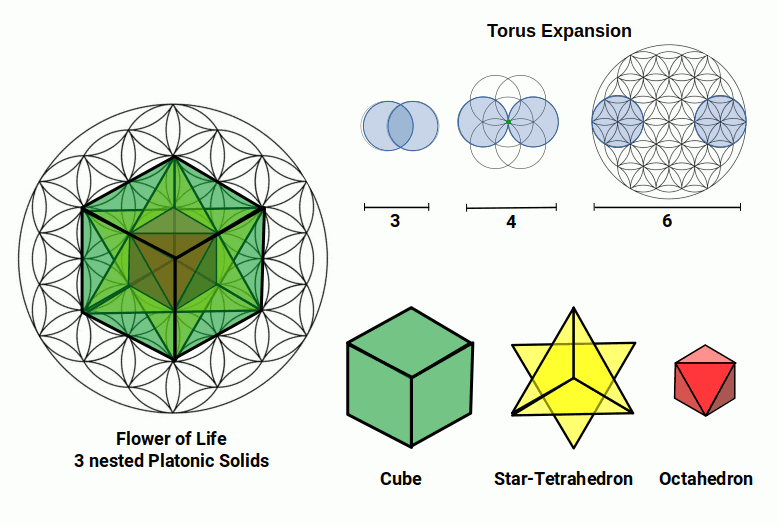
Within the Flower of Life, the three Simple Solids nest perfectly inside one another — the octahedron nested inside the star tetrahedron, which in turn defines the corners of the cube — usually inscribed by a double circle that separates them from the higher pair. This nested arrangement is what we call the System of Reality: the spatial structure that organises objective experience, like the frames of a film.
The Ordinance of Reality
The two Higher Solids emerge only in the outer ring of the Fruit of Life. By connecting the adjacent centres of all 13 Fruit-of-Life circles, the icosahedron is generated — and within its inner circle the dodecahedron is projected, encompassing the cube. The result is the Stellated Dodecahedron, a fact rarely recognised in the literature. This pentagonal set, governed by Φ, is what we call the Ordinance of Reality: the temporal aspect of existence, the geometry that organises memory and the five-sense experience into sequential moments.


Metatron's Cube also hides further geometries: the cuboctahedron and the rhombic dodecahedron, which work collectively to render moments in time and produce the coherent experience of reality for each observer. Together, the System and the Ordinance — the spatial and the temporal — form the complete blueprint of three-dimensional regular form encoded in a single 2D figure. This is the deepest expression of the ancient claim that sacred geometry is the blueprint of reality, and it forms the geometric basis of our Atomic Geometry theory.
From Implicit to Explicit
The most philosophically profound aspect of Metatron's Cube is not any specific form it contains but the act of construction through which it is created. The Fruit of Life is a pattern of circles. The circles are curved, continuous, enclosing — they hold space, they surround centres, they define regions of inside and outside. The lines of Metatron's Cube are the opposite: they are direct, angular, penetrating, connecting. They do not surround; they join. They do not enclose; they relate. The act of drawing a line between two circle centres is the act of making explicit the relationship between the two circles — acknowledging that the centres are separate points and that they are connected, that the distance between them has a specific value, that their relationship is a definite geometric fact rather than a vague proximity.
When we draw all 78 lines — connecting every centre to every other centre without exception — we are performing a geometric act of total mutual acknowledgement. No circle is privileged over any other. No relationship is ignored. Every centre is in direct geometric relationship with every other centre, and that relationship is made visible by the line. The resulting figure is not just the sum of its 78 lines; it is the statement that the 13 circles of the Fruit of Life form a perfectly interconnected community, a system in which every part has a direct line of connection to every other part. This is a powerful image of wholeness — not the wholeness of a unified, undifferentiated mass, but the wholeness of a community of distinct individuals who are all in explicit relationship with one another.
This is also why Metatron's Cube contains the Platonic Solids: the Platonic Solids are the three-dimensional forms in which vertices are all equivalent — every vertex has the same relationship to the others, the same angles, the same face arrangement. They are three-dimensional expressions of the same principle of total mutual equivalence that Metatron's Cube expresses in two dimensions. The tetrahedron's four vertices are all equivalent; the cube's eight vertices are all equivalent; the icosahedron's twelve vertices are all equivalent. When you map the centres of the Fruit of Life onto three-dimensional space, you find that specific subsets of the 13 centres are in the precise relationships that define each Platonic Solid's vertices. The circles already contained the solids, waiting to be made explicit by the act of connection.
The journey from the Flower of Life to the Fruit of Life to Metatron's Cube to the five Platonic Solids is the journey from potential to actuality, from the general to the specific, from the implicit to the explicit. The Flower contains all; the Fruit selects the essential thirteen; Metatron's Cube makes explicit all relationships among the thirteen; the Platonic Solids emerge as the three-dimensional forms latent in those relationships. At every step, the same information is present — but at each step it is more articulated, more visible, more available for understanding. This is the arc of sacred geometry as a whole: not the addition of new information from outside, but the progressive revelation of what was always already present in the beginning, in the original act of drawing one circle and then placing another so that its edge passes through the first one's centre.
In the next chapter, we explore The Sphere — the three-dimensional circle, the threshold form between the flat world of compass constructions and the solid world of polyhedra.
FAQ
What is the Fruit of Life?
The Fruit of Life is the set of thirteen full, adjacent circles extracted from the 61-circle Flower of Heaven. They lie along the three hexagonal axes through the centre — one at the centre, six tangent to it, and six more tangent to those — and never overlap. Connecting their centres produces Metatron's Cube.
How is Metatron's Cube constructed?
Metatron's Cube is created by drawing a straight line connecting every circle centre to every other centre in the Fruit of Life. With 13 centres, this produces 78 line segments. Within these crossing lines, the two-dimensional projections of all five Platonic Solids (tetrahedron, cube, octahedron, dodecahedron, icosahedron) can be identified.
Why is the number thirteen significant in the Fruit of Life?
The kissing number in 3D sphere packing is twelve — twelve spheres of equal radius can simultaneously touch one central sphere, arranged at the vertices of a cuboctahedron. Counting the central sphere with its twelve neighbours gives thirteen — the same arrangement as the Fruit of Life. Thirteen also appears in the Maya calendar cycle, in Kabbalistic numerology (where it equals both 'love' and 'one' in Hebrew), and as element 13 (aluminium), which crystallises in the same cuboctahedral arrangement.
What is the difference between Simple and Higher Solids?
The three Simple Solids — tetrahedron, octahedron, and cube — are built from triangles and squares, and appear already in the Seed of Life. They form the System of Reality, the spatial structure of objective experience. The two Higher Solids — dodecahedron and icosahedron — are built from pentagons, governed by the golden ratio (Φ), and only emerge at the level of the Fruit of Life. They form the Ordinance of Reality, the temporal structure that organises memory and the five-sense experience into sequential moments.
Who is the Archangel Metatron and why is the Cube named after him?
In Jewish tradition, Metatron is the archangel who led the people of Israel through the wilderness after their exodus from Egypt — a guide through unknown territory, the angel of orientation. The attribution is fitting: Metatron's Cube orients reality, providing the geometric scaffolding from which the five Platonic Solids and all higher forms emerge.