Beyond the Golden Ratio
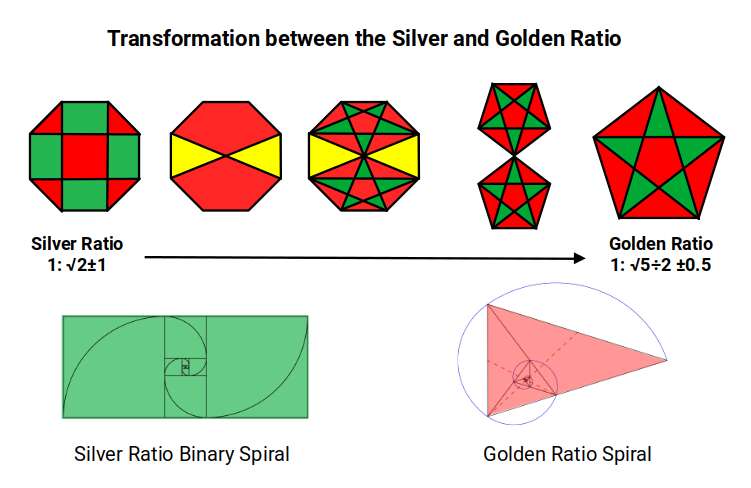
The Golden Ratio is the most celebrated of a whole family of proportions — a family sometimes called the metallic means — each of which arises from a specific type of self-referential proportion and each of which is associated with a different geometric symmetry and a different pattern of appearance in nature. The Golden Ratio φ ≈ 1.618 is the first and most famous member of this family, associated with five-fold symmetry, the pentagon, and the Fibonacci sequence. But it is not alone.
The Silver Mean, denoted δS (or sometimes by the symbol σ), has the value 1 + √2 ≈ 2.414. It arises from the proportion analogous to the one that defines φ, but with a different integer: where φ satisfies the equation x = 1 + 1/x, the Silver Mean satisfies x = 2 + 1/x. The Silver Mean is associated with eight-fold symmetry, the octagon, the square, and a different set of natural patterns. Just as the Fibonacci sequence converges to φ in the ratio of its consecutive terms, the Pell sequence (0, 1, 2, 5, 12, 29, 70, 169, 408...) converges to δS in the ratio of its consecutive terms.
The existence of this family of metallic means is significant for sacred geometry because it suggests that the universe does not have a single dominant proportion but a family of proportions, each associated with a different symmetry type, each arising in different contexts, and each playing a specific geometric role in the organisation of matter, energy, and form. The Golden Ratio governs the geometry of life and five-fold growth. The Silver Mean governs the geometry of four-fold structure and the eight-fold symmetry of the natural world.
Key takeaways
- The Silver Mean (1 + √2 ≈ 2.414) is the second metallic mean, associated with eight-fold symmetry and the octagon — just as the Golden Ratio is associated with five-fold symmetry and the pentagon.
- Islamic geometric art is the world's most sophisticated exploration of the Silver Mean's geometry, with some medieval patterns achieving quasiperiodic tilings that Western mathematics did not discover until Penrose's work in 1974.
The Silver Mean
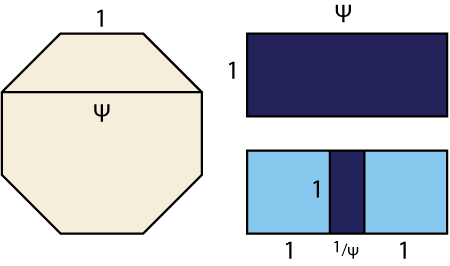
The connection between the Silver Mean and the octagon is as direct and as geometric as the connection between the Golden Ratio and the pentagon. In a regular octagon — an eight-sided polygon with all sides equal and all interior angles equal to 135° — the ratio of the longest diagonal (connecting two diametrically opposite vertices) to the shorter diagonal (connecting two vertices separated by one vertex) is √2. The ratio of the longer diagonal to the side of the octagon is 1 + √2 — the Silver Mean. Just as the diagonal of the pentagon gives φ when divided by the pentagon's side, the diagonal of the octagon gives δS when divided by the octagon's side.
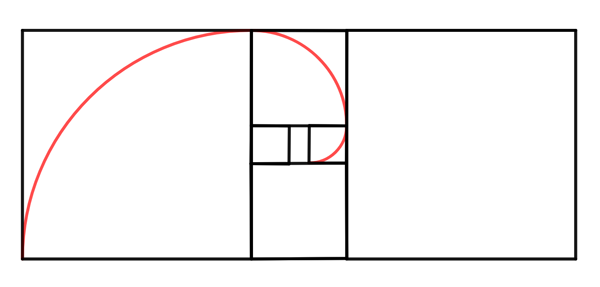
The square is equally central to the Silver Mean. The diagonal of a square with side length 1 is √2 — the square root of two, which is deeply embedded in the Silver Mean since δS = 1 + √2. The proportion √2 is the foundation of what is known as the A-series paper sizing standard (A4, A3, A2, etc.): each A-format sheet has sides in the ratio 1:√2, which means that when folded in half, the resulting sheet has the same proportions as the original. This self-similar folding property — the sheet reproduces itself at a different scale — is a consequence of the Silver Mean's geometry and is why the A-format standard is so elegant and useful.
In the Japanese design tradition, the proportion 1:√2 (which implies the Silver Mean in its extensions) is known as yamato-hi or the Japanese ratio. Traditional Japanese architecture, woodwork, and garden design make extensive use of this proportion, considering it more harmonious and more in keeping with Japanese aesthetic sensibility than the Golden Ratio, which is more dominant in the Western and Mediterranean tradition. The different aesthetic preferences of different cultures may partly reflect the different geometric traditions underlying their art forms: Mediterranean cultures, rooted in Greek geometry, developed sophisticated treatments of the pentagon and φ; East Asian cultures developed equally sophisticated treatments of the square, the octagon, and δS.
At the cosmic scale, barred spiral galaxies — including our own Milky Way — display the Silver Mean's geometry. The central bar structure, with spiral arms extending from both ends, follows the proportions of the octagon and the 1:√2 ratio. Where the Golden Ratio's spiral shapes unbarred spiral galaxies, the Silver Mean's geometry organises the barred variety — roughly two-thirds of all spiral galaxies in the universe.

Islamic Geometric Art
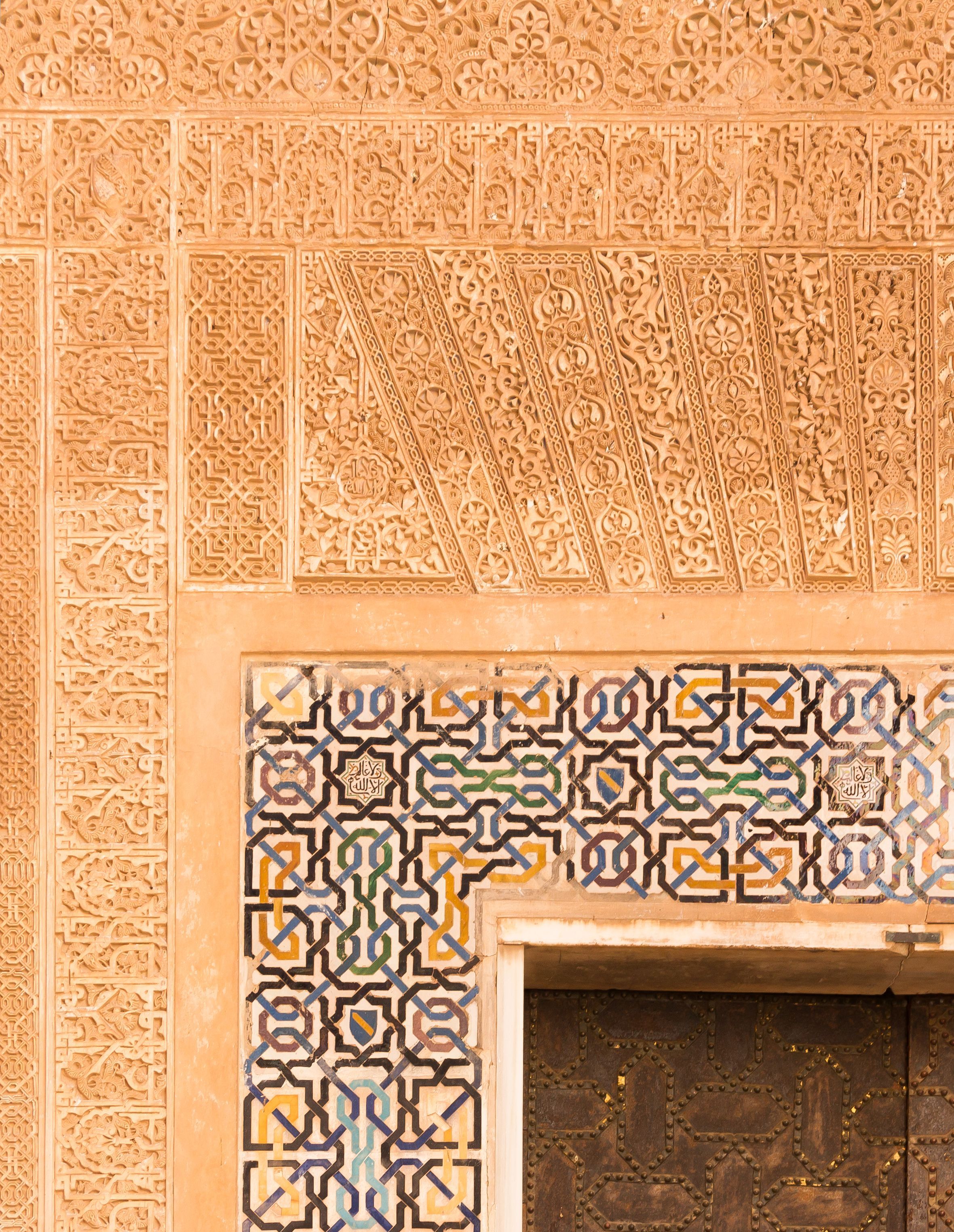
If any single artistic tradition can be said to have explored the geometry of the Silver Mean and eight-fold symmetry to its fullest extent, it is the Islamic geometric art tradition — one of the most sophisticated and visually extraordinary bodies of decorative art in human history. Over a period of roughly a thousand years, from the eighth to the eighteenth centuries, artists and craftsmen across the Islamic world — from Morocco to Central Asia, from Spain to Indonesia — developed a tradition of geometric decoration based on complex interlocking patterns derived from the octagon and from the Silver Mean proportions implicit in eight-fold and four-fold symmetry.
The fundamental unit of Islamic geometric construction is the circle divided into eight equal parts — the octagon — from which the designer derives the star polygon, the interlacing squares, the complex eight-pointed rosette, and the infinite plane-filling tilings that cover the walls of mosques, madrasas, and palaces. The Alhambra in Granada, the Friday Mosque in Isfahan, the Süleymaniye Mosque in Istanbul, the Madrasa Bou Inania in Fez — these are among the most celebrated examples of a tradition that is simultaneously a profound mathematical exploration of plane symmetry and a spiritual practice aimed at expressing, through geometric perfection, the infinite nature of God.
The underlying philosophy of Islamic geometric art connects directly to the sacred geometry tradition. In Islamic theology, the creation of representational images of living beings was considered inappropriate for sacred space (though this prohibition was interpreted differently in different times and places), while geometric decoration was not only permitted but celebrated as the purest form of beauty — the beauty of abstract mathematical order, reflecting the order of divine creation. The artist who constructs a perfect geometric tiling is engaged, in this understanding, in an act of worship: revealing in visual form the mathematical harmony that underlies the created world.
Modern mathematical analysis of Islamic geometric patterns has revealed extraordinary sophistication. Some patterns, particularly those from the Darb-i Imam shrine in Isfahan (15th century) and the Gonbad-e Kabud tomb tower in Maragheh (12th century), have been shown to be quasiperiodic — patterns that never exactly repeat, that fill the plane without any periodic repetition, and that exhibit ten-fold or five-fold symmetry. The mathematical equivalent of these patterns — Penrose tilings — was not discovered in Western mathematics until 1974, when Roger Penrose published his famous aperiodic tilings. The craftsmen of medieval Islam had constructed equivalent patterns by geometric intuition and craft knowledge five centuries earlier. And the fundamental proportions governing these quasiperiodic patterns involve both the Golden Ratio (for five-fold symmetry) and the Silver Mean (for eight-fold symmetry).
The Silver Mean in Three Dimensions
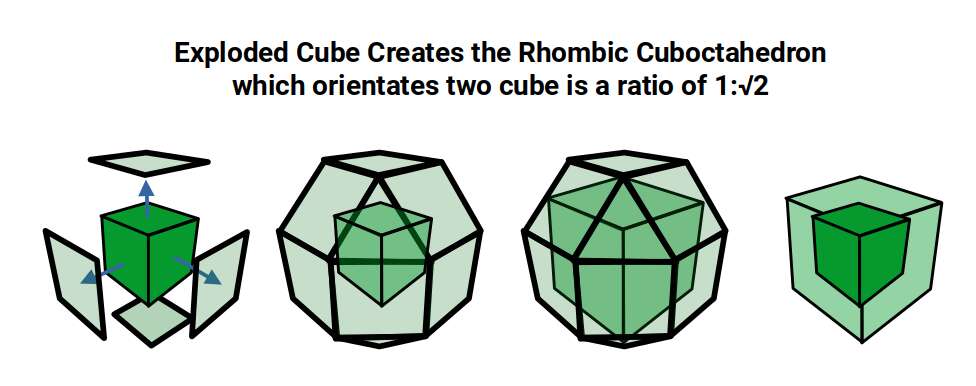
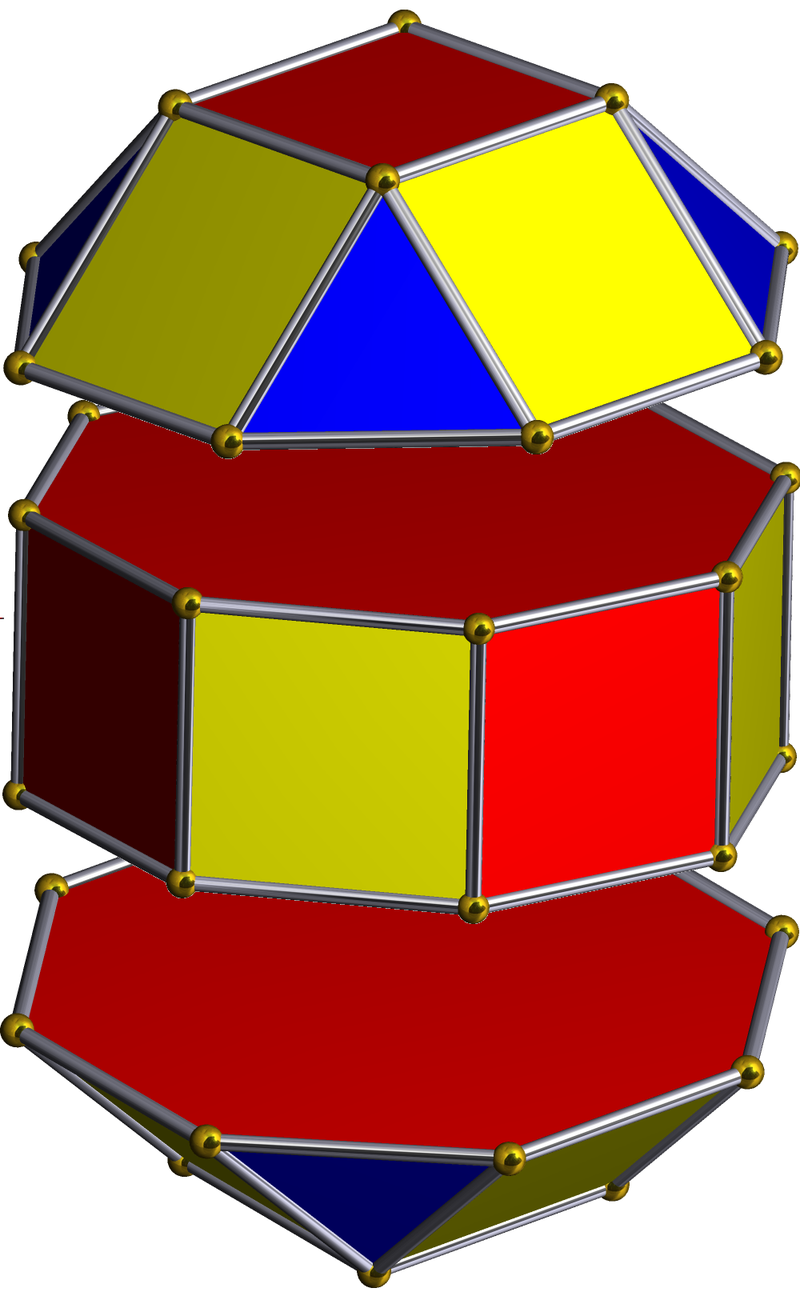
Just as the Golden Ratio finds its three-dimensional expression in the dodecahedron and icosahedron, the Silver Mean extends into three dimensions through the Rhombic Cuboctahedron — an Archimedean Solid whose octagonal midsection encodes the 1:√2 proportion. The Rhombic Cuboctahedron is generated by "exploding" a cube — pulling each face outward along its normal — and the resulting form nests two cubes in the ratio 1:√2, the Silver Mean made solid.
Conclusion
The Silver Mean reveals that the Golden Ratio is not alone — it is one member of a family of metallic means, each associated with a different geometric symmetry and a different tradition of art and design. Where the Golden Ratio governs five-fold growth and the geometry of living forms, the Silver Mean governs eight-fold structure, the octagon, and the extraordinary tradition of Islamic geometric art.
In the next chapter, we turn to fractals — the self-similar patterns that arise when simple geometric rules are applied recursively at every scale, connecting the metallic means to the infinite complexity of coastlines, clouds, and the Mandelbrot Set.
FAQ
What is the Silver Mean?
The Silver Mean (δS = 1 + √2 ≈ 2.414) is the second member of the metallic means family, after the Golden Ratio. It satisfies the equation x = 2 + 1/x and is associated with eight-fold symmetry and the octagon, just as the Golden Ratio is associated with five-fold symmetry and the pentagon. The Pell sequence (0, 1, 2, 5, 12, 29...) converges to the Silver Mean in its consecutive ratios.
How does the Silver Mean appear in art and design?
The Silver Mean underlies Islamic geometric art, which explores eight-fold and four-fold symmetry through complex interlocking patterns based on the octagon. In Japanese design, the proportion 1:√2 (embedded in the Silver Mean) is known as yamato-hi and governs traditional architecture and garden design. The A-series paper standard (A4, A3, etc.) also uses the √2 proportion.