Introduction
The Platonic Solids — five perfectly regular polyhedra — are the most symmetrical solids possible. For their philosophical and natural significance, see Platonic Solids — From Plato to Nature. But Archimedes of Syracuse discovered a richer family: convex polyhedra built from two or more types of regular polygon arranged identically at every vertex. These are the Archimedean Solids, and there are exactly thirteen of them. They are the natural next step after the Platonic Solids, and understanding them reveals a beautiful hierarchy of three-dimensional symmetry.
Key Takeaways
- An Archimedean Solid is vertex-transitive: the arrangement of faces around every vertex is identical.
- There are exactly thirteen Archimedean Solids, generated from the Platonic Solids by truncation, expansion (cantellation), and snubbing.
- Truncation cuts each vertex to produce a new face: truncating the cube gives 8 triangles and 6 octagons; truncating the icosahedron gives 12 pentagons and 20 hexagons (the football pattern).
- Two Archimedean Solids are chiral (exist in mirror-image pairs): the snub cube and the snub dodecahedron.
- The duals of the thirteen Archimedean Solids are the thirteen Catalan Solids.
The Thirteen Solids
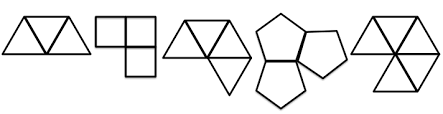
A semi-regular polyhedron (or Archimedean Solid) is a convex polyhedron with regular polygonal faces of two or more types and identical vertex configurations throughout. Prisms and antiprisms are excluded by convention. There are exactly thirteen Archimedean Solids, each derived from a Platonic Solid through one of three geometric operations.
| Solid | Faces | Derived from |
|---|---|---|
| Truncated Tetrahedron | 4 triangles + 4 hexagons | Tetrahedron (truncated) |
| Cuboctahedron | 8 triangles + 6 squares | Cube/Octahedron (rectified) |
| Truncated Cube | 8 triangles + 6 octagons | Cube (truncated) |
| Truncated Octahedron | 6 squares + 8 hexagons | Octahedron (truncated) |
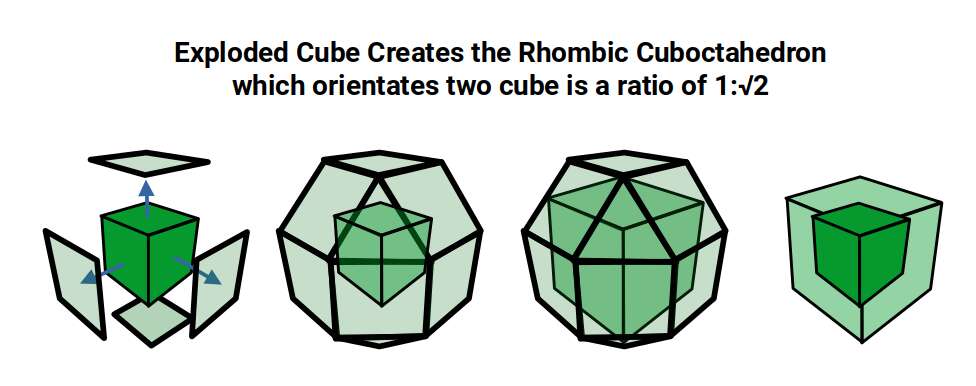
| Rhombicuboctahedron | 8 triangles + 18 squares | Cube/Octahedron (expanded) |
| Truncated Cuboctahedron | 12 squares + 8 hexagons + 6 octagons | Cube/Octahedron (truncated) |
| Snub Cube | 32 triangles + 6 squares | Cube (snubbed) — chiral |
| Icosidodecahedron | 20 triangles + 12 pentagons | Icosahedron/Dodecahedron (rectified) |
| Truncated Dodecahedron | 20 triangles + 12 decagons | Dodecahedron (truncated) |
| Truncated Icosahedron | 12 pentagons + 20 hexagons | Icosahedron (truncated) |
| Rhombicosidodecahedron | 20 triangles + 30 squares + 12 pentagons | Icosahedron/Dodecahedron (expanded) |
| Truncated Icosidodecahedron | 30 squares + 20 hexagons + 12 decagons | Icosahedron/Dodecahedron (truncated) |
| Snub Dodecahedron | 80 triangles + 12 pentagons | Dodecahedron (snubbed) — chiral |
The truncated icosahedron — 12 pentagons and 20 hexagons — is the pattern of a football (soccer ball) and also the structure of the C₆₀ buckminsterfullerene molecule.
Truncation
Cutting each vertex of a Platonic Solid to produce a new face. Truncating to the midpoints of edges yields a truncated version with two face types.
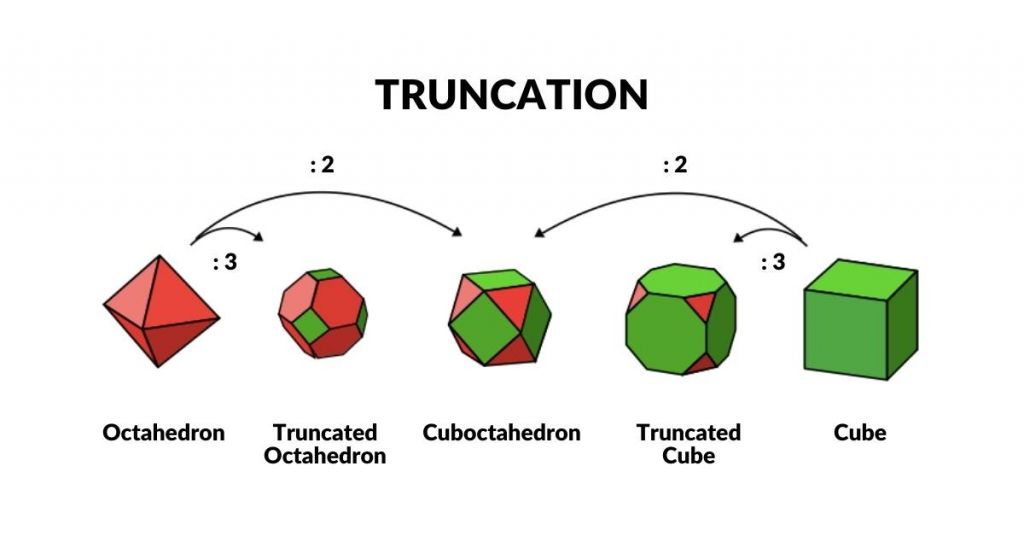
Use the interactive below to explore how each Platonic Solid transforms through truncation. The colours reveal the dual relationship: the new faces created by truncation are coloured with the dual solid's colour — green cube faces truncate to reveal red octahedral faces, blue dodecahedron faces truncate to reveal purple icosahedral faces, and vice versa.
Expansion & Snubbing
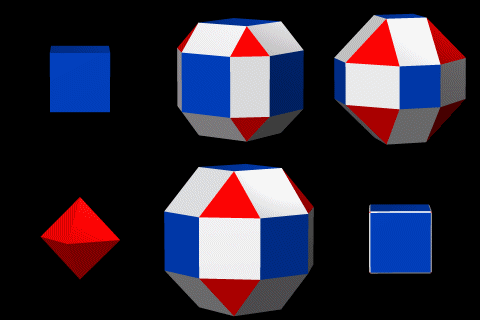
Expansion (Cantellation)
Moving each face outward and filling the gaps with new faces.
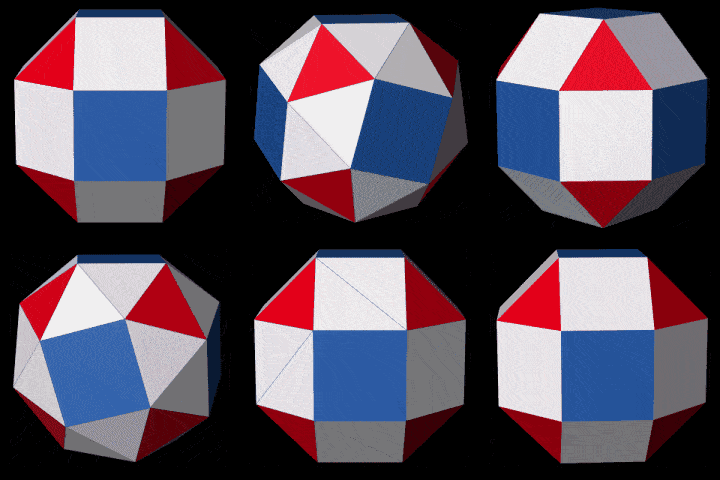
Snubbing
Twisting the faces and filling with triangles — produces chiral solids with no planes of symmetry.
The Cuboctahedron
The cuboctahedron occupies a unique position among the Archimedean Solids. It is a quasiregular polyhedron — every edge borders exactly one triangle and one square, giving it a structural regularity more complete than any other Archimedean Solid. Buckminster Fuller named it the Vector Equilibrium because of a property unique among all polyhedra: the distance from the centre to every vertex equals the edge length. No direction is preferred — perfect geometric balance.
| Property | Value |
|---|---|
| Faces | 14 (8 triangles + 6 squares) |
| Vertices | 12 |
| Edges | 24 |
For edge length a:
- Surface area: 2a²(3 + √3) ≈ 9.4641 a²
- Volume: V = 5√2 / 3 · a³
The vertices of a cuboctahedron with edge length √2 lie at all permutations of (±1, ±1, 0), (±1, 0, ±1), (0, ±1, ±1). Its symmetry group is octahedral (O_h), the same as the cube and octahedron. The cross-section at the equator is a regular hexagon.
Truncation Sequence
The cuboctahedron sits at the exact midpoint between the cube and octahedron — also called a rectified cube or rectified octahedron, formed by truncating either parent to its edge midpoints:
| Stage | Faces | Edges | Vertices |
|---|---|---|---|
| Octahedron | 8 triangles | 12 | 6 |
| Truncated Octahedron | 8 hexagons + 6 squares | 36 | 24 |
| Cuboctahedron | 8 triangles + 6 squares | 24 | 12 |
| Truncated Cube | 8 triangles + 6 octagons | 36 | 24 |
| Cube | 6 squares | 12 | 8 |
Sphere Packing
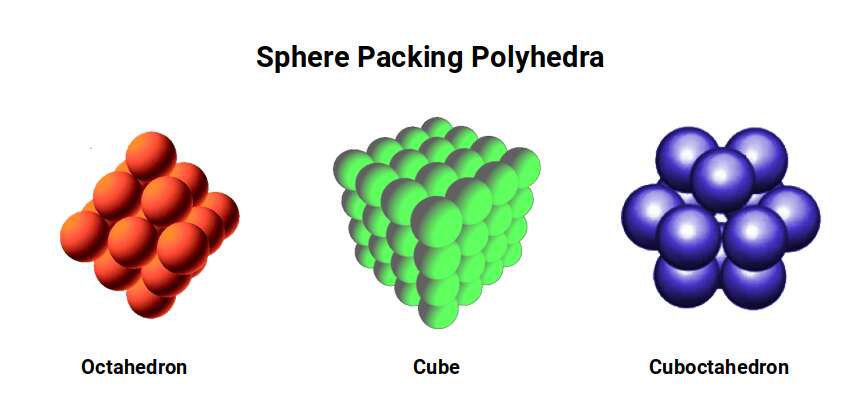
Surround a sphere with identical spheres, each touching the central one. The maximum in three dimensions is twelve, and their centres sit at the vertices of a cuboctahedron. This is the densest possible packing — approximately 74% of available volume (Kepler's conjecture, proved by Thomas Hales in 1998) — and the structure of metallic crystals such as copper, gold, and aluminium.
The Jitterbug
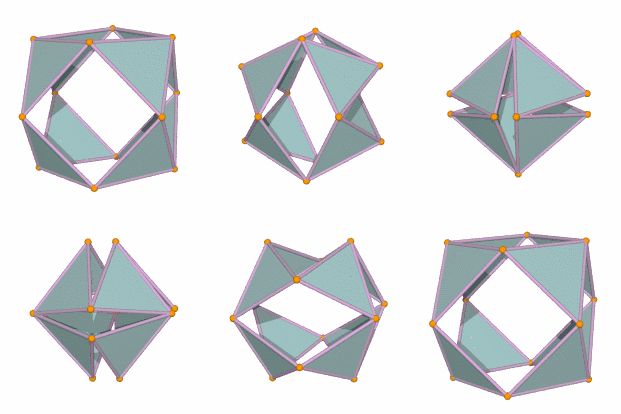
Buckminster Fuller's Jitterbug is a flexible hinged model that transforms the cuboctahedron continuously through the icosahedron to the octahedron and finally to a flat plane. It revealed that these are not separate objects but stages of a single dynamic process — the Platonic Solids as moments in a continuous geometric flow.
For more on the Vector Equilibrium, its role in sacred geometry, atomic structure, and the Flower of Life, see the dedicated Cuboctahedron page. ## Conclusion
The thirteen Archimedean Solids occupy the precise middle ground between the total regularity of the Platonic Solids and the infinite variety of irregular polyhedra — they have regular faces of more than one type, but the same vertex arrangement throughout. Their truncation sequences connect every Platonic Solid to its dual through a chain of intermediate forms, and the cuboctahedron's role as vector equilibrium — with its twelve surrounding spheres — links pure geometry to the closest-packing structure of metallic crystals. Buckminster Fuller's Jitterbug transformation reveals that these are not static objects but moments in a continuous geometric flow.
The duals of the thirteen Archimedean Solids — the Catalan Solids — are explored in the next chapter.