Introduction
A mathematical treatment: proofs, formulas, and symmetry groups. For the philosophical and natural significance, see Platonic Solids — From Plato to Nature.
The Platonic Solids are among the most remarkable objects in all of mathematics: five perfectly symmetrical three-dimensional forms, each built from identical regular polygons, with the same number of faces meeting at every vertex. They fascinated the ancient Greeks, inspired Plato's cosmology, and continue to appear throughout modern science — from crystal structures to viral architecture. What makes them extraordinary is that there are exactly five, no more and no less, and this fact can be proved with simple arithmetic.
Key Takeaways
- There are exactly five Platonic Solids — no more are possible, because the face angles at each vertex must sum to less than 360°.
- Euler's formula V − E + F = 2 holds for every convex polyhedron; it can be verified for all five Platonic Solids.
- Duality swaps faces and vertices: the cube and octahedron are duals; the dodecahedron and icosahedron are duals; the tetrahedron is self-dual.
- The symmetry group of the dodecahedron and icosahedron has 60 rotational symmetries — the largest of any Platonic Solid.
- The icosahedron appears in viral capsid architecture; the cube dominates crystal chemistry; all five appear in Plato's cosmology in the *Timaeus*.
What is a Regular Polyhedron?
A regular polyhedron (or Platonic Solid) is a convex solid that satisfies three conditions:
- Every face is a congruent regular polygon (all sides equal, all angles equal).
- The same number of faces meet at every vertex.
- The solid is convex — no face is "pushed inward".
These three conditions together are far more restrictive than they might appear.
Why Exactly Five Exist
The key insight is that the faces meeting at each vertex must fit together without overlapping and without leaving a flat plane (which would give a tessellation, not a solid). The sum of the face angles at each vertex must therefore be less than 360°.
Consider which regular polygons can serve as faces:
| Regular polygon | Interior angle | Faces at vertex | Sum of angles | Possible? |
|---|---|---|---|---|
| Equilateral triangle | 60° | 3 | 180° | Yes — tetrahedron |
| Equilateral triangle | 60° | 4 | 240° | Yes — octahedron |
| Equilateral triangle | 60° | 5 | 300° | Yes — icosahedron |
| Equilateral triangle | 60° | 6 | 360° | No — flat, not a solid |
| Square | 90° | 3 | 270° | Yes — cube |
| Square | 90° | 4 | 360° | No — flat |
| Regular pentagon | 108° | 3 | 324° | Yes — dodecahedron |
| Regular pentagon | 108° | 4 | 432° | No — exceeds 360° |
| Regular hexagon | 120° | 3 | 360° | No — flat |
Equilateral triangle (60°)
3 faces → 180° · Yes — tetrahedron
4 faces → 240° · Yes — octahedron
5 faces → 300° · Yes — icosahedron
6 faces → 360° · No — flat
Square (90°)
3 faces → 270° · Yes — cube
4 faces → 360° · No — flat
Regular pentagon (108°)
3 faces → 324° · Yes — dodecahedron
4 faces → 432° · No — exceeds 360°
Regular hexagon (120°)
3 faces → 360° · No — flat
No polygon with seven or more sides can ever work: three such faces would already give more than 360°. Therefore exactly five regular polyhedra are possible.
The Five Platonic Solids
Tetrahedron

- Faces: 4 equilateral triangles
- Vertices: 4
- Edges: 6
- Faces at each vertex: 3
- Dual: Tetrahedron (self-dual)
The tetrahedron is the simplest of all polyhedra. Four equilateral triangles meet in a pyramid-like form, with three faces at each vertex. It is self-dual — constructing the dual of a tetrahedron (by placing a vertex at the centre of each face and connecting adjacent vertices) produces another tetrahedron. Its symmetry group has 12 rotational symmetries.
Octahedron

- Faces: 8 equilateral triangles
- Vertices: 6
- Edges: 12
- Faces at each vertex: 4
- Dual: Cube
The octahedron looks like two square pyramids joined at their bases. Four equilateral triangles meet at each vertex. Notice that the cube has 6 faces and 8 vertices, while the octahedron has 8 faces and 6 vertices — and both have 12 edges. This is a signature of duality.
Cube (Hexahedron)

- Faces: 6 squares
- Vertices: 8
- Edges: 12
- Faces at each vertex: 3
- Dual: Octahedron
The cube is the most familiar regular solid. Three squares meet at each vertex. It has the same symmetry group as the octahedron — 24 rotational symmetries. The cube and octahedron are duals of each other.
Dodecahedron

- Faces: 12 regular pentagons
- Vertices: 20
- Edges: 30
- Faces at each vertex: 3
- Dual: Icosahedron
The dodecahedron is built from twelve regular pentagons — the same polygon whose diagonals encode the golden ratio. Three pentagons meet at each vertex. The dodecahedron and icosahedron are duals of each other (note: 12 faces ↔ 20 vertices, both 30 edges).
Icosahedron

- Faces: 20 equilateral triangles
- Vertices: 12
- Edges: 30
- Faces at each vertex: 5
- Dual: Dodecahedron
The icosahedron is the most "sphere-like" of the five, with twenty equilateral triangular faces and five meeting at each vertex. It has 60 rotational symmetries — the largest symmetry group of any Platonic Solid.
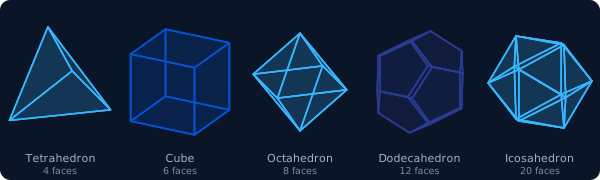
Summary Table
| Solid | Faces (F) | Vertices (V) | Edges (E) | Faces at vertex | Dual |
|---|---|---|---|---|---|
| Tetrahedron | 4 | 4 | 6 | 3 | Tetrahedron |
| Cube | 6 | 8 | 12 | 3 | Octahedron |
| Octahedron | 8 | 6 | 12 | 4 | Cube |
| Dodecahedron | 12 | 20 | 30 | 3 | Icosahedron |
| Icosahedron | 20 | 12 | 30 | 5 | Dodecahedron |
Tetrahedron
4 faces · 4 vertices · 6 edges · 3 at vertex
Dual: Tetrahedron (self-dual)
Cube
6 faces · 8 vertices · 12 edges · 3 at vertex
Dual: Octahedron
Octahedron
8 faces · 6 vertices · 12 edges · 4 at vertex
Dual: Cube
Dodecahedron
12 faces · 20 vertices · 30 edges · 3 at vertex
Dual: Icosahedron
Icosahedron
20 faces · 12 vertices · 30 edges · 5 at vertex
Dual: Dodecahedron
Euler's Formula
For every convex polyhedron — not just the Platonic Solids — the following holds:
where V = vertices, E = edges, F = faces. Verify for each Platonic Solid:
- Tetrahedron: 4 − 6 + 4 = 2 ✓
- Cube: 8 − 12 + 6 = 2 ✓
- Octahedron: 6 − 12 + 8 = 2 ✓
- Dodecahedron: 20 − 30 + 12 = 2 ✓
- Icosahedron: 12 − 30 + 20 = 2 ✓
Euler discovered this relationship in 1750, though it was known implicitly by Descartes. It is one of the great theorems of topology, and it holds for any convex polyhedron regardless of how many faces it has.
Symmetry Groups
Each Platonic Solid has a rotation group — the set of all rotations that map the solid to itself.
| Solid | Rotation group | Order (number of rotations) |
|---|---|---|
| Tetrahedron | A₄ (alternating group) | 12 |
| Cube / Octahedron | S₄ (symmetric group) | 24 |
| Dodecahedron / Icosahedron | A₅ (alternating group) | 60 |
The cube and octahedron share a symmetry group because they are duals. The same holds for the dodecahedron and icosahedron. The tetrahedron is self-dual and has the smallest symmetry group.
For the cosmological significance of the Platonic Solids — Plato's elemental theory, Kepler's cosmic mystery, and their appearance in nature — see Platonic Solids — From Plato to Nature.
Frequently Asked Questions
Why are there exactly five Platonic Solids and not more?
The constraint is that the face angles meeting at each vertex must sum to less than 360° (otherwise the solid would be flat or impossible). Working through every regular polygon: equilateral triangles can meet in groups of 3, 4, or 5 (giving tetrahedron, octahedron, icosahedron); squares in groups of 3 (cube); pentagons in groups of 3 (dodecahedron). Hexagons and above give 360° or more at the vertex, so no further solids are possible. The proof is elementary arithmetic.What is Euler's formula and does it apply to all polyhedra?
Euler's formula V − E + F = 2 relates the number of vertices, edges, and faces of any convex polyhedron. It applies to all convex polyhedra — and more generally to any polyhedron topologically equivalent to a sphere (simply connected, with no holes). A torus (doughnut-shaped) polyhedron satisfies V − E + F = 0 instead. Euler's formula is a topological invariant, which is why it persists across wildly different shapes.What does it mean for two polyhedra to be duals of each other?
The dual of a polyhedron is constructed by placing a new vertex at the centre of each face, then connecting two new vertices whenever their corresponding faces share an edge. The result is a new polyhedron in which faces and vertices are swapped. The tetrahedron maps to itself (self-dual). The cube maps to the octahedron (6 faces ↔ 6 vertices, 8 vertices ↔ 8 faces). The dodecahedron maps to the icosahedron (12 ↔ 20, 20 ↔ 12).Where do Platonic Solids appear in nature?
The icosahedron appears in viral capsid structures — many viruses build their protein shells in this shape because it provides the most efficient way to enclose a volume with identical subunits. The cube appears in common salt and iron pyrite crystals. The octahedron appears in diamond and spinel crystal structures. Single-celled radiolarians build silica skeletons with full Platonic symmetry. The dodecahedron and icosahedron both appear in quasicrystal structures in materials science.How are the Platonic Solids related to the golden ratio?
The dodecahedron and icosahedron are intimately connected to the golden ratio φ = (1 + √5)/2 ≈ 1.618. The faces of a dodecahedron are regular pentagons, and the diagonal-to-side ratio of a regular pentagon is exactly φ. The icosahedron's vertices can be described using three mutually perpendicular golden rectangles (rectangles with side ratio 1 : φ). This connection between the golden ratio and icosahedral symmetry reappears in quasicrystals and in the geometry of viral capsids.Conclusion
The five Platonic Solids are uniquely determined by the single constraint that identical regular polygons meet at every vertex with face angles summing to less than 360° — a constraint so tight that only five solutions exist. Their mutual relationships — duality, the golden ratio threading through the icosahedron and dodecahedron, the appearance of all five in Kepler's cosmic model — reveal a depth of structure that makes them the central objects of three-dimensional geometry. From viral capsids to crystal lattices, their symmetry groups govern the most regular structures in nature.
Every Platonic Solid has a dual — a partner solid formed by swapping faces and vertices. The next chapter explores Dual Polyhedra.