Introduction
Cylinders, cones, and the sphere are the fundamental curved surfaces of classical geometry. Cylinders and cones are the curved counterparts of prisms and pyramids — generated by rotating a rectangle or right triangle about a fixed axis. The sphere, generated by rotating a semicircle about its diameter, is the most symmetric of all solids, with every point on its surface equivalent to every other. This chapter derives the area and volume formulae for all three, introduces frustums and conic sections, and covers the rich geometry of spherical triangles, zones, and lunes.
Key Takeaways
- A right circular cylinder of radius r and height a has lateral area 2πra and volume πr²a.
- A cone of revolution with base radius r, height a, and slant height s has lateral area πrs and volume ⅓πr²a.
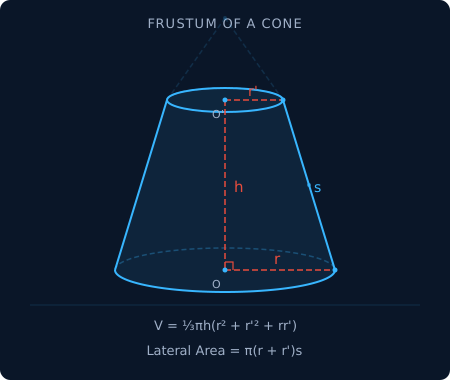
- A frustum (truncated cone) with base radii r and r' and altitude a has volume ⅓πa(r² + r'² + rr').
- The four conic sections — circle, ellipse, parabola, hyperbola — are all produced by cutting a right circular cone with a plane at different angles.
- The surface area of a sphere of radius r is 4πr²; the volume is 4/3 · πr³.
- The sum of the angles of a spherical triangle is always greater than 180° and less than 540°; the excess over 180° (in radians) equals the area on a unit sphere.
- The area of a zone (spherical band between two parallel planes) equals 2πrh, where h is the altitude — independent of the zone's position on the sphere.
- Archimedes showed that the surface area of a sphere equals the lateral area of its circumscribed cylinder, and its volume equals two-thirds of that cylinder's volume.
Surfaces of Revolution
A surface of revolution is generated by rotating any curve (the generatrix) about a fixed line (the axis of revolution). Each point on the generatrix describes a circle whose plane is perpendicular to the axis. A cross-section perpendicular to the axis consists of one or several circles. Any plane containing the axis is called meridional, and the cross-section by this plane is a meridian — all meridians of a surface of revolution are congruent.
Cylinders
Cylindrical Surface — a surface generated by a straight line constantly parallel to a fixed line, touching a fixed curve not in its plane.
Cylinder — a solid bounded by a cylindrical surface and two parallel plane surfaces. The cylindrical surface between the planes is the lateral surface; the plane portions are the bases. The altitude is the perpendicular distance between the bases.
Right cylinder — elements perpendicular to bases. Oblique cylinder — elements not perpendicular to bases.
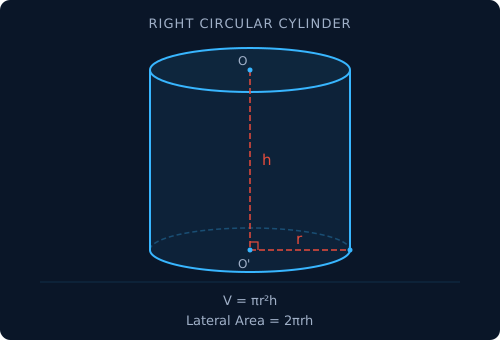
Circular Cylinder — a cylinder whose bases are circles. A right circular cylinder, generated by revolving a rectangle about one side, is a cylinder of revolution.
Propositions
- Every section of a cylinder made by a plane through an element is a parallelogram.
- Corollary: Every such section of a right cylinder is a rectangle.
- The bases of a cylinder are congruent.
- Corollary: Any section parallel to the base is congruent to the base.
- Corollary: The line joining the centres of the bases passes through the centres of all parallel sections.
Tangent Plane — a plane containing an element of the cylinder but not cutting the surface. A plane through a tangent to the base and the element at the point of contact is tangent to the cylinder.
Cylinder as a Limit — if a prism with a regular polygon base is inscribed in or circumscribed about a cylinder and the number of sides is indefinitely increased, the volume and lateral area of the cylinder are the limits of those of the prism.
Formulae
For a right circular cylinder of altitude a and base radius r: - Lateral area: l = 2πra - Total area: t = 2πr(a + r) - Volume: v = πr²a
Similar Cylinders — generated by revolving similar rectangles about corresponding sides. - Lateral areas and total areas are to each other as the squares of their altitudes or radii. - Volumes are to each other as the cubes of their altitudes or radii.
Conic Surface and Cone
Conic Surface — a surface generated by a line (the generatrix) that constantly passes through a fixed point (the vertex) and touches a fixed curve (the directrix). The generatrix in any position is an element. An indefinitely extended generatrix produces two nappes — upper and lower.
Cone — a solid bounded by a conic surface and a plane cutting all its elements. The plane is the base, the perpendicular from vertex to base is the altitude.
Circular Cone — a cone with a circular base. The line joining the vertex and the centre of the base is the axis.
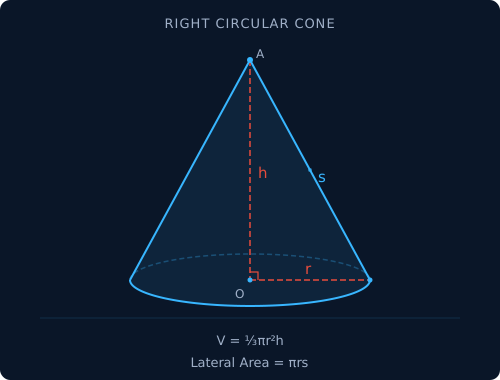
Right Cone (Cone of Revolution) — axis perpendicular to base; generated by revolving a right triangle about one leg. The hypotenuse is the slant height.
Propositions
- Every section through the vertex is a triangle.
- Every section parallel to the base of a circular cone is a circle.
- Corollary: The axis passes through the centre of every parallel section.
Frustum of a Cone — the portion between the base and a section parallel to the base.
Formulae
For a cone of revolution with base radius r, altitude a, and slant height s: - Lateral area: l = πrs - Total area: t = πr(s + r) - Volume: v = ⅓πr²a
For a frustum with base radii r and r', altitude a, and slant height s: - Lateral area: l = π(r + r')s - Volume: v = ⅓πa(r² + r'² + rr')
Similar Cones — generated by revolving similar right triangles about corresponding legs. - Lateral areas and total areas are to each other as the squares of altitudes, radii, or slant heights. - Volumes are to each other as the cubes of those dimensions.
Conic Sections
A conic section is any curve produced by the intersection of a plane with a right circular cone:
| Plane orientation | Section |
|---|---|
| Parallel to base | Circle |
| Slight angle to base | Ellipse |
| Parallel to one element | Parabola |
| Perpendicular to base | Hyperbola (two branches) |
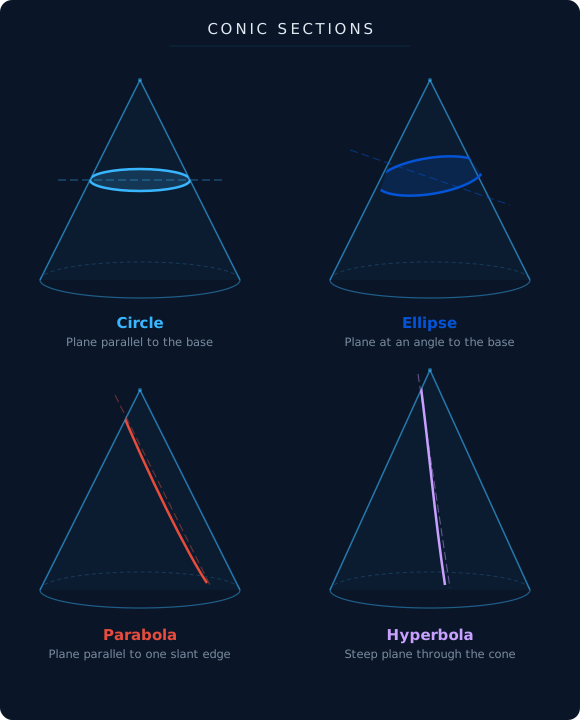
The ancient Greek mathematicians studied conic sections systematically, culminating around 200 BC with Apollonius of Perga's comprehensive treatment of their properties.
The Sphere
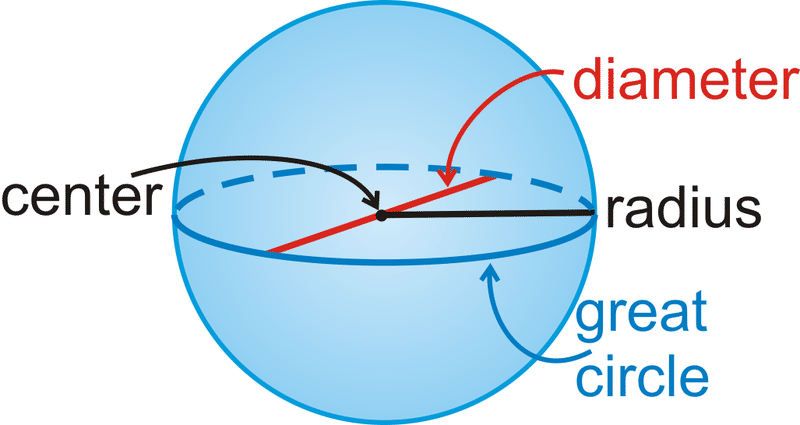
A sphere is a closed surface in three-dimensional space, all of whose points are equally distant from a fixed interior point called the centre. The common distance is the radius; a line through the centre terminated at both ends by the sphere is a diameter.
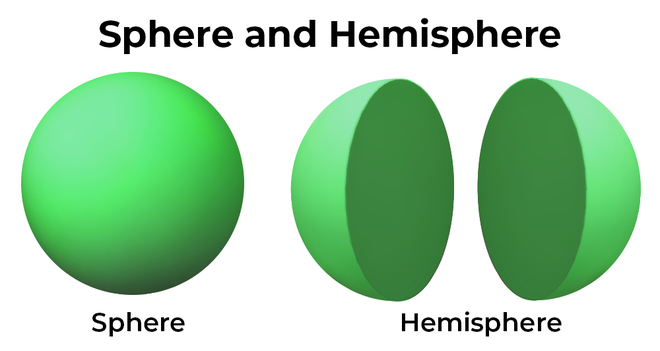
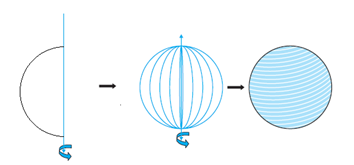
A sphere may also be defined as the solid of revolution generated by rotating a semicircle about its diameter.
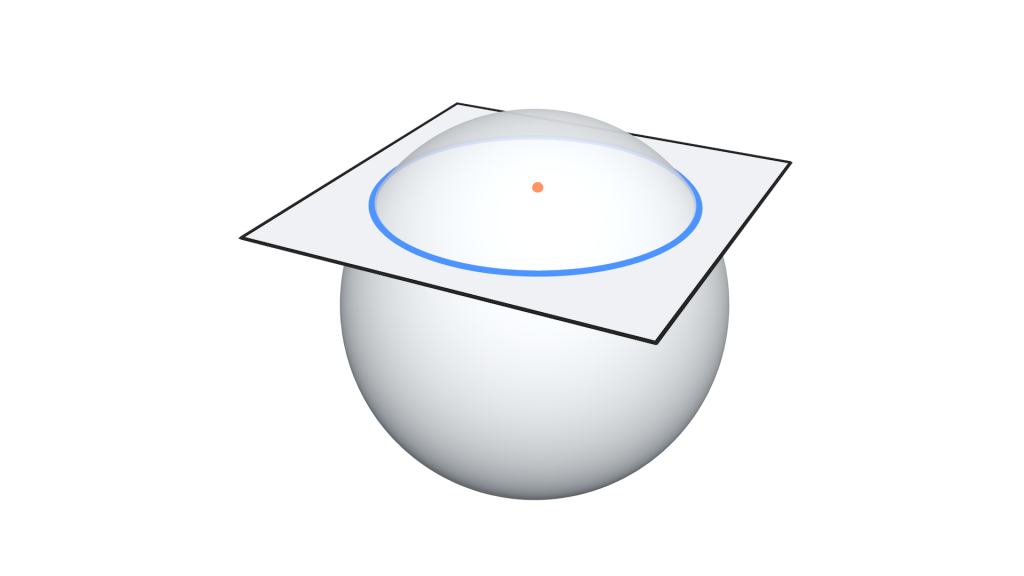
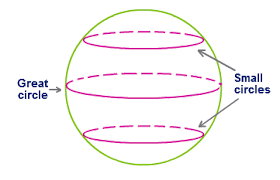
Great and Small Circles
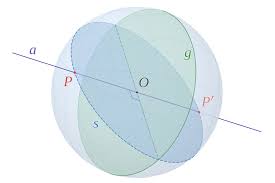
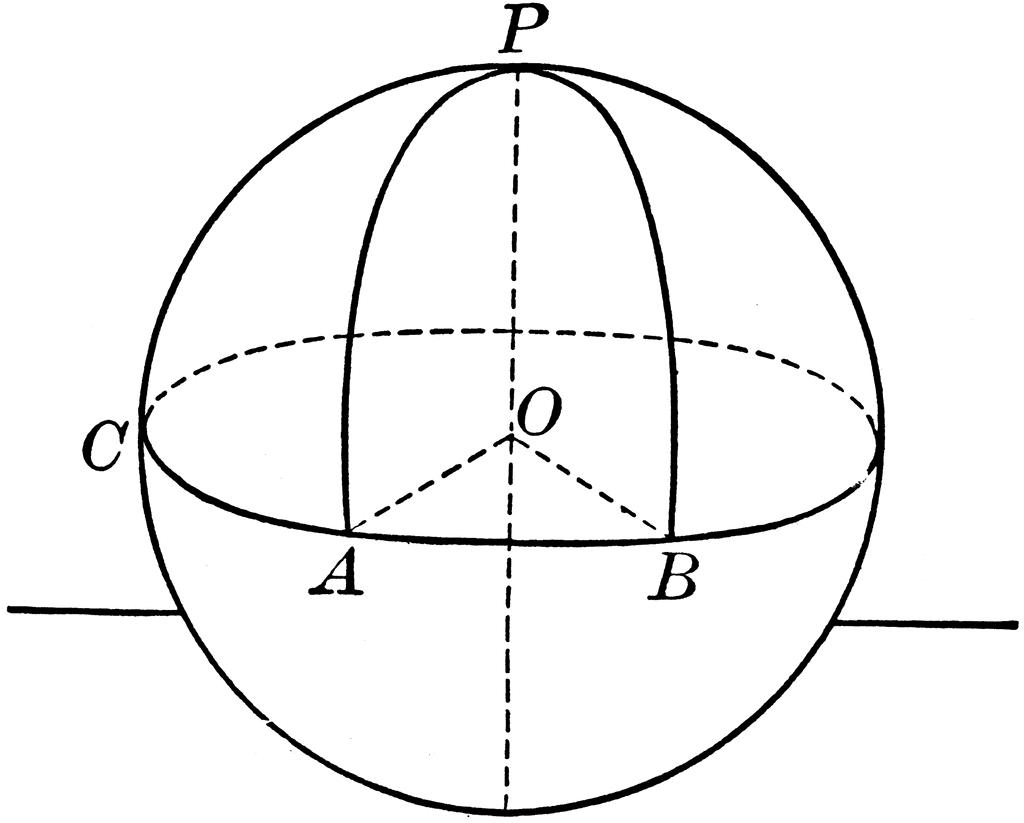
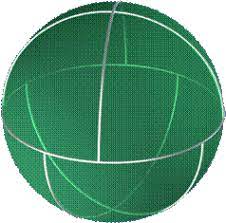
Great circle — the intersection of the sphere with any plane through the centre. All great circles of a sphere are equal; any two great circles bisect each other.
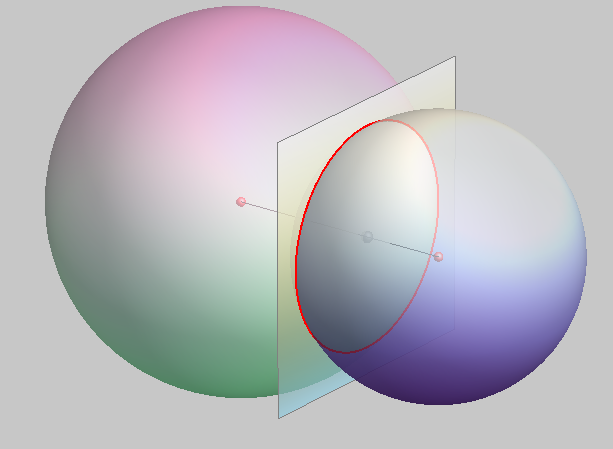
Small circle — the intersection of the sphere with any plane not through the centre.
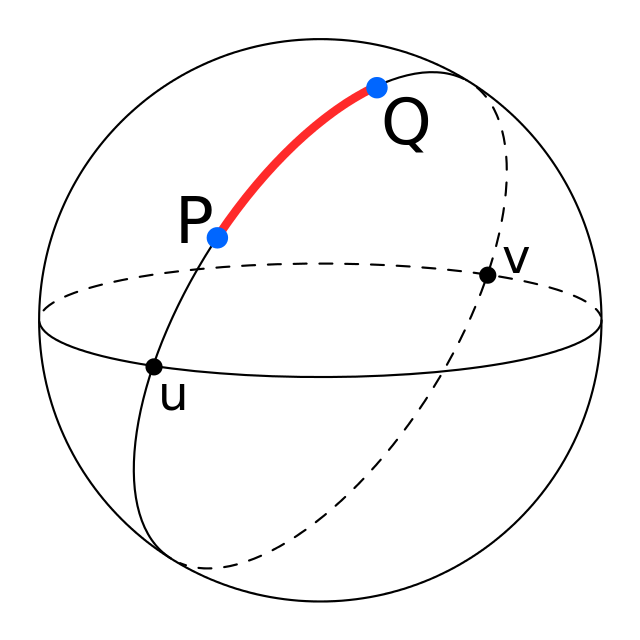
The shortest path between two points on a sphere lies along the arc of the great circle through them — this arc is the spherical distance between the points.
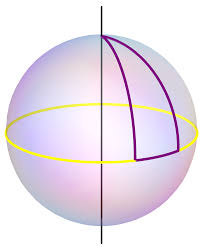
Poles — the two points of intersection of the sphere with the axis of a circle on the sphere (the axis being the diameter perpendicular to the plane of the circle). Every point of a great circle is equidistant from its two poles; that distance is a quadrant (90°).
Tangent Plane
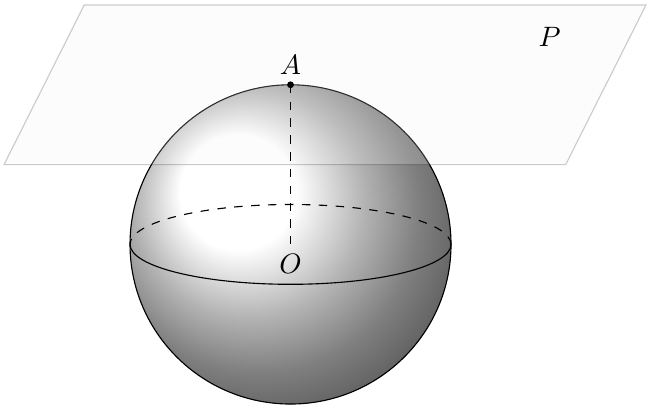
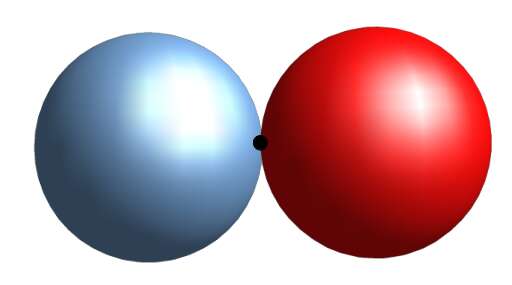
A tangent plane to a sphere at a point P is the plane perpendicular to the radius drawn to P. It touches the sphere at P only, and every line in the tangent plane through P is tangent to the sphere.
Inscribed and Circumscribed Spheres
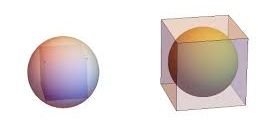
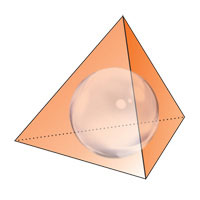
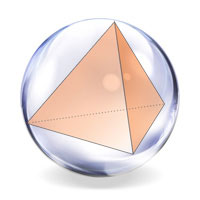
A sphere is inscribed in a polyhedron if it is tangent to every face. A sphere is circumscribed about a polyhedron if every vertex of the polyhedron lies on the sphere.
Every regular polyhedron has both an inscribed and a circumscribed sphere, both concentric with the polyhedron.
Spherical Polygons and Triangles
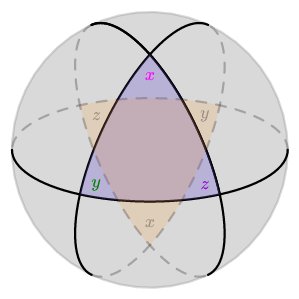
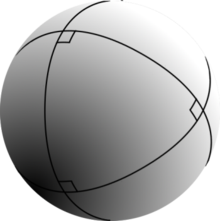
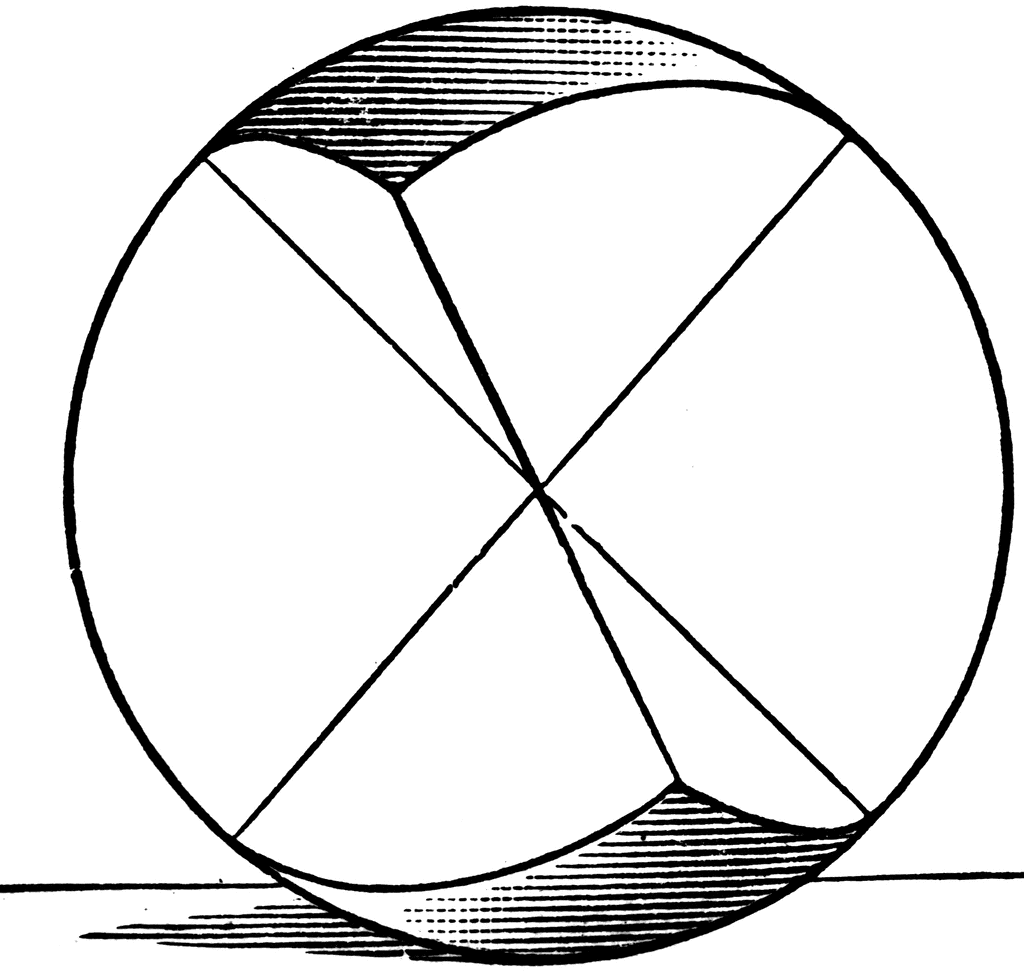
A spherical polygon is a figure on the surface of a sphere bounded by arcs of great circles. Each arc is a side; the angle between adjacent sides at a vertex is a spherical angle, equal to the dihedral angle between the planes of the two great circles.
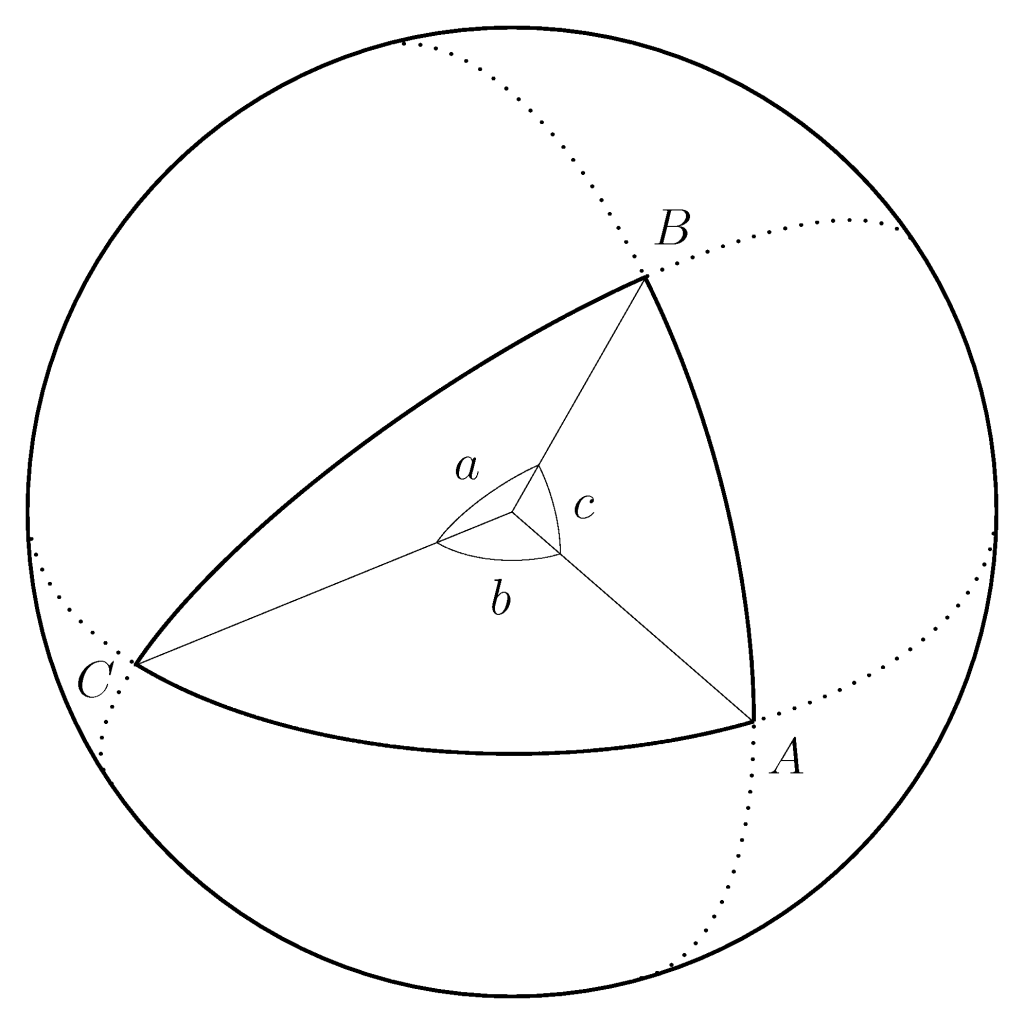
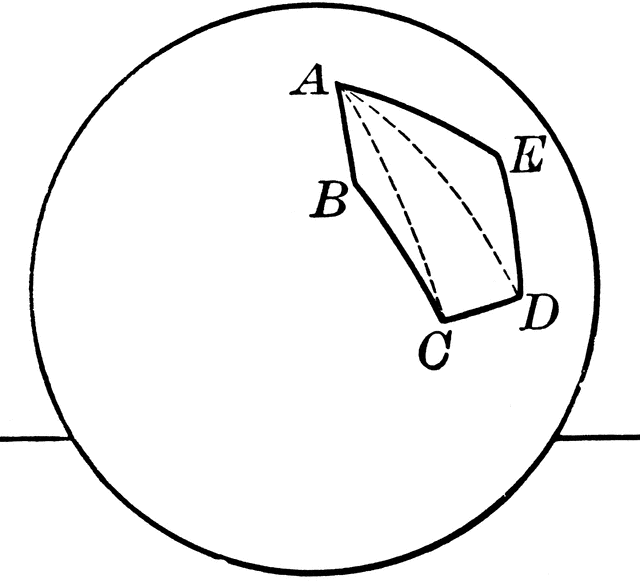
A spherical triangle has three great-circle arcs as sides. Each side is expressed as an angle — the central angle subtended at the centre of the sphere.
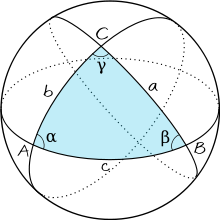
Properties of Spherical Triangles
- Each side is less than a semicircle (180°).
- The sum of the sides is less than 360°.
- The sum of the angles is greater than 180° and less than 540°.
- Two spherical triangles are congruent if they have three sides, two sides and the included angle, or two angles and the included side equal.
The spherical excess E of a spherical triangle is:
E = A + B + C − 180°
where A, B, C are the angles in degrees. The area of the triangle on a unit sphere equals the spherical excess in radians.
Area of a spherical triangle on a sphere of radius r:
Area = E · r² (with E in radians)
Zones and Lunes
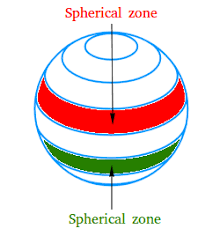
Zone — the portion of a spherical surface between two parallel planes. Its area depends only on the altitude (perpendicular distance between the planes) and the radius of the sphere.
- Area of a zone = 2πr · h, where r is the radius and h the altitude of the zone.
- The entire sphere is a zone of altitude 2r: area = 4πr².
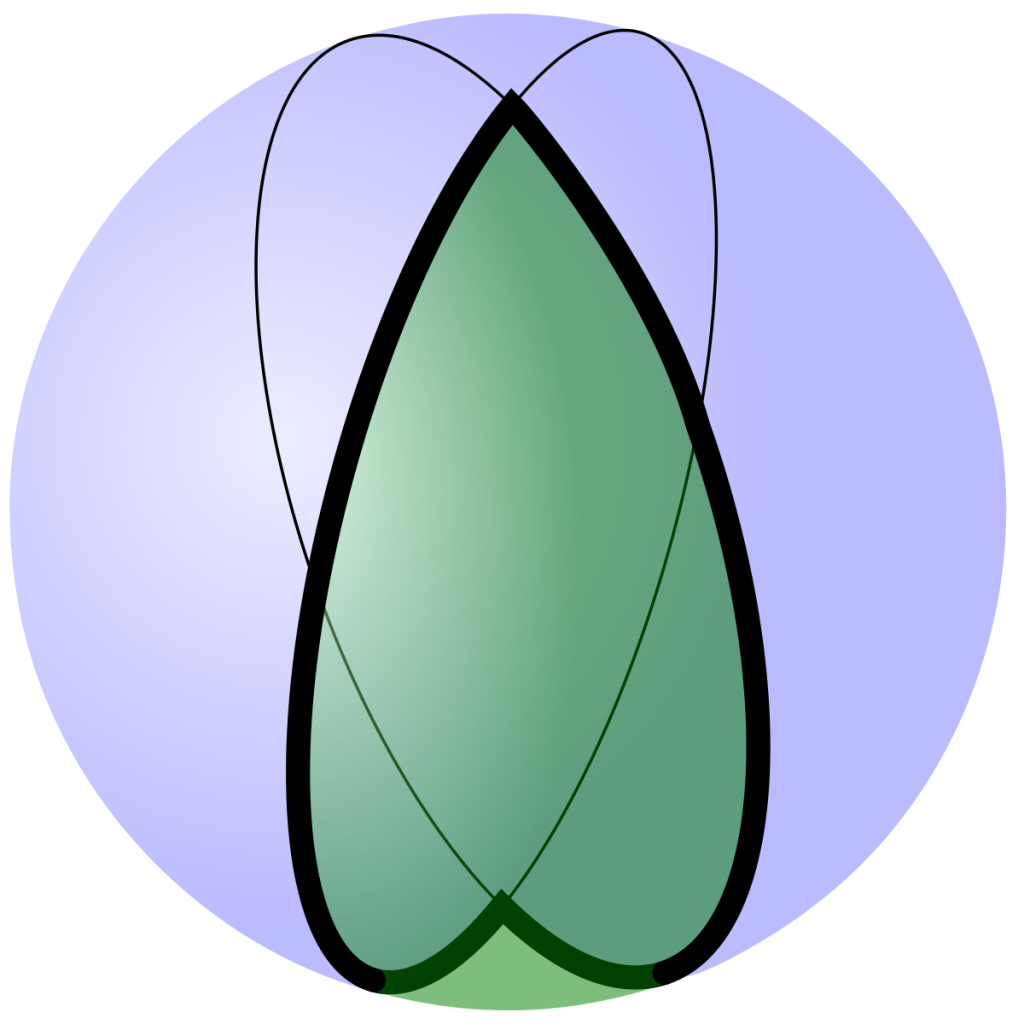
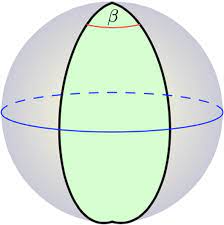
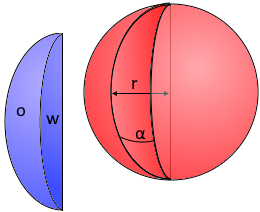
Lune — the portion of a spherical surface between two great semicircles. Its area is proportional to its angle.
- Area of a lune of angle θ (radians) = 2r²θ.

Spherical Segments and Sectors
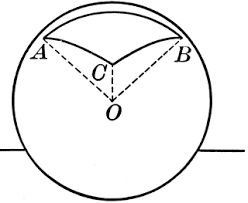
Spherical segment — the solid between a sphere and one or two parallel cutting planes.
- Volume of a spherical segment of one base (spherical cap) of height h: v = ⅓πh²(3r − h)
- Volume of a spherical segment of two bases (zone solid): v = ⅙πh(3a² + 3b² + h²), where a, b are the base radii and h the altitude.
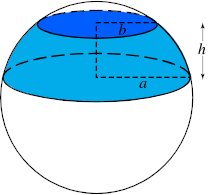
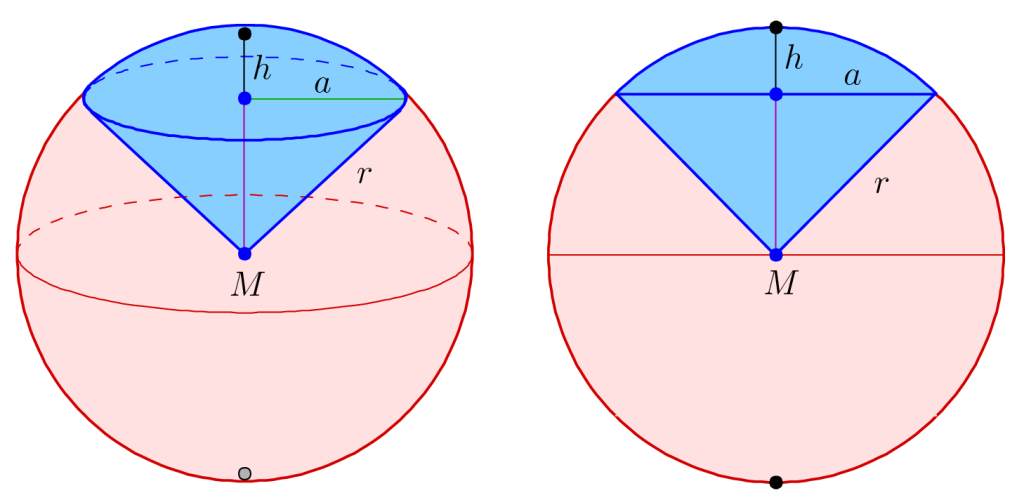
Spherical sector — the solid formed by rotating a circular sector about the diameter of the sphere lying in the plane of the sector.
- Volume of a spherical sector: v = ⅔πr²h, where h is the altitude of the corresponding zone.
Surface Area and Volume of a Sphere
For a sphere of radius r:
- Surface area: S = 4πr²
- Volume: V = 4/3 · πr³
Corollaries: - The surface areas of two spheres are to each other as the squares of their radii. - The volumes of two spheres are to each other as the cubes of their radii. - The surface of a sphere equals the lateral area of the circumscribed cylinder. - The volume of a sphere equals two-thirds the volume of the circumscribed cylinder.
The last two results were discovered by Archimedes, who considered them among his greatest achievements.
Conclusion
Cylinders, cones, and the sphere complete the classical study of curved surfaces. The cylinder and cone arise naturally as surfaces of revolution from the simplest plane figures — the rectangle and the right triangle — while the sphere emerges from the semicircle. Their formulae share a satisfying unity: the volume of a cone is one-third that of the cylinder with the same base and height, and the volume of a sphere is two-thirds that of its circumscribed cylinder. The conic sections — circle, ellipse, parabola, and hyperbola — reveal that slicing a single cone at different angles produces the curves that govern planetary orbits, projectile paths, and the geometry of reflection. On the sphere itself, the rich structure of great circles, spherical triangles, and spherical excess extends plane geometry into a curved world where parallel lines meet and the angles of a triangle always sum to more than 180°.
With curved surfaces covered, the next chapter introduces the most symmetrical solids of all — the Platonic Solids.