
Part 4 of 5
Part 4 — Solid Geometry
Enter the third dimension — explore prisms, pyramids, the sphere, the Platonic and Archimedean solids, and the elegant world of three-dimensional geometry.
Solid geometry extends all that you have learned into three-dimensional space. Here shapes have volume and surface area, and the relationships between them reveal some of the most beautiful patterns in all of mathematics.
In this part you will explore prisms, pyramids, cylinders, cones, and the sphere, learning how to calculate their volumes and surface areas. You will then meet the Platonic solids — the five perfect three-dimensional forms known since antiquity — followed by the Archimedean solids, Catalan solids, and compound polyhedra. Each family of shapes carries its own deep geometric symmetry.
This is where geometry becomes truly three-dimensional, and where the ancient and the modern converge in pure form.
Chapters in this Part
-
15
Lines, Planes and Solid Angles→
Solid geometry fundamentals — planes, perpendiculars, dihedral angles, polyhedral angles, and propositions governing lin…
-
16
Prisms and Pyramids→
Prisms, pyramids, parallelepipeds, frustums, and Cavalieri's principle — a complete guide to polyhedra in Euclidean geom…
-
17
Cylinders, Cones and the Sphere→
Explore the geometry of curved surfaces — cylinders, cones, and the sphere — their properties, surface areas, volumes, a…
-
18
Platonic Solids→
The five Platonic Solids — why exactly five exist, their properties, Euler's formula, symmetry, duality, and their role …
-
19
Dual Polyhedra→
Dual polyhedra — dual pairs of Platonic Solids, constructing duals, self-dual polyhedra, rectification, and duals of Arc…
-
20
Compound Polyhedra→
Compound polyhedra — the stella octangula, five regular polyhedral compounds, and the four Kepler-Poinsot star polyhedra…
-
21
Archimedean Solids→
The thirteen Archimedean Solids — semi-regular polyhedra arising from truncation, expansion, and snubbing of the Platoni…
-
22
Catalan Solids→
The thirteen Catalan Solids — duals of the Archimedean Solids, their properties, and notable examples like the rhombic d…
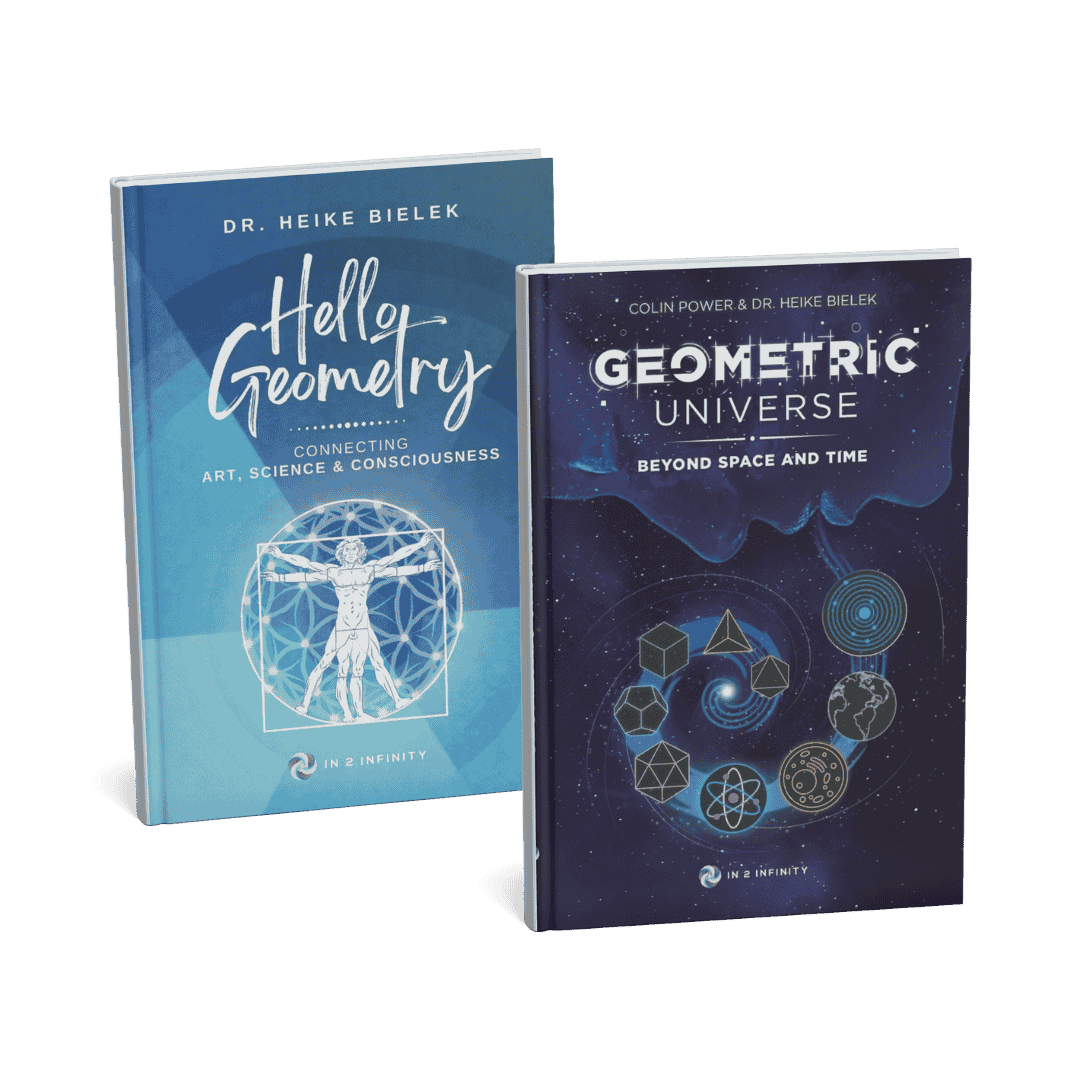
Take it further with the books
Continue beyond the guide — from Hello Geometry, a beginner-friendly introduction, to The Geometric Universe, the complete geometric theory.
Explore the books →