Introduction
Every polyhedron carries within it the seeds of another — its dual — formed by swapping the roles of faces and vertices. This elegant reciprocity, called duality, runs through the entire taxonomy of regular and semi-regular polyhedra and reveals a deep structural symmetry in three-dimensional space.
Key Takeaways
- The dual of a polyhedron is formed by placing a vertex at the centre of each face and connecting vertices that correspond to adjacent faces.
- Duality swaps faces and vertices: F of the original becomes V of the dual, V becomes F, and E stays the same.
- Euler's formula V − E + F = 2 is preserved under duality because swapping V and F leaves the equation unchanged.
- All pyramids are self-dual; the tetrahedron is the most famous self-dual [Platonic Solid](/ultimate-guide-to-sacred-geometry/platonic-solids/).
- The duals of the thirteen Archimedean Solids are the thirteen Catalan Solids, which are face-transitive rather than vertex-transitive.
Every polyhedron has a dual — a companion solid that swaps the roles of faces and vertices. Where the original solid has a face, the dual has a vertex; where the original has a vertex, the dual has a face. The number of edges is preserved. This relationship, called duality, runs throughout all of polyhedral geometry and reveals a deep symmetry in the way three-dimensional solids are organised.
The Duality Operation
To construct the dual of a polyhedron, place a new vertex at the centre of each face of the original. Then connect two new vertices with an edge whenever the corresponding faces of the original share an edge. The result is the dual polyhedron.
More precisely, for each face of the original (with n edges), there is one vertex of the dual; for each vertex of the original (where m faces meet), there is one face of the dual with m sides.
The rule for vertices, edges, and faces follows directly: - Faces (F) of the original → Vertices (V) of the dual - Vertices (V) of the original → Faces (F) of the dual - Edges (E) of the original → Edges (E) of the dual (the count is the same)
Euler's formula is automatically preserved: if V − E + F = 2 for the original, then F − E + V = 2 for the dual (swapping V and F).
The Dual of the Dual
Taking the dual of a dual returns to the original polyhedron (up to scaling and centering). Duality is therefore an involution — applying it twice gives back what you started with.
This is analogous to the transpose operation in linear algebra, or negation in arithmetic. The dual of the dual is canonically the same shape.
Dual Pairs of Platonic Solids
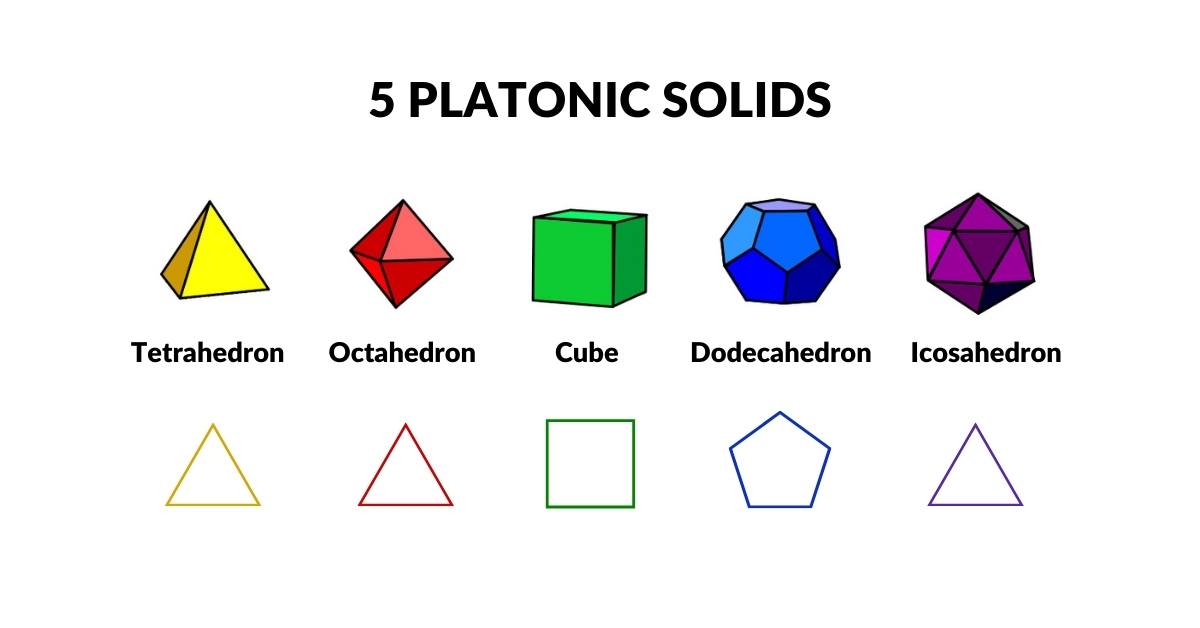
The five Platonic Solids fall into three groups under duality.
Tetrahedron — Self-Dual
The tetrahedron is its own dual. Placing a vertex at the centre of each of its four faces and connecting them produces another tetrahedron, rotated by 90° relative to the first.
| Tetrahedron | Dual (tetrahedron) | |
|---|---|---|
| Faces | 4 | 4 |
| Vertices | 4 | 4 |
| Edges | 6 | 6 |
Cube and Octahedron
The dual of the cube is the octahedron, and vice versa. The cube has 6 faces and 8 vertices; the octahedron has 8 faces and 6 vertices. Both have 12 edges.
| Cube | Octahedron | |
|---|---|---|
| Faces | 6 | 8 |
| Vertices | 8 | 6 |
| Edges | 12 | 12 |
To see this concretely: the cube has 6 faces, so the octahedron has 6 vertices. The cube has 8 vertices, so the octahedron has 8 faces. The octahedron's faces are triangles because 3 faces meet at each vertex of the cube.
Dodecahedron and Icosahedron
The dual of the dodecahedron is the icosahedron.
| Dodecahedron | Icosahedron | |
|---|---|---|
| Faces | 12 | 20 |
| Vertices | 20 | 12 |
| Edges | 30 | 30 |
The dodecahedron has 12 pentagonal faces, so the icosahedron has 12 vertices. Three faces meet at each vertex of the dodecahedron, so the icosahedron has triangular faces. Five faces meet at each vertex of the icosahedron — matching the five-sided faces of the dodecahedron.
Self-Dual Polyhedra
A polyhedron is self-dual if it is combinatorially identical to its own dual. The tetrahedron is the most famous example, but all pyramids are self-dual: a pyramid with an n-gon base has n + 1 faces and n + 1 vertices. Swapping faces and vertices gives the same type of solid.
A square pyramid, for instance, has 5 faces and 5 vertices — its dual is another square pyramid (in general position, not necessarily the same shape, but the same combinatorial structure).
Rectification — the Midpoint Between Duals
The rectified form of a polyhedron is obtained by truncating each vertex to the midpoint of every edge. This produces a new polyhedron in which every original vertex and every original face contributes a new face, and all edges are of equal length.
The cuboctahedron is the rectification of both the cube and the octahedron — it sits precisely "between" them in the duality. It has 8 triangular faces (one from each face of the octahedron) and 6 square faces (one from each face of the cube), with 12 vertices and 24 edges.
Similarly, the icosidodecahedron is the rectification of both the dodecahedron and the icosahedron. These rectified forms are among the Archimedean Solids.
Duality and Euler's Formula
Duality preserves Euler's formula in a particularly elegant way. If V − E + F = 2 for a polyhedron, then for its dual (with V' = F, E' = E, F' = V): V' − E' + F' = F − E + V = 2.
This shows that Euler's formula is in a sense dual to itself — it is unchanged when faces and vertices are swapped. This is one reason why the formula V − E + F = 2 is regarded as a topological invariant: it reflects a deep property of the sphere that is independent of the specific combinatorial structure of any particular polyhedron.
The principle of duality extends beyond the Platonic Solids to the Archimedean Solids and their duals, the Catalan Solids.
Conclusion
Duality is one of the most far-reaching symmetries in polyhedral geometry: it swaps faces and vertices while preserving edge count and Euler's formula, and it pairs the five Platonic Solids into two dual pairs plus one self-dual. The rectification operation — truncating to edge midpoints — produces the Archimedean Solids that sit geometrically between each dual pair, and superimposing dual pairs generates the compound polyhedra explored in the next chapter. Euler's formula V − E + F = 2 is literally self-dual: swapping V and F leaves it unchanged.
When dual pairs are superimposed, they create beautiful interpenetrating forms. The next chapter explores Compound Polyhedra.