Prisms and pyramids are the most elementary solid figures. A prism extends a polygon into space by sweeping it along a perpendicular axis; a pyramid tapers a polygon to a single apex. This chapter establishes their definitions, derives formulas for lateral area and volume, and introduces Cavalieri's principle — one of the most elegant ideas in solid geometry.
Key Takeaways
- The volume of any prism equals its base area multiplied by its altitude.
- The volume of any pyramid equals one-third of its base area multiplied by its altitude.
- The lateral area of a right prism equals the altitude times the perimeter of the base.
- Cavalieri's Principle: two solids with equal cross-sectional areas at every height have equal volumes.
- The volumes of similar polyhedra are proportional to the cubes of their corresponding edges; surface areas are proportional to the squares.
What is a Polyhedron?
A polyhedron is a geometric solid bounded by polygons. Its boundary polygons are faces; a common side of two adjacent faces is an edge; several faces meeting at a common vertex form a polyhedral angle. A straight segment connecting two vertices not in the same face is a diagonal. A polyhedron with every section being a convex polygon is convex — we consider only convex polyhedra here.
Prisms
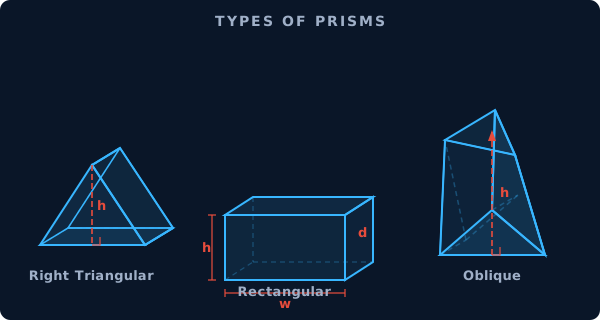
A prism is a polyhedron with two congruent polygonal faces in parallel planes (the bases) and parallelogram lateral faces. The altitude is the perpendicular distance between the bases.
- Right prism — lateral edges perpendicular to bases; lateral edges equal altitude.
- Oblique prism — lateral edges oblique to bases.
- Right section — a section perpendicular to all lateral edges.
- Truncated prism — the portion between the base and an oblique cutting plane.
Prisms are named by their base: triangular, quadrangular, etc.
Propositions
- Sections made by parallel planes cutting all lateral edges are congruent polygons.
- Lateral area of a prism = lateral edge × perimeter of a right section.
- Corollary: Lateral area of a right prism = altitude × perimeter of base.
- An oblique prism is equivalent to a right prism whose base equals a right section of the oblique prism and whose altitude equals a lateral edge.
Parallelepiped
A parallelepiped is a prism with parallelogram bases.
- Right parallelepiped — lateral edges perpendicular to bases.
- Rectangular parallelepiped — right parallelepiped with rectangular bases.
- Cube — all six faces are squares.
Volume: - Volume of a rectangular parallelepiped = product of its three dimensions (= base × altitude). - Volume of any parallelepiped = base × altitude. - Volume of a triangular prism = base × altitude. - Volume of any prism = base × altitude. - Corollary: Prisms with equivalent bases and equal altitudes are equivalent.
Pyramids
A pyramid is a polyhedron with a polygonal base and triangular lateral faces meeting at a common vertex. A triangular pyramid (four triangular faces) is a tetrahedron.
Altitude — perpendicular from vertex to base plane. Lateral area — sum of areas of lateral faces.
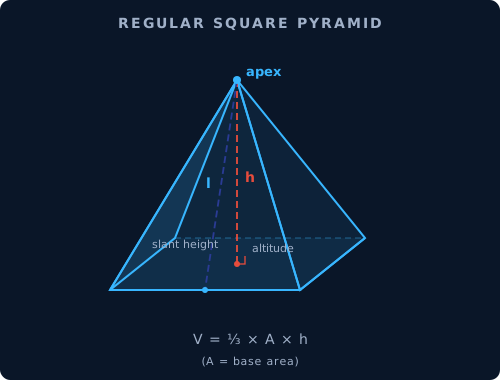
Regular pyramid — base is a regular polygon whose centre coincides with the foot of the altitude. Lateral edges are equal; lateral faces are congruent isosceles triangles; all faces have the same slant height.
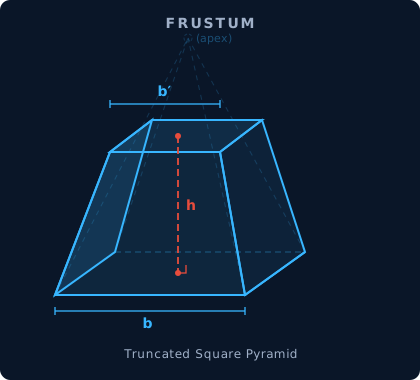
Frustum — the portion of a pyramid between the base and a section parallel to the base.
Propositions
- Lateral area of a regular pyramid = ½ × slant height × perimeter of base.
- Corollary: Lateral area of a frustum of a regular pyramid = ½ × (sum of base perimeters) × slant height.
- If a pyramid is cut by a plane parallel to the base, edges and altitude are divided proportionally, and the section is similar to the base.
- Volume of a triangular pyramid = ⅓ × base × altitude.
- Volume of any pyramid = ⅓ × base × altitude.
- Frustum volume: v = ⅓a(b + b' + √bb'), where a is the altitude and b, b' are the two bases.
Cavalieri's Principle
The Italian mathematician Bonaventura Cavalieri (17th century) formulated:
If two solids are positioned so that for each plane parallel to a given plane, the cross-sections of the two solids are equivalent, then the volumes of the solids are equal.
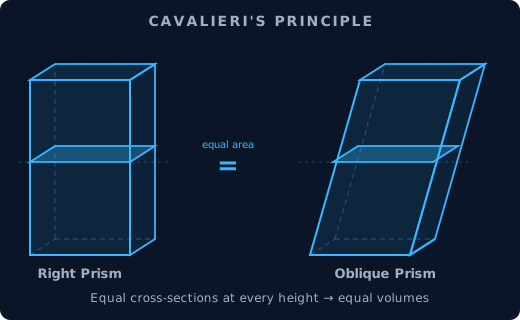
This principle justifies many volume equivalences — for example, two prisms with equal altitudes and equivalent bases are equivalent because their cross-sections at every height are equivalent.
Similarity of Polyhedra
Two polyhedra are similar if they have respectively congruent polyhedral angles and similarly positioned similar faces. Corresponding elements are homologous.
- Homologous edges are proportional.
- Surface areas of similar polyhedra are to each other as the squares of homologous edges.
- Volumes of similar polyhedra are to each other as the cubes of homologous edges.
A cross-section parallel to the base of a pyramid cuts off a smaller pyramid similar to the original.
Symmetries of Space Figures
Central symmetry — two figures are symmetric about a point O if every point A of one corresponds to a point A' of the other such that O is the midpoint of AA'.
Bilateral symmetry — two figures are symmetric about a plane P if every point A of one corresponds to A' of the other such that AA' is perpendicular to P and bisected by it.
Axial symmetry — two figures are symmetric about a line l if every point A of one corresponds to A' of the other such that AA' is perpendicular to l, intersects it, and is bisected by that intersection.
Conclusion
Prisms and pyramids are the primary building blocks of solid geometry — every polyhedral volume computation reduces, via triangulation, to sums of prismatic and pyramidal volumes. Cavalieri's Principle and the similarity ratio for volumes (scaling by k³) are tools that carry forward into every subsequent chapter on three-dimensional solids. The symmetry conditions — central, bilateral, and axial — provide the geometric vocabulary needed to classify the more complex solids ahead.
The next chapter explores Cylinders, Cones and the Sphere — the first curved surfaces in the guide.