Introduction
Fractals are among the most visually striking and philosophically profound objects in mathematics. Unlike the smooth curves and regular polygons of classical Euclidean geometry, fractals are rough, fragmented, and infinitely detailed — yet they are not random. They are structured by a single elegant principle: self-similarity. A fractal looks the same at every scale of magnification, because its large-scale form is built from smaller copies of itself, which are in turn built from still smaller copies, and so on without limit.
The term was coined by Benoît Mandelbrot in 1975, but the patterns themselves are far older — they are the actual geometry of the natural world. Coastlines, mountain ranges, river networks, trees, lungs, broccoli, clouds, and lightning bolts are all fractal. Sacred geometry has always intuited this principle: that simple geometric rules, applied recursively, generate the infinite complexity of nature. In this chapter we explore the mathematics of fractals, their appearance in the natural world, and their deep connection to the pentagon, the Golden Ratio, and the broader tradition of sacred geometry.
Key takeaways
- Fractals are geometric forms that are self-similar across scales — every part, when magnified, resembles the whole — and they have non-integer (fractal) dimensions.
- Classic fractals include the Koch Snowflake (infinite perimeter, finite area), the Sierpinski Triangle, and the Mandelbrot Set — all generated by the recursive application of simple rules.
- Fractals are the actual geometry of nature: coastlines, trees, river deltas, lungs, and Romanesco broccoli all display self-similar structure at every scale.
- The pentagon is a natural fractal of the Golden Ratio — no external rule is needed, only the continuation of its own diagonals — revealing why φ appears so pervasively in living growth.
What Is a Fractal?
The word fractal was coined by the mathematician Benoît Mandelbrot in 1975, from the Latin fractus (broken, fractured), and it describes geometric forms that are self-similar across scales: forms in which every part, when magnified, resembles the whole. Mandelbrot, who spent his career studying irregular and fragmented geometric forms in the real world — the shapes of coastlines, clouds, mountains, turbulence, price fluctuations — coined the word to describe what all these phenomena have in common: a geometry that repeats itself at every scale of magnification, a structure that is equally complex whether you look at the large scale or the small scale.
Classical Euclidean geometry describes smooth, regular forms: straight lines, circles, spheres, polyhedra. These forms look simpler as you zoom in; a small section of a large circle looks nearly straight. Fractal forms are the opposite: they look equally complex at every scale, and their boundary or surface never simplifies into a smooth curve or plane. A coastline, mapped at the scale of continents, shows bays and peninsulas; mapped at the scale of individual beaches, shows rocks and inlets; mapped at the scale of individual boulders, shows crevices and protrusions; and at every scale the degree of complexity — the ratio of actual perimeter to straight-line distance — remains approximately constant. This scale-invariant complexity is the defining feature of fractal geometry.
Fractals have a fractal dimension — a dimension that is not an integer. A line is one-dimensional; a filled square is two-dimensional. But a Koch Snowflake — a fractal constructed by repeatedly adding smaller equilateral triangles to the sides of an original equilateral triangle — has a dimension of approximately 1.26: more than a line but less than a filled area. A fractal that fills space more densely has a higher fractal dimension. The fractal dimension is a precise measure of how "filled" a fractal is and how fast its measured length or area grows as the measurement scale decreases.
Classic Fractals
The Mandelbrot Set is the most famous fractal and one of the most extraordinary objects in mathematics. It is defined by the simplest possible iteration in the complex plane: starting from the point z = 0, repeatedly apply the rule z → z² + c, where c is a fixed complex number. If the sequence of values remains bounded (does not fly off to infinity), then c is in the Mandelbrot Set; if the sequence escapes to infinity, c is not. The boundary of the Mandelbrot Set — the set of all c values at the exact threshold between bounded and unbounded — is infinitely complex: every zoom into the boundary reveals new structures, new spirals, new bulbous protrusions, new seahorse valleys and lightning bolt filaments, without limit. The Mandelbrot Set is self-similar not in the exact sense (the small copies of the Set visible in the boundary are not exact copies of the whole, but distorted near-copies) but in the sense that new structures continue to appear at every scale.
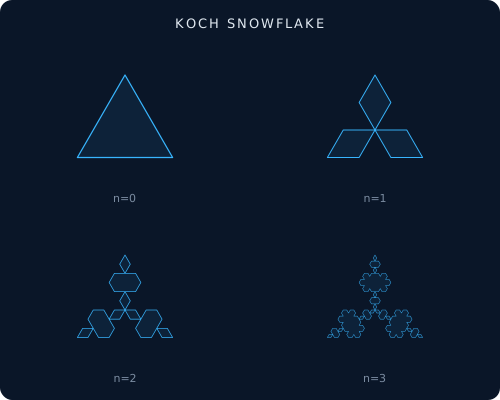
The Koch Snowflake demonstrates how an infinite perimeter can enclose a finite area. Starting with an equilateral triangle, you replace the middle third of each side with a smaller equilateral triangle, giving a Star of David shape. Then you replace the middle third of each of the new sides with a still smaller equilateral triangle, and so on, indefinitely. The perimeter of the resulting shape grows without limit (each iteration multiplies it by 4/3), but the area converges to a finite value (8/5 of the original triangle's area). The resulting snowflake shape is a fractal with dimension log(4)/log(3) ≈ 1.26.
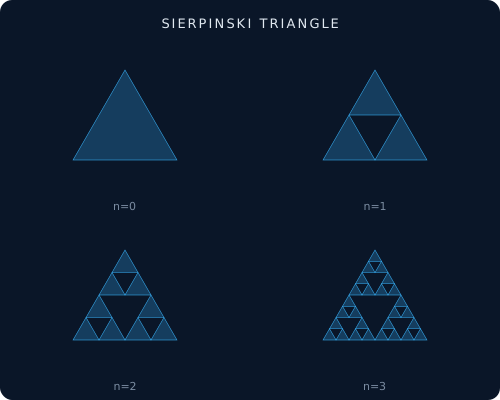
The Sierpinski Triangle is constructed by a different rule: take an equilateral triangle and remove the central inverted triangle (leaving three smaller triangles), then remove the central triangle from each of those three, and repeat indefinitely. The result is a fractal with dimension log(3)/log(2) ≈ 1.585, and it has the remarkable property that every scale of the triangle contains an identical copy of the overall pattern. This exact self-similarity at every scale makes the Sierpinski Triangle one of the clearest possible illustrations of the fractal principle.
Fractals in Nature
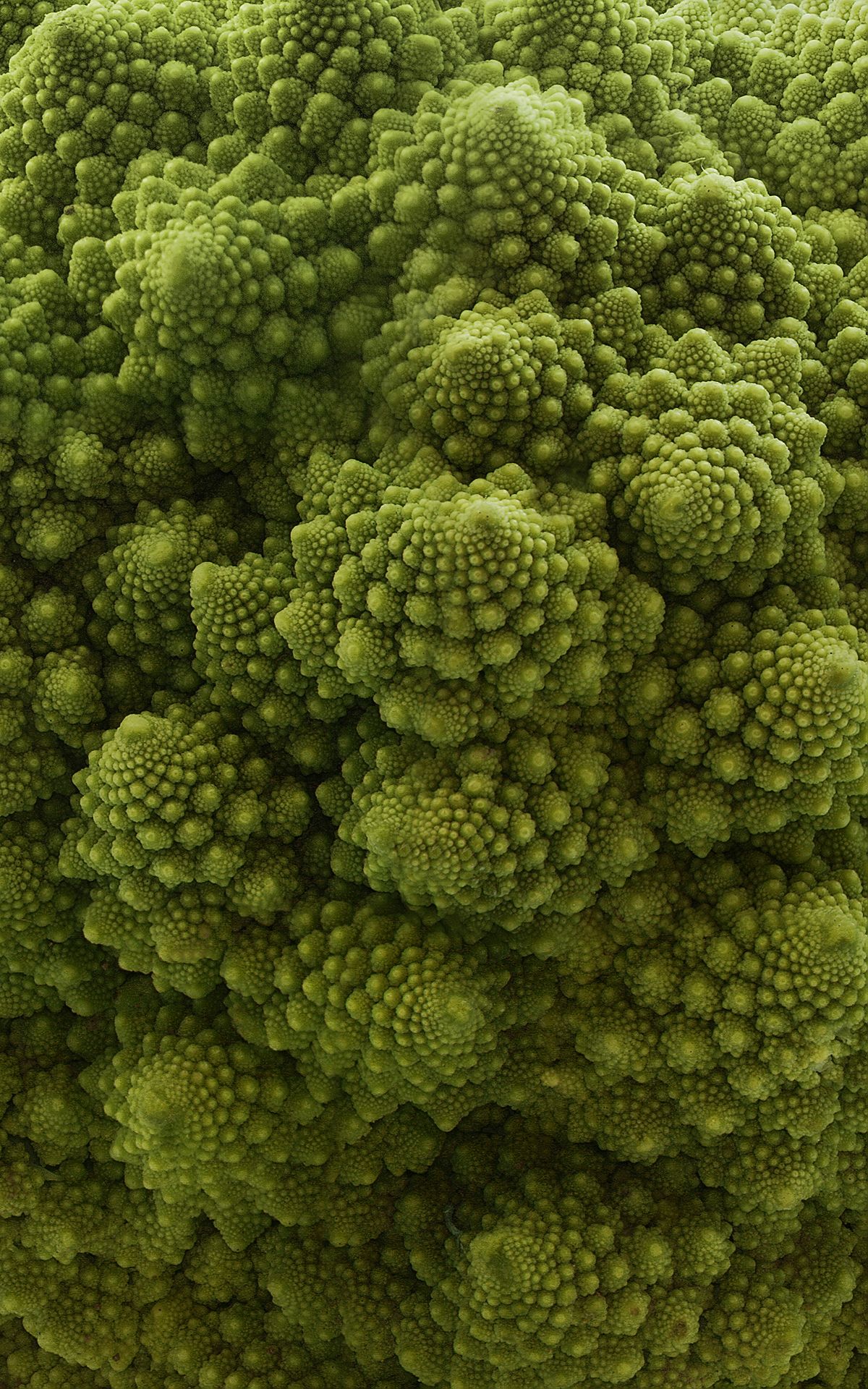
Fractals are not merely mathematical curiosities; they are the actual geometry of the natural world. Before Mandelbrot gave us the word and the mathematical framework, natural forms that we now recognise as fractal were simply described as irregular, complex, rough — too complicated for classical geometry to handle. Mandelbrot's insight was that these forms are not complicated in a random or disordered way: they are complicated in a structured, self-similar way, and their structure is describable by simple rules applied recursively.
The branching of trees is fractal: a tree's main trunk divides into branches, each branch divides into smaller branches, each of those divides again, and the pattern repeats down to the scale of twigs. At every level of branching, the pattern is approximately similar: the angle of branching, the ratio of parent branch diameter to child branch diameter, and the number of branches at each split all follow consistent rules. The fractal dimension of typical trees is between 1.8 and 2.3, reflecting the fact that trees must fill three-dimensional space with their branches in order to maximise light capture. The branching of the human lung's bronchial tree follows the same principles, filling a three-dimensional volume with a branching structure of maximum surface area for gas exchange.
River deltas are fractal. The Mississippi Delta, the Nile Delta, the Okavango Delta in Botswana — all display self-similar branching patterns, with each distributary channel dividing into smaller channels in a pattern that reproduces, at every scale, the overall branching geometry of the delta. Mountain ranges are fractal: the jaggedness of a mountain skyline looks approximately the same at the scale of a whole range as at the scale of a single peak, and a fractal dimension between 2.1 and 2.5 characterises different types of terrain. The human circulatory system is fractal. The pattern of broccoli Romanesco — a conical head made of spiralling florets, each of which is itself a smaller conical head of spiralling sub-florets — is one of the most precise natural fractals visible to the naked eye.
The Pentagon's Fractal
The deepest connection between fractals and sacred geometry is revealed in the pentagon. Most fractals require a deliberate constructive process — the Koch Snowflake requires that you repeatedly modify each side, the Sierpinski Triangle requires that you repeatedly remove the central region. These are imposed fractal structures, requiring an external rule to be applied. The pentagon, uniquely among the regular polygons, is naturally fractal: no external rule is required, only the continuation of the inherent structure of the pentagon itself.
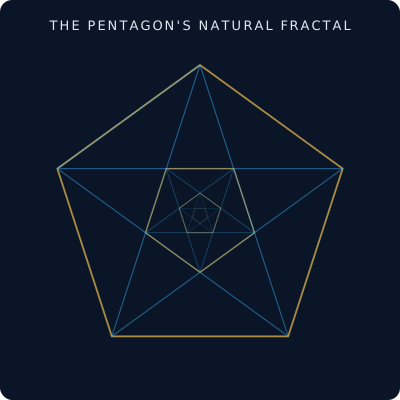
Draw a regular pentagon. Connect its five diagonals. The five diagonals intersect inside the pentagon to form a smaller regular pentagon at the centre, rotated by 36° relative to the original. This smaller pentagon has its own five diagonals, which in turn form an even smaller pentagon at its centre. And so on, forever — no external rule required, only the continuation of the diagonals. The result is a fractal nested pentagon, with each level smaller than the previous by the factor φ², and the whole assembly is the pentagram fractal, a naturally occurring infinite self-similar structure.
This is why the Golden Ratio and the Fibonacci sequence appear so pervasively in nature: they are the signatures of the pentagon's natural fractal growth process. Wherever growth occurs through the repetition of a five-fold rotational symmetry — as in the growth of flower petals, the arrangement of seeds, the phyllotactic spirals of plants — the Golden Ratio arises inevitably, because it is the scale factor of the pentagon's inherent fractal. Nature does not calculate φ; it simply expresses the geometry of five-fold growth, and φ is the inevitable consequence.
The silver mean, analogously, is the scale factor of the octagon's fractal — the factor by which the nested squares and octagons of the Islamic geometric tradition scale from one level to the next. The metallic means, fractals, and sacred geometry are not separate domains of inquiry but different perspectives on the same deep mathematical reality: the relationship between simple geometric symmetries and the infinite complexity that arises when those symmetries are allowed to generate their own intrinsic cascades of scale.
Tessellations in Nature and Art
Fractals and tessellations share a common principle: both demonstrate how simple geometric rules can fill space with structured pattern. Where fractals repeat across scales, tessellations repeat across the plane — and in nature, these two modes of geometric organisation often intertwine.
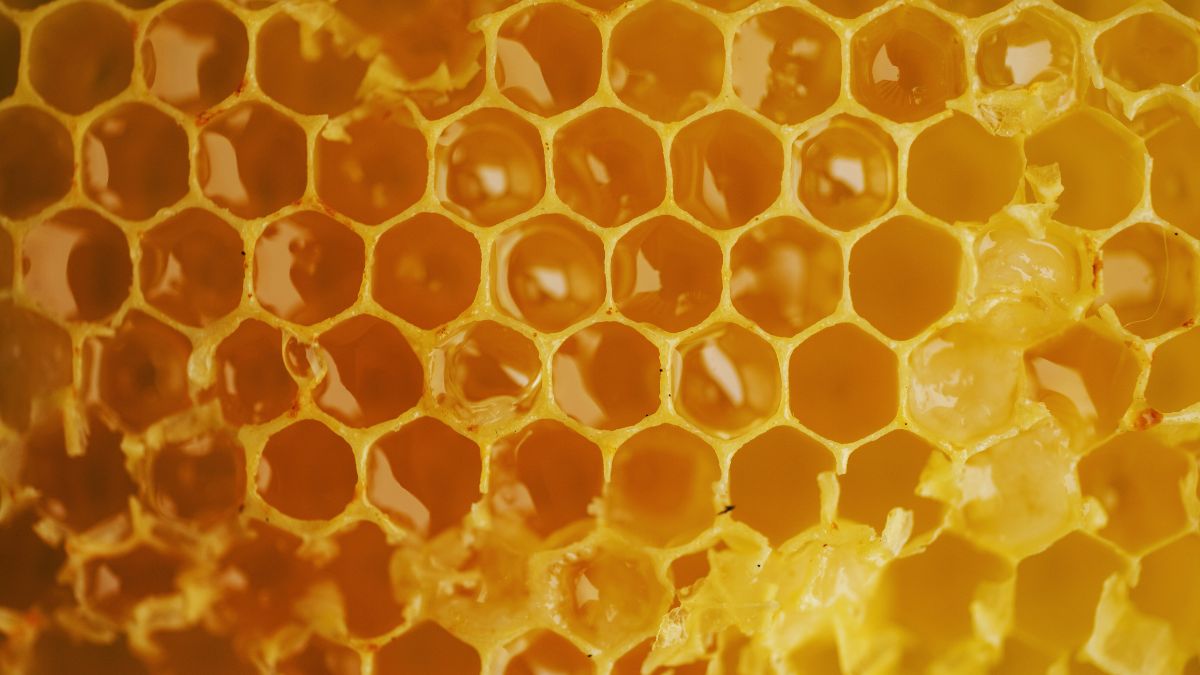
The honeycomb is the most familiar natural tessellation. Bees construct their combs from regular hexagons — the only regular polygon (apart from the square and equilateral triangle) that tiles the plane without gaps. The hexagonal tessellation is not merely convenient; it is optimal. In 1999 Thomas Hales proved the Honeycomb Conjecture: of all ways to partition a plane into regions of equal area with the least total perimeter, the regular hexagonal grid is the best. Bees, through millions of years of evolutionary refinement, had arrived at the mathematically optimal solution.
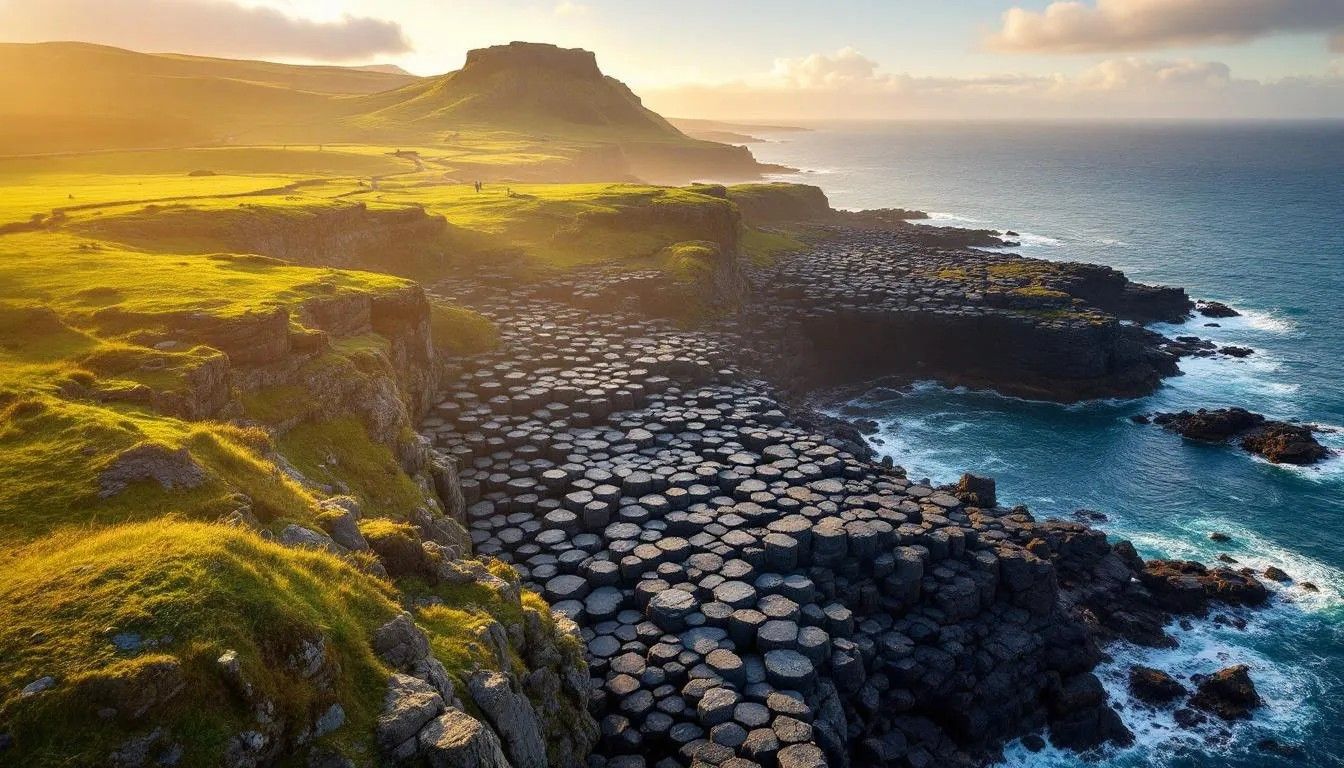
Basalt columns — most famously at the Giant's Causeway in Northern Ireland and at Fingal's Cave on the Scottish island of Staffa — display hexagonal tessellation in stone. When basaltic lava cools and contracts, stress fractures propagate through the rock in a pattern that minimises total crack length, producing hexagonal columns. The same geometry that governs the bee's wax governs the fracturing of stone: the hexagon is nature's preferred solution to the problem of dividing a surface efficiently.
Crystal lattices extend tessellation into three dimensions. The fourteen Bravais lattices — the fourteen distinct ways to arrange points in three-dimensional space with translational symmetry — describe the geometry of every crystalline substance. From the cubic lattice of table salt to the hexagonal close-packing of metals, the geometry of crystals is the geometry of three-dimensional tessellation, and many crystal structures correspond directly to the Platonic and Archimedean solids explored in earlier chapters.
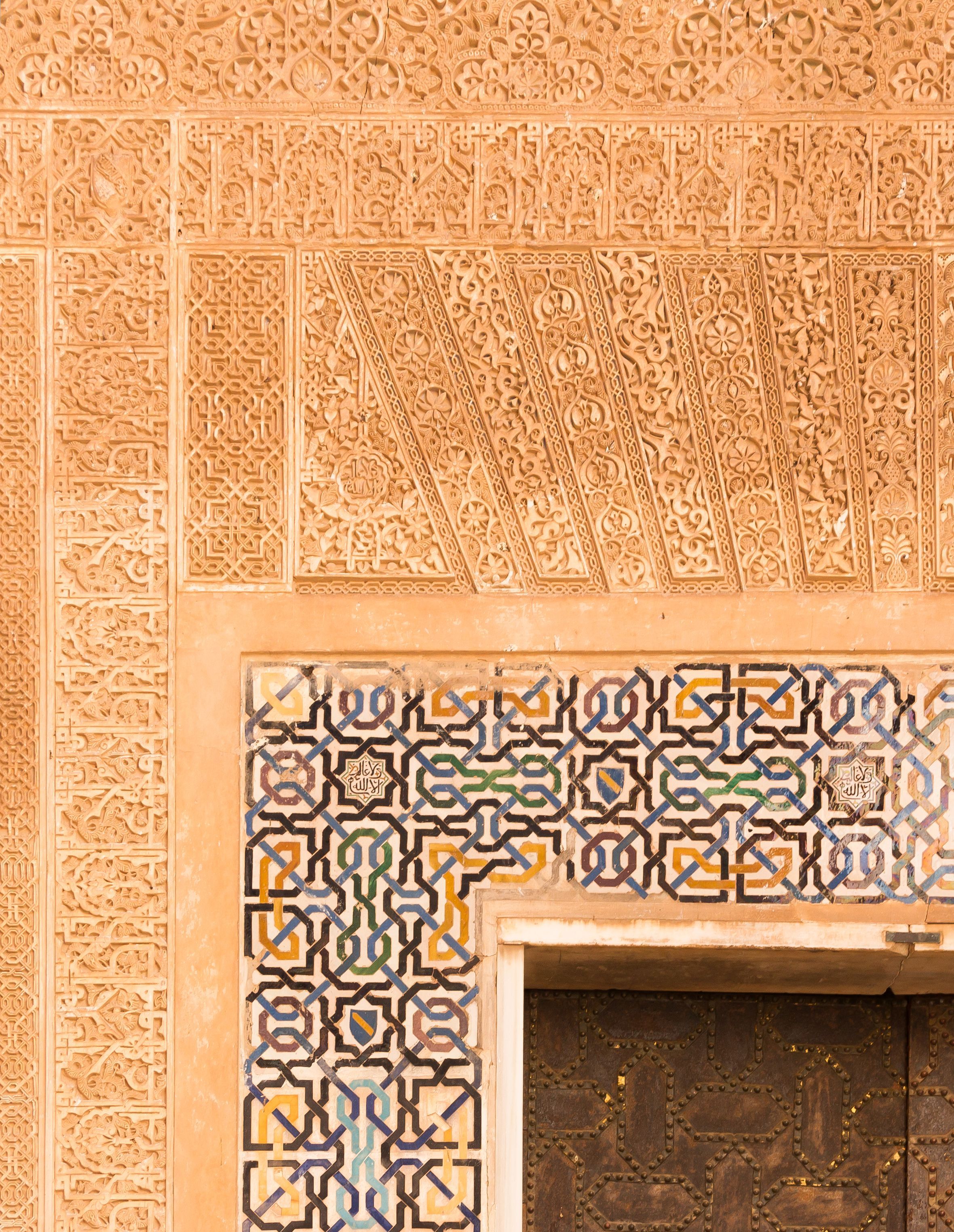
The tradition of Islamic geometric art, discussed in the previous chapter in the context of the Silver Mean, is simultaneously one of the world's great traditions of tessellation art. The Alhambra in Granada contains examples of all seventeen wallpaper groups — the seventeen mathematically distinct ways to create a repeating pattern on a plane using combinations of rotation, reflection, and translation. Some medieval Islamic patterns go further: the quasiperiodic tilings found at the Darb-i Imam shrine in Isfahan (15th century) achieve aperiodic plane-filling — patterns that never exactly repeat — predating Roger Penrose's famous aperiodic tilings by five centuries.
M.C. Escher, the twentieth-century Dutch graphic artist, brought tessellation art to a modern audience. Escher's interlocking figures — birds that transform into fish, lizards that tessellate into one another — are mathematically rigorous tessellations in which the tile shape has been deformed from a regular polygon into a recognisable figure while preserving the symmetry properties that allow it to tile the plane. Escher's work makes viscerally visible what tessellation mathematics describes abstractly: the way that simple symmetry rules can generate infinite pattern. For the full mathematical treatment of tessellations — regular, semi-regular, and Penrose tilings — see the Tessellations chapter in the geometry guide.
Consciousness and Perception
The relationship between fractal geometry and human perception is one of the more remarkable findings of recent cognitive science. Multiple studies have shown that human beings, across cultures and regardless of prior familiarity with fractal mathematics, consistently find fractal patterns aesthetically pleasing — and specifically, find patterns with fractal dimensions in the range of 1.3 to 1.8 most pleasing. This is precisely the range of fractal dimensions of most natural landscapes: coastlines, forests, clouds, rivers.
The evolutionary interpretation is straightforward: human beings evolved in fractal natural environments, and our perceptual systems were calibrated to those environments. We find fractal patterns pleasing because they signal, at a deep neurological level, the presence of natural environments — environments that provided food, shelter, and safety. The fractal patterns of Gothic cathedral architecture, of Persian carpet designs, of Japanese karesansui (Zen rock) gardens, and of the fractal-edged leaves and petals of the plants used in traditional floral decoration all exploit this hardwired preference. They create environments that our nervous systems interpret as deeply natural and therefore deeply calming.
The neuroscientist Richard Taylor, who has studied the fractal properties of Jackson Pollock's drip paintings, has proposed that the fractal patterns in Pollock's work are what generate their distinctive aesthetic impact and their capacity to reduce the viewer's physiological stress response. Pollock, who created his paintings by moving through the space of the canvas in large, flowing gestures, may have been unconsciously generating fractal patterns — patterns his own nervous system was calibrated to find beautiful — through the fractal dynamics of his bodily movement itself. The fractal geometry of consciousness may, in this reading, be the geometric substrate of aesthetic experience itself: the dimension at which human perception recognises itself in the world.
Conclusion
Fractals reveal that infinite complexity can arise from the simplest of geometric rules, applied recursively. The Koch Snowflake, the Sierpinski Triangle, and the Mandelbrot Set are not exotic mathematical curiosities — they are the geometric language in which nature writes its forms, from the branching of trees to the jaggedness of coastlines to the spiralling florets of Romanesco broccoli.
The pentagon's natural fractal connects this principle directly to sacred geometry: the Golden Ratio emerges inevitably from five-fold self-similarity, just as the Silver Mean emerges from eight-fold self-similarity. Fractals, metallic means, and tessellations are different expressions of the same deep truth — that the universe builds its astonishing variety from simple geometric symmetries repeated across every scale of existence.
In the next chapter, we turn to cymatics — and discover that sound itself creates geometric form.
FAQ
What is a fractal?
A fractal is a geometric form that is self-similar across scales — every part, when magnified, resembles the whole. The term was coined by Benoît Mandelbrot in 1975. Fractals arise naturally from the recursive application of simple geometric rules and appear throughout nature in coastlines, mountains, clouds, broccoli, ferns, river networks, and lightning bolts.
How do fractals relate to sacred geometry?
Fractals demonstrate that simple geometric rules, applied recursively, can generate infinite complexity — the same principle underlying sacred geometry's progression from point to line to circle to Flower of Life. The pentagon is itself a fractal of the Golden Ratio, and many sacred geometry patterns exhibit fractal self-similarity across scales.