The Universe Is Sound
Before there was form, there was vibration. This is not merely a mystical claim: it is the conclusion of modern quantum field theory, which describes all particles and all forces as excitations — vibrations — of underlying quantum fields. Matter is not solid stuff; it is the pattern of resonant vibration in the quantum vacuum. Energy is not a separate ingredient added to matter; it is the dynamic quality of those vibrations, the amplitude and frequency and pattern of their oscillation. The solid, visible world of everyday experience is built, at its deepest level, from the geometry of vibration.
The study of cymatics — the investigation of the visible forms that sound and vibration create in physical media — is therefore not a peripheral curiosity but a window onto one of the most fundamental aspects of physical reality: the relationship between vibration and form. When you watch sand on a vibrating plate arrange itself into geometric patterns as a tone is sounded, you are watching, in immediate and tangible form, the process by which vibration creates structure. The patterns that appear in the sand are not arbitrary; they are the geometric expression of specific resonant modes, the spatial eigenstates of the vibrating system. They are the geometry of sound made visible.
The word cymatics was coined by the Swiss physician and natural scientist Hans Jenny, who published his foundational book Kymatik in 1967. But the phenomenon itself was first rigorously documented more than a century earlier by the German physicist Ernst Chladni, one of the founders of acoustics as a scientific discipline. Chladni's experiments, performed in the late eighteenth century with a violin bow and metal plates covered with sand, produced the first systematic visual documentation of the relationship between acoustic frequencies and geometric form — and they astonished audiences across Europe, including Napoleon Bonaparte, who offered Chladni a prize of three thousand francs to explain the mathematics behind the patterns.
Key takeaways
- Cymatics makes the geometry of sound visible — sand, powder, and liquids on vibrating surfaces arrange themselves into precise geometric patterns determined entirely by the frequency of vibration.
- Many cymatic patterns are immediately recognisable as classical sacred geometry forms: hexagonal Seed of Life patterns, Flower of Life mandalas, and complex symmetric rosettes all arise naturally from specific acoustic frequencies.
- The cymatic principle — that vibration creates geometric form — aligns with both quantum field theory (all particles are vibrational excitations) and ancient traditions like Nada Brahma ("the universe is sound") and the Pythagorean music of the spheres.
Chladni Figures
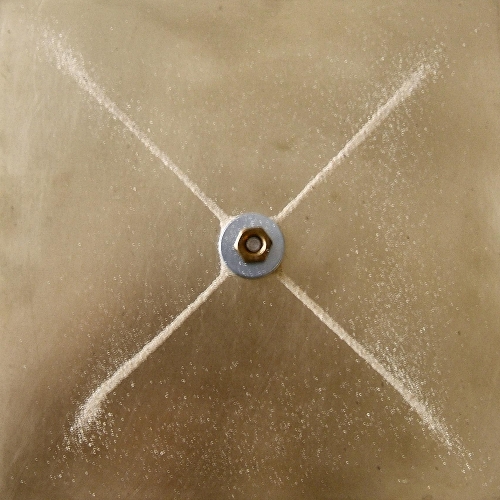
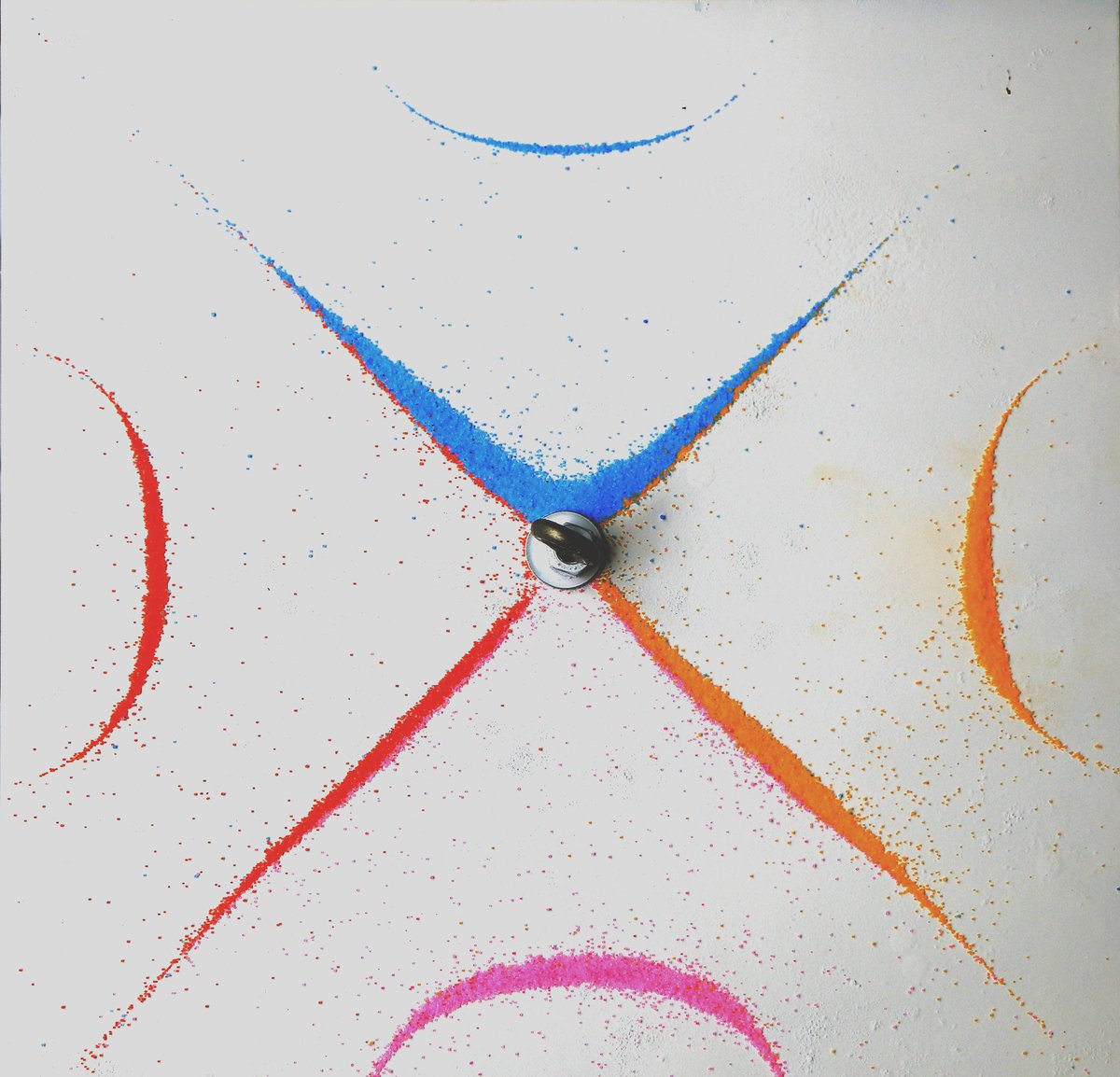
Ernst Chladni was born in 1756 in Wittenberg, Germany, and trained first as a lawyer before devoting himself to the scientific study of acoustics. His experimental method was elegantly simple: take a metal plate, sprinkle fine sand on its surface, clamp the plate at a specific point to hold it fixed, and draw a violin bow along the edge of the plate. The bowing sets the plate into vibration at specific resonant frequencies — the natural modes of the plate determined by its size, shape, and material. The sand, light and freely mobile, migrates away from the regions of the plate that are vibrating (the antinodes, where the amplitude of vibration is maximum) and accumulates along the lines where the plate is stationary (the nodal lines, where the amplitude is zero). The result is a geometric pattern of sand lines tracing the nodal structure of the vibrating plate.
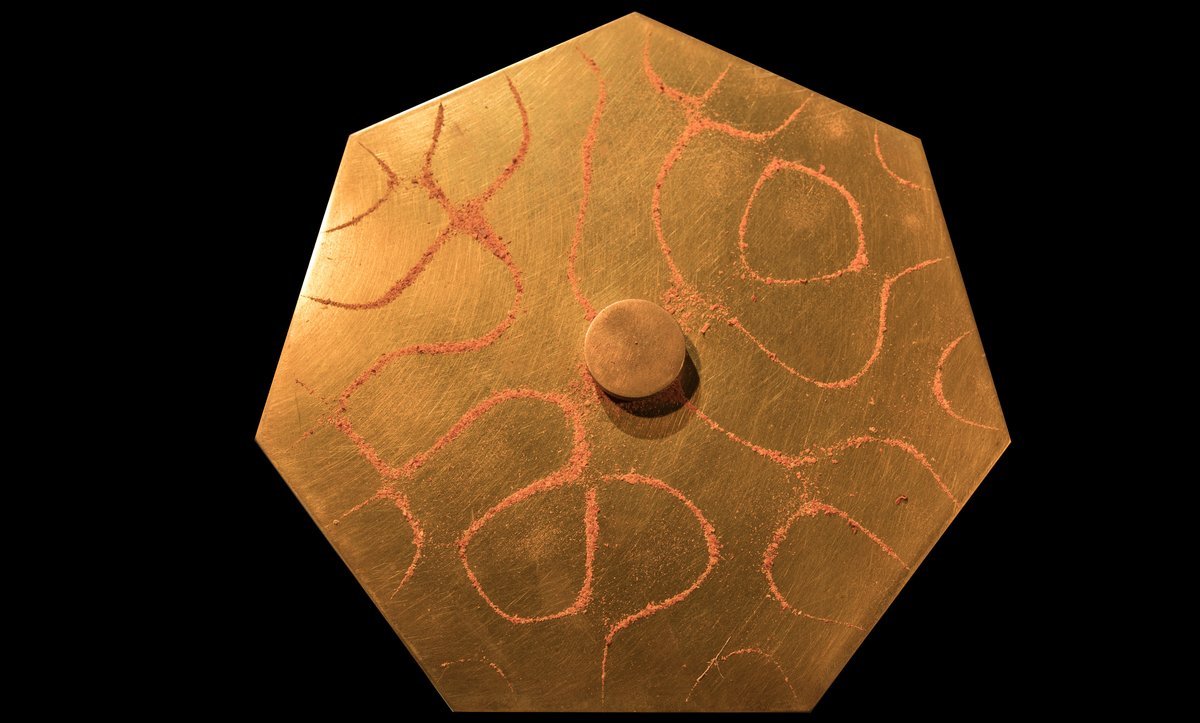
What Chladni found, and what became immediately evident to anyone who saw the demonstrations he performed across Europe in the 1780s and 1790s, was that these patterns are geometric — and not randomly or arbitrarily geometric, but organised according to the familiar patterns of symmetric geometry. A square plate bowed at a corner while clamped at its centre produces a pattern of two diagonal lines crossing at the centre — an X shape, the nodal lines of the simplest mode of vibration. Bowed at a different point and clamped at a different nodal location, the same plate produces a pattern of interlocking circles and straight lines. At higher frequencies — higher notes — the patterns become more complex, but always more symmetric and always more ordered. Simple frequencies produce simple geometric forms; complex frequencies produce complex geometric mandalas.
Chladni published his findings in his 1787 book Entdeckungen über die Theorie des Klanges (Discoveries in the Theory of Sound), which established the scientific study of acoustics on a rigorous experimental foundation. The patterns he documented, now known universally as Chladni figures, can be reproduced with complete consistency: a given plate, clamped at a given point, bowed at a given position, at a given frequency, will always produce the same pattern. The geometry of the pattern is determined entirely by the physics of the vibrating system — by the shape of the plate, the material's elasticity, and the frequency of excitation. There is nothing arbitrary about it; it is the mathematical inevitability of standing wave resonance made visible in sand.
Hans Jenny
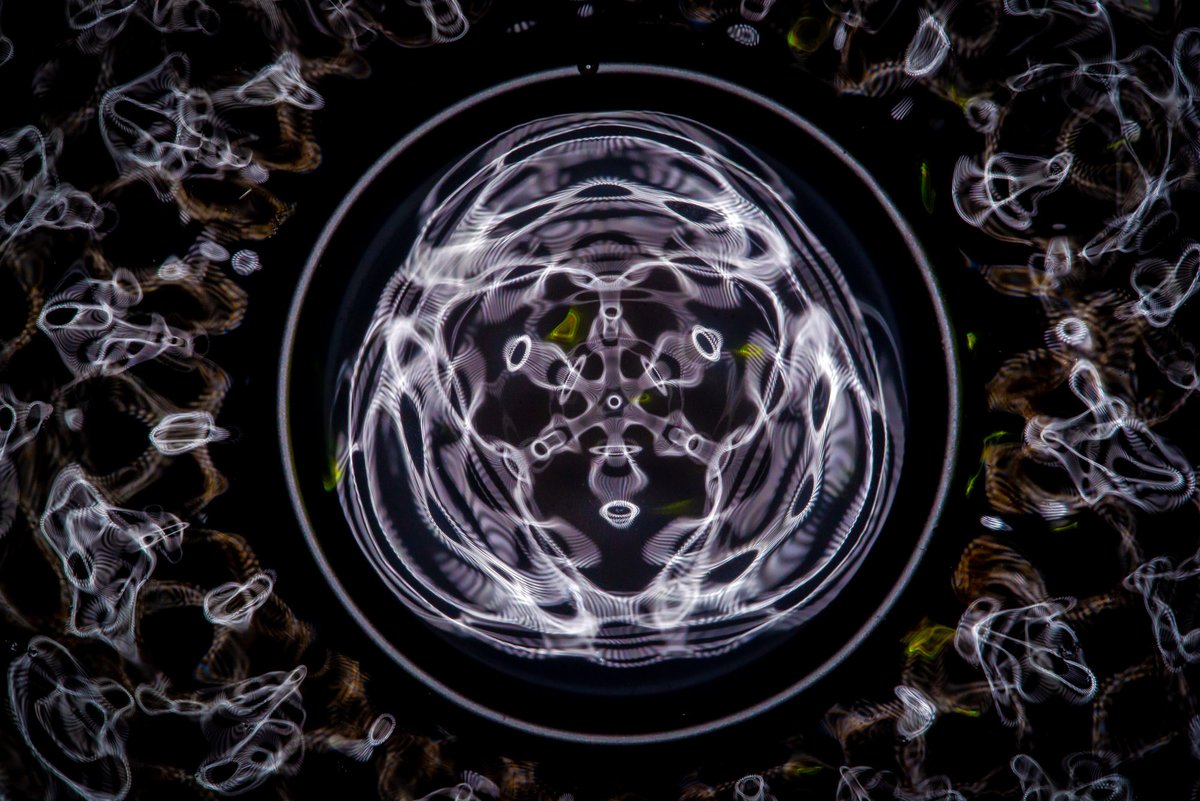
Ernst Chladni gave the world the fundamental observation: sound produces geometric form in physical media. Hans Jenny gave that observation a name — cymatics — and extended it dramatically in scope, depth, and visual richness. Where Chladni worked with sand on flat metal plates, Jenny worked with a much wider range of materials: not only sand and metal powder on flat surfaces, but pastes, gels, liquids, and three-dimensional media, excited not only by bowing but by electronically controlled oscillators capable of generating any frequency with precision.
Jenny, who trained as a physician and practiced as a doctor while pursuing natural philosophy as his deeper vocation, spent twenty years conducting and documenting cymatics experiments. His work, summarised in the two volumes of Kymatik published in 1967 and 1972, contained hundreds of photographs of the geometric forms created in various media by sound at different frequencies. The images are extraordinary. Coloured liquids excited at certain frequencies form intricate mandala patterns with multiple axes of symmetry. Lycopodium powder on circular plates forms patterns that closely resemble the Flower of Life and other sacred geometry forms. Three-dimensional forms — columns, hills, craters, spirals — spontaneously arise in viscous fluids when they are vibrated at specific frequencies.
Jenny observed, and documented photographically, a remarkable phenomenon at the transition between frequencies: when the oscillator driving the vibrating medium is swept slowly from one frequency to another, the pattern in the medium does not gradually change from the first pattern to the second. Instead, it rapidly disintegrates into a chaotic, turbulent state, and then, with equal rapidity, organises itself into the new pattern corresponding to the new frequency. The transition is not gradual but abrupt, passing through disorder. This behaviour — order, chaos, new order — is the cymatic signature of a phase transition, and it mirrors the behaviour described in many contemplative traditions as the structure of transformation: the dissolution of old form, the passage through chaos or emptiness, and the emergence of new form. Cymatics makes this universal pattern literally visible.
Sacred Geometry of Sound
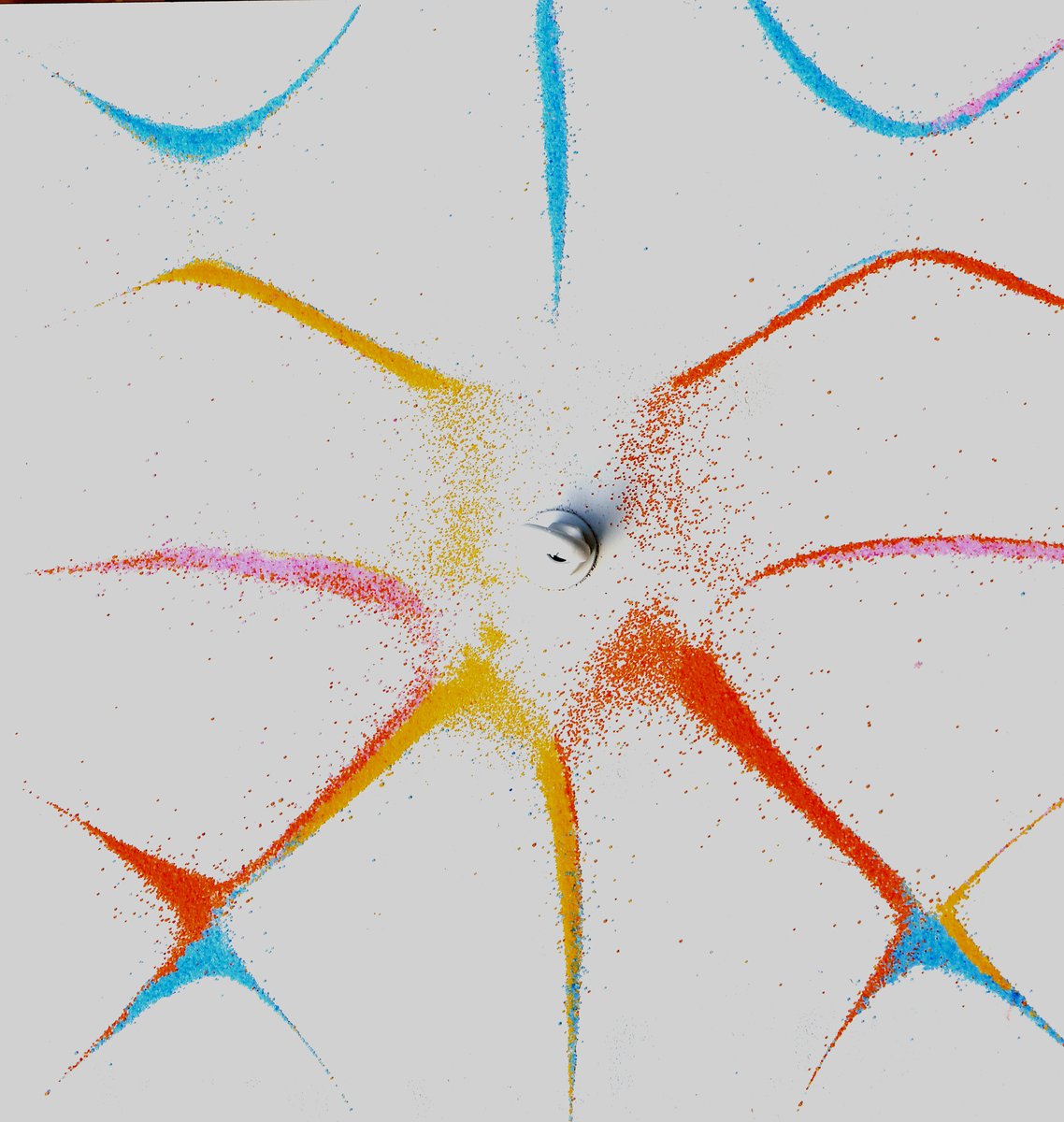
Perhaps the most striking aspect of Chladni figures for sacred geometry researchers is how many of them are immediately recognisable as classical sacred geometry forms. This recognition is not a matter of forcing a resemblance; the patterns correspond with genuine geometric precision.
The simplest Chladni figures on circular plates are circles, radial lines, and combinations thereof — the most basic elements of sacred geometry construction. At the simplest modes, a circular plate produces either a single circle (a nodal ring) or a pair of diametrically opposite nodal lines (a diameter). At slightly higher modes, it produces a combination: a circle with two or more radial lines. The hexagonal pattern — six-fold radial symmetry — arises naturally at a specific frequency on circular plates, producing a pattern identical to the Seed of Life mandala viewed in pure nodal geometry.
The four-fold Chladni figure on a square plate — the simple X of two crossing nodal lines — is the geometric cross, perhaps the most universal symbol in all human cultures, arising spontaneously from the most basic mode of acoustic resonance. This is not coincidental: the cross is the natural geometric form of the simplest standing wave on a symmetric two-dimensional surface. The fact that the cross is, geometrically, the nodal line pattern of a fundamental resonance may help explain its universal appearance in sacred traditions: it is the most basic geometric expression of resonance itself.
At higher frequencies, Chladni patterns on circular plates produce forms recognisable as the Star of David (two sets of three radial lines, offset by 60°), the eight-pointed star (four sets of radial lines), and complex patterns resembling the more elaborate forms of the Flower of Life. Jenny's photographs of three-dimensional cymatic forms in liquids show patterns resembling the Platonic Solids' projections, and some of his images of vibrated pastes produce forms that closely resemble the rosettes and star polygons of Islamic geometric art. Sound, it appears, naturally produces sacred geometry — because both are expressions of the same underlying mathematics of resonance and symmetry.
Nada Brahma

The cymatic observation — that sound creates form — is not a discovery of eighteenth-century European science. It is the central claim of several of the oldest and most sophisticated cosmological traditions in the world, and in each of those traditions, it is held not as a poetic metaphor but as a literal description of the mechanism of creation.
In the Hindu philosophical tradition, the concept of Nada Brahma — the universe is sound — is one of the foundational principles of several schools of philosophy, including the Kashmir Shaivism and the Shaiva Siddhanta traditions. Nada (sound, vibration) is held to be the first principle of creation: before the world of form came into being, there was only the primordial vibration — the cosmic OM or AUM — and all of creation is the differentiation of that single vibration into the infinite variety of specific frequencies that correspond to specific forms. Matter is frozen vibration; form is the geometric consequence of resonance. This is precisely the cymatic understanding, stated in philosophical language rather than scientific language.
The Sanskrit mantra tradition holds that specific sounds — specific combinations of consonants and vowels — have specific effects on the physical and energetic reality they are sounded into. This is not merely poetic belief: the tradition has developed, over several thousand years, an extraordinarily detailed and precise catalogue of which sounds produce which effects, with specific applications in ritual, healing, and meditation. The bija mantras (seed syllables) — OM, AIM, HRIM, KLIM, KRIM, and others — are each held to correspond to specific energetic qualities and to have specific effects when resonated in the body or the environment. Cymatics gives this tradition a visual dimension: if we could photograph the Chladni figures produced in a fine medium by the resonance of each of these syllables in the chest cavity, we would presumably see the specific geometric forms corresponding to each syllable's acoustic pattern.
In the Hebrew Bible, the first act of creation is speech: "And God said, Let there be light." The creative act is not a physical manipulation but a vocalisation — a sound that generates form. The entire creation narrative in Genesis 1 proceeds by speech acts: God says, and it is. This is the Hebrew theological encoding of the same principle that Nada Brahma expresses in Sanskrit: sound is generative of form, and the creation of the physical world is an act of cosmic resonance. Kabbalistic tradition extended this into a complete sonic cosmology: the twenty-two letters of the Hebrew alphabet are not merely linguistic symbols but the twenty-two fundamental resonant archetypes from which all created forms are generated, with each letter corresponding to a specific vibration and a specific aspect of creation.
Frequency and Harmony
One of the most important discoveries of cymatics is the relationship between frequency ratios and the quality of the resulting geometric patterns. When two vibrations are applied simultaneously to a medium, the pattern that results depends not on the absolute values of the frequencies but on their ratio. And the quality of the pattern — its degree of symmetry, its geometric regularity, its clarity and stability — depends on whether that ratio is a simple integer fraction or a complex irrational ratio.
Simple integer ratios produce highly ordered, symmetrical, stable patterns. The ratio 1:2 (an octave in musical terms) produces a simple, symmetric pattern. The ratio 2:3 (a perfect fifth) produces a more complex but still highly ordered pattern. The ratio 3:4 (a perfect fourth), 4:5 (a major third), and other simple harmonic ratios all produce clear, geometric, symmetric cymatic forms. These are the ratios that musicians describe as consonant — as harmonious, pleasing, resolved.
Complex, irrational, or near-prime ratios produce disordered, asymmetric, unstable patterns. The frequencies that musicians describe as dissonant — the minor second (frequency ratio approximately 15:16), the augmented fourth (the tritone, ratio approximately √2:1) — produce Chladni patterns that are turbulent, irregular, and constantly shifting. The sand cannot settle into a stable geometric form because the two interfering vibrations never produce a stable nodal structure.
This cymatic discovery provides a physical basis for the universal human experience of musical consonance and dissonance. Musicians across every culture, from ancient Mesopotamia to contemporary electronic music, have discovered the same intervals, the same harmonic ratios, the same distinction between consonant and dissonant tones — not because of cultural convention but because these properties are physically real, grounded in the acoustic physics of resonance and the geometric mathematics of interference patterns. Harmony is not a cultural preference; it is the geometry of vibration.
Water Crystals and Resonance
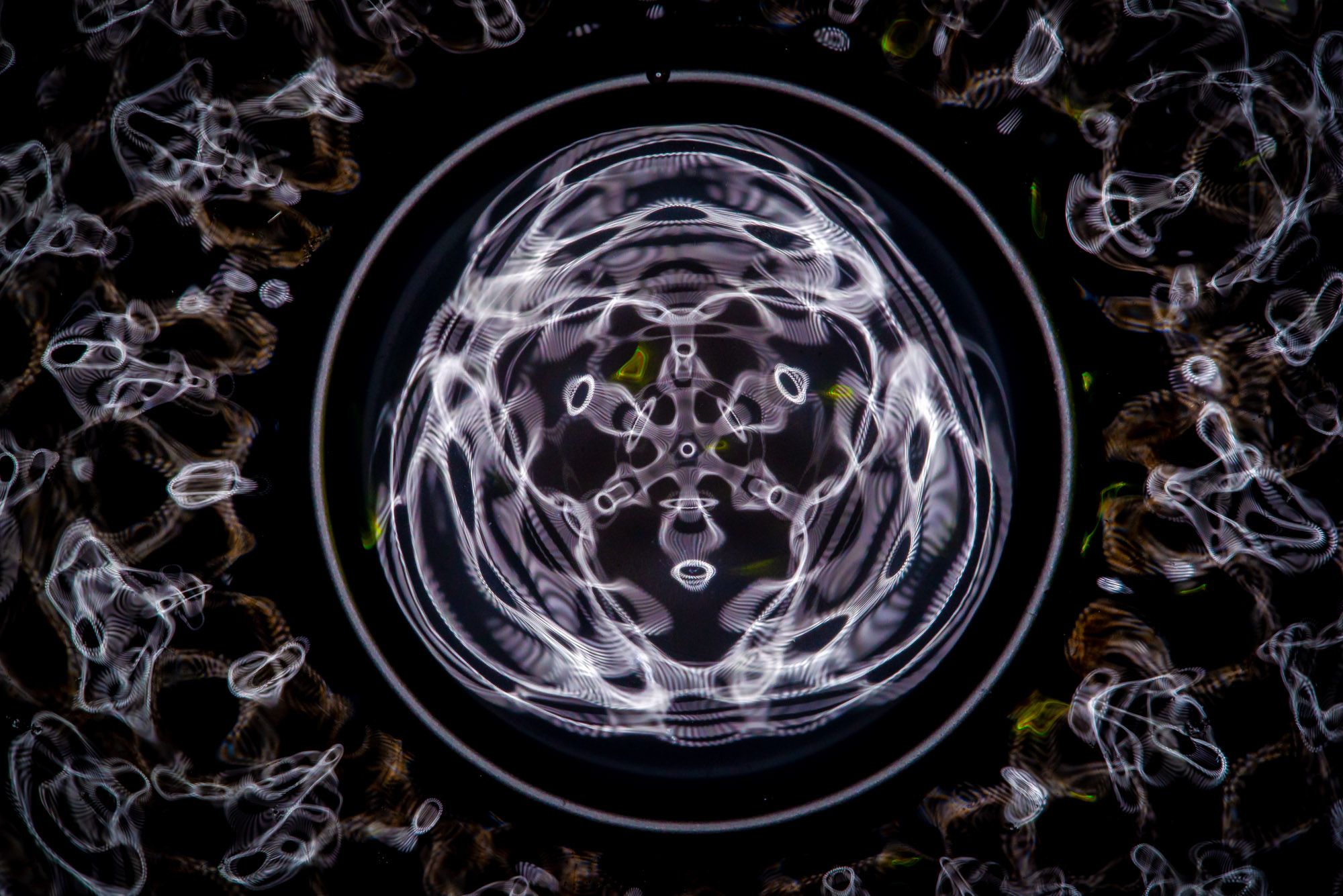
The Japanese researcher Masaru Emoto conducted experiments in the 1990s and 2000s in which water was exposed to different words, music, prayers, and other stimuli, and then rapidly frozen. Photographs of the resulting ice crystals, published in his books and widely circulated online, appeared to show that water exposed to positive words and intentions formed beautiful, symmetric, snowflake-like crystals, while water exposed to negative words or heavy metal music formed asymmetric, irregular, or distorted crystals.
Emoto's work became enormously popular and was cited widely as evidence that water is sensitive to human consciousness and intention. Scientifically, however, his methodology has been severely criticised: the crystals were selected subjectively by Emoto and his associates, without blinding; the experiments were not conducted under controlled conditions; and multiple attempts to replicate his results under rigorous conditions have not succeeded. The scientific consensus is that Emoto's specific claims about the effect of words and intentions on water crystals are not supported by reliable evidence.
What is not in doubt is the underlying cymatic reality: water is extremely responsive to acoustic vibration, and different frequencies create dramatically different structures in water. Chladni's work is rigorous and reproducible, and it shows unambiguously that sound creates geometry in physical media. The broader field of bioelectromagnetics — the study of the effects of electromagnetic fields on biological systems — has produced rigorous, replicated results showing that weak electromagnetic fields can influence cellular processes, gene expression, and tissue healing. The hypothesis that subtle vibrations influence the structure and properties of water is not inherently unscientific; it is the specific methodology and controls of Emoto's work that are problematic.
From the sacred geometry perspective, what matters is the central cymatic truth that Chladni and Jenny established rigorously: vibration creates geometry. The specific extension of this truth to consciousness, intention, and language remains an active and contested area of research. But the foundation is solid, and it is one of the most direct experimental demonstrations available of the sacred geometry principle that form and frequency are two aspects of the same reality.
The AUM Frequency
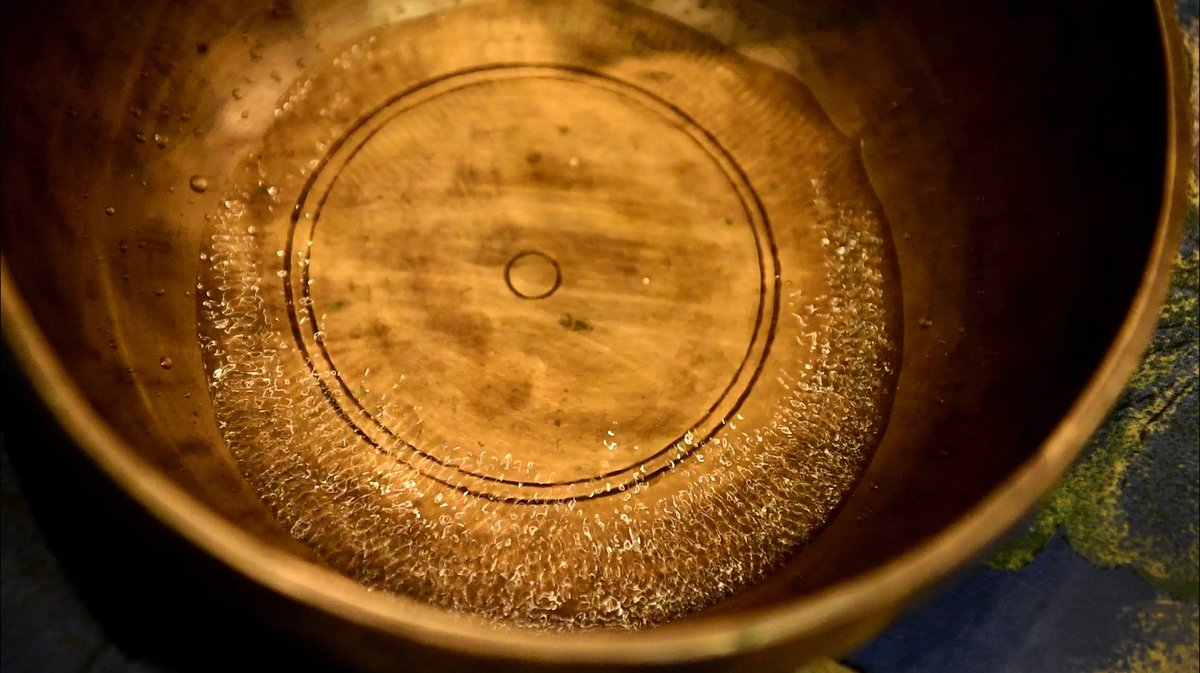
In the practice of sacred sound traditions, the vibration of specific tones within the body is understood to activate and organise the body's own geometric energy structures — the chakras, the nadis, the bioelectric field. The most universally sacred of these tones is AUM (OM), the primordial sound of Hindu, Buddhist, and Tibetan tradition, held to be the vibration from which all creation arises and to which all creation returns.
The frequency at which OM resonates most powerfully in the human chest cavity — the frequency at which the thoracic resonance chamber vibrates sympathetically — is approximately 136.1 Hz, a frequency known in Vedic tradition as the frequency of the Earth year: the annual revolution of the Earth around the Sun, translated from cycles per year into cycles per second. This frequency is also very close to C# in concert tuning, and it is related by exact frequency ratios to several of the planetary frequencies calculated by multiplying the orbital frequencies of the planets by powers of two until they fall within the audible range.
Hans Jenny's cymatic experiments at the frequency of 136.1 Hz produced some of the most geometrically complex and beautiful patterns in his entire body of work — forms that he and subsequent researchers have compared to the Flower of Life mandala. Whether or not the exact comparison is precise, the point is significant: the frequency at which the human body most naturally resonates the primordial sound of creation is a frequency that produces elaborate, multi-layered sacred geometry patterns in physical media. The body, when vibrated at its own natural frequency, generates the geometry of the Flower of Life in the surrounding field. This is what the ancient sacred traditions have been saying, in various languages and various symbolic systems, for thousands of years. Cymatics makes it visible.
In the next chapter, we explore Sacred Geometry in Science — from atomic orbitals to planetary orbits, how these geometric patterns structure the physical universe at every scale.
FAQ
What is cymatics?
Cymatics is the study of the visible geometric forms that sound and vibration create in physical media. The term was coined by Swiss scientist Hans Jenny in 1967. When sand, powder, or liquid is placed on a vibrating surface, it arranges itself into geometric patterns determined by the frequency of vibration — making the geometry of sound literally visible.
What are Chladni figures?
Chladni figures are the geometric patterns formed when sand on a vibrating metal plate migrates to the nodal lines (where the plate is stationary) and away from the antinodes (where vibration is maximum). First documented by Ernst Chladni in the 1780s, they demonstrate that simple frequencies produce simple geometric forms and higher frequencies produce increasingly complex, symmetric mandalas.
How do cymatic patterns relate to sacred geometry?
Many Chladni figures are immediately recognisable as classical sacred geometry forms. Hexagonal patterns matching the Seed of Life arise at specific frequencies on circular plates. Flower of Life patterns appear in lycopodium powder experiments. The geometric forms produced by vibration correspond to the same mathematical structures that sacred geometry has identified as fundamental.
What is the significance of cymatics for understanding reality?
Cymatics provides tangible evidence that vibration creates geometric form — consistent with quantum field theory's description of all particles as vibrational excitations of underlying fields. Ancient traditions across cultures (Nada Brahma, AUM, the Pythagorean music of the spheres) described the universe as fundamentally vibrational, and cymatics offers visible confirmation of this principle.