Introduction
Sacred geometry is not confined to temples and mandalas — it is the geometry of nature itself, operating at every scale of existence. The same Platonic Solids, harmonic ratios, and self-similar patterns that sacred geometry traditions have explored for millennia appear in the structure of the atom, the shapes of molecules, and the orbits of the planets. This chapter traces that thread from the smallest scales of matter to the largest scales of the cosmos.
Key takeaways
- The electron orbitals of the atom map directly onto the Platonic and Archimedean Solids — the same forms explored throughout this guide — producing a geometric model more accurate than the Bohr model.
- Molecular geometry follows the same polyhedral logic: carbon forms hexagonal rings (the cuboctahedron), water is bent at the tetrahedral angle, and viruses are icosahedral.
- Kepler's nested Platonic Solids model of the solar system was the first attempt to apply sacred geometry to empirical science — and his harmonic analysis of planetary speeds led directly to his three laws of planetary motion.
- The Earth-Moon-Sun system and the Venus pentagram encode geometric proportions — including the Golden Ratio, π, and the squaring of the circle — at astronomical scales.
Atomic Geometry
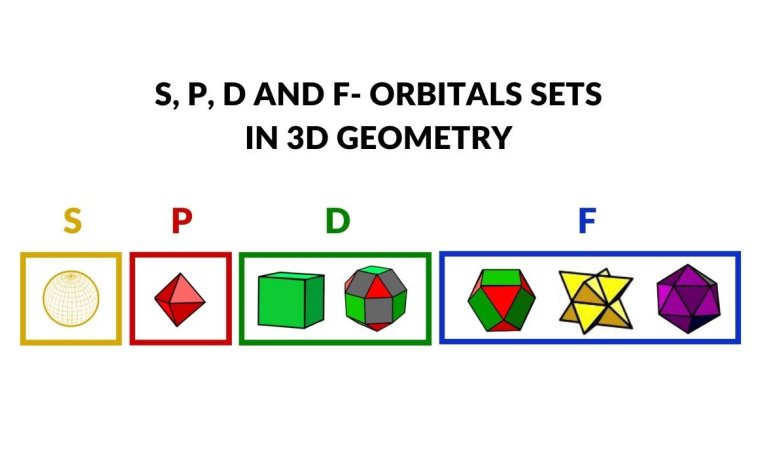
The most striking modern confirmation of sacred geometry's relevance to science comes from the structure of the atom. The S, P, D, and F electron orbitals — the quantum mechanical regions where electrons are found — map directly onto the geometric forms we have studied throughout this guide. The S-orbital is a sphere. The P-orbitals form an octahedron. The D-orbitals introduce the cube. The F-orbitals complete the cuboctahedron.
This is not an analogy — it is a precise geometric correspondence. Our Atomic Geometry research demonstrates that the in-sphere, mid-sphere, and out-sphere ratios of these nested polyhedra predict the atomic radii of all stable elements on the periodic table, outperforming the Bohr model for key elements such as helium by over 500%. The Flower of Life pattern, when extended, contains the geometric template for the orbital shells. Metatron's Cube — formed by connecting the centres of the thirteen circles in the Fruit of Life — encodes all five Platonic Solids, and these same solids structure the electron cloud.
For the full treatment, see Atomic Geometry, S-Orbital Geometry, P-Orbital Geometry, D-Orbital Geometry, and History of the Atom.
Molecular Geometry
The geometric order of the atom extends into molecular structure. When atoms bond, the arrangement of their electron pairs determines the shape of the resulting molecule — and these shapes are the same polyhedra that sacred geometry has studied for millennia.

The VSEPR model (Valence Shell Electron Pair Repulsion) predicts molecular shapes by assuming that electron pairs repel each other into the most symmetrical arrangement possible — which is always a polyhedral form. Two electron pairs produce a line. Three produce a triangle. Four produce a tetrahedron — the shape of methane (CH₄) and the reason water bends at 104.5° (close to the tetrahedral angle of 109.5°). Five produce a trigonal bipyramid. Six produce an octahedron — the shape of sulphur hexafluoride (SF₆).
Carbon, the element at the foundation of all biological life, forms hexagonal rings in graphite and diamond lattices — the same hexagonal geometry found in the Flower of Life. Buckminsterfullerene (C₆₀), the football-shaped carbon molecule, is a truncated icosahedron — one of the thirteen Archimedean Solids. Viruses, including adenovirus, are icosahedral — the same twenty-faced Platonic Solid that appears in the Flower of Life and governs the geometry of the noble gases in P-Orbital Geometry.
The geometry of molecules is not imposed from outside — it emerges from the same geometric logic that structures the atom. The Platonic Solids are not merely mathematical curiosities; they are the shapes of matter itself.
The Sky as Sacred Text
For most of human history, the sky was the primary text of sacred geometry. The movements of the Sun, Moon, and planets were not merely astronomical phenomena to be catalogued but a geometric language to be decoded — a living demonstration of the mathematical order underlying creation, written in light and time at the largest scale available to human observation.
Harmony of the Spheres
Pythagoras of Samos, who lived in the sixth century BCE, is credited in the ancient sources with the discovery that musical consonance is a consequence of simple mathematical ratios. The legend relates that he heard blacksmiths hammering in their forge and noticed that some combinations of hammers sounded harmonious while others did not; and that when he weighed the hammers, he found that the harmonious pairs had weights in simple ratios: 1:2, 2:3, 3:4. He is said to have confirmed this discovery with string experiments: a string of half the length of another, at the same tension, sounds exactly one octave higher (ratio 1:2); a string of 2/3 the length sounds a perfect fifth higher (ratio 2:3); a string of 3/4 the length sounds a perfect fourth higher (ratio 3:4).
The Pythagoreans extended this discovery from music to cosmology. If the ratios 1:2, 2:3, 3:4 govern the harmonious relationships between musical tones, and if the physical universe is constructed according to mathematical ratios, then the distances between the celestial spheres — the spheres on which the Sun, Moon, and planets were believed to move — should stand in the same harmonic ratios. The planets in their courses would therefore produce a music inaudible to ordinary human ears but present nonetheless as a real mathematical reality — the Music of the Spheres, the Musica Universalis.
Plato, deeply influenced by Pythagorean philosophy, incorporated the Music of the Spheres into his cosmological dialogue the Timaeus, where he describes the creation of the World Soul in terms of harmonic divisions: the Demiurge (the divine craftsman) creates the soul by dividing a primordial material into parts standing in the ratios 1:2:4:8 (the octave series) and 1:3:9:27 (the triple series), then filling in the intervals with harmonic means and geometric means to create a complete scale of seven tones. The World Soul is, in this account, a musical scale from which the structure of the cosmos is woven. The cosmos is not merely described by mathematics; it is made of mathematics.
Kepler's Mysterium
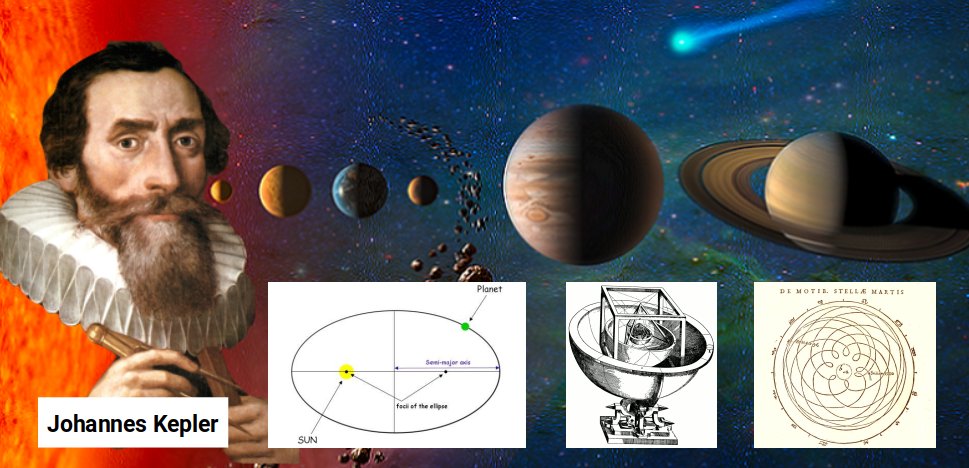
Johannes Kepler (1571–1630) was one of the last great astronomer-mathematicians to work simultaneously in the tradition of sacred geometry and the emerging tradition of quantitative empirical science, and his attempt to reconcile the two led to some of the most original astronomical thinking of any era.
Kepler was deeply convinced, on both religious and philosophical grounds, that the solar system was geometrically ordered according to mathematical principles — and that discovering this order was an act of religious devotion, a reading of the mind of God as expressed in creation. In his first major work, Mysterium Cosmographicum (The Cosmic Mystery, 1596), published when he was twenty-five, he proposed a solution to what he regarded as the fundamental problem of astronomy: why are there exactly six planets (the six known at the time — Mercury, Venus, Earth, Mars, Jupiter, Saturn), and why do their orbits have the specific relative sizes they do?
His answer was extraordinary: the six planetary orbits are separated by the five Platonic Solids, nested one within another in a specific order. The sphere of Saturn's orbit is circumscribed about a cube; inside the cube is inscribed the sphere of Jupiter's orbit. Inside Jupiter's sphere is circumscribed a tetrahedron; inside the tetrahedron is inscribed the sphere of Mars's orbit. Inside Mars's sphere is circumscribed a dodecahedron; inside the dodecahedron is inscribed the sphere of Earth's orbit. Inside Earth's sphere is circumscribed an icosahedron; inside the icosahedron is inscribed the sphere of Venus's orbit. Inside Venus's sphere is circumscribed an octahedron; inside the octahedron is inscribed the sphere of Mercury's orbit.
The model was based on a profound mathematical insight: there are exactly five Platonic Solids, and there are exactly five gaps between six planetary orbits. The five Platonic Solids and the five inter-orbital gaps are in natural correspondence. Kepler calculated the ratios of the inscribed and circumscribed sphere radii for each Platonic Solid and compared them to the known ratios of adjacent planetary orbital radii. The agreement, while not perfect, was remarkable: errors of only a few percent in most cases. For Kepler, this was not a coincidence but a revelation — proof that God had constructed the solar system according to the geometry of the Platonic Solids.
Harmonices Mundi
Kepler eventually recognised that the Platonic Solid model could not be made to agree with precise astronomical observations — the planetary orbits are ellipses, not circles, and their exact proportions do not exactly match the Platonic Solid predictions. But he never abandoned his conviction that the solar system was harmonically ordered, and in his masterwork Harmonices Mundi (The Harmony of the World, 1619), he found the harmony at a deeper level: in the speeds of the planets rather than the sizes of their orbits.
Kepler had discovered, by 1619, his three laws of planetary motion — the mathematical rules governing the shapes, sizes, and speeds of planetary orbits that bear his name. Using these laws, he could calculate the maximum and minimum speeds of each planet as it moved around its elliptical orbit (maximum at perihelion, the closest point to the Sun; minimum at aphelion, the furthest point). He expressed these maximum and minimum speeds as musical intervals — ratios of speeds translated into ratios of notes — and found that the intervals he obtained corresponded to the intervals of musical scales.
Saturn's speed ratio (perihelion to aphelion) was close to the interval of a minor third (ratio 5:6). Jupiter's ratio was close to a minor third as well. Mars's ratio was close to a perfect fifth (ratio 2:3). Earth's ratio was extremely small — close to a minor second, the interval of a semitone — corresponding to the fact that Earth's orbit is nearly circular and its speed varies very little between perihelion and aphelion. Venus's ratio was also very small. Mercury's ratio was the largest of all the planets, spanning more than an octave.
When Kepler combined the harmonies of all the planets simultaneously, he found — and he describes this in passages of extraordinary emotional intensity — that certain momentary alignments of the planets produce perfect three- and four-voice harmonies, like a choir suddenly achieving perfect consonance for an instant before the individual voices move apart again. The cosmos, in his vision, is engaged in a continuous polyphonic improvisation — mostly dissonant, passing through moments of perfect harmony, never exactly repeating, always generating new combinations. It is one of the most beautiful metaphors in the history of science — and it is grounded in precise mathematical calculation.
Earth, Moon, and Sun
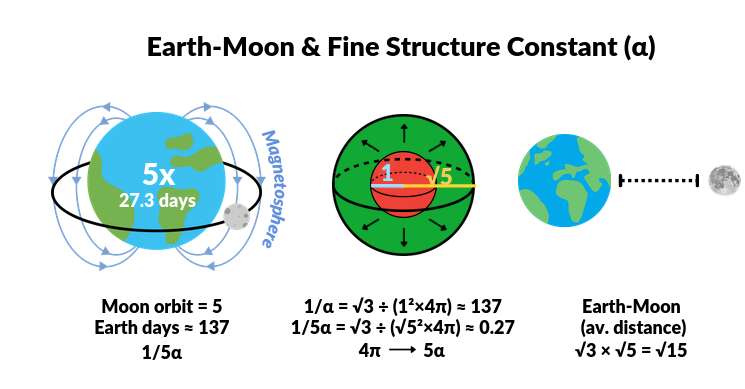
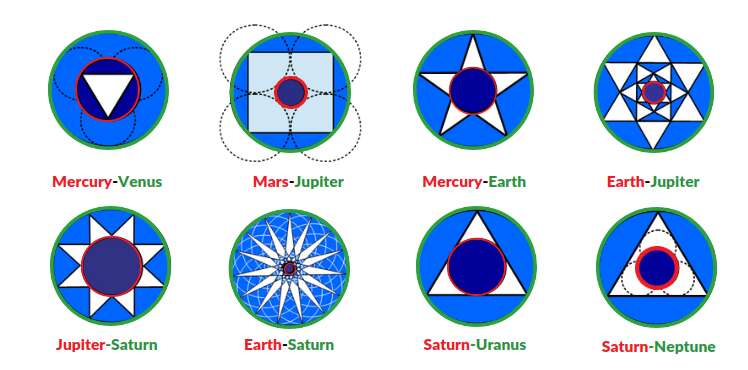
Among all the geometric relationships in the solar system, none has fascinated sacred geometry researchers more than the relationship between the Earth, Moon, and Sun — specifically, the extraordinary coincidence that makes total solar eclipses possible.
The Sun has a diameter approximately 400 times greater than the Moon's diameter. The Sun is approximately 400 times further from the Earth than the Moon. These two ratios are, to a remarkable degree of precision, equal — and their equality means that, as seen from the Earth's surface, the Sun and Moon appear almost exactly the same angular diameter in the sky: approximately 0.5 degrees. It is this coincidence that makes total solar eclipses possible: the Moon, at its closest approach to Earth, is just large enough to cover the Sun's disk completely, revealing the corona — the outer atmosphere of the Sun — as a ring of fire around the Moon's silhouette. Move the Moon a little further away, and it would be too small to cover the Sun. Move the Moon a little closer, and it would be too large, and total eclipses would look different.
There is no known physical reason why the ratio of sizes and the ratio of distances should be so nearly equal. The Moon's distance from the Earth varies because the Moon's orbit is elliptical, and total solar eclipses are possible only when the Moon is near the closer part of its orbit. But the precision of the correspondence remains striking. It has been noted by several researchers that the ratio 1:400 is close to 1:φ⁷ ≈ 1:29.0... — not a precise match, but suggestive of the kind of Fibonacci-related ratio that appears throughout natural geometry.
The Earth-Moon system has other geometric properties of interest. The radius of the Moon is 27.3% of the radius of the Earth — a ratio close to 3/11, which is a significant approximation in the pi relationship. The combined Earth-Moon system, when the two bodies are placed tangentially, yields a geometry in which a square around the Earth and a circle through the Moon's centre are in ratio close to π. John Michell and other sacred geometry researchers have explored this geometry extensively, arguing that the dimensions of the Earth and Moon encode the constants π and φ in their proportional relationship — and that ancient monuments, including Stonehenge and the Great Pyramid, are scaled models of the Earth-Moon geometric relationship.
The Great Pyramid
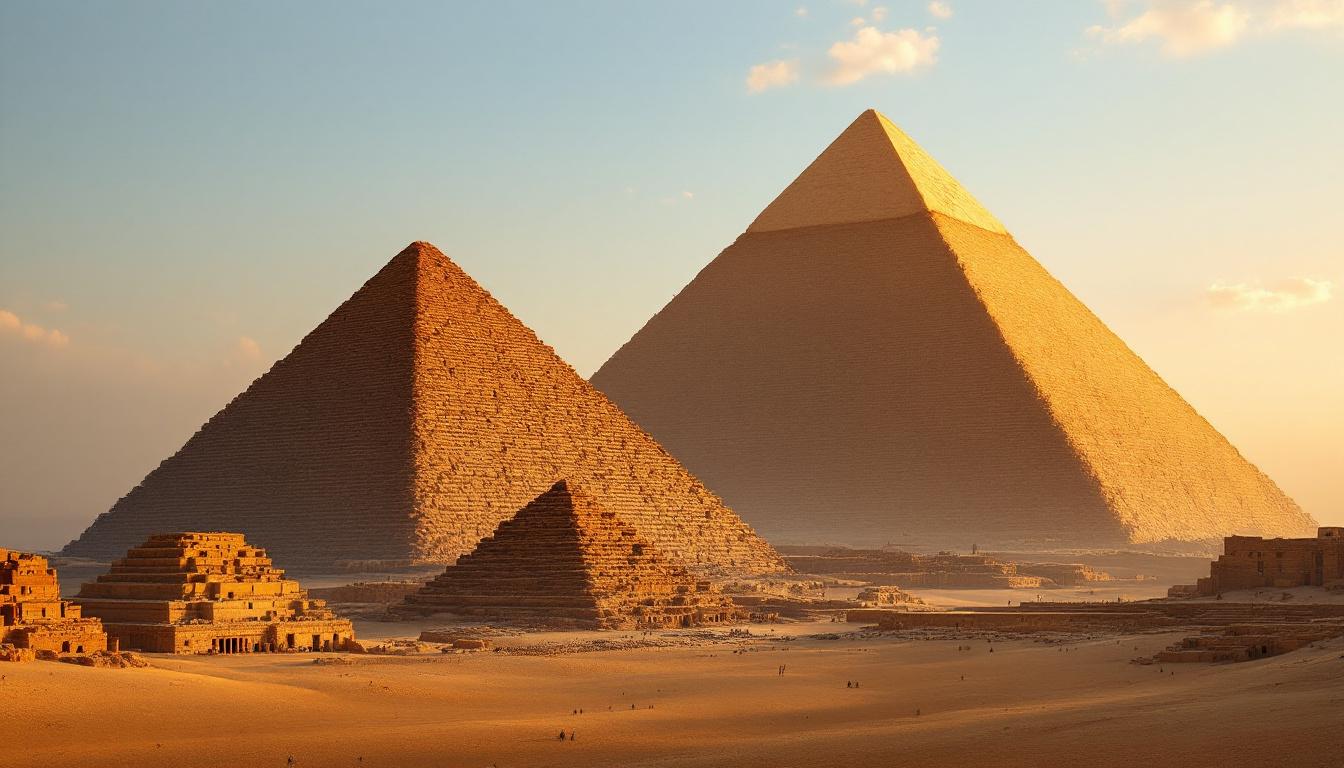
The Great Pyramid of Giza, constructed approximately 2560 BCE, is the most precisely constructed large building in the ancient world, and its dimensions have been the subject of intense geometric and astronomical analysis since the nineteenth century. The pyramid encodes a series of geometric and mathematical constants with a precision that is difficult to explain as coincidence.
The most widely noted encoding is the relationship between the pyramid's height and the circumference of its base. If the height of the Great Pyramid is taken as the radius of a circle, then the circumference of that circle equals the perimeter of the pyramid's base, to within a fraction of one percent. In other words, the pyramid embeds the ratio 2π in the relationship between its height and base — and it does so in a building constructed with instruments that should, in principle, have no access to the value of π. The Egyptians could have achieved this encoding by using a drum of specific diameter to measure out the base distances, but whether this was intentional or a consequence of a specific slope angle chosen for practical reasons remains debated.
The slope of the pyramid's faces encodes the Golden Ratio. The ratio of the slant height (the distance from the apex to the midpoint of a base edge) to half the base length is φ — approximately 1.618. This means that the faces of the pyramid are Golden Gnomon triangles — isoceles triangles in which the ratio of the equal sides to the base is φ. Whether intentional or not (and the evidence of so many overlapping encodings makes coincidence seem increasingly unlikely), the Great Pyramid is a building in which π and φ are simultaneously expressed in a single structure, as they are related in the equation e^(iπ) + 1 = 0 (Euler's identity), which is the most celebrated equation in mathematics.
The pyramid's orientation is also geometric: its four faces are oriented to the four cardinal directions — north, south, east, west — with a precision of less than 0.1 degrees, which exceeds what can be achieved by compass (since there was no compass in ancient Egypt) and requires either star sightings of extraordinary precision or a geometric method exploiting the symmetry of shadows. The north face points toward true north, not magnetic north. The builders of the Great Pyramid were doing solar and stellar geometry, and they were very good at it.
Venus and the Pentagram
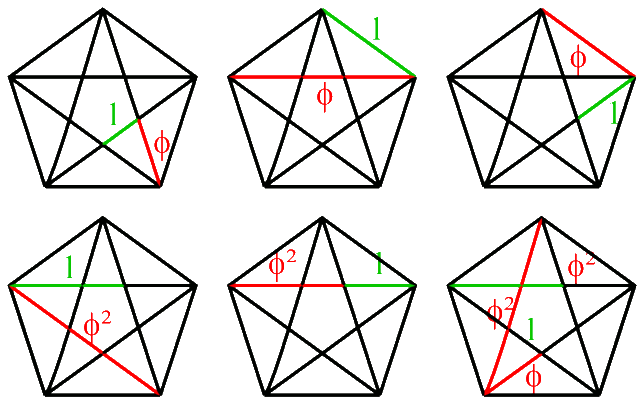
The most beautiful example of sacred geometry encoded in the movements of the solar system is the Venus pentagram — the five-petalled rose pattern that Venus traces against the background of fixed stars over an eight-year cycle.
Venus is the brightest object in the sky after the Sun and Moon, and it was closely observed by astronomers in every ancient civilisation. The Babylonians kept systematic records of Venus's appearances as morning and evening star for over a thousand years. The Maya constructed an elaborate astronomical calendar system in which the 584-day synodic period of Venus (the time between one superior conjunction with the Sun and the next) was one of the fundamental units. The ancient Greek name for the planet — Hesperus when it appeared in the evening sky, Phosphorus when it appeared in the morning sky — reflects the observation of its two distinct appearances, which the Greeks initially believed to be two different celestial bodies before realising they were one.
What makes Venus geometrically extraordinary is the following: Venus completes almost exactly 13 synodic cycles (conjunctions with the Sun as seen from Earth) in 8 Earth years. More precisely, 8 Earth years = 13 Venus synodic periods = 5 Venus inferior conjunctions (the moments when Venus passes between Earth and Sun). This 8:13:5 relationship, involving three consecutive Fibonacci numbers, means that Venus traces a five-petalled rose pattern relative to the Earth over an eight-year cycle: at each of the five inferior conjunctions in the eight-year period, Venus is seen from Earth at a different point in the sky, and the five points are spaced equally around the ecliptic, forming the vertices of a regular pentagon. Connect the five vertices and you have the pentagram — the five-pointed star of sacred geometry — drawn in the sky by the orbit of Venus over eight years.
The ancient Pythagoreans used the pentagram as the symbol of their school, stamping it on letters to identify themselves to each other. The pentagram was a symbol of health and wisdom. It encodes the Golden Ratio in every one of its intersections. And it is traced in the sky by the goddess planet — Venus, Aphrodite, Ishtar — over the course of eight years. The sacred geometry tradition did not need to impose the pentagram on the heavens; the heavens drew it themselves.
Scale-Invariant Geometry
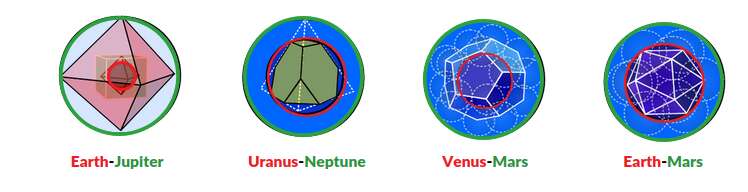
One of the most profound suggestions in our research is that the geometric logic that structures the solar system is the same geometric logic that structures the atom — that the same proportions, the same ratios, the same Platonic Solid relationships that appear in the orbital geometry of the planets appear also in the geometry of the electron cloud. If true, this would be a form of scale invariance at the most fundamental level: the universe is built from the same geometric template at every scale, from the subatomic to the astronomical.
The specific connection proposed is through the relationship between orbital resonances and orbital geometry. Orbital resonances — the tendency for orbiting bodies to settle into orbits whose periods stand in simple integer ratios — are one of the most important organising principles in the solar system. The Laplace resonance of the inner three Galilean moons of Jupiter (Io, Europa, and Ganymede orbit with periods in the ratio 1:2:4) and the 3:2 resonance between Pluto and Neptune are among the most celebrated examples. These resonances are the astronomical expression of the same harmonic ratios that Pythagoras found in music strings and Kepler found in planetary speeds.
In atomic physics, the quantum numbers of the electron's state define the specific resonant modes of the electron wave function in the potential well of the nucleus — the same mathematics, applied to quantum waves rather than gravitational orbits. The principal quantum number n defines the orbital shell just as the semi-major axis defines a planetary orbit. The angular momentum quantum number l defines the orbital shape just as the eccentricity of an ellipse defines its deviation from circularity. Both the solar system and the atom are governed by the same underlying mathematics of resonance in a central force field, and both express the same geometric patterns — the Platonic Solids, the harmonic ratios, the scale-invariant spirals — as consequences of that mathematics.
Our Atomic Geometry research takes this connection further: by mapping the S, P, D, and F electron orbitals directly onto the Platonic Solids and Archimedean Solids, it produces a geometric model of the atom that predicts atomic radii more accurately than the Bohr model. The S-orbital is a sphere, the P-orbitals form an octahedron, the D-orbitals introduce the cube, and the F-orbitals complete the cuboctahedron — the same nested polyhedral sequence that Kepler proposed for the planets, now found to structure the electron cloud. The Flower of Life, the Seed of Life, and the Metatron's Cube are not merely beautiful diagrams — they are the blueprints of atomic structure itself.
Sacred geometry, in this reading, is not merely the geometry of ancient temples; it is the geometry of the universe across all scales.
In the next chapter, we reach the Conclusion & Further Reading — a summary of the journey from the first circle to the geometry of the cosmos, with resources for continuing the exploration.
FAQ
What was Kepler's Platonic Solid model of the solar system?
In his 1596 Mysterium Cosmographicum, Kepler proposed that the six known planetary orbits were separated by the five Platonic Solids nested between concentric spheres: a cube between Saturn and Jupiter, a tetrahedron between Jupiter and Mars, a dodecahedron between Mars and Earth, an icosahedron between Earth and Venus, and an octahedron between Venus and Mercury. The model was ultimately incorrect but inspired his discovery of the correct laws of planetary motion.
What is the Music of the Spheres?
The Music of the Spheres (Musica Universalis) is the Pythagorean doctrine that the planets in their orbits express the same mathematical ratios that govern musical harmony. Kepler refined this in his 1619 Harmonices Mundi, finding that the ratios of each planet's maximum to minimum orbital speed correspond to specific musical intervals — a discovery that led directly to his third law of planetary motion.
Are there genuine geometric proportions in the solar system?
Yes. The Earth-Moon system encodes several notable geometric relationships: the ratio of the Moon's radius to the Earth's radius closely approximates 3:11, and when a circle representing the Moon is placed tangent to a circle representing the Earth, the combined system closely approximates the squaring of the circle. The Great Pyramid of Giza encodes similar proportions in its dimensions.
What is the Venus-Sun pentagram?
Venus traces a nearly perfect five-petalled pattern (pentagram) as seen from Earth over eight years, completing five synodic cycles. This five-fold symmetry — the signature of the Golden Ratio — appears in the relative orbital periods and positions of Venus and Earth, making it one of the most striking geometric relationships in the solar system.