Congratulations
You have completed the Ultimate Guide to Sacred Geometry. From the primordial dot to the geometry of the solar system, you have traced the unfolding of form itself — the same patterns that underpin mathematics, physics, biology, and art.
Key Takeaways
Part 1 — Foundations
Sacred geometry begins with the simplest possible act: placing a point. From the dot, the line extends into the first dimension. The compass and straightedge — the only tools permitted — enforce a discipline that reveals relationships no algebra can express. Cultures across the ancient world, from Egypt to India to Greece, recognised these patterns as fundamental to reality.
Part 2 — The Circle & Its Offspring
The circle is the mother of all form. Two circles of equal radius generate the Vesica Piscis, the womb from which the triangle, square, and all regular polygons emerge. Repeating this process produces the Seed of Life (7 circles), the Egg of Life (13 circles), the Flower of Life (19 circles), and finally the Fruit of Life and Metatron's Cube — a single diagram encoding all five Platonic Solids.
Part 3 — Three Dimensions
The flat patterns of Part 2 lift into three-dimensional space. The sphere is the 3D analogue of the circle, and the five Platonic Solids — tetrahedron, cube, octahedron, icosahedron, dodecahedron — are the only perfectly regular solids possible. The cuboctahedron (Vector Equilibrium) sits at the balance point of all twelve directions.
Part 4 — Higher Dimensions
Beyond three dimensions, geometry does not stop. The torus describes the geometry of flow and return — from magnetic fields to the shape of the universe. The hypercube (tesseract) projects four-dimensional structure into our three-dimensional awareness. The Merkaba, the star tetrahedron, unites ascending and descending energies into a single form.
Part 5 — In Nature & Science
Sacred geometry is not abstract — it is encoded in nature at every scale. The Fibonacci sequence and the Golden Ratio govern growth patterns from sunflower seeds to spiral galaxies. The Silver Mean and fractal self-similarity describe branching and scaling. Cymatics reveals that sound itself creates geometric patterns. At the atomic level, electron orbitals and molecular bonds follow geometric templates. And at the largest scale, the solar system embeds the Platonic Solids in its orbital ratios.
The Core Insight
Sacred geometry reveals a single principle: the universe builds complexity from simplicity through geometric self-organisation. A point becomes a line, a line sweeps a circle, circles intersect to form the Vesica Piscis, and from that seed, every form in nature unfolds. The same proportions appear at atomic, biological, planetary, and cosmic scales — not by coincidence, but because geometry is the language in which nature expresses its laws.
Further Reading
Books
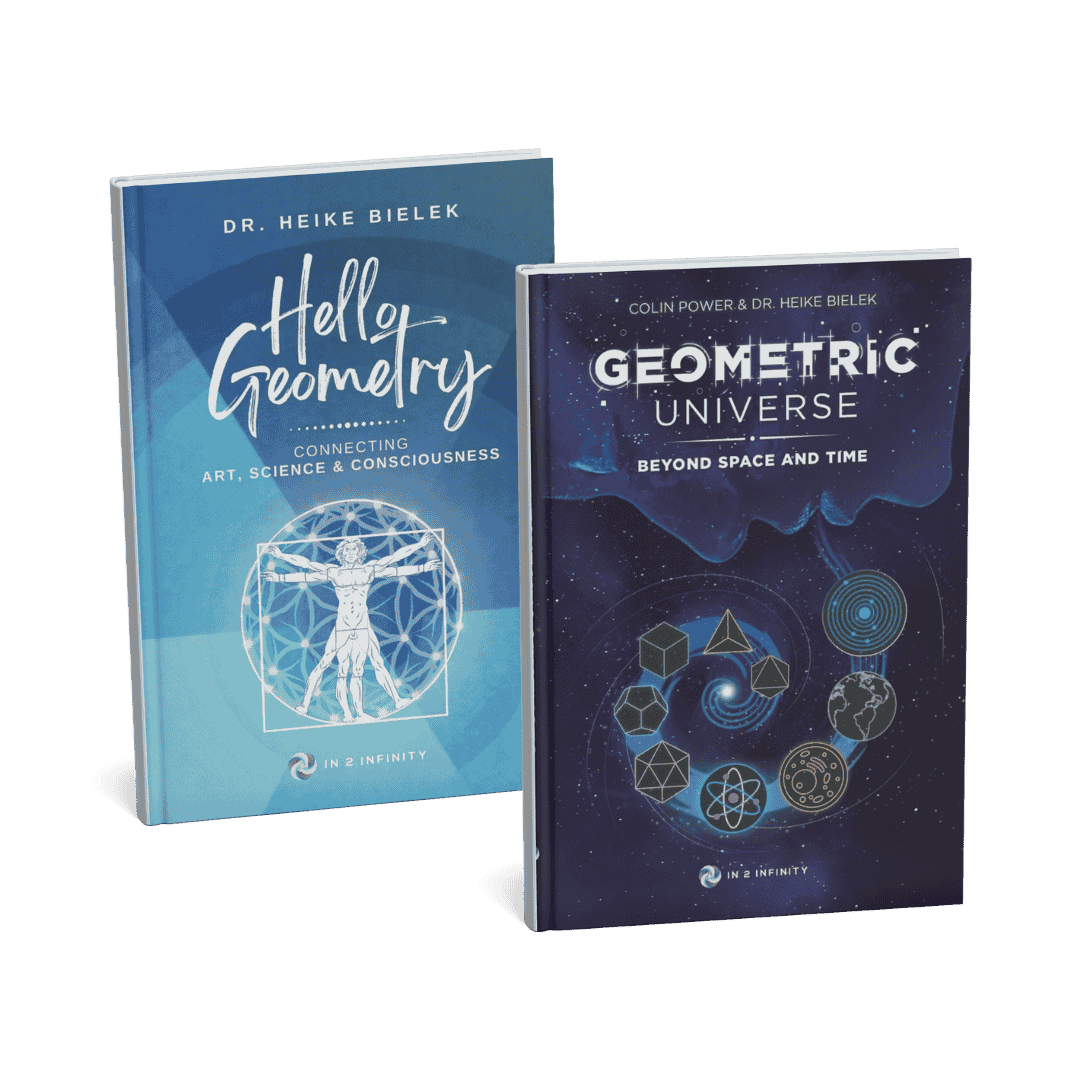
- The Geometric Universe — our complete geometric theory, from number theory through atomic physics to the structure of the cosmos
- Euclid's Elements — the foundational text of geometry, still unsurpassed after 2,300 years
- The Hidden Geometry of Flowers by Keith Critchlow — sacred geometry in the plant kingdom
- A Beginner's Guide to Constructing the Universe by Michael S. Schneider — an accessible introduction to the geometric archetypes
On This Site
- The Guide to Geometry — a companion guide covering Euclidean geometry from fundamentals through solid geometry
- Theory Hub — explore our articles on mathematics, physics, astrophysics, and philosophy
- Start Here — an overview of our approach to geometric science
Next Steps
- Practice construction — get a compass and straightedge and draw the Seed of Life, the Flower of Life, and Metatron's Cube by hand. The understanding that comes through the hand is different from reading.
- Observe nature — look for spirals, branching patterns, hexagonal tessellations, and fivefold symmetry in the world around you.
- Explore the theory — read our articles on atomic geometry, number theory, and astrophysics to see how sacred geometry connects to modern science.
- Go deeper — study the Platonic Solids, their duals, and the Archimedean Solids to see how the five perfect forms connect to every level of structure in nature.