Introduction
When certain frequencies of light — particularly those in the ultraviolet range — strike the surface of a material, electrons are ejected from the surface. This phenomenon, known as the Photoelectric Effect, depends on the frequency of the incident light, not on its intensity. A dim ultraviolet lamp will trigger electron emission; a bright incandescent lamp will not. This frequency dependence appeared to contradict classical wave theory and led Albert Einstein, building on Max Planck's quantisation of energy, to propose that light exists as discrete particle-like packets called photons.
The photon hypothesis has remained the standard explanation for over a century. Yet it introduces a deep conceptual problem: light undeniably exhibits wave behaviour in diffraction and interference experiments. The resulting tension — wave-particle duality — has never been resolved within standard quantum mechanics. It is treated as a fundamental feature of nature, not an open question. We believe it is still an open question.
This article presents an alternative explanation. Using a 4D wave model of electromagnetism, grounded in the concept of a 4D Aether and the measured properties of the Cosmic Microwave Background (CMB), we show that every observed feature of the photoelectric effect can be accounted for without ever invoking a photon particle. The frequency threshold, the instantaneous emission of electrons, the saturation current, and the work function relationships all follow from simple geometric ratios, resolving wave-particle duality at its source. The energy released is not carried by the light itself — it is extracted from the vacuum of space.
The photoelectric effect is a phenomenon in which electrically charged particles are released from a material when it absorbs electromagnetic radiation, generating a current in a connected circuit. The fact that this requires light above a certain frequency seemed to contradict the classical interpretation of electromagnetic waves, since a continuous low-frequency wave ought to build up charge over time rather than exhibiting an abrupt threshold.
When Max Planck resolved the Ultraviolet Catastrophe by reformulating classical electromagnetism, his solution introduced a new constant into physics. The Planck constant (h) — a fixed unit of energy — suggested that energy is quantised at microscopic scales. Einstein then used this quantisation to propose that photons of a specific frequency each carry a fixed amount of energy, while lower-frequency photons carry too little energy to eject an electron no matter how many of them arrive. Only photons above the threshold frequency could initiate emission, explaining its frequency dependence.
This model, however, carries a serious internal problem. The mainstream view holds that it is the photon's energy that is transferred to the electron. Yet this does not match the experimental evidence: the emission is almost instantaneous. If energy transfer from the light were the mechanism, there should be a measurable delay as energy accumulates. Instead, the emission appears to show that the energy is already present within the material, and that light merely acts as a trigger. Furthermore, it is possible to relate the work function (W) and the threshold wavelength (λ) to the speed of light without using the Planck constant at all:
(Wλ)² = c/2
A light wavelength of √150 nm produces a photon energy of around 10 eV. This article explains the geometric reason for this relationship and, in doing so, resolves the wave-particle duality paradox through simple ratio — unifying the photoelectric effect with the laws of 4D electromagnetism and the properties of the Cosmic Microwave Background.
Key takeaways
- The photoelectric effect's near-instantaneous electron emission is incompatible with photon energy transfer — it implies the energy is already present in the material and that light acts only as a trigger, resonating with the evanescent surface field to release energy stored in the vacuum.
- The work function and threshold wavelength can be related to the speed of light via (Wλ)² = c/2 — without using the Planck constant — suggesting the effect arises from geometric ratios of 4D electromagnetism rather than from discrete photon packets.
- The Cosmic Microwave Background provides the energy reservoir: its wavelength relates to visible light wavelengths by a cube-root scaling factor of 100, connecting the macroscopic background field to the nanometre scale of atomic surface interactions.
The Photoelectric Effect Experiment
There are several experimental setups used to examine the photoelectric effect. The simplest involves cleaning the surface of a metal plate and placing it on an electroscope. The plate is made negatively charged through induction using a statically charged rod, causing the two metal leaves of the electroscope to repel each other. When a normal incandescent light is shone onto the plate, no change in charge occurs. When the light is replaced with a UV source, however, a discharge of photoelectrons is observed immediately and the leaves cease to repel.
More elaborate setups use a circuit connected to a power source so that the plate can be charged to a range of positive and negative voltages, while the frequency and intensity of the light are varied independently. This enables precise measurement of the relationship between incident light and electron flow. Modern computer simulations based on these measurements allow the relationships to be explored interactively before reading further.
The Intensity of Light
The first law of the photoelectric effect was discovered by Aleksandr Stoletov, who demonstrated a proportional relationship between the intensity of light and the induced current. Intensity in physics corresponds to brightness — the same quality experienced when using a dimmer switch. In the photoelectric effect, once the threshold frequency is exceeded, increasing the intensity of the incident light results in more current, because more electrons are released per unit time. This proportionality between intensity and current is entirely consistent with a wave model: more wave energy arriving at the surface liberates more electrons, without any need to invoke a particle count.
Energy from the Vacuum
The whole universe is filled with a Cosmic Microwave Background (CMB) — a pervasive electromagnetic field in the microwave region of the spectrum. Conventionally regarded as a relic of the Big Bang, the CMB's measured spectral radiance reveals a deep geometric correspondence to the speed of light and to electron energy that points toward a different interpretation. In our theory of the 4D Aether, the CMB is the medium through which electromagnetic waves propagate — and it is the source of the energy released in the photoelectric effect.
The CMB can be characterised by either its wavelength peak or its frequency peak, producing two related sets of values. When measured by wavelength, the CMB has a frequency of approximately 160 GHz and a corresponding wavelength of 1.87 mm. This wavelength is generated by dividing 1.5 by 2√3 and squaring the result, yielding the ratio 3/16:
(1.5 ÷ 2√3)² = 0.1875 = 3/16 = CMB wavelength
In the previous section, the resistance of the vacuum was expressed as 6π² ÷ 4π² = 1.5, which produces a single unit of energy. This value divided by 2√3 and squared gives the CMB wavelength. The value 3/16 can be written as the speed of light divided by 4². Assigning 3 to the speed of light gives a frequency of 160 GHz:
3 ÷ (3/16) = 16 = CMB frequency
The second CMB measurement, taken by frequency peak, yields a value approximately equal to √8. This is obtained by dividing 2√3 by √1.5:
(2√3 ÷ √1.5) = 2.828 = √8 = CMB frequency
The corresponding wavelength follows from dividing the speed of light (3) by this frequency:
3 ÷ (3√2) = (3√2) ÷ 4 = 1.060 = CMB wavelength
These results establish the geometric nature of both CMB measurements. Notice that an EM wave with a wavelength of 200 nm produces a frequency of 150 petahertz (1.5 in normalised units), unifying the electron and photon energies into a single unit (E). When the photon energy (Ep) is set to 1, the wavelength reduces to √1.5. The values 1.5 and √1.5 appear reciprocally in the CMB spectral radiance:
By wavelength: (1.5 ÷ 2√3)² = CMB λ and 1.5 EM frequency = 1 Energy (E)
By frequency: (2√3 ÷ √1.5) = CMB frequency and √1.5 EM λ = 1 Photon energy (Ep)
Since the product of wavelength and frequency always equals the speed of light, λ and f are reciprocals of each other. Both measurements of the CMB invoke the numbers 1.5 and 2√3, unified to photon energy (Ep) and energy (E). The CMB is not a distant relic of a primordial explosion. It surrounds every atom in the universe. This article proposes that it is intimately related to the photoelectric effect — that the electrons are not set in motion by the energy of light, but by energy extracted from the vacuum field.
The geometric basis for this becomes clearer when spatial scaling is considered. A unit square has a diagonal of √2. A cube with a side of length 1 has a longest diagonal of √3, while a cube with a side of √2 has a longest diagonal of √6, which halves to √1.5. The same ratios appear in 2D as the distances between the nodes of two interlocking circles scaled at 1:√2.
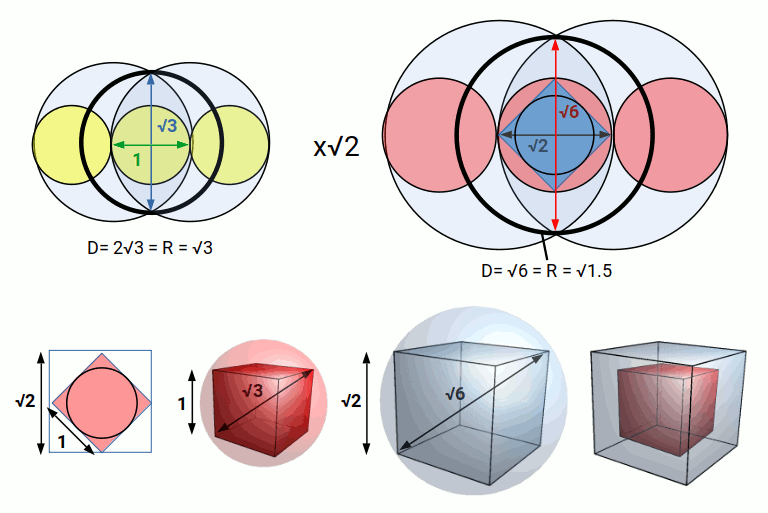
With this geometric foundation, the unification of the CMB to the energy (E) and photon energy of EM waves becomes tractable. An EM wave of wavelength 200 nm produces an energy (E) of 1; when the wavelength is reduced to √1.5 the photon energy (Ep) equals 1.
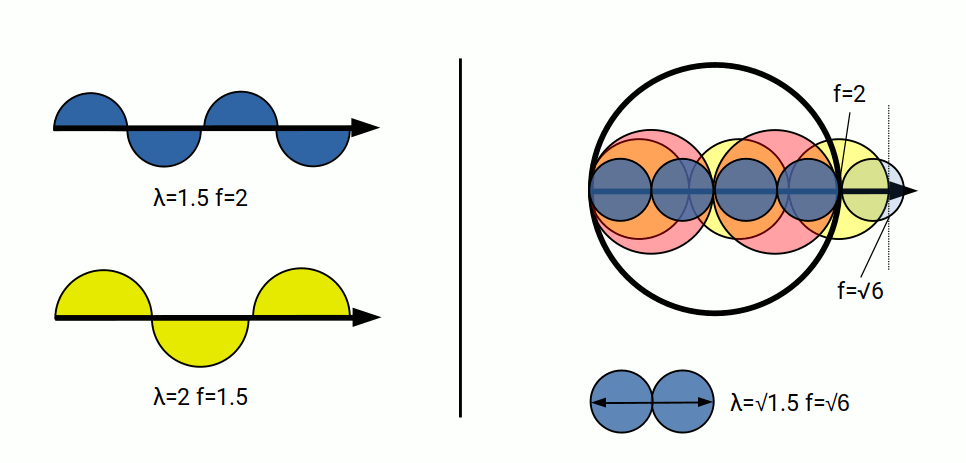
The frequencies of the CMB and their relationship to the electromagnetic resistance of the vacuum are most naturally expressed geometrically. A frequency of 160 divides a line of length 3 (the speed of light) into 16 wavelengths; √8 is the diagonal of a square with side 2, and so divides the same line differently. A square of side 6 superimposed over one of side 4 captures both: the values 6 and 4 correspond to μ₀ and √(1/ε₀) (excluding π), which together produce the electromagnetic resistance of the vacuum.
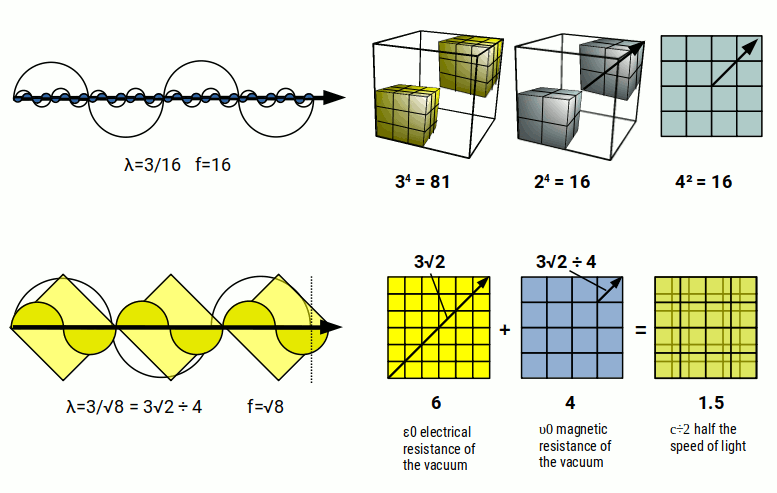
Interestingly, all matter in the universe is composed of only 81 stable atoms, formed from a maximum of 16 electron pairs in a single shell — derived from 3⁴ and 2⁴ respectively. This geometric representation of the CMB unifies its properties with the resistance of the vacuum, which limits the speed of light (causality) through a hyper-cubic structure that orients the atoms and electrons of the entire universe into a unified moment of time.
Harmony and Resonance
The concept of resonance shows that a wave at one frequency can set another wave vibrating at a related frequency. On a guitar, pressing the second fret of the second string creates the musical 5th. When the first string is plucked, the second string resonates. Moving to a semitone below the 5th breaks this effect entirely. The same principle governs acoustics, electrical circuits, EM waves, and atomic physics — wherever constructive interference aligns wave peaks, amplitude is amplified.
The photoelectric effect exhibits a direct correlation to the frequencies of the CMB. The EM wave that initiates electron emission in magnesium has a frequency of √3/2. When this is divided by √8/2 (half the CMB frequency), the result is a wave of frequency √1.5. Dividing again by the same CMB frequency yields √3. At this point, frequency and wavelength reach equilibrium, both exhibiting a value of √3.
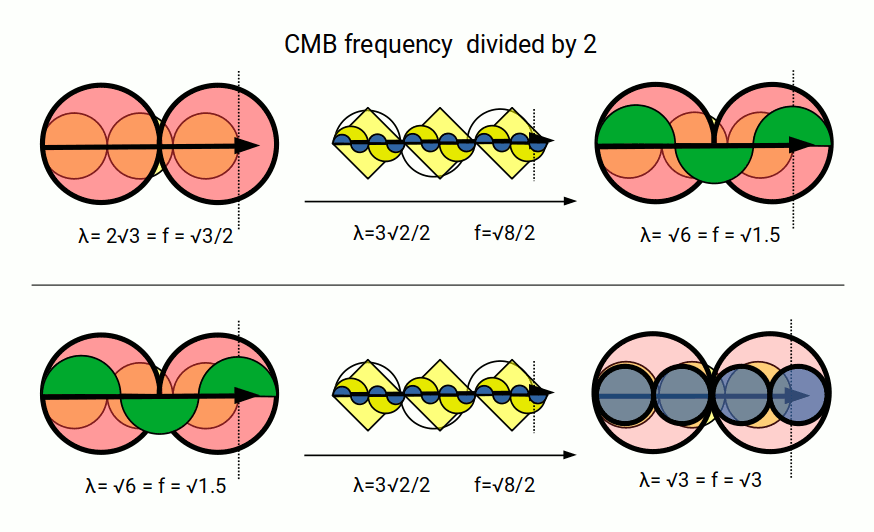
Scalar Waves
The evidence assembled so far provides substantial support for the hypothesis that the photoelectric effect is driven by energy extracted from the CMB — a 4D Aether. Magnesium is a particularly instructive element: its work function is in direct ratio to its threshold frequency such that, when the two are multiplied and squared, the result is half the speed of light. We have also shown that c/2 is unified to the CMB wavelength, since 1.874 ≈ √1.5 × 10⁻³.
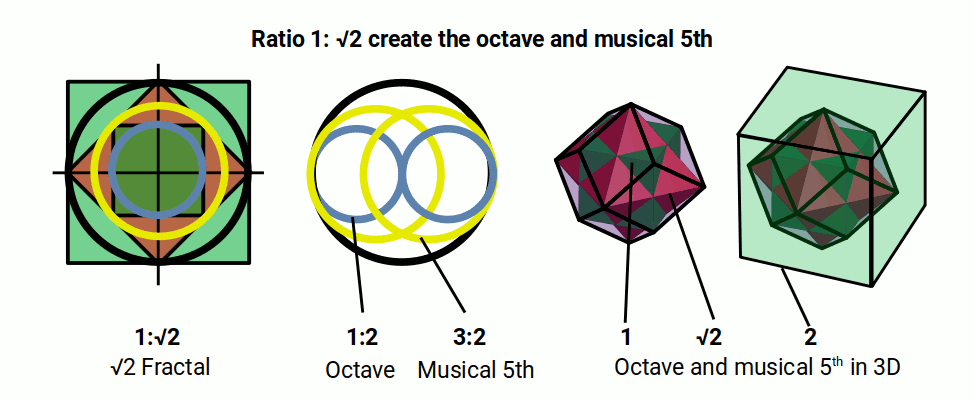
The structural reason for this lies in the relationship between EM waves and musical ratios. When two unit circles overlap equally, the distance between their intersection nodes is √3, which defines a new set of waves with a wavelength of 2√3. This is most clearly seen in geometric form.
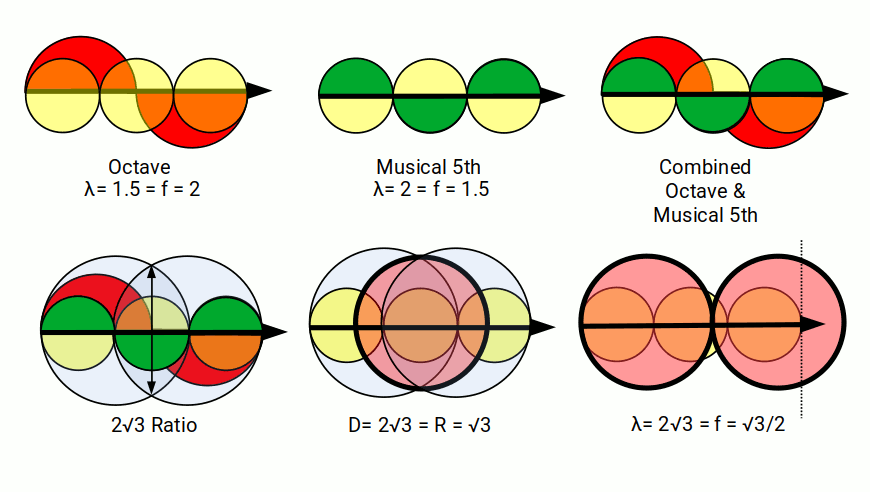
This EM wave has a wavelength of 2√3, or approximately 346 nm, which corresponds to the work function of magnesium. The number of photons per joule is also approximately √3. Since 2√3 = √12, squaring gives 12 — the atomic number of magnesium (12 protons, 12 electrons, 12 neutrons in its most stable isotope). Squaring 12 gives 144, which is only 6 nm short of 150, the result produced by the work function equation. As a further note, 144 appears in the Fibonacci sequence and is related to the limiting growth formations of plants, as observed in the sunflower.
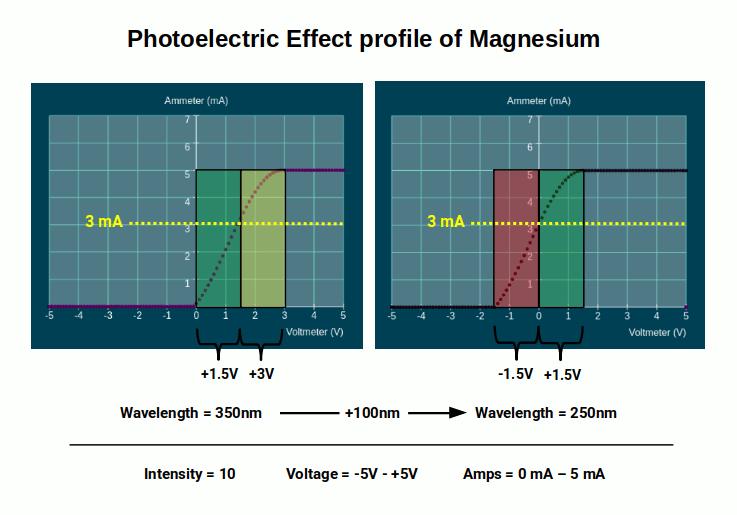
Reducing the wavelength from 350 nm to 250 nm shifts the photoelectric curvature from a 0V–to–+3V range to a −1.5V–to–+1.5V range — a shift of exactly half. A wavelength of 2√3 (346 nm) divided by √2 gives √6 ≈ 244.9 nm, close to the 250 nm boundary. Scaling again by √2 shifts the curvature by a further half, leaving a wavelength and frequency that both equal √3. The EM wave therefore scales by a factor of √2; after two iterations, the wavelength is halved and the curvature shifts by −3V.
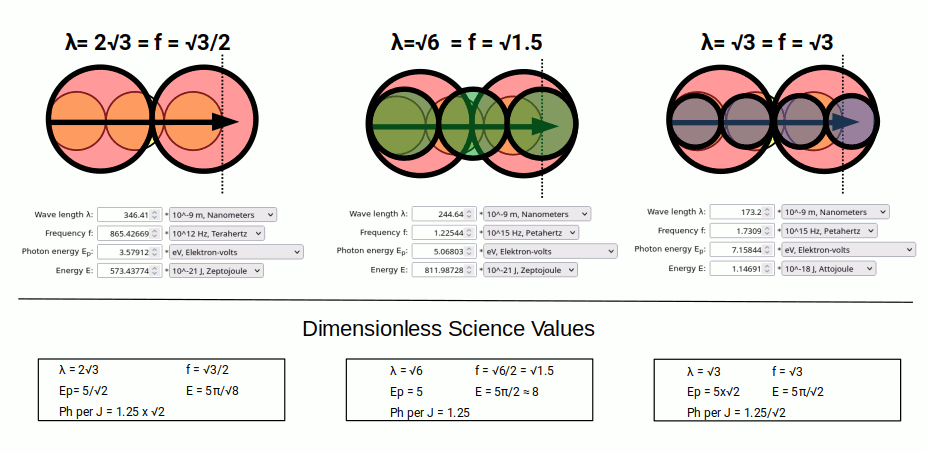
At the midpoint, photon energy approaches 5, which exceeds energy by a factor of 2/π, giving E ≈ 0.785 = 0.5π/2, equivalent to the fraction 4/5. The number of photons per joule is 1.25 (= 5/4), the reciprocal of energy. A pattern is emerging around the numbers 4, 5, and 8, connected to π. Geometrically, the 5-pointed star generates the Golden ratio, and the 8-sided octagon generates the Silver ratio. The former is √1.25 ± 1; the latter √2 ± 1.
The CMB wavelength exhibits two values — 1.87 mm (close to √(2√3), differing by only 1.004) and 3/√8 (which multiplied by √2 equals 1.5). In both cases, EM waves scale not by halving but through the ratios √2 and √3 — the geometric ratios of the square and the cube, and the same ratios that structure musical scales. Electromagnetism appears to be ordered by the principles of geometry and music, operating as scalar waves.
4D Waves
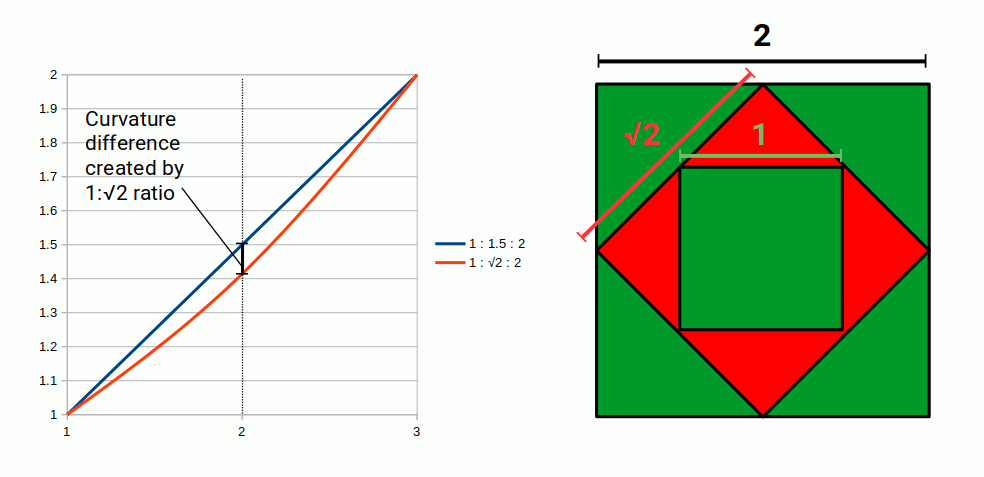
The appearance of the 1:√2 ratio in EM scaling is not coincidental — it reflects the physical geometry of electromagnetic waves. Each wavelength comprises an electric field (E) and a magnetic field (B) offset at 90° to each other. As they expand together to their maximum amplitude, the distance between them grows at exactly 1:√2. From the perspective of the 4D Aether, this expansion traces the geometry of an Octahedron. We call this structure Octahedral Light.
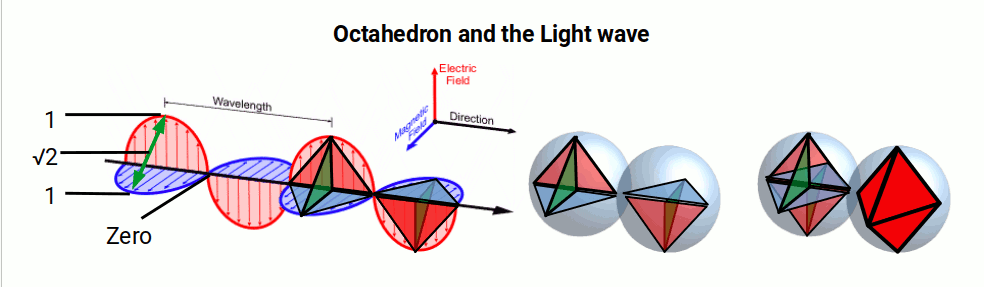
This octahedral structure is the mechanism by which the 4D Aether continuously expands and contracts, transmitting energy through the vacuum of space at the speed of light. Each component wave expands and contracts at 90° over the course of a single wavelength. Two Octahedra complete one full cycle. This is analogous to electron half-spin, where a 720° rotation in 4D corresponds to a single 360° rotation in 3D — a property of 4D rotation applied equally to all virtual particles and EM waves in our geometric model.
Six Octahedra combine to form a larger Octahedron twice the size. This structure fills 3D space with eight tetrahedral gaps into which small cubes fit, producing a compound of Cube and Octahedron. Connecting the corners of this compound generates the Rhombic-Dodecahedron, which is the 3D template for the 4D Hypercube (Tesseract). If the octahedral unit has a side length of 1, the Rhombic-Dodecahedron has a side length of √1.5.
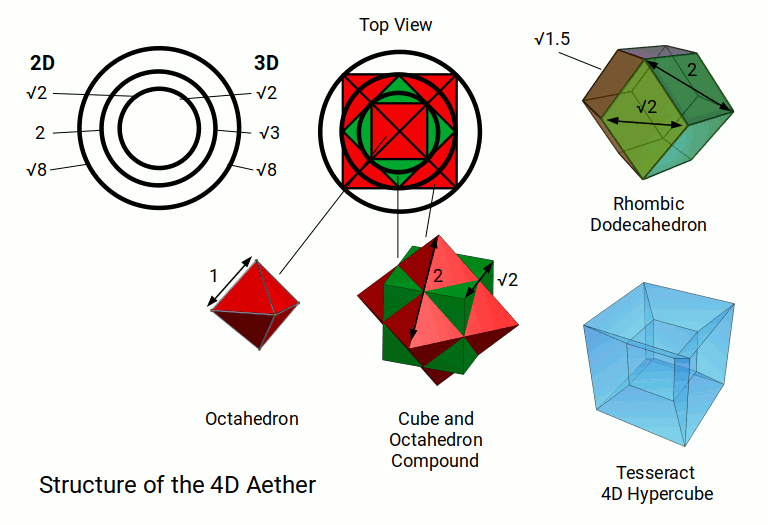
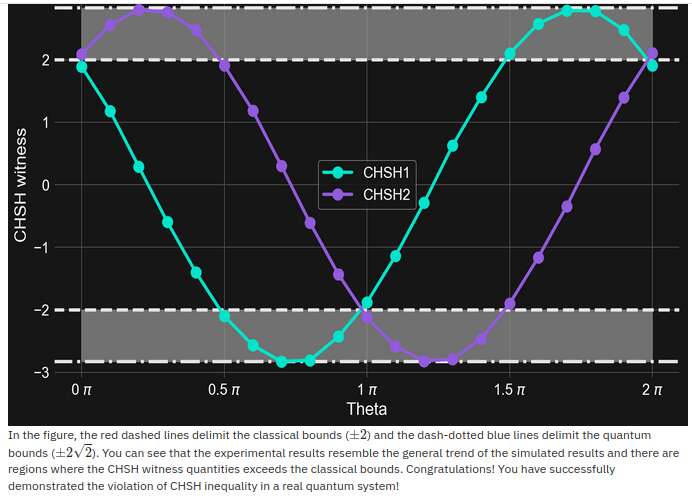
This 4D structure explains why quantum mechanics must normalise its equations using √2 — a key point in understanding Bell's theorem. When two light polarisers are placed at 90° to each other (blocking light) and a third is inserted at 45°, light becomes visible again, with an intensity predicted by quantum physics to be √8. This result follows directly from the geometric structure of light, with no need to invoke faster-than-light communication.
The 1:√2 ratio is geometrically defined by a set of squares nested at 45° — the √2 fractal — which also encodes the musical 5th and octave. In 3D space, this fractal is expressed in the Cube-Octahedron compound, defining the Rhombic-Dodecahedron and the template for hyper-cubic space.
This template appears in Atomic Geometry and is central to Geo-Quantum Mechanics, which produces a model of all stable elements accurate to within 500% better than the Bohr and Van der Waals models for atomic radii. Two versions of the template — one based on a cube of side 1 and one on a cube of side √2 — form a Hypercubic model when superimposed on the same centre.
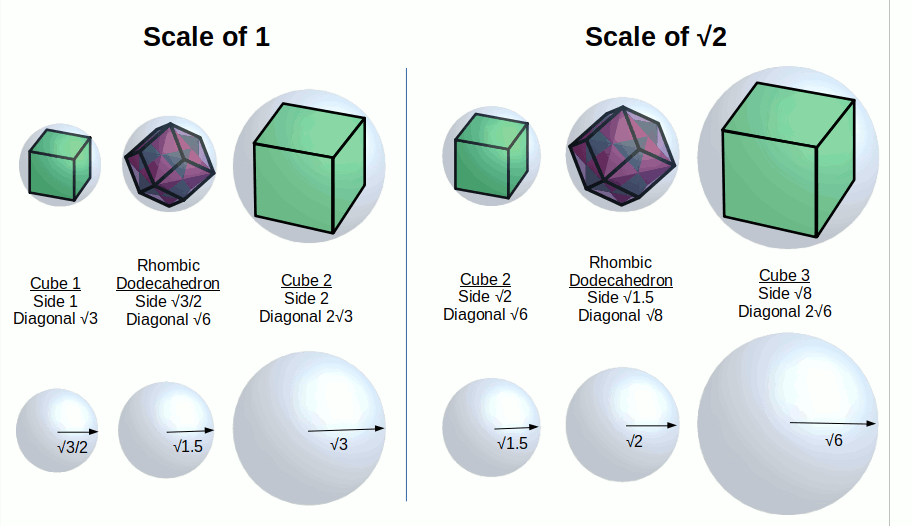
All the components needed to explain the CMB and the EM waves that unify photon energy are now in place. It is √1.5 that bridges the two scales. As the light wave is octahedral in nature, it passes through this compound, forming a sphere of radius √1.5 that surrounds both the Rhombic-Dodecahedron at scale 1 and the Cube at scale √2. This unified ratio enables the two Hypercubes to rotate in unison at 1:√2 — the ratio inherent in all EM waves. This is the 4D Aether: the structure of space that quantises the light wave and transmits EM radiation through the vacuum at the speed of light.
Work Function–Wavelength Equation
The relationship between the threshold wavelength and the work function across different materials also follows a precise ratio. Multiplying the work function (W) by the threshold wavelength (λ) and squaring the result consistently yields a value close to half the speed of light:
(Wλ)² = c/2
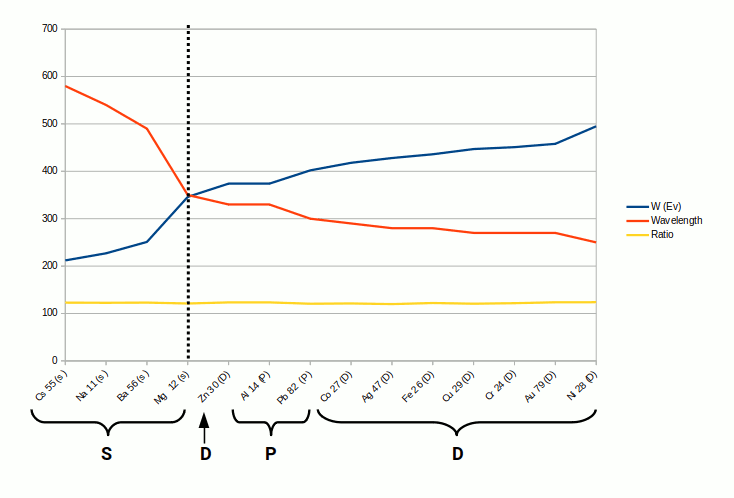
This means the threshold wavelength multiplied by the work function equals √150, the point at which the EM wave unifies with a single unit of photon energy. Crucially, this unification is achieved without the Planck constant. The relationship is expressed entirely through simple ratio. Since the concept of the photon particle and wave-particle duality both rest on the photon solution to the frequency threshold, an alternative equation that reproduces the same result — without quantisation — casts serious doubt on the photon hypothesis.
Through this equation, Wλ = √1.5, which is the value that unifies the hyper-cubic scales of reality and forms the side length of the Rhombic-Dodecahedron at the √2 scale. This wavelength also produces a photon energy of exactly 1 in an EM wave.
The conclusion is that the Planck constant defines a ratio, not an intrinsic quantity of energy. This is confirmed by examining why classical electromagnetism failed to predict the curvature of black body radiation: Rayleigh and Jeans used the harmonic series rather than harmonic ratio in their calculation.
The work function–wavelength equation also links to the CMB wavelength of 1.87 mm. Raised to the power of 4:
1.87⁴ = 1.235 × 10⁻³ ≈ √1.5 × 10⁻³
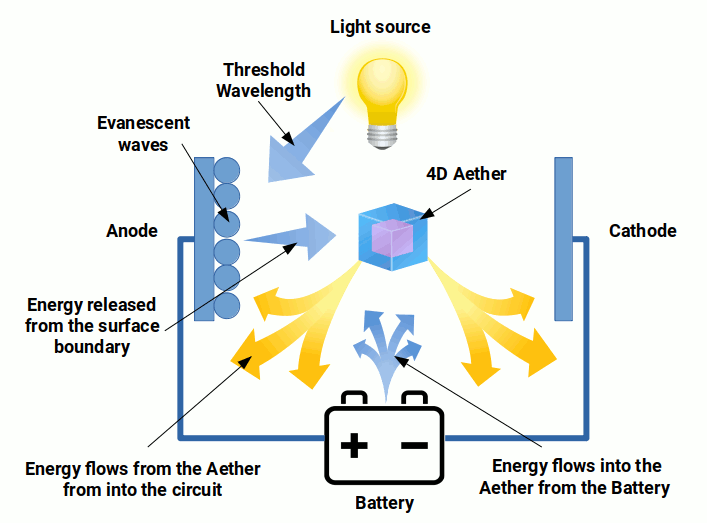
The solution to the photoelectric effect can therefore be understood as the interaction of the 4D Aether at the surface boundary of the material. At atomic scales, all solid matter is bounded by evanescent waves. When an EM wave of a particular scale reaches this surface, it disturbs the evanescent field and draws energy from the vacuum. A photoelectron is the ejection of energy from the disruption of this surface boundary — extracting energy from the vacuum of space.
If the 4D Aether theory is correct, we have already discovered the operating principle behind extracting a potentially unlimited energy source. What remains is to refine the methods by which this energy is obtained.
The Geometry of Magnesium
Among the 14 elements examined, magnesium is the point where the work function and threshold wavelength curves intersect. Magnesium has an atomic number of 12, with 12 protons, 12 electrons, and 12 neutrons in its most stable isotope. According to Atomic Geometry, the magnesium atom has the structure of an Octahedron (a complete set of P-orbitals) surrounded by a 4D torus field (the pair of S-orbital electrons).
Elements with outer-shell electrons in a single orbital shell tend to exhibit lower work functions, making them particularly responsive to the photoelectric effect at lower frequencies. In Geo-Nuclear Physics, the 12 neutrons and protons of magnesium form a nucleus with the structure of a 24-cell 4D polytope (the Octaplex), represented in 3D as a Cuboctahedron and Rhombic-Dodecahedron dual. The magnesium atom has a radius of 150 pm and a diameter of 300 pm — directly correlating to the Wλ² equation and the speed of light.
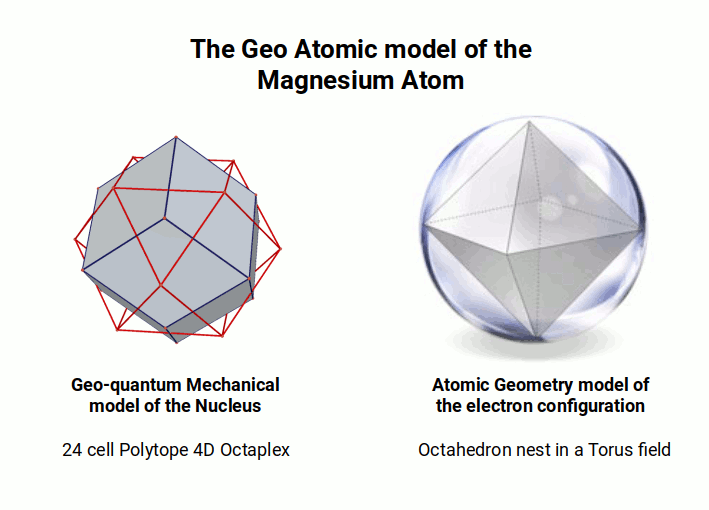
Magnesium has a radius of 1.5 Å and therefore a surface area of 9π, the value for energy (E) multiplied by π. This may explain why magnesium is central to photosynthesis. Within the chlorophyll molecule, a single magnesium atom is suspended in a magnetic field by four nitrogen atoms (atomic number 7). When struck by sunlight, the magnesium atom vibrates and the energy released splits a water molecule, powering life.
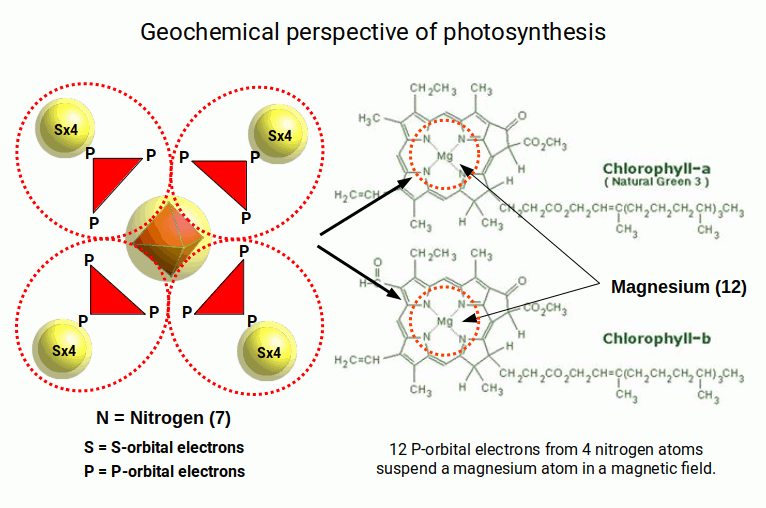
This completely reframes the photochemical process. Plants do not convert sunlight energy into chemical energy. Instead, the frequencies of light cause the magnesium atom to vibrate, which extracts energy from the vacuum of space. This energy is then used to split a water molecule, the chemical energy of which powers life.
This model also explains why the structure of compounds and molecules can dramatically affect the work function. If the energy originates from the background Aether, the geometry of the material becomes the dominant factor — not the photon energy of the incident light.
It also accounts for Photoelectric Fatigue: the gradual reduction in photoelectron output over time, which has been shown to be caused by the growth of a thin oxidation layer on the material surface. If the photoelectric effect is a disturbance of the evanescent surface field, then the formation of an oxide layer disrupts the geometric resonance between the EM wave and the surface, reducing the efficiency of energy extraction. This plays a key role in semi-conductive materials development and may reframe our understanding of processes such as rusting and battery discharge. As new research increasingly challenges the traditional photon-based view, the 4D Aetheric model satisfies many of the anomalies being uncovered at the frontier.
Squaring the Circle
Having established the √2 scaling principle, we can examine more carefully the precise threshold point. The magnesium work function is 2√3, but the wavelength that triggers the photoelectric effect is approximately 349 nm — about 3.5 nm higher. This produces a frequency of around 857 THz. Squared, the result equals approximately √3 − 1. Scaling by √2 gives 121 nm (notably close to 11² = 121). Dividing by 2√3 recovers 349 nm — the original wavelength scaled by a factor of 10:
√f × √2 = 1.21 and 1.21 ÷ 2√3 = 0.349
EM wave: f = √3 − 1, λ = 3.49
Mg work function = 2√3
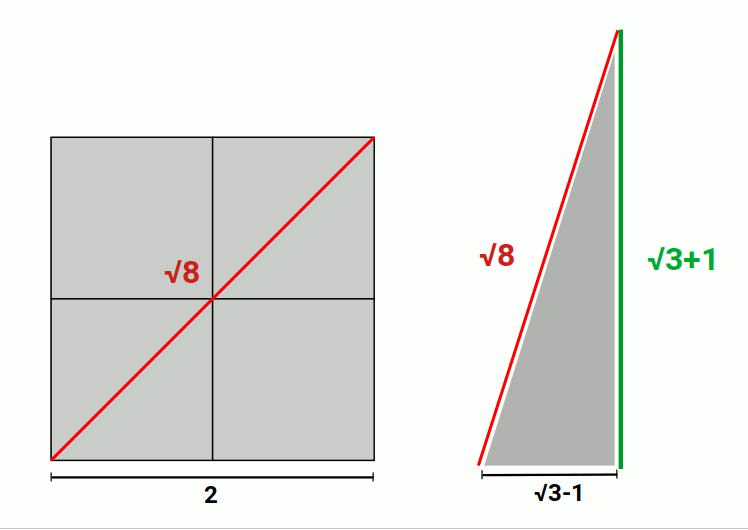
The value √3 − 1 also relates to the heat/frequency relationship of the CMB. Measured by frequency, the CMB temperature is 2.73 K (= √3 + 1), while its frequency is √8 (282 GHz). These can be placed on a right-angled triangle with √3 − 1 at the base, which is precisely the frequency that triggers the photoelectric effect in magnesium.
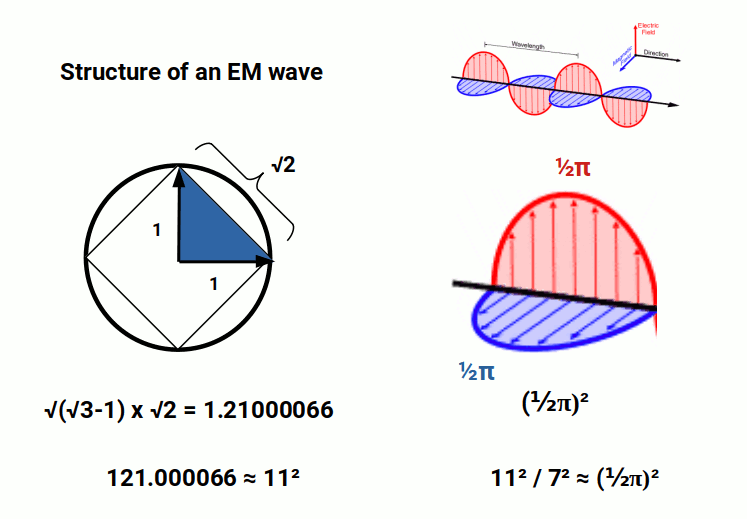
When the threshold frequency 0.856 (= √(√3 − 1)) is multiplied by √2, the result is 1.21000066. The value 121 = 11². Divided by 7², this approximates ½π². The E and B fields of an EM wave are offset at 90°, so their maximum separation is √2. Since π describes the relationship between a circle's diameter and circumference, ½π is the distance of a half circle. Squaring when the two waves multiply gives a half-wave circumference of ½π², approximated by 11² ÷ 7². This is the geometric principle underlying squaring the circle — as illustrated in the Sandreckoner diagram and in Leonardo da Vinci's Vitruvian Man.
At the threshold wavelength, photon energy is approximately 4.9 = 0.7². Frequency is approximately 12.1 = 11²/10. The value 7² = 49 is derived from the photon energy; 11² = 121 from the frequency. The squaring of the circle emerges from this ratio.
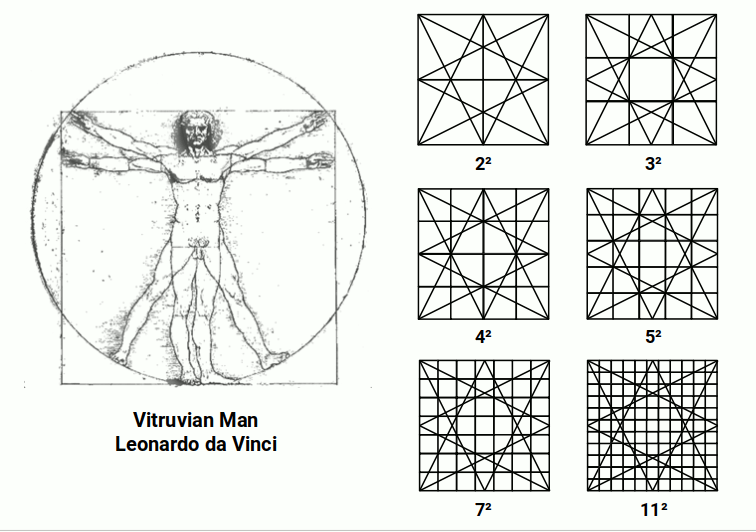
EM waves exhibit circular geometry; free space (vacuum) is isotropic (flat), so extracting energy from it requires a transformation between the circular and the rectilinear. The photoelectric effect operates precisely at this boundary. When the waveform falls into resonance with the square lattice of matter, energy is extracted from the vacuum of space.
Cubing the Surface of a Sphere
The surface area of a square is the side length squared. A cube has six faces, so its total surface area is six times the area of a single face. For a cube whose face has area π (side length √π), the total surface area is 6π:
√π² × 6 = 6π
The surface area of a sphere is 4πr². Setting r = √1.5 gives a surface area of 4π × 1.5 = 6π.
Therefore, a sphere of radius √1.5 has the same surface area as a cube of side length √π. The critical wavelength that initiates the photoelectric effect is exactly the radius of this sphere.
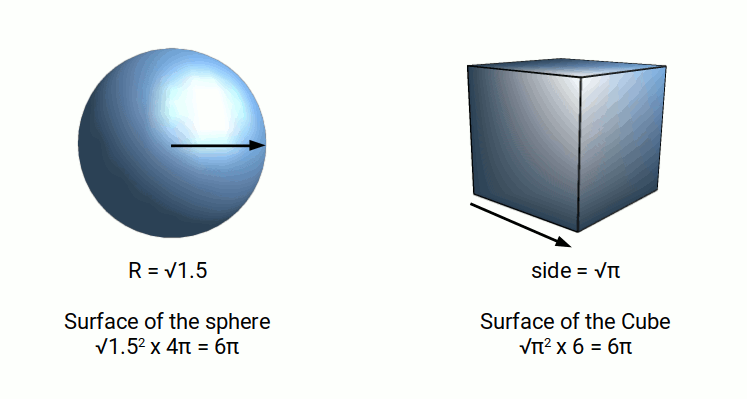
The sphere of radius √1.5, produced by the threshold EM wave, falls into harmonic resonance with the cubic lattice structure of matter. When brought into resonance, energy from the vacuum begins to be extracted, initiating the photoelectric effect. The ancient geometric metaphor of the circle (energy, spirit) meeting the square (matter) turns out to be a precise physical description: the point where matter is transformed into energy.
The CMB and the Fine Structure Constant
The fine structure constant α (≈ 1/137) is a dimensionless constant expressing the coupling of the electron to the atomic structure. Its precise value has no explanation within standard theory. In Dimensionless Science, α = 4π/√3. Dividing by π transforms this to the simple fraction 4/√3.
The critical wavelength can be calculated from α and the CMB frequency:
(√8 ÷ (α/π)) ÷ W = λ
(√8 ÷ (α/π)) ÷ λ = W
When √8 is divided by 4/√3, the result is √6/2 = √1.5:
√8 ÷ (4/√3) = √6 ÷ 2 = √1.5
This illustrates a direct relationship between the CMB frequency and the coupling of the electron to its atom — further evidence that the energy released in the photoelectric effect does not originate with the incident EM wave but is extracted from the vacuum. Both the work function and the threshold wavelength are defined by the ratio of the fine structure constant to the uniform CMB frequency that permeates the entire universe.
Gravity and Magnitude
Many of the calculations presented here use simplified geometric ratios based on Dimensionless Science constants, which produce accurate results without requiring standard magnitudes. This approach allows us to focus on geometric relationships between constants and to demonstrate the conceptual connections clearly.
The formula (Wλ)² = c/2 produces a result that is out by a factor of 100 compared to SI values. This is resolved by including the gravitational constant. When c/2 is multiplied by G, the result is very close to 1/100:
(c ÷ 2) × G = 0.0100044
Rearranging gives equations for both the work function and the threshold wavelength at the correct order of magnitude:
(√(c² × G) ÷ 2) / W = λ
(√(c² × G) ÷ 2) / λ = W
In Dimensionless Science, the gravitational constant is 2/3 and the speed of light is 3. These produce exactly the same result as the fine structure solution:
(√(3² × 2/3) ÷ 2) = √8 ÷ ((4π/√3)/π)
This points to a new correlation between gravity and the speed of light. The gravitational solution also maps directly to Newton's law of gravitation: the gravitational constant is multiplied by mass and divided by the square of the distance between objects.
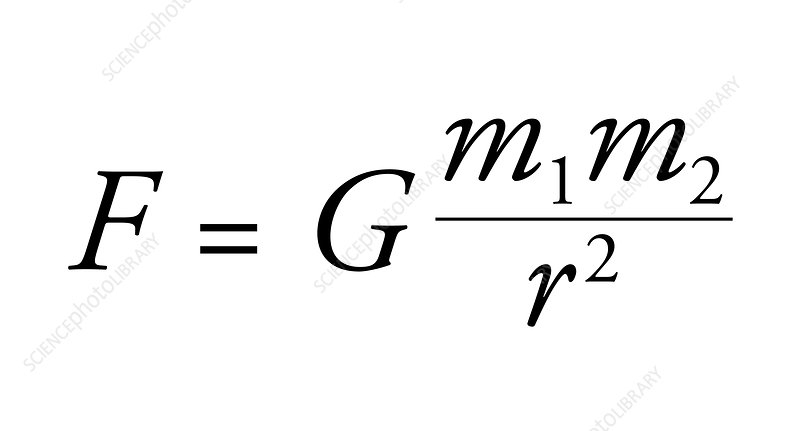
In this formulation, the distance r² becomes √2 — the same ratio through which light waves scale to produce the musical 5th. The gravitational constant appears in its square root form, consistent with recent work in string theory on the unification of electromagnetism and gravity through √G. √G also appears in the escape velocity equation: V_esc = √(2GM)/r. Substituting c² for M and dividing by the CMB wavelength reproduces the photoelectric result:
Photoelectric effect = √(3² × 2/3) ÷ 2
CMB relationship = √(2 × 2/3 × 3²) ÷ √8
Escape Velocity = √(2G × c²) ÷ CMB frequency
What this expresses is that the energy is already inherent within the atomic structure of the material. When the threshold wavelength is reached, energy is released into the 4D Aether, then absorbed back into the connected circuit. Electricity does not flow through wires — it is conducted through Aetheric fields and absorbed uniformly throughout the circuit. This concept is explored further in our article on Quantum Foam.
Current Saturation
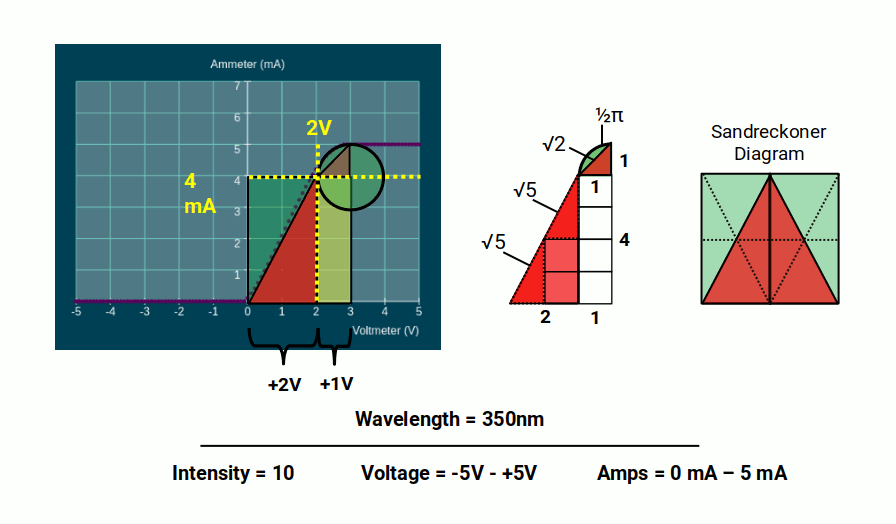
The saturation current is traditionally explained by proposing that above a certain light frequency, every photon has sufficient energy to produce a photoelectron, so increasing the voltage produces no further current. The 4D wave model offers a different view: once saturation is reached, any increase in voltage produces a proportional increase in resistance, which holds the current constant at 5 mA.
Examining the curvature reveals that the emission begins with an immediate proportional rise in current as voltage increases. This proportionality holds from zero to approximately +2 V. Over the final volt (between +2 V and +3 V), the current rise slows sharply before reaching saturation. Changing the EM frequency shifts the entire curve along the voltage axis without altering its shape.
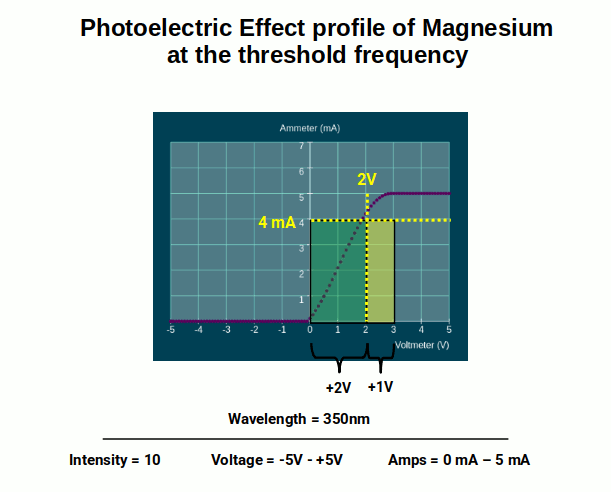
The two-thirds mark of the starting wavelength (2√3) is found by dividing it by √1.5. The curvature sits at a 'sweet spot' between 1.2 and 1.22; beyond this point, the current relationship changes from the √1.5 ratio to 2/√3 until saturation at +3 V. At the +2 V point, the EM wave has a wavelength of √8 — the same value as the CMB frequency.
Since wavelength and frequency are related by the speed of light (3), multiplying the CMB wavelength by 3 gives √8. The shift point in the curvature is exactly three times the CMB wavelength — the ratio of the musical 5th.
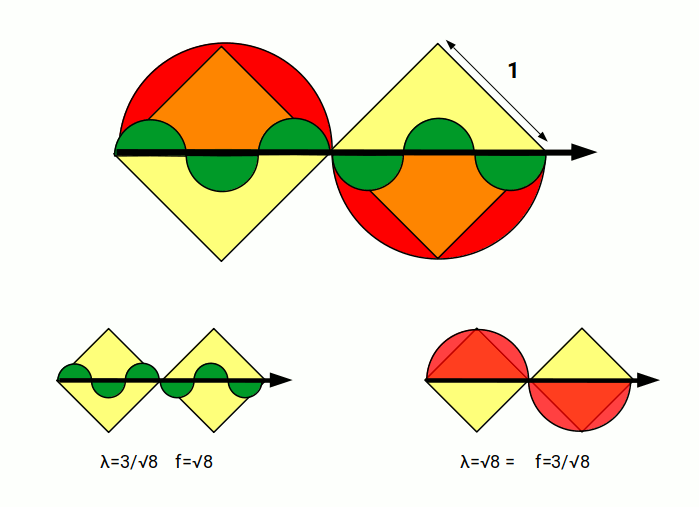
The voltage–current relationship can be approximated by two right-angled triangles. The 2:1 ratio of amps to volts up to +2 V defines a triangle with base 2 and altitude 4 — the same dimensions as the Sandreckoner triangle used to square the circle. The final section of the curvature forms a near-perfect quarter arc, wrapping around a unit square with arc length ½π.
Plotting frequency against wavelength squared shows that as wavelength decreases and frequency increases, the saturation point (5 mA) occurs where the frequency equals the starting wavelength — in the 120–122 nm range. At this same point, the square of the wavelength falls to the initial frequency value, and the current equals √8.
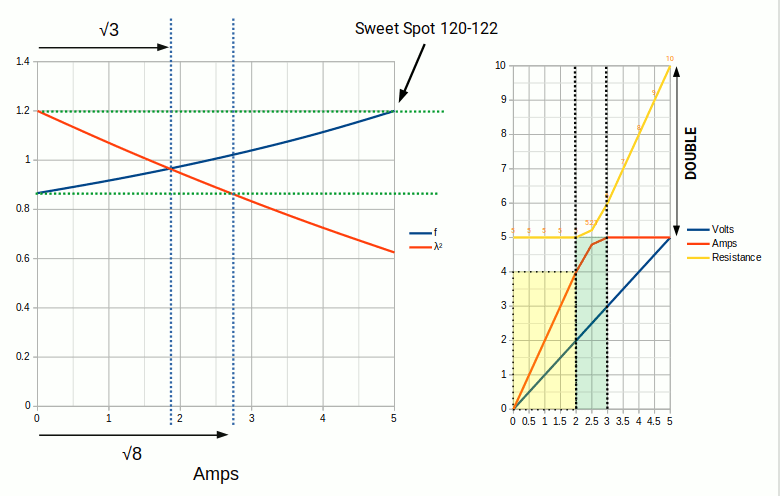
Plotting resistance against voltage and current: the 1:2 ratio of amps to volts is maintained up to +2 V and 4 mA, keeping resistance proportional at 5 ohms. Between +2 V and +3 V, a sharp curvature occurs, after which amps and resistance exchange roles — amps remain fixed at 5 mA while the voltage:resistance ratio becomes 1:2.
This exchange mirrors the folding of numerical space described in our geometric solution to the Riemann Hypothesis, where analytic continuation places non-trivial zeros at the 0.5 mark by swapping complex numbers between the positive and negative planes. The saturation of the photoelectric current reflects the same geometric principle: the folding of space switches current and resistance through a quarter arc, maintaining the 1:2 ratio throughout.
Future Ramifications
This article has developed a wave-based solution to the photoelectric effect that operates entirely without photon particles. Because the photoelectric effect lies at the heart of modern quantum theory, this solution directly challenges the standard scientific model of reality. The implications for future technology are profound.
The process of converting light into electrical energy takes on a different character entirely. Solar cells coated with thin films of magnesium are already showing increased efficiency — consistent with the geometric resonance model proposed here. Magnesium and sodium batteries, cheap and non-toxic compared to lithium-ion, are being explored as sustainable alternatives. These developments align naturally with the 4D Aether interpretation.
As civilisation becomes ever more dependent on electricity, the development of clean, abundant energy generation becomes critical. The 4D Aether theory offers a theoretical foundation for extracting energy from the vacuum of space — an effectively unlimited source. Armed with a rigorous geometric model, new circuit designs tuned to specific resonant frequencies become conceivable, paving the way toward zero-emission energy abundance.
Conclusion
The photoelectric effect does not require a photon particle. Every observed feature of the effect — the frequency threshold, the instantaneous emission of electrons, the work function relationships across elements, the saturation current, and the curvature of the current-voltage profile — follows from the geometry of 4D electromagnetic waves interacting with the Cosmic Microwave Background.
The key results are:
- The work function–wavelength equation (Wλ)² = c/2 holds for 14 elements and is derived from simple ratio, without the Planck constant.
- The threshold wavelength √1.5 unifies the hyper-cubic scales of the 4D Aether, equals the side length of the Rhombic-Dodecahedron at the √2 scale, and produces a photon energy of exactly 1.
- The CMB frequency (√8) is directly related to the threshold frequency of magnesium through harmonic resonance, and to the point at which the photoelectric saturation curvature changes.
- The fine structure constant and the gravitational constant independently reproduce the same threshold relationship, linking the photoelectric effect to both electromagnetism and gravity through the geometry of the 4D Aether.
- Magnesium's centrality to photosynthesis is explained: the chlorophyll molecule uses light frequencies to vibrate the magnesium atom, extracting energy from the vacuum — not converting photon energy directly.
The Planck constant describes a geometric ratio, not a fundamental quantity of energy. Wave-particle duality is not a fundamental property of nature — it is a consequence of adopting a particle model to describe a geometric phenomenon. The 4D Aether resolves the paradox: light is a wave, quantisation is geometric, and the energy released in the photoelectric effect comes from the vacuum of space.
This also restores coherence to Max Planck's original intuition that light behaves like oscillating strings. It opens a pathway toward a unified understanding of matter, energy, music, and geometry, and suggests a new mathematical system for future investigation of the quantum world.
FAQ
Does the photoelectric effect prove that light is made of photon particles?
Not necessarily. While Einstein's photon model correctly predicts the frequency threshold, a 4D wave model of light interacting with the cosmic microwave background can account for all the same observations — including the frequency dependence, instantaneous emission, and saturation current — without invoking a particle.
Why is the photoelectric effect instantaneous if no energy transfer from the light is involved?
In the 4D Aether model, the energy is already present within the atomic structure of the material. The incident EM wave acts only as a trigger, resonating with the evanescent surface field and releasing energy already stored in the vacuum. This naturally explains the near-zero time delay observed experimentally.
I noticed that the CMB wavelength is at the millimetre scale, whereas the EM waves that produce the photoelectric effect are at the nanometre scale. How do you reconcile this difference?
The CMB is measured over a metre of space, whereas light waves are characterised in the photoelectric effect at the scale of a single atom. There are 100,000 nanometres in a millimetre; the cube root of 100,000 is 100, which is the scaling factor of the EM light waves that produce the photoelectric effect.
The atomic radii you use for magnesium differ from standard Van der Waals values. Why?
The figures quoted in this article are derived from physical measurement rather than theoretically calculated Van der Waals radii. A comparison of both sets of values can be found on the Wikipedia atomic radii data page.