Introduction
The speed of light is one of the most famous numbers in all of science: exactly 299,792,458 metres per second in a vacuum. Nothing in the universe is known to travel faster. Yet here is the puzzle that physicists rarely explain to a general audience — why is it that particular speed? Why not twice as fast, or infinitely fast?
The answer, it turns out, is not about light itself. It is about the medium light travels through: the vacuum of space. Far from being empty, the vacuum exerts a very real electromagnetic resistance on every light wave that passes through it. That resistance sets the speed limit. Understanding where that resistance comes from, and why it produces the precise value it does, opens a window onto the deep geometric structure of the universe.
This matters because the constancy of the speed of light underpins Einstein's Theory of Relativity and, with it, everything from GPS satellites to nuclear energy. If the speed of light varied with direction, location, or the motion of the observer, causality — the rule that causes must precede effects — would break down entirely. The fact that it is fixed, and provably derivable from two other measurable constants of the vacuum, hints that space itself has a precise geometric architecture rather than being a featureless void.
This article explains the mechanism using straightforward geometry and the framework of Dimensionless Science, which re-expresses the standard physical constants as pure ratios — revealing patterns that the conventional notation obscures. No advanced mathematics is required.
Key takeaways
- The speed of light is set not by light itself but by the electromagnetic properties of the vacuum — the electric permittivity ε₀ and magnetic permeability μ₀ together create a fixed impedance that every light wave must overcome.
- When those constants are stripped of their SI units and expressed as dimensionless geometric ratios, they reduce to pure multiples of π and the number 3, revealing that the vacuum has an underlying geometric architecture.
- The two vacuum constants correspond geometrically to two concentric spheres in a 1:3 radius ratio; the speed of light is simply the ratio of their radii, and energy is the ratio of their surface areas.
What is a photon?
The photon is often described as a massless particle of light, but a more accurate picture is a wave packet — a compact bundle of oscillating electric and magnetic fields travelling together. Because it has both an electric and a magnetic component, it is called an electromagnetic wave. Crucially, light has no mass, which means it is not slowed by inertia in the way ordinary matter would be; instead it is slowed by the electromagnetic properties of the medium it travels through.
Quantum physics treats light as existing in a dual state — simultaneously particle and wave — most famously demonstrated by the double-slit experiment. Electromagnetism, by contrast, treats light purely as a wave. These two perspectives lead to quite different intuitions about how the universe is built, but both agree on one thing: light has a wavelike nature, and that nature is governed by the properties of the vacuum it travels through.
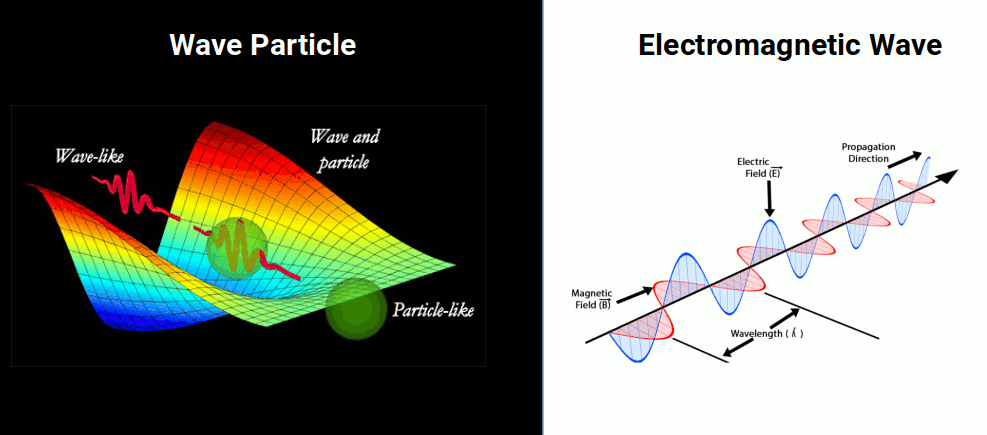
Both views leave the same question open: what property of the vacuum determines how fast the wave travels? To answer that, we need to understand resistance.
What is resistance?
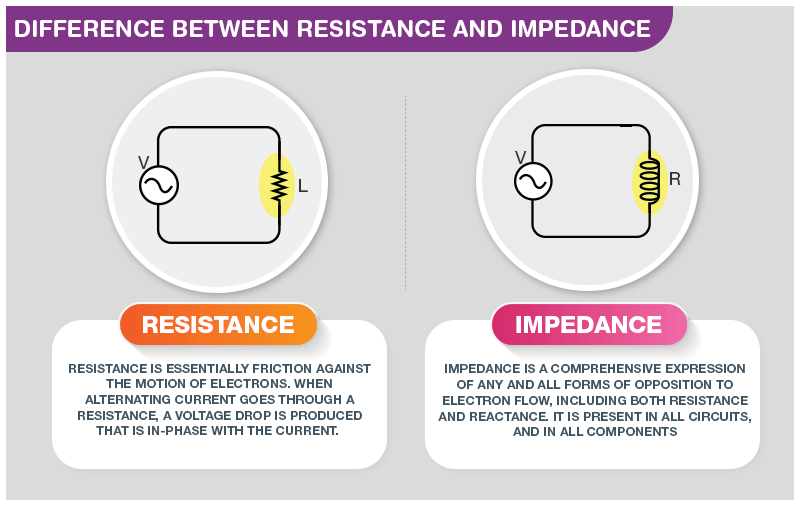
Resistance, in physics, is anything that opposes the flow of energy through a medium. Everyone has experienced it: walking through water is harder than walking through air because water has greater resistance. You need more energy, and you move more slowly.
The same principle applies to light. The vacuum of space — though it contains no atoms — is not truly empty. It possesses both an electric resistance (technically called permittivity, symbol ε₀) and a magnetic resistance (technically called permeability, symbol μ₀). Together these create an electromagnetic impedance — the combined resistance of the vacuum to an alternating electromagnetic wave — that every light wave must overcome in order to propagate.
If a light wave cannot muster enough energy to push through that impedance, it fails to propagate at all — it collapses back into the background, the way a wave too small to crest the shore simply sinks back into the sea.
This immediately raises a deeper question: if the vacuum has electromagnetic properties, what fills it?
Energy in the vacuum
The idea that "empty" space is full of energy is well established in physics, even if its full nature remains mysterious. A single cubic centimetre of the vacuum is estimated to contain an enormous density of zero-point energy — the irreducible minimum energy that quantum mechanics predicts must exist even at absolute zero temperature. Scientists have so far been unable to tap this energy source directly, but its existence is not in doubt.
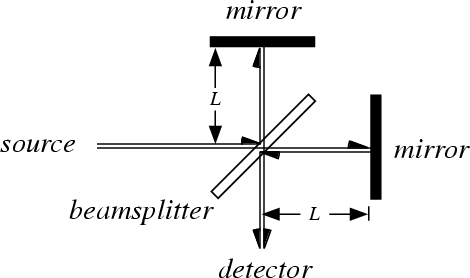
The search for the underlying structure of this energy has a long history. In the nineteenth century, physicists proposed an all-pervading medium called the Aether to explain how light waves could travel through space. The famous Michelson–Morley experiment of 1887 failed to detect any motion relative to this Aether, undermining the classical picture.
Einstein's photon concept explained how light could travel through a vacuum without needing a material medium — but it never fully answered the question of where the electromagnetic impedance of that vacuum originates. Later discoveries have deepened the puzzle rather than resolved it.
In 1964, A. G. Doroshkevich and Igor Novikov identified the Cosmic Microwave Background (CMB) — a faint glow of microwave radiation that fills the entire observable universe, a relic of the early hot universe. And at the frontier of quantum physics, the theory of quantum foam proposes that space at the smallest scales seethes with fleeting pairs of virtual particles, constantly appearing and annihilating.
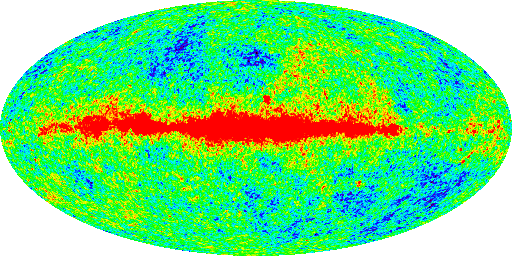
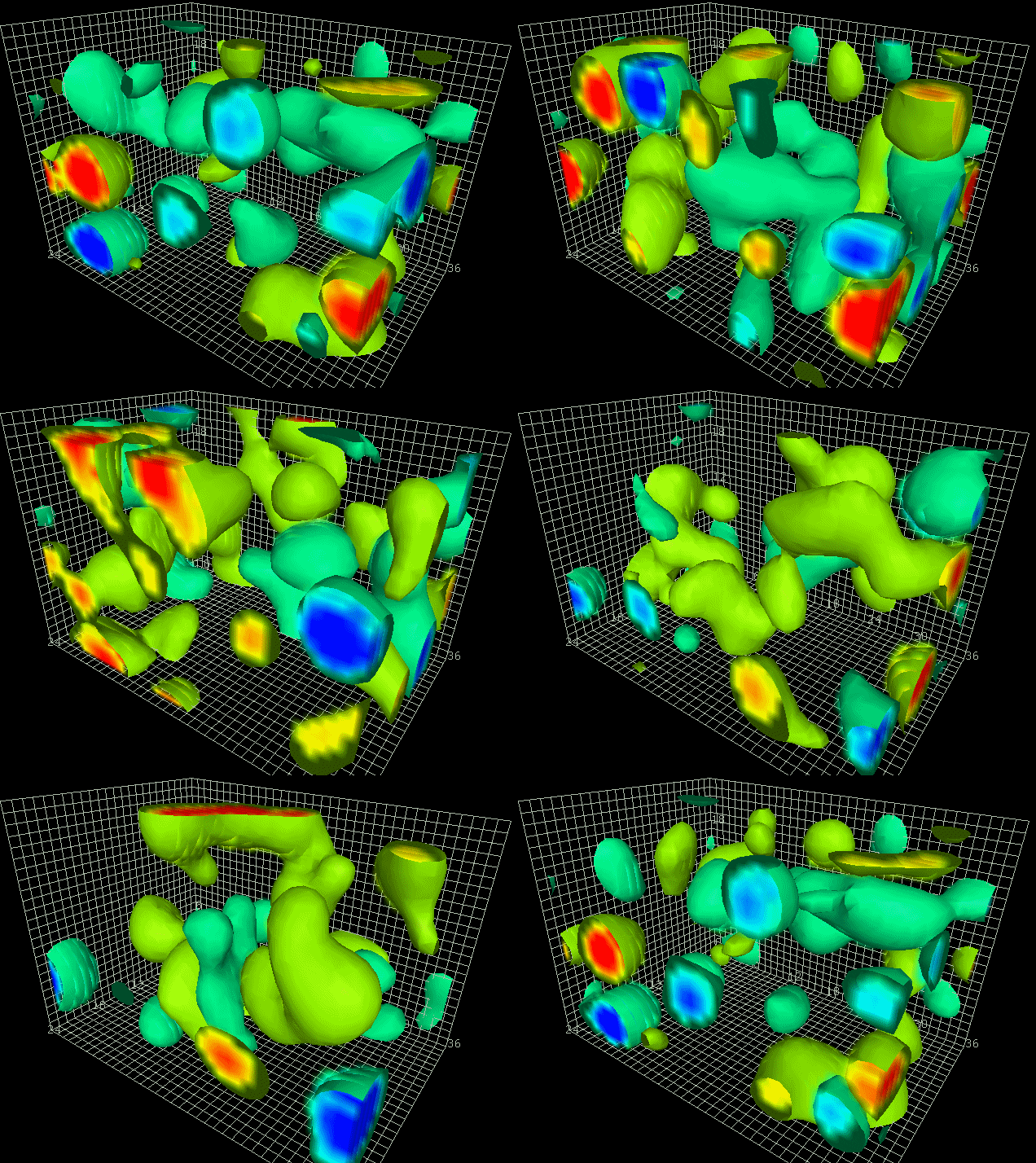
None of these discoveries, remarkable as they are, tells us why the vacuum's impedance has the particular value that produces light at 299,792,458 m/s. For that we need to look at the constants themselves.
Three key scientific constants
The speed of light is a universal constant — a quantity whose value is the same everywhere in the universe, for all observers, at all times. It carries the symbol c and has been defined exactly as:
c = 299,792,458 metres per second
This value is not arbitrary. It is derived directly from two other constants that characterise the electromagnetic properties of the vacuum:
- ε₀ (epsilon-zero) — the electric permittivity of free space (how strongly the vacuum resists an electric field): ε₀ = 8.854187817 × 10⁻¹² Farads/metre
- μ₀ (mu-zero) — the magnetic permeability of free space (how strongly the vacuum resists a magnetic field): μ₀ = 1.256637061 × 10⁻⁶ Henries/metre
At first glance these three numbers look completely unrelated. But they unify into the number 1 in a precise and elegant way — and that unification is the key to understanding why c has the value it does.
Light and the impedance of the vacuum
The square of the speed of light is obtained by multiplying the reciprocal values of ε₀ and μ₀:
The square of the speed of light equals the reciprocal of the product of the two vacuum resistance constants. This relationship is not an approximation — it is an exact identity.
Taking the square root gives the speed of light itself:
Change either constant, and c changes with it.
Notice that c² also appears in Einstein's famous equation E = mc². If mass equals 1, then E = c². This means the reciprocal product of ε₀ and μ₀ is numerically identical to energy when mass is 1 — a deep connection between the structure of the vacuum and the nature of energy that we will explore geometrically below. (For a related exploration of how speed ratios connect to energy, see the article on the speed of sound and light ratio.)
The light cycle
Standard mathematics tends to express equations as a linear sequence: input → calculation → output. Geometric and 4D mathematics often express the same relationships as a cycle — a loop that can be repeated indefinitely, reflecting the oscillatory nature of the phenomenon being described.
The relationship between c, ε₀ and μ₀ can be arranged as a circular cycle: start with 1, divide by ε₀, divide by c, divide by μ₀, divide by c again — and arrive back at 1.
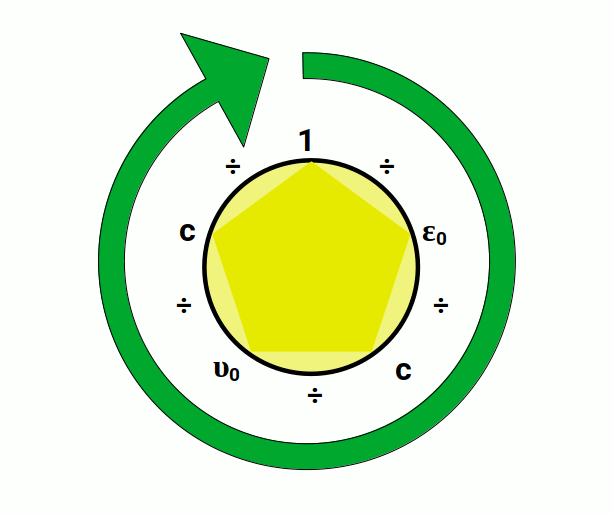
Notice that c appears twice in the loop; when those two instances are combined they produce c², the energy term. This is not a coincidence — it reflects the two-phase nature of an electromagnetic wave, which oscillates between an electric state and a magnetic state with each half-cycle. The cycle also encodes the relationship noted in reciprocal number space: the constants only unify cleanly when expressed as reciprocals, because the vacuum resists the propagation of energy rather than facilitating it.
The Dimensionless Science constants
Until the early twenty-first century it was common in electromagnetism to express the speed of light as the round number 300,000,000 m/s (3 × 10⁸). The magnetic constant μ₀ was given the value 4π × 10⁻⁶, which in turn made the electric constant ε₀ equal to 1/(36π × 10¹²). The powers of ten are unit bookkeeping — they arise from the choice of metres and seconds as the base units, not from the underlying physics.
Dimensionless Science strips away the powers of ten — which arise purely from our choice of metres and seconds as base units, not from the underlying physics — and expresses the constants as pure geometric ratios:
- c → 3
- μ₀ → 4π
- ε₀ → 1/(36π)
The light cycle then becomes:
36π ÷ 3 ÷ 4π ÷ 3 = 1
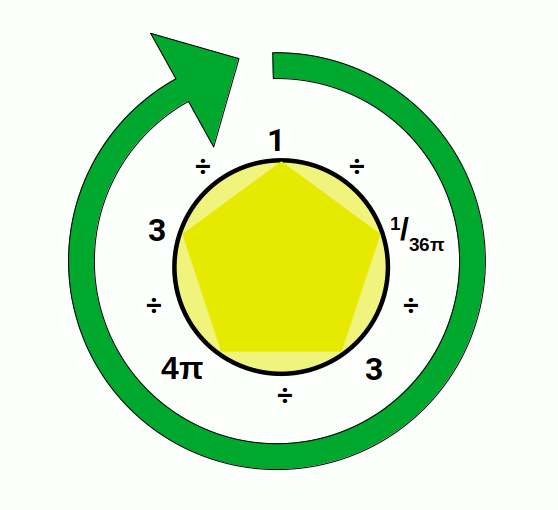
The simplicity that emerges — pure multiples of π divided by the number 3 — strongly suggests a geometric structure underlying these constants. The factors of π are not decorative: they are the signature of circular and spherical geometry. The next section makes that structure explicit.
The geometry of the vacuum constants
The constant π (pi) defines the ratio between a circle's circumference and its diameter; it is the same at every scale. Most people know the formula πr² for the area of a circle. Fewer know its three-dimensional counterpart: the surface area of a sphere is 4πr². The factor of 4 is the only difference between the two formulas, and it is the same factor of 4 that appears in μ₀ = 4π.
- πr² = area of a circle
- 4πr² = surface area of a sphere
This distinction turns out to be directly relevant to the constants of light. The magnetic constant μ₀ has a Dimensionless Science value of 4π — exactly the surface area of a sphere with radius 1 (since 1² × 4π = 4π). The reciprocal of the electric constant ε₀ has a Dimensionless Science value of 36π — exactly the surface area of a sphere with radius 3 (since 3² × 4π = 36π).
We can therefore represent the two vacuum resistance constants as two concentric spheres: an inner sphere of radius 1 (magnetic) and an outer sphere of radius 3 (electric).
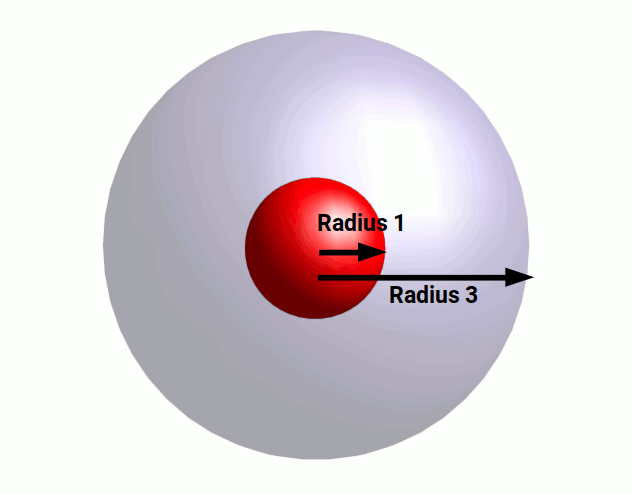
The ratio of the two surface areas is 36π / 4π = 9 = c². Energy, in this picture, is the difference in scale between the two spheres. The speed of light is simply the ratio of their radii: 3/1 = 3, corresponding to 3 × 10⁸ m/s in standard units. A question that once seemed arbitrary — why that speed? — now has a geometric answer: because those are the two spheres that the electromagnetic properties of the vacuum define.
The 4D perspective
A four-dimensional torus (doughnut shape) projected onto a 2D plane appears as two concentric circles. With the inner circle at radius 1 (representing μ₀) and the outer at radius 3 (representing the reciprocal of ε₀), we have a direct geometric picture of the light cycle. The torus is the natural 4D object that encodes the cyclic relationship between electricity and magnetism — and it is the same object that appears in the 4D geometric wave model of matter.
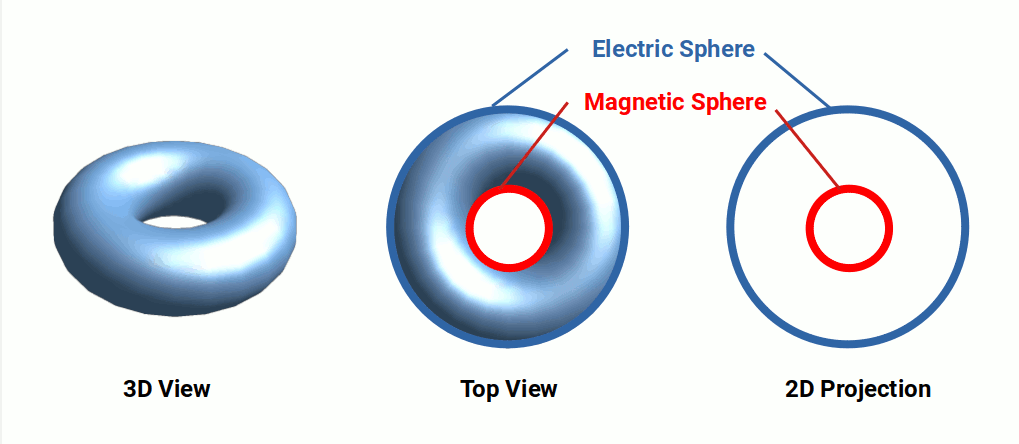
When a light wave forms, it must carry enough energy to complete one cycle of the inner (magnetic) sphere. Once it does, the wave expands outward as a sphere in all directions. As the surface grows, the energy density of the electric resistance ε₀ spreads more thinly across it — until the wave completes its cycle at the outer sphere radius and the "bubble" bursts.
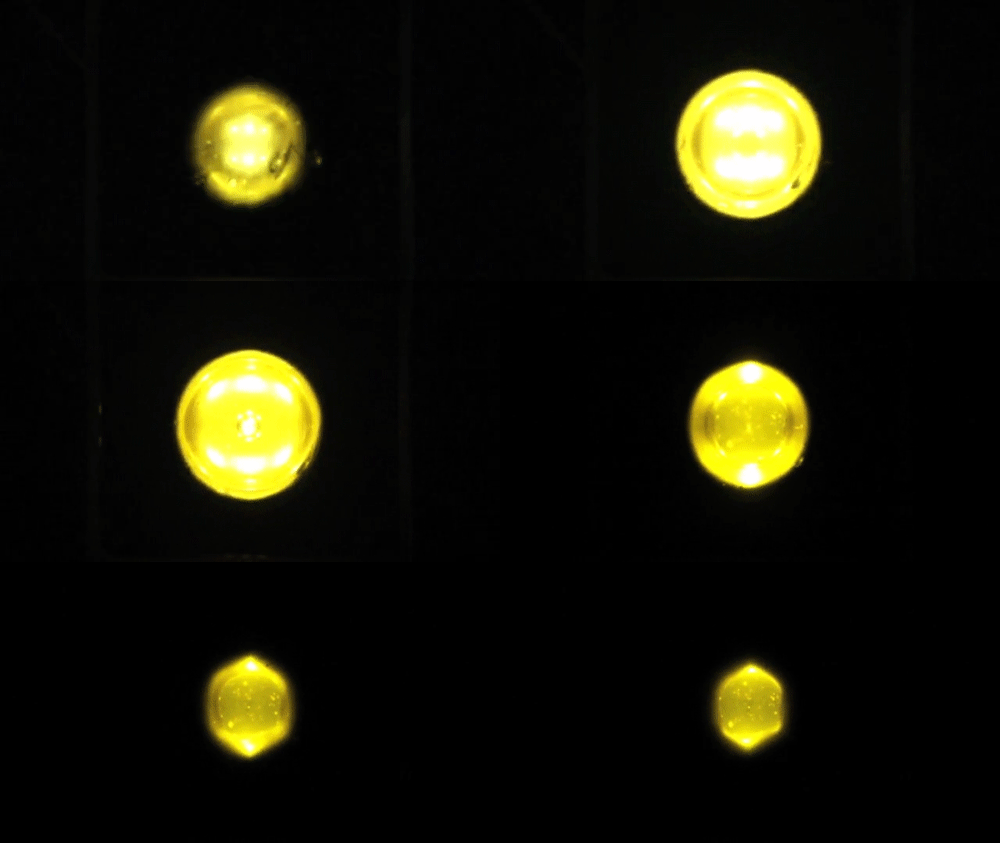
This picture is analogous to the theory of quantum foam. However, the 4D perspective reframes it: in 4D space the sphere is not expanding linearly — it is rotating. The inner magnetic sphere rotates through 4D space and re-emerges at the larger electric scale. The two spheres are in constant motion, continuously exchanging states. From this view, electricity and magnetism are not two separate phenomena but a single one, differentiated only by the scale of the two spheres that together form the 4D torus. This is also the geometric foundation explored in the zero boundary concept, where the transition between inner and outer scales defines the boundary condition of the quantum.
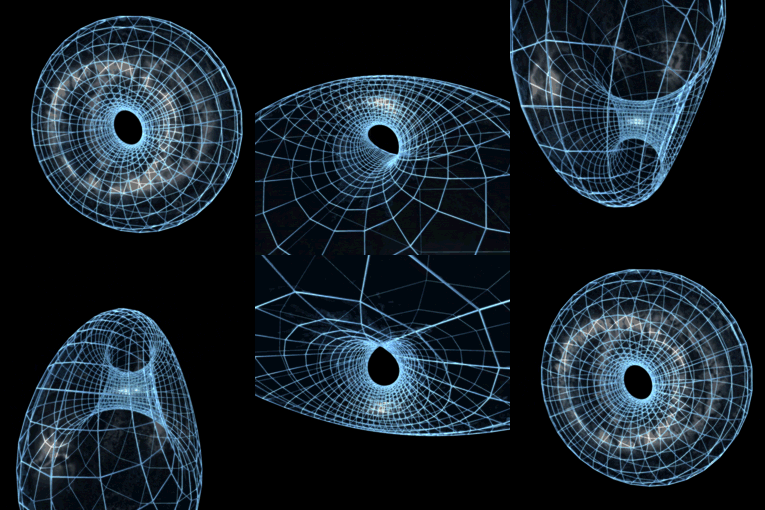
Observing the rotating torus, notice that the central axis shifts orientation — the "hole" facing the viewer rotates 90° to face sideways. Electromagnetic waves display exactly this behaviour: their electric and magnetic fields are always perpendicular (90° offset) to each other. The geometry of the torus is not imposed on the physics — it is the physics, expressed in a different language.
Light, quantisation, and the Flower of Life
The quantisation of light — the fact that it only exists in discrete packets (quanta) — can be visualised as the expansion of an inner sphere to an outer sphere in a radius ratio of exactly 1:3. A quantum of light is not a particle in the classical sense; it is the minimum energy unit required to complete one full cycle of the light torus. This is connected to the Planck constant, which sets the scale of that minimum energy in terms of frequency.
This 1:3 ratio is also encoded in one of the oldest geometric patterns known: the Flower of Life.
The Flower of Life is constructed by tiling overlapping circles of equal radius in a hexagonal arrangement, producing a central circle surrounded by six touching circles. Taking the central circle as radius 1, the outermost boundary of the pattern falls at radius 3 — the exact ratio of the magnetic and electric constants in the Dimensionless Science model.
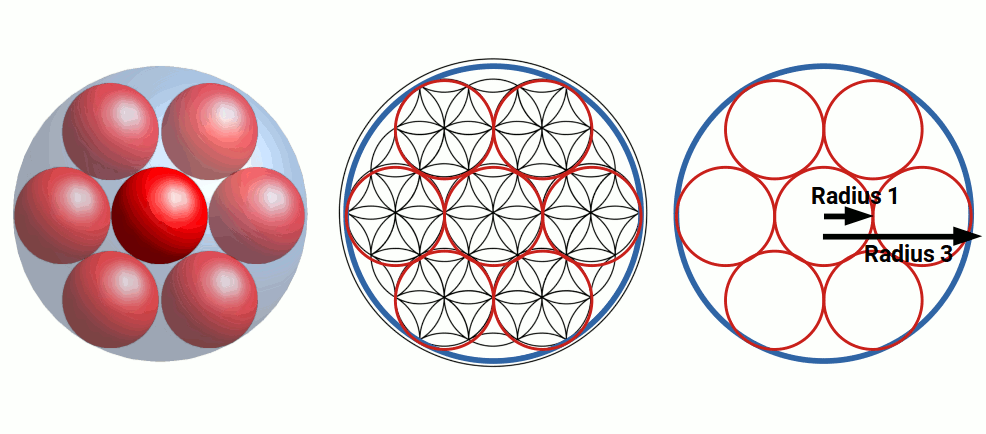
The Flower of Life has long been regarded as a fundamental geometric pattern across many cultures. What has not previously been noted is that its inner-to-outer radius ratio maps directly onto the fundamental constants c, ε₀ and μ₀. It provides a natural geometric expression of the 4D torus model of light. Whether this correspondence is coincidence, or reflects a deeper geometric intuition encoded in ancient traditions, is an open question — but the ratio itself is exact, not approximate.
Conclusion
The speed of light is constant because the vacuum of space is not empty. It possesses precise electromagnetic properties — an electric permittivity ε₀ and a magnetic permeability μ₀ — that together create a fixed impedance through which every light wave must travel. Those two constants, and nothing else, determine the value of c.
When these constants are expressed geometrically rather than algebraically, they correspond to two concentric spheres in a radius ratio of 1:3. The speed of light is the ratio between those spheres; energy is the ratio of their surface areas. In four dimensions, the oscillation of a light wave becomes the rotation of a torus — a single, unified structure in which electricity and magnetism are two aspects of the same geometry.
This geometric picture resolves a question that standard physics leaves mostly unanswered: not just what the speed of light is, but why it has to be that value. The vacuum is not a passive backdrop to physics — it is an active geometric structure, and the speed of light is one of its most direct signatures.
The implications extend well beyond light itself. If the vacuum has geometric structure, then the other fundamental constants — the electron charge, the Planck constant, the fine-structure constant — may also arise from that same geometry rather than being independently arbitrary numbers. That is the direction in which Dimensionless Science is heading: toward a unified geometric foundation for all of physics, one in which the constants are not inputs to the theory but outputs of the geometry.
FAQ
If the speed of light is about 300 million metres per second, how big is the torus field you mentioned?
The second is quite a long time frame at the atomic scale. The technical radius for the magnetic constant μ₀ is around 1000 nanometres, and the reciprocal of the electrical resistance constant is three times that. At the speed of light, those sizes correspond to time frames of 3 femtoseconds for μ₀ and 9 femtoseconds for ε₀. The femtosecond is precisely the measurement range used for the visible light spectrum.
Is there any scientific evidence for this 4D model of light?
The 4th dimension is intrinsically difficult to quantify from a 3D perspective. Mathematics expresses scientific findings through the relationships between constants; when those are translated into 4th-dimensional geometry, a new picture emerges. The model is consistent with all known electromagnetic measurements and correctly reproduces the values of c, ε₀ and μ₀ from simple geometric ratios. While there is no direct experimental evidence that light behaves this way, there is equally no evidence that it does not — and the model does resolve several conundrums left open by the traditional quantum physics view, including the origin of light quantisation and the perpendicular relationship between electric and magnetic fields.
Does this mean the vacuum of space is made of something?
That is the central question. The vacuum has measurable electromagnetic properties — permittivity and permeability — which means it resists and stores both electric and magnetic energy. Whether that capacity arises from virtual particle pairs, a structured geometric medium, or something else entirely remains an open question. The geometric model presented here is agnostic about the underlying substance; it describes the structure of the vacuum's behaviour rather than its material nature.