Geometry in Stone
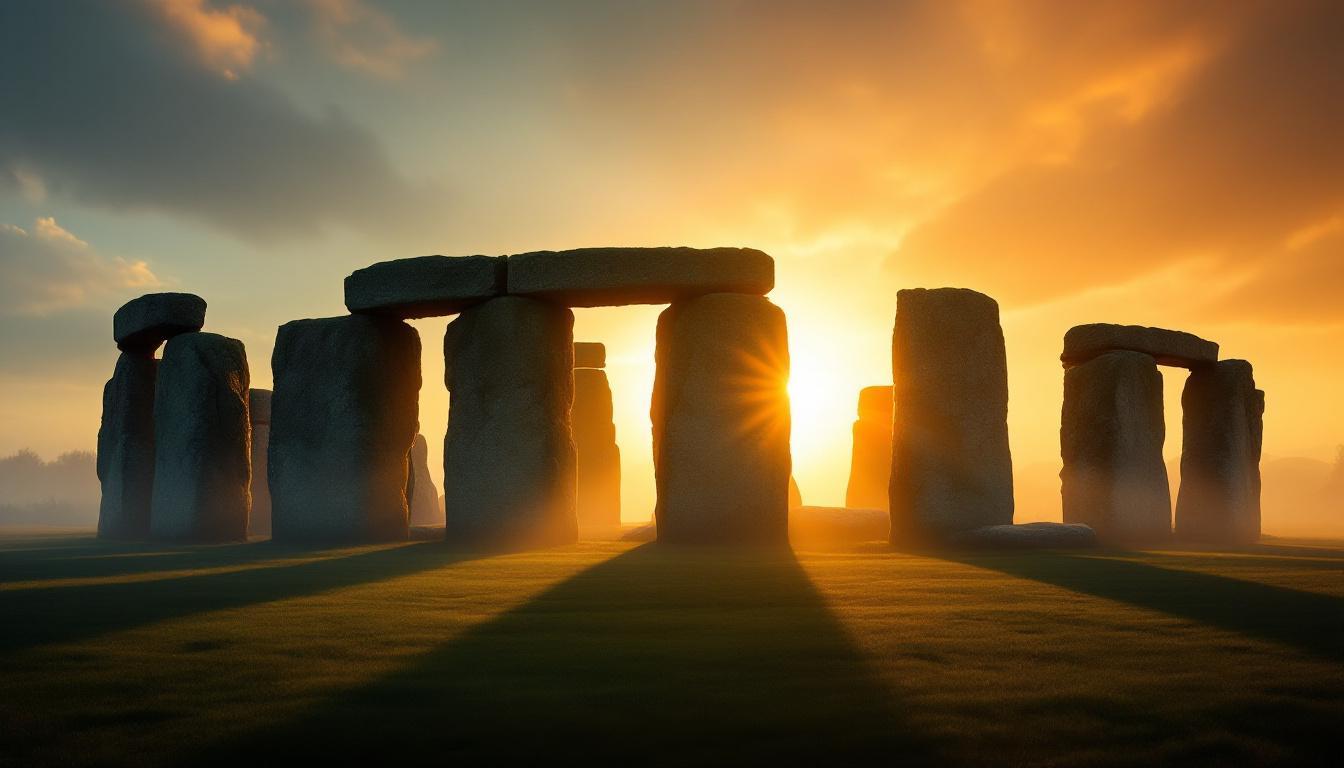
The oldest evidence of deliberate geometric construction in the human record predates writing by millennia. The Neolithic peoples of western Europe who built the great stone circles between approximately 3500 BCE and 1500 BCE were doing something that modern archaeology has consistently underestimated: they were practising sophisticated geometric construction at landscape scale, using the rope-and-peg method to lay out ellipses, flattened circles, and egg-shaped rings with a precision that cannot be accounted for by trial and error.
The Scottish engineer Alexander Thom spent much of the twentieth century surveying hundreds of stone circles across Britain and Brittany, and his findings — published in a series of books beginning with Megalithic Sites in Britain (1967) — demonstrated that many of these monuments are not simple circles at all. They are geometrically complex forms: flattened circles constructed from two arcs of different radii, egg shapes derived from Pythagorean triangles, ellipses whose axes encode specific integer relationships. The stone circles at Avebury, Brodgar, and Callanish, and the elliptical rings scattered across the Scottish highlands, all show evidence of careful geometric planning. The people who built them did not have Euclidean geometry in the Greek sense — they had something older and more practical: the knowledge that a rope of fixed length, pegged at one end, traces a circle; that two pegs and a rope triangle of specific proportions generates a right angle; that geometric forms can be scaled up to any size while maintaining their proportional relationships exactly.
Stonehenge, the most famous of these monuments, is aligned with the summer solstice sunrise and the midwinter sunset with a precision that has been confirmed by modern astronomical surveys. Its geometry — the relationship between the sarsen circle, the trilithon horseshoe, and the outlying station stones — encodes proportional relationships that several researchers have argued reflect a sophisticated understanding of the lunar and solar cycles expressed in geometric form. Whether or not those specific claims survive scrutiny in every detail, the undeniable fact is that Neolithic builders were capable of large-scale geometric construction, that they aligned their monuments with astronomical precision, and that they were doing so thousands of years before the Greek philosophers who are conventionally credited with the beginning of geometric science. The tradition is older than Greece. The impulse to find order in space, to express cosmological understanding in geometric form, is as old as the human mind.
Key takeaways
- Sacred geometry predates writing — Neolithic stone circles (3500–1500 BCE) demonstrate sophisticated geometric construction at landscape scale, aligned with astronomical precision.
- The tradition passed through Egypt (rope-stretchers, pyramids, Flower of Life), Greece (Pythagorean philosophy, Euclid's Elements), the Islamic golden age (girih tiles, quasi-periodic patterns), medieval cathedral builders, and the Renaissance before its modern revival.
- Scientific discoveries in the twentieth century — fractals, quasicrystals, biological growth patterns — independently confirmed geometric principles that the sacred geometry tradition had emphasised for millennia.
Ancient Egypt
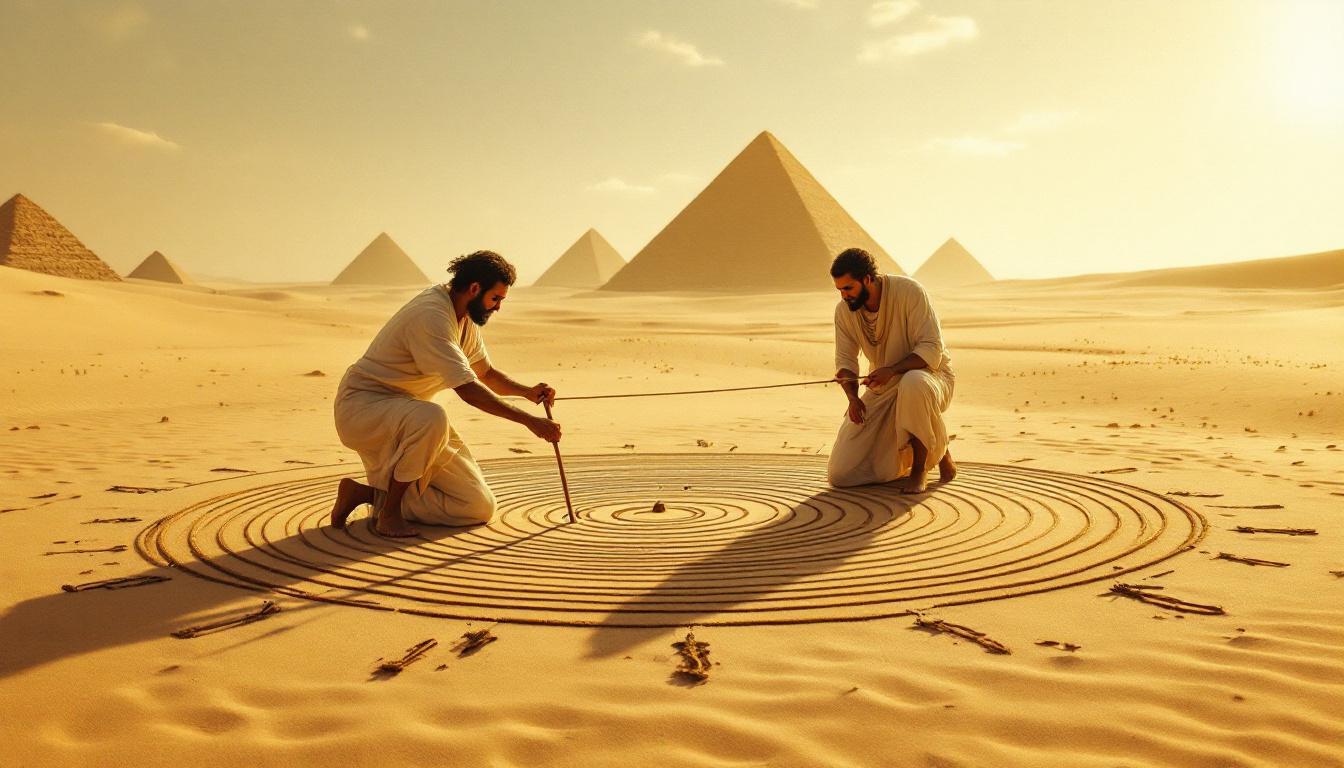
Egypt is the civilisation that most clearly and directly connects geometric practice with sacred meaning, and the connections run so deep that they are nearly inseparable. The Nile, the source of Egyptian life, was also the occasion for geometry's most ancient practical application. Every year the river flooded, depositing its life-giving silt across the farmlands of the delta and the valley — and simultaneously erasing every field boundary, every property marker, every surveying stake that had been placed the previous season. When the waters receded, the entire landscape had to be re-measured and re-apportioned. This annual act of geometric reconstruction was called, in Egyptian, setting out the earth, and it was performed by the harpedonaptai — the rope-stretchers — who were professional surveyors equipped with knotted ropes and geometric knowledge.
The most important of their tools was the 3-4-5 rope triangle. A rope knotted at equal intervals to create twelve segments, when formed into a closed loop and stretched into a triangle with sides of 3, 4, and 5 segments, produces a perfect right angle at the corner between the sides of 3 and 4. This is a direct application of the Pythagorean theorem — but it was in use in Egypt more than a thousand years before Pythagoras was born. With this tool, the harpedonaptai could establish north-south and east-west lines of perfect precision, divide land into equal areas, and align temple walls with astronomical orientations. The act was not merely technical. The word Ma'at — the central Egyptian concept of cosmic order, justice, and truth — was also the word for the plumb line and the square, the tools of the builder. To measure truly was to enact Ma'at. Geometry and sacred order were the same thing.
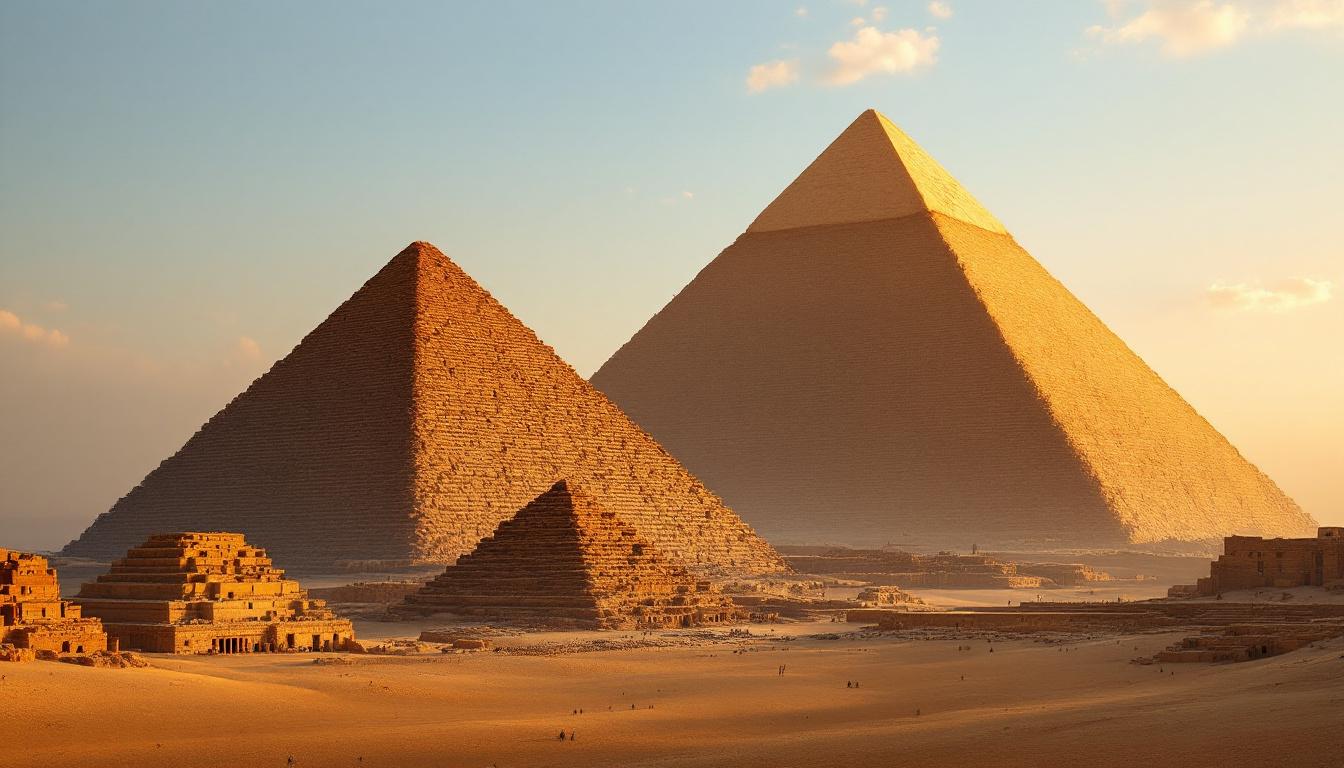
The Great Pyramid of Giza, built around 2560 BCE, is the most studied geometric structure in human history, and the debate about what its proportions encode has not diminished with time but intensified. The pyramid's base is a square of extraordinary precision: the four sides differ in length by less than 0.1%, and the four corners are right angles accurate to within fractions of a degree. The ratio of the pyramid's perimeter to its height is 2π — the same ratio as the circumference of a circle to its radius — accurate to less than 0.05%. The ratio of the slant height of a face to half the base length is φ, the golden ratio, accurate to within 0.1%. Whether these relationships were consciously intended or are the geometric consequence of using a specific measurement system is a question that is still actively argued. But the Egyptian architects and overseers who designed and built the pyramid were working with an understanding of proportion — of the relationships between geometric forms — that was clearly not accidental. The Great Pyramid stands not just as an engineering achievement but as evidence that at least three thousand years before the Renaissance, a culture existed that understood geometric proportion at a profound level and expressed that understanding in permanent stone.
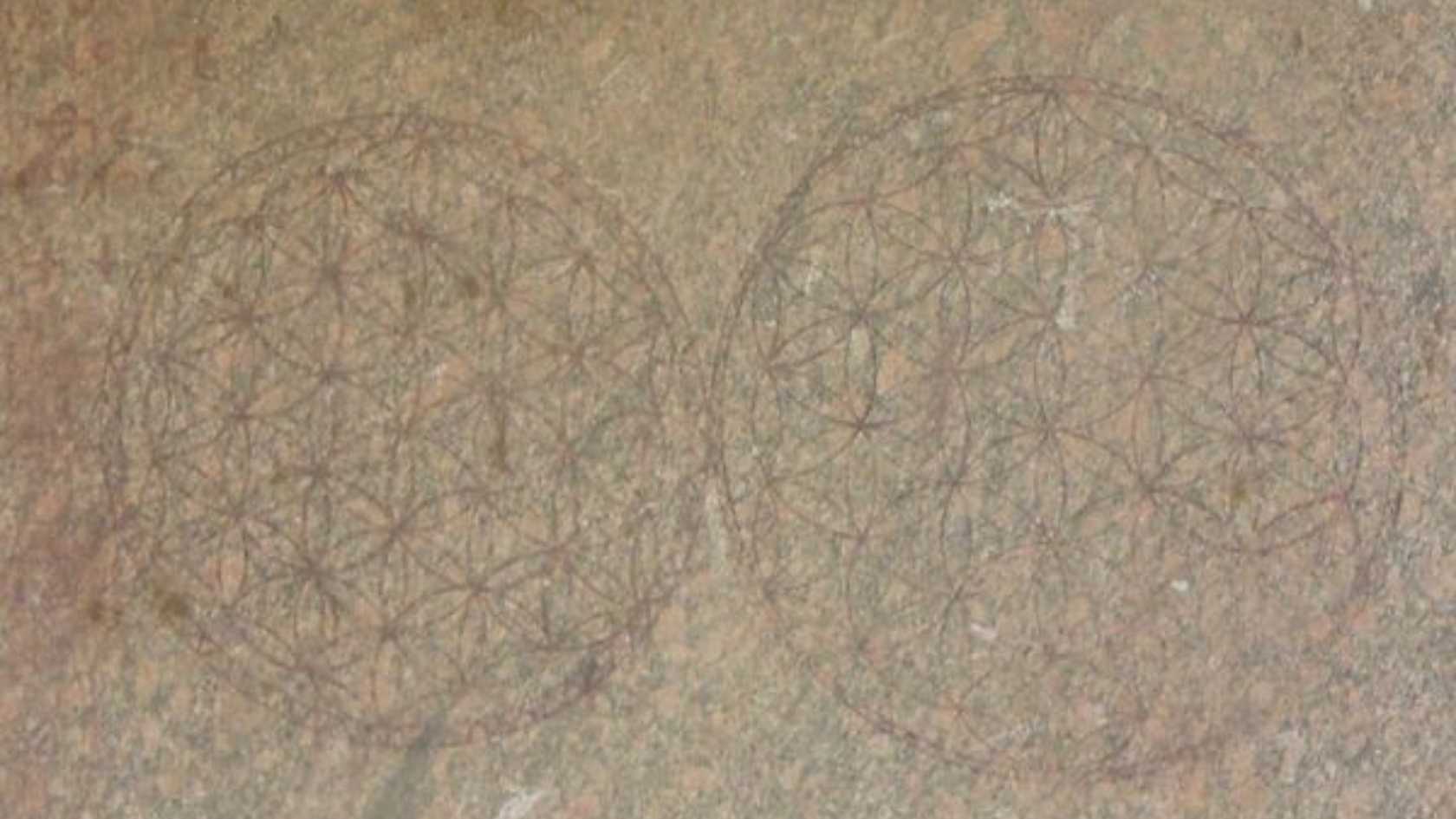
The Flower of Life — the interlocking circle pattern that is perhaps the central motif of the entire sacred geometry tradition — appears inscribed in red ochre on the granite columns and floor of the Temple of Osiris at Abydos, one of the most ancient temple sites in Egypt. These inscriptions, whose age is estimated at somewhere between 1500 and 4000 BCE, are not carved but drawn, with a precision that strongly suggests they were made with a compass. The circles are perfectly equal and perfectly interlocked. They are not decorative elements — they appear in the inner sanctum of the temple, in spaces not intended for general viewing. The Flower of Life at Abydos is evidence that the matrix of interlocking circles which generates the entire vocabulary of sacred geometric forms was known in Egypt at an extraordinarily early date, and was considered significant enough to be placed in one of the most sacred spaces in the ancient world.
Greece
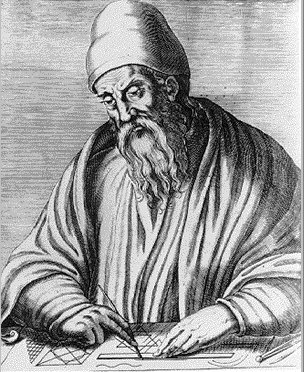
The Greeks are conventionally credited with the invention of geometry as a formal discipline — a body of knowledge organised around definitions, axioms, and logical proofs. This credit is partly deserved and partly a symptom of the fact that we have far more Greek texts than Egyptian or Babylonian ones. The historical reality is that Greek geometry was built substantially on Egyptian and Babylonian foundations. Thales of Miletus, the first named Greek geometer (sixth century BCE), is said to have studied in Egypt. Pythagoras, according to the ancient biographers, spent twenty-two years studying in Egyptian temples. Euclid, who codified Greek geometry in his Elements around 300 BCE, worked at Alexandria — the great library and research institution that was itself an Egyptian institution under Greek administration.
What the Greeks added to the geometric knowledge they inherited was the demand for proof. Egyptian and Babylonian geometry was practical and empirical: this method works, here is how to apply it. Greek geometry was axiomatic and deductive: these are our starting assumptions, and from them alone, using only logical inference, we derive these results. This shift produced an entirely different relationship to geometric knowledge. A practical method can be replaced by a better method. An axiomatically proved theorem is certain in a way that no improvement can touch, because it was never uncertain to begin with. The Greek insight was that geometric truth is a form of necessity — it cannot be otherwise — and that this necessity is accessible to the human mind through reason alone.
Pythagoras and his school (active in southern Italy from roughly 530 BCE) represent the most direct connection between Greek mathematics and the sacred geometry tradition. For the Pythagoreans, number was not merely a tool but the substance of reality. The ratios of whole numbers that produce musical harmony — 1:2 for the octave, 2:3 for the fifth, 3:4 for the fourth — were considered to be the same ratios that governed the orbits of the planets (the music of the spheres) and the proportions of the human body. Geometry was the spatial expression of arithmetic: the triangle expressed the number three, the square expressed four, the pentagon expressed five, and each carried its own cosmological significance. The Pythagoreans discovered the existence of irrational numbers — quantities that cannot be expressed as ratios of integers — and the discovery is said to have caused a crisis, even a scandal, within the brotherhood. The diagonal of a unit square has a length of √2, which is irrational: it cannot be expressed exactly as any fraction. This was philosophically disturbing in a worldview built on the idea that all things are number, because it meant that some geometric relationships were beyond the reach of the number system the Pythagoreans knew.
Plato, writing in the fourth century BCE, elevated sacred geometry to the level of cosmology. In the Timaeus, his great dialogue about the nature of the universe, Plato identified the five regular convex polyhedra — the tetrahedron, cube, octahedron, icosahedron, and dodecahedron — as the building blocks of physical reality. Fire is composed of tetrahedral particles, he argued, because the tetrahedron is the sharpest and most penetrating solid. Earth is composed of cubes, because the cube is the most stable and immovable. Air is octahedral, water icosahedral, and the dodecahedron — the most complex and spherical of the five solids — represents the cosmos as a whole. This was not presented as mythology but as reasoned argument: if the physical world has a geometric substrate, what could it be? The five regular solids are the only possible regular convex polyhedra in three dimensions — this is a mathematical fact — and so the world's geometric fabric must be composed of these forms. Plato's Timaeus created a tradition of cosmological geometry that would persist for two thousand years.
Euclid's Elements, composed around 300 BCE, is the text through which the entire Greek geometric tradition was transmitted to the medieval Islamic world and to Renaissance Europe. It is arguably the most influential mathematics text ever written. The Elements is organised as a sequence of propositions, each proved from previous ones or from the small set of initial axioms, beginning with the simplest and proceeding to the most complex. The entire edifice is built from compass-and-straightedge constructions — every proof either constructs a figure or demonstrates a relationship between constructed figures. The sacred geometry tradition is, in one sense, the living practice of what Euclid described in axiomatic form.
The Islamic Golden Age
Between the eighth and thirteenth centuries, the Islamic world presided over one of the most remarkable intellectual flowerings in human history. Greek, Persian, and Indian mathematical traditions were translated, synthesised, and extended by scholars working across a vast geographic arc from Baghdad to Cordoba. In mathematics, this period produced algebra, trigonometry, and advances in number theory. In geometry, it produced an extraordinary tradition of architectural and decorative art that pushed the application of compass-and-straightedge principles further than they had ever been taken before.
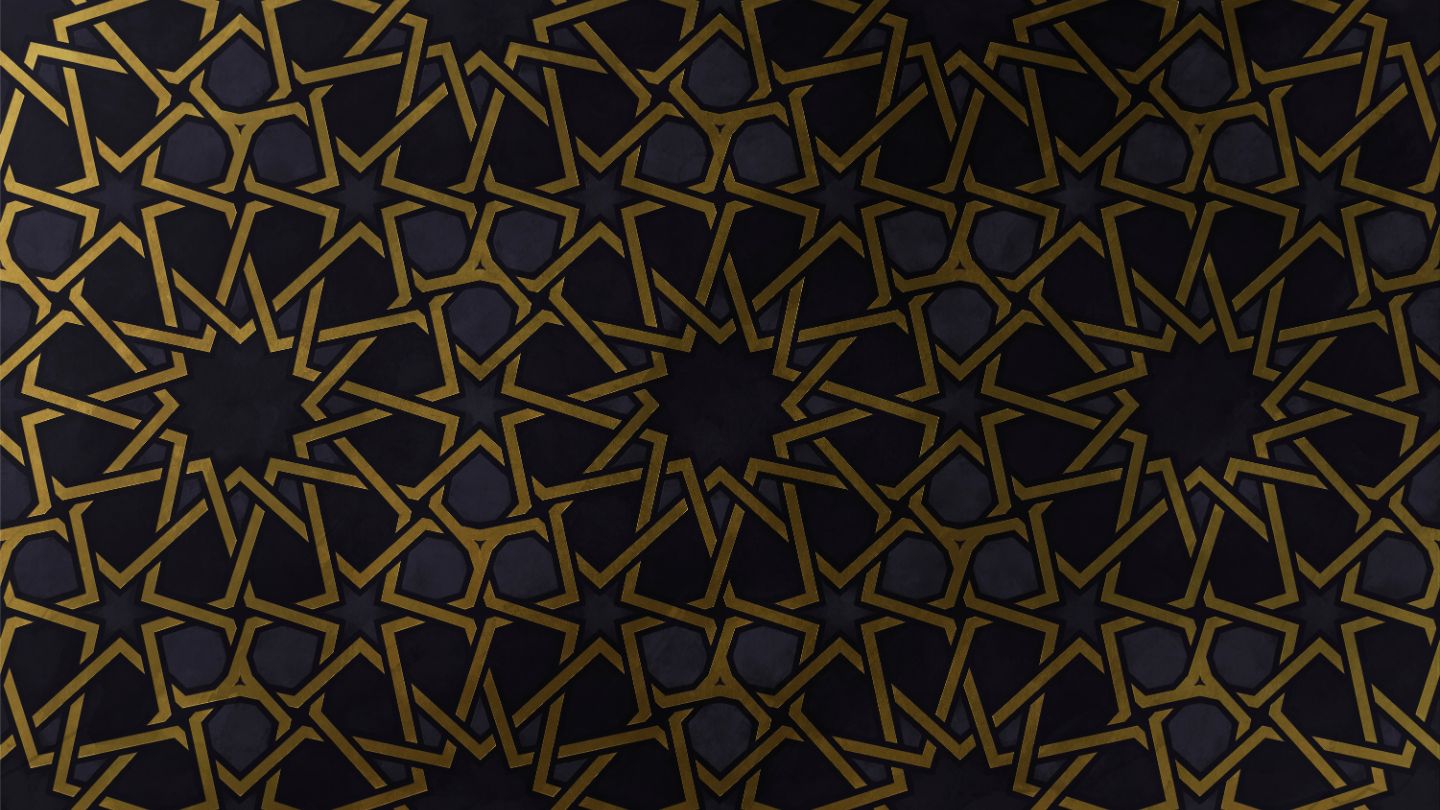
The central constraint of Islamic sacred art — the traditional prohibition on representational images of living beings in religious contexts — directed the creative energy of artists and craftsmen toward the exploration of geometric pattern. What emerged was not a limitation but a liberation: the discovery that the plane can be subdivided into infinitely complex patterns using a small set of geometric forms, and that those patterns carry a profound contemplative charge. The arabesque — the flowing, interlacing geometric pattern that covers the surfaces of the great mosques — is not decoration in the superficial sense. It is a visual argument about the nature of unity and infinity: that the One (Allah, in the Islamic tradition) expresses itself in infinite multiplicity, and that the infinite multiplicity is always and everywhere an expression of the One. The geometric pattern that has no beginning and no end, that can always be extended further, that is simultaneously whole at every scale — this is a visual form of the theological proposition that there is only one God.

The dome — the defining form of Islamic sacred architecture — is a geometric statement of the same idea at architectural scale. The interior of the dome of the Süleymaniye Mosque in Istanbul, or the Sheikh Lotfollah Mosque in Isfahan, is a space that draws the eye irresistibly upward toward a central point of light, surrounded by an ever-more-complex geometric pattern that appears to emerge from that centre and expand outward to encompass the entire vault. Standing beneath such a dome is a geometric experience: the circle of the base becomes the sphere of the vault, and the sphere contracts to a point of light at its apex. The worshipper is placed at the centre of a geometric cosmos, with the point of divine unity directly above them.
The girih tiles — a set of five polygon shapes whose interlocking creates the complex repeating patterns found in Islamic geometric art from roughly the eleventh century onward — were recognised by the physicist Peter Lu and the mathematician Paul Steinhardt in 2007 as encoding quasi-periodic patterns equivalent to those described by Penrose in 1974 and found in quasicrystals in the 1980s. The Darb-i Imam shrine in Isfahan, built in 1453, contains a girih-tile pattern that is genuinely quasi-periodic — it cannot tile the plane by simple repetition, and its structure is mathematically equivalent to a two-dimensional section through a five-dimensional periodic lattice. Islamic craftsmen of the fifteenth century were constructing, from compass and straightedge, patterns whose mathematical structure would not be formally described in Western science for another five hundred years. The sacred geometry tradition, in its Islamic flowering, was running significantly ahead of what the Western mathematical tradition would recognise until the late twentieth century.
Medieval Europe
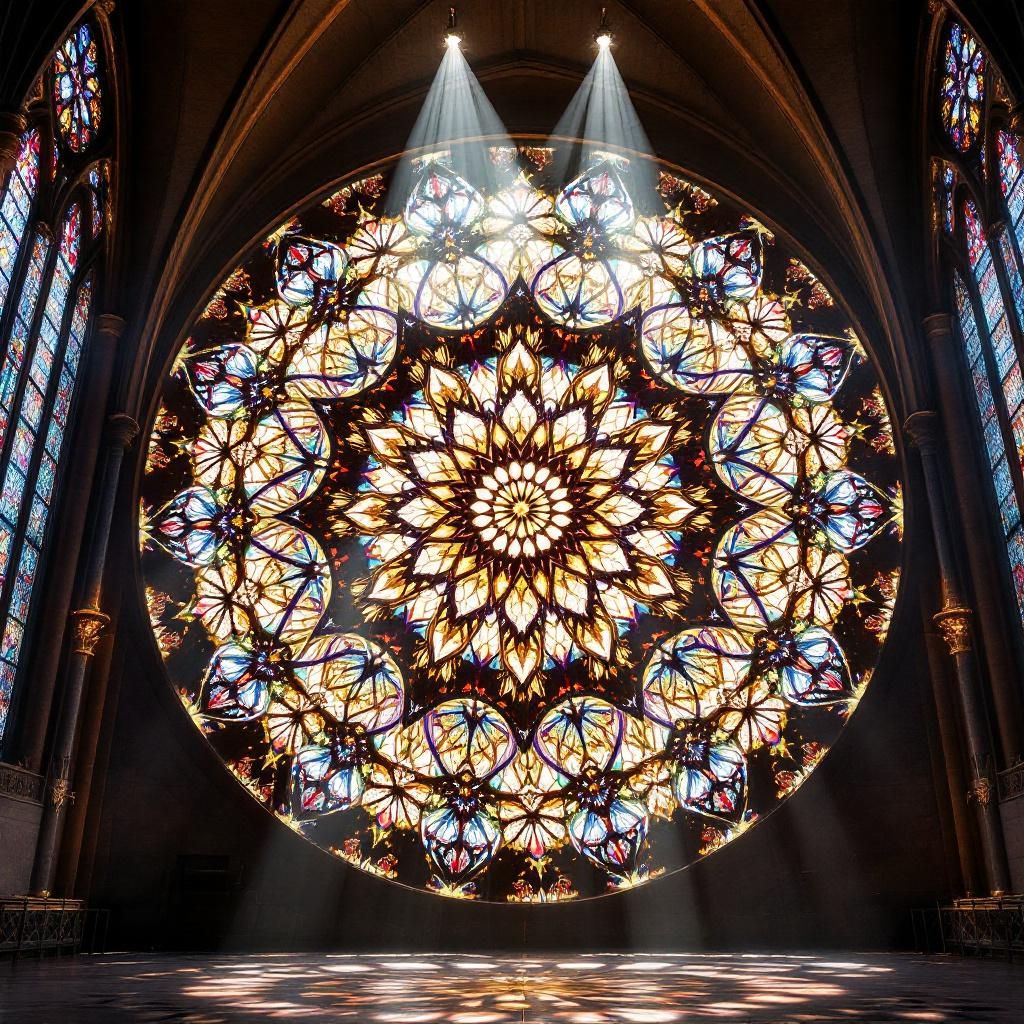
The Gothic cathedral is, among many other things, one of the most ambitious geometric projects in human history. The ambition of the Gothic architects was not merely to build large structures — the Romanesque buildings they replaced were often quite massive — but to build structures in which the geometry itself carried theological meaning. The soaring verticality of the Gothic nave was intended to draw the eye and the soul upward toward God. The rose window — the great circular window of coloured glass found in virtually every major Gothic cathedral — is a mandala: a circular, symmetrically subdivided form that represents the cosmos as geometry. The proportional systems used to design Gothic buildings were derived directly from compass-and-straightedge constructions, and those systems were the professional secrets of the master builders' lodges.
The cathedral of Notre-Dame de Paris, begun in 1163, is a geometrically sophisticated building whose proportions reflect a careful system of whole-number and irrational relationships. The plan, the elevation, the window tracery, and the vault forms are all related to each other through a consistent proportional scheme derived from the square and its diagonal — the ratio of 1 to √2. Chartres Cathedral, rebuilt after a fire in 1194, is perhaps even more remarkable: its labyrinth — a circular path set into the floor of the nave — encodes a proportional relationship to the great rose window of the west façade that has been analysed and confirmed by several researchers. The labyrinth has the same diameter as the rose window. If the rose window were hinged at the base of the west wall and folded down to the floor, it would sit exactly over the labyrinth. This is not a coincidence: it is a geometric argument encoded in stone, a statement that the circular path of the labyrinth and the circular light of the window are the same thing at different scales.
The master builders who designed these structures belonged to guilds — the Freemason guilds, from whose organisation the later Masonic fraternity took its name and much of its symbolism. The knowledge that allowed them to derive the proportions of a complex Gothic vault from a circle drawn on a building site was genuinely valuable professional knowledge, and it was genuinely kept secret. The master mason who knew how to translate a geometric construction on paper into the precise angles of flying buttresses and ribbed vaults was in possession of technical knowledge that had taken years of apprenticeship to acquire. The secrecy was practical before it was symbolic. But the symbolic layer was there from the beginning: the compass and the square, the tools of the builder's trade, were also the tools of God the Architect of the Universe — an image that appears in medieval Christian manuscripts showing God measuring the cosmos with a compass at the moment of creation.
The Renaissance
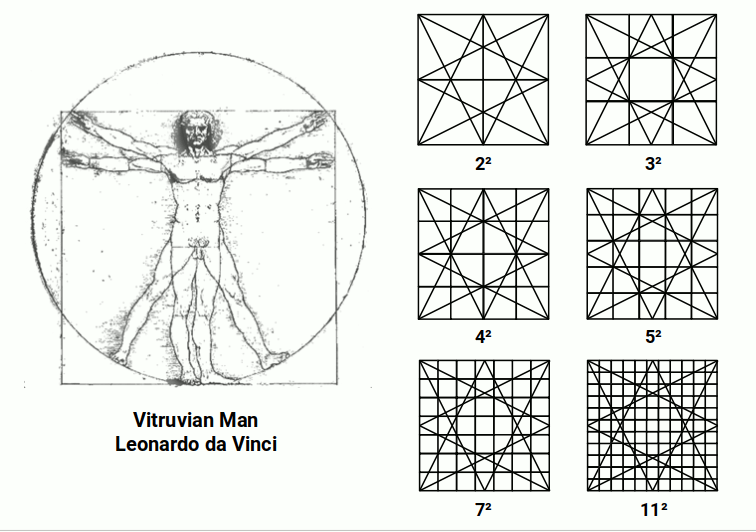
The Renaissance recovery of classical antiquity brought Greek geometry back to the centre of European intellectual life, and it brought it together with the humanist project of understanding the human body and human proportion as the measure of all things. Leonardo da Vinci's Vitruvian Man — the image of a human figure simultaneously inscribed in a circle and a square, arms and legs extended to touch the boundaries of both forms — is the most famous visual statement of the Renaissance conviction that human proportion and cosmic geometry are expressions of the same underlying order. The circle represents the divine, the square represents the earthly, and the human body simultaneously belongs to both.
Luca Pacioli, the Franciscan friar and mathematician who was Leonardo's close collaborator, published De Divina Proportione in 1509. The text is a sustained meditation on the golden ratio and its geometric and aesthetic applications, illustrated with Leonardo's extraordinary drawings of the regular and semi-regular polyhedra. Pacioli argued that the divine proportion — φ — possessed a unique theological status among mathematical relationships: like God, it was one (there is only one golden ratio); like the Trinity, it was three (it involves three terms in proportion); and it was irrational, beyond the reach of common measure, as God is beyond human comprehension. This was not a metaphor but an argument: the geometry of φ was, for Pacioli, a genuine trace of the divine reason in the structure of the world.
Leon Battista Alberti and Andrea Palladio applied geometric proportion systematically to architecture, working from the Vitruvian principle that the proportions of the ideal building should be derived from the proportions of the ideal human body. Palladio's villas — the Villa Rotonda, the Villa Barbaro, and dozens of others — are exercises in geometric proportion: the plan is a square, the facade is governed by specific height-to-width ratios derived from whole-number relationships, and the rooms are related to each other by harmonic proportions borrowed from music theory. When you stand in a well-proportioned Palladian room, the feeling of rightness — of being in a space that makes sense — is a direct sensory experience of geometric proportion. The body recognises the relationships before the mind names them.
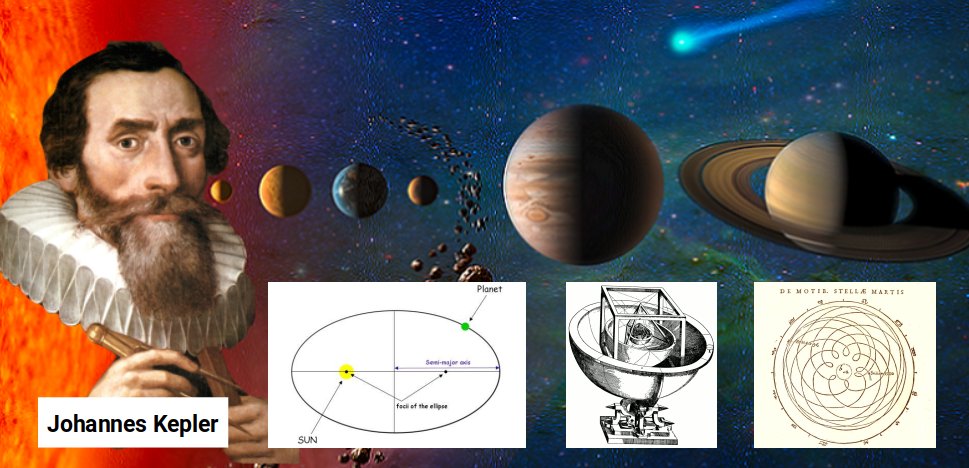
Johannes Kepler, working in the first decade of the seventeenth century, attempted to explain the structure of the solar system as a geometric necessity: he proposed in his Mysterium Cosmographicum (1596) that the five gaps between the six known planets corresponded to the five Platonic solids nested inside each other, each inscribed in a spherical shell whose radius was the orbital radius of its planet. The model was eventually refuted by better observations — the planetary orbits are ellipses, not perfect circles, and their relative sizes do not match the Platonic solid model exactly. But the impulse was directly Platonic and sacred-geometric: Kepler was asking why the solar system has the structure it has, and his answer was that its proportions are geometric necessities. He was wrong about the specific mechanism, but he was doing exactly what Plato had done two thousand years earlier — looking at the cosmos and asking what geometric logic underlies its form.
The Modern Era
The industrial revolution and the subsequent dominance of quantitative science gradually separated the formal mathematical tradition from the sacred geometry lineage. Academic geometry became algebraic and then topological and then categorical — increasingly abstract, increasingly remote from the compass-and-straightedge tradition. The practical geometric knowledge of the master builders was displaced by structural engineering based on stress calculations. The proportional systems of Renaissance architecture gave way to functional planning and, eventually, to the abstraction of the International Style, in which proportion was explicitly rejected in favour of modular standardisation.
The recovery of the sacred geometry tradition in the twentieth century came from several directions at once. The French philosopher and Egyptologist René Schwaller de Lubicz spent fifteen years, from 1936 to 1951, systematically surveying the Temple of Luxor in Egypt, and concluded that its entire spatial organisation — the plan, the proportions of its rooms and columns, the relationship between different parts of the complex — was based on a sophisticated system of geometric proportion derived from the golden ratio and the square root of two. His findings were published in the monumental work Le Temple de l'Homme (1957). Schwaller argued that the Egyptians possessed a form of geometric intelligence that was qualitatively different from and in some respects more sophisticated than the purely analytical approach of modern mathematics — a living, embodied knowledge of proportion that was simultaneously mathematical, biological, and cosmological.
Robert Lawlor, drawing on Schwaller's work, wrote Sacred Geometry: Philosophy and Practice (1982), a text that brought the compass-and-straightedge tradition to a wide contemporary audience for the first time. Lawlor's book was notable for combining rigorous geometric instruction — the reader was taken through actual constructions step by step — with philosophical depth, drawing on Plato, Pythagorean number theory, Egyptian cosmology, and the work of D'Arcy Wentworth Thompson on biological form. It established the term sacred geometry in its contemporary usage and made the practice accessible to artists, architects, designers, and spiritual practitioners who had no formal mathematical training.
Simultaneously, and largely independently, scientific research was converging on geometric principles that the sacred geometry tradition had always emphasised. The discovery of fractals by Benoit Mandelbrot in the 1970s revealed that natural forms — coastlines, snowflakes, fern leaves, blood vessel networks — have a self-similar geometric structure that is invariant across scale: the same patterns repeat at every level of magnification. This is a geometric statement about the deep structure of biological and physical systems, and it resonates directly with the sacred geometry insight that the same proportions appear at every scale. The discovery of quasicrystals in the 1980s, and their connection to the Penrose tiling patterns that had been known since the 1970s and to the Islamic girih-tile tradition that had been practised since the thirteenth century, demonstrated that the geometric forms studied in the sacred geometry tradition were not merely aesthetically appealing but were genuine solutions to fundamental problems in the mathematics of space.
Where We Stand Today
Today the sacred geometry tradition exists simultaneously in several worlds that do not always communicate with each other but that are, in their different ways, engaged with the same underlying reality. In academic mathematics, the study of tilings, polyhedra, and geometric group theory continues to reveal deep truths about the structure of space that resonate with traditional sacred geometry themes. In physics, the geometric structure of spacetime and the possibility that space itself has a discrete geometric substrate at the Planck scale are active research questions. In biology, the geometric principles governing the growth and form of living organisms — the phyllotaxis of plants, the geometry of protein folding, the spatial organisation of embryonic development — are increasingly well understood, and they repeatedly invoke the proportions that sacred geometry has always emphasised.
In design and architecture, a renewed interest in proportional systems and in geometry as a source of aesthetic and spatial order has produced a generation of architects and designers who work explicitly with sacred geometric principles. In popular culture, the Flower of Life, the Metatron's Cube, the Sri Yantra, and other geometric forms from various traditions have become widely recognised symbols, though their geometric meaning is often lost in their cultural adoption as logos and tattoos. And in the practice of sacred geometry itself — the patient, meditative work of compass-and-straightedge construction — there is a growing community of practitioners who experience the tradition as exactly what it has always been: a direct engagement with the geometry of space, an encounter with the patterns that underlie all form, and a form of contemplative practice that is simultaneously rigorous, creative, and deeply satisfying.
The tradition is, in other words, alive. It has survived the collapse of ancient civilisations, the burning of libraries, the displacement of geometric architecture by modernist abstraction, and the long dominance of purely quantitative approaches to mathematical knowledge. It survives because it is rooted in something that cannot be destroyed: the behaviour of circles drawn with a compass, which is the same in the twenty-first century as it was when the first practitioner pressed a stick into Egyptian sand and traced the circumference of the first perfect circle, four thousand years ago and more.
In the next chapter, we explore The Dot & The Line — the two elemental forms from which every geometric construction begins.
FAQ
Did sacred geometry originate in ancient Egypt or ancient Greece?
The practice predates both. Neolithic stone circles in Britain and Brittany (3500–1500 BCE) show sophisticated geometric construction at landscape scale. Egypt developed the tradition further with the rope-stretchers and temple geometry, and Greece added the demand for axiomatic proof — but the impulse to express cosmological understanding in geometric form is as old as human civilisation.
What is the connection between Islamic geometric art and modern mathematics?
Islamic craftsmen of the fifteenth century constructed quasi-periodic tiling patterns using girih tiles that are mathematically equivalent to Penrose tilings (described in 1974) and the atomic structure of quasicrystals (discovered in the 1980s). They were constructing patterns whose mathematical structure would not be formally described in Western science for another five hundred years.
Who revived sacred geometry in the modern era?
The French Egyptologist René Schwaller de Lubicz spent fifteen years surveying the Temple of Luxor and demonstrated its golden-ratio proportional system. Robert Lawlor then brought the compass-and-straightedge tradition to a wide audience with Sacred Geometry: Philosophy and Practice (1982). Simultaneously, scientific discoveries in fractals and quasicrystals confirmed geometric principles the tradition had always emphasised.
Were the Freemasons connected to sacred geometry?
Yes. The medieval Freemason guilds were the cathedral builders whose master masons knew how to derive Gothic vault proportions from circle constructions. Their professional secrets were genuine geometric knowledge acquired through years of apprenticeship. The later Masonic fraternity inherited both the name and much of the symbolism from these working stonemasons.