The Dot
There is a paradox at the very beginning of geometry, and the tradition of sacred geometry has never tried to resolve it — it has sat with the paradox and looked at it closely, because the paradox itself is informative. The paradox is this: the point, the foundational element from which all geometry proceeds, has no size. Euclid defined it in the opening words of the Elements as that which has no part — no width, no length, no depth, no dimension. It is pure location without extension. You cannot actually draw a point. The mark you make on the paper — the dot of your pencil — has a width, however fine. The actual point is the ideal object that the dot approximates: position without extent, presence without dimension.
This paradox — how can something that has no size be the foundation of a science of spatial magnitude? — is not a flaw in the geometry. It is a feature. It tells us something important about the relationship between the ideal and the actual. The geometric point is not a physical object. It is a concept — the concept of location itself, extracted from everything that is usually attached to location in the physical world. In the physical world, everything that has a location also has a size, a mass, an energy, a duration. The geometric point strips all of this away and asks: what is left when you remove everything but the fact of being here rather than there? What remains is pure position — the bare minimum of geometric existence, the seed from which all extension will grow.
In sacred geometry, the dot is not treated as a limit case or an abstraction to be quickly passed over on the way to more interesting things. It is the beginning — not in the sense that it precedes everything temporally, but in the sense that everything else is a development of what it contains. The dot sits at the heart of the Monad — the circle-with-central-point that the Pythagoreans used as the symbol of the One — representing the undivided unity that is prior to every distinction, every relationship, every form. It is the stillness before the first vibration, the silence before the first word, the potentiality before the first act. To take the dot seriously — to sit with it, to ask what it means rather than hurrying past it — is already to be engaged in the deepest question that sacred geometry asks: what is the relationship between nothing and everything, between the dimensionless and the dimensional, between the void and the cosmos?
Key takeaways
- The dot (point) and the circle are inverse geometric principles — infinite compression and infinite expansion of the same form. The dot contains the potential for every circle; the circle is the dot extended into space.
- The first line in sacred geometry is the radius — exactly ONE — from which all proportions are derived. The line represents the first dimension, the first act of distinction, and the masculine principle of direction.
- Dot (0D), line (1D), and circle (2D) form the three primordial elements, each arising when the previous gains a new degree of freedom — together constituting the complete foundation of all geometric construction.
Contracted Infinity
One of the most striking insights in our geometric tradition is the relationship between the dot and the circle as inverse geometric principles. The circle is a point expanded to encompass a radius — it is the dot extended outward into two-dimensional space, creating a boundary, an inside and an outside, a centre and a circumference. The dot is a circle contracted to its limit — the circle whose radius has been reduced to zero, leaving only the centre. In this sense, the dot is not the absence of the circle. It is the circle's most concentrated form.
This inversion has a profound implication. The circle, as the first chapter of this guide described, contains everything — every point on its circumference is equidistant from its centre, every direction is equally accessible from it, every other form in sacred geometry is born within it or between circles. The circle is, in this sense, infinite in its generative potential. But the dot is equally infinite — in the other direction. It is not the expansion of potential but its maximal concentration. If the circle is infinite expansion, the dot is infinite compression. They are not opposites in the sense of contradicting each other; they are opposites in the sense of being the two limiting cases of the same form, as a volume of gas has both maximum expansion (a large, diffuse cloud) and maximum compression (a point-like singularity) as its two extremes.
In modern physics, this idea has unexpected resonances. The Big Bang singularity — the state of the universe before its expansion began — is described as a point of infinite density and zero extent: a dot that contained, in compressed form, all the matter and energy and spacetime that would subsequently expand into the observable universe. A black hole singularity, at the centre of a gravitational collapse, is the same concept in reverse: a region that compresses matter and energy back toward a point of infinite density. The dot that begins every sacred geometry construction is, philosophically, both of these things: the singularity from which the universe expands outward, and the point toward which it would collapse if expansion reversed. The sacred geometer who places their compass point on the paper and draws the first circle is enacting, at a scale of centimetres, the geometry of creation: infinite potential gathered to a point, then released into the expansion of space.
This is not a metaphor imposed on the geometry from outside. It is a consequence of taking the geometric point seriously and asking what kind of thing it is. The point has no size, but its potential for extension is unlimited — it can be the centre of a circle of any radius, from the infinitesimally small to the arbitrarily large. In this sense, the point contains every circle — or rather, it contains the potential for every circle. It is the seed of infinite form in the same sense that a seed contains the potential for a tree: not by having the tree's structure already assembled within it, but by having the generative capacity to produce that structure when the right conditions are present.
Mathematics and Philosophy
The Pythagorean tradition placed the point at the heart of the Monad — the circle-with-central-point that symbolises the One — and treated it as the source of all number. This is a more profound claim than it first appears. Number, in the Pythagorean system, was not merely a counting device. Number was the principle of discreteness, of individuation — the quality that makes one thing distinguishable from another. The Monad — pure unity, before any division — is prior to number in the same sense that the dot is prior to all geometric form. Two is the first multiplicity, arising when the Monad contemplates itself and creates a distinction between the self that contemplates and the self that is contemplated. Three is the first triangle, the first relation of three distinct elements, the first form that is self-stable in two dimensions. And so on through the Tetrad, Pentad, Hexad, Heptad, Ogdoad — each number expressing a qualitatively different relationship with space, with stability, with generation.
The dot, in this tradition, is the silent centre of everything. It is not a number — it is what numbers come from. It is not a form — it is what forms are born of. The Neoplatonic philosopher Plotinus, writing in the third century CE, described the ultimate principle of reality — the One — as a point that is simultaneously everywhere and nowhere: everywhere, because everything that exists participates in it; nowhere, because it has no location that could be specified. The Plotinian One is, in a precise philosophical sense, the geometric point raised to its metaphysical extreme: pure unity, pure presence, without dimension or extension, from which the entire cascade of existence flows outward as the circle flows from the centre.
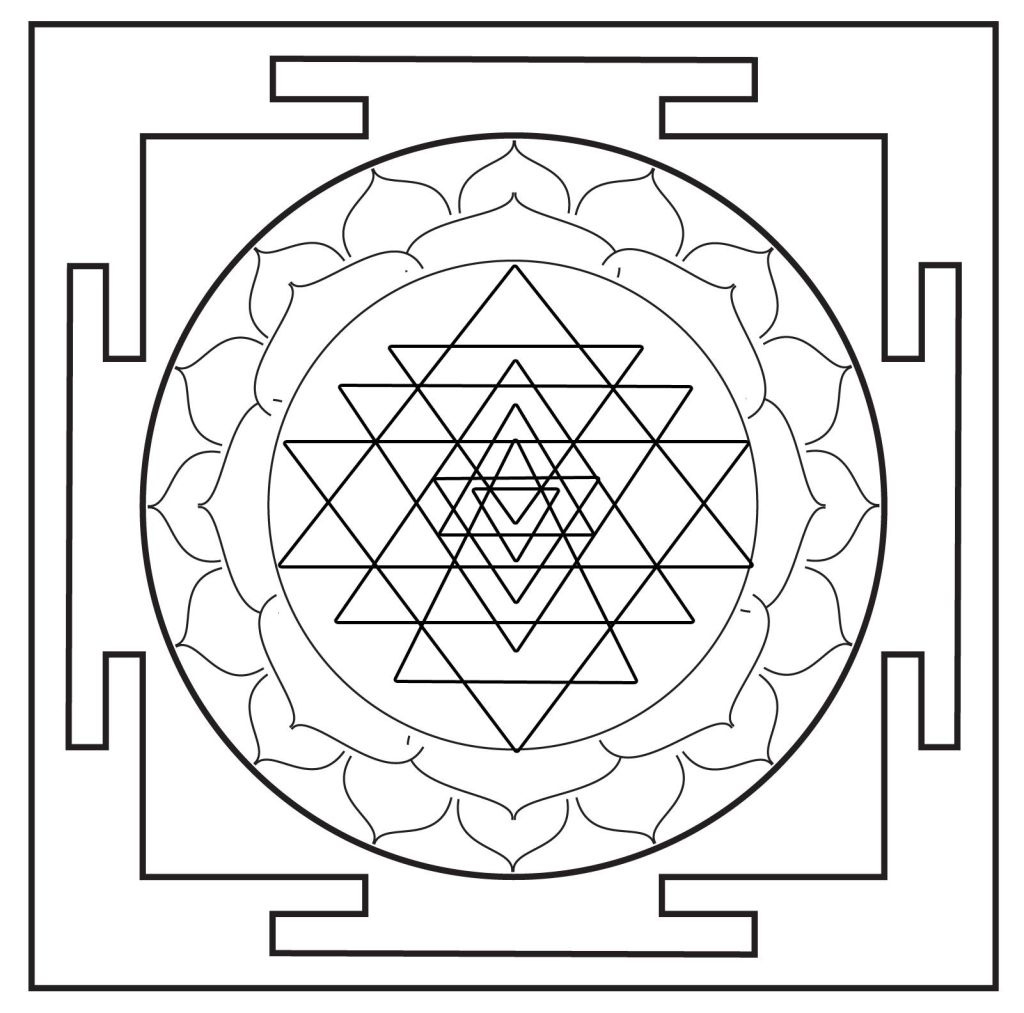
In Vedic philosophy, the bindu — the sacred dot that appears at the centre of the Sri Yantra and in the sacred art of many Hindu traditions — is the compressed form of consciousness itself, the still point from which the entire manifest universe unfolds. The Sri Yantra, one of the most geometrically complex sacred diagrams in existence, is built from nine interlocking triangles — four pointing upward, five pointing downward — that create forty-three smaller triangles surrounding a central lotus and, at the absolute centre, the bindu: a single dot. Everything in the diagram unfolds from and returns to that point. The geometry is a map of consciousness: from the unity of the bindu through successive levels of differentiation and multiplicity, and back again. The dot is not the end of the diagram — it is the diagram's source and ground.
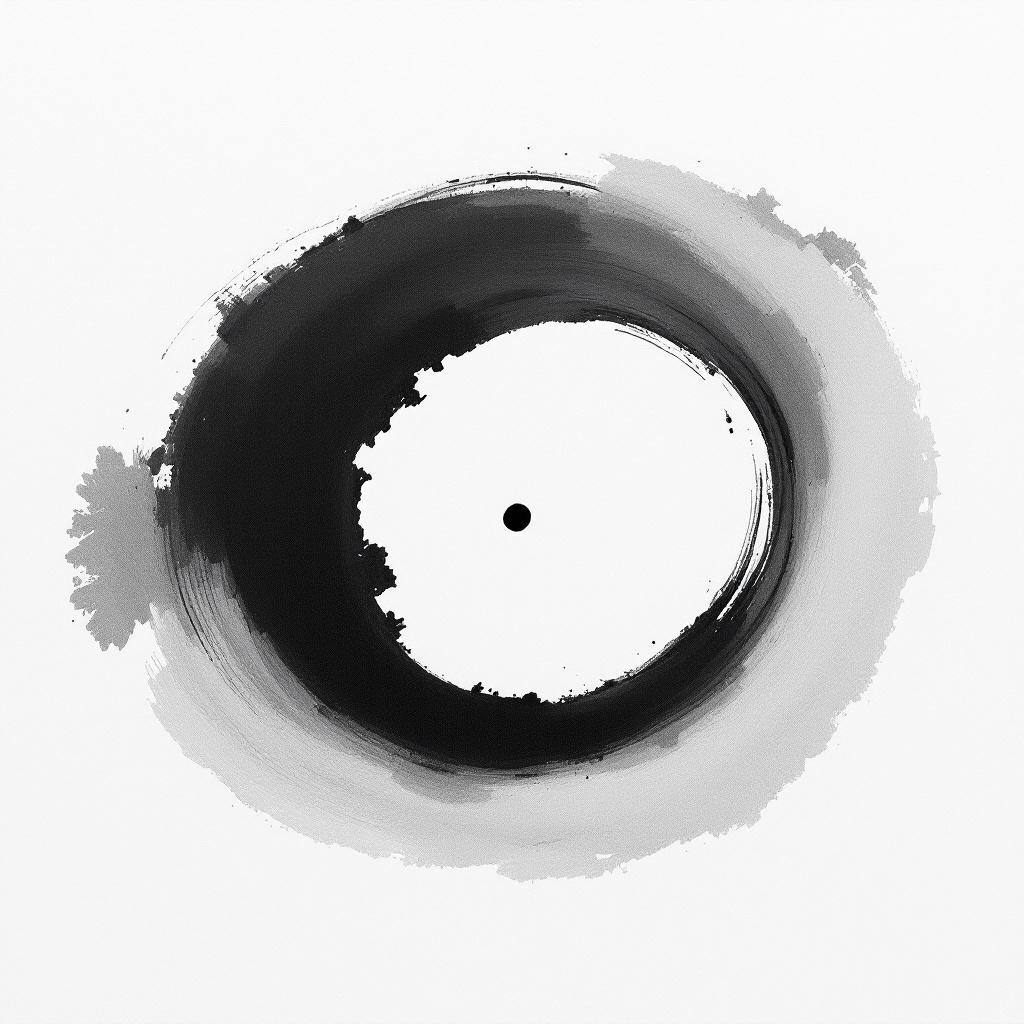
In Zen Buddhism, the ensō — the circle brushed in a single gesture — is always accompanied, in traditional calligraphy, by a small dot that may or may not be explicit in the painted form but is always conceptually present. The ensō represents freedom, wholeness, and the nature of mind; the dot at its centre is the mind that draws it — the self-aware point from which the brush sweeps outward into the circle of its own nature. The dot is the meditator; the circle is the meditation. Together, they express the relationship between consciousness and its expression in form.
The Line
If the dot is the first element of sacred geometry — the seed at the heart of the Monad, the point of departure — the line is the first event. The line does not exist until something moves. When the dot divides — when what was one becomes two — the line is the relationship between the two. It is the expression of the distance between two points, the directed connection between them, the path that must be travelled to go from here to there. The line is the first dimension: one degree of freedom, one axis of extension, the simplest possible relationship between two points.
In sacred geometry, the first line is not an arbitrary line. It is the radius — the line that connects the centre of the first circle to any point on its circumference. This line is defined by the opening of the compass: it is exactly ONE, the unit from which all other proportions in the construction will be derived. The radius is therefore the most important single line in the entire tradition. It is not just a measurement. It is a relationship: the relationship between the centre of the circle and its boundary, between the origin of the geometric universe and its first expression in space. All subsequent lines in a sacred geometry construction are either copies of this first radius (when circles of equal size are drawn) or are defined by the intersection of circles and lines (when new lengths and directions emerge from the logic of the construction).
The line as the horizon — the visual threshold between earth and sky — is one of the oldest and most universal geometric metaphors for the beginning of human awareness. Before the horizon, there is no distinction between above and below, near and far, self and world. The horizon draws the first line across the undifferentiated field of experience, creating above and below, establishing a direction, making orientation possible. This is the masculine principle in sacred geometry: the line as the first act of distinction, the cutting of the undifferentiated into the differentiated, the establishment of direction in a field that previously had none. In the Chinese cosmological tradition, the first principle of creation is the division of the undivided Tao into yang (the active, directed principle, symbolised by an unbroken line) and yin (the receptive, enclosing principle, symbolised by a broken line). The first hexagram of the I Ching, Ch'ien, is six unbroken lines — pure yang, pure direction, the creative principle in its maximum expression. The geometry is the philosophy.
Physics and Modern Science
The geometric line — one-dimensional, extending in a single direction, with no breadth or thickness — has exact equivalents in the conceptual vocabulary of modern physics. The world-line of a particle in spacetime is the line traced by a point through four-dimensional space as it moves through time: it is the one-dimensional trajectory of a zero-dimensional particle through a four-dimensional continuum. The entire history of a particle — where it was at every moment from its creation to its destruction — is encoded in a single curve in four-dimensional spacetime. This is the dot extended through time as the radius extends through space: the point gaining a dimension by virtue of its movement.
The ray of light is another geometric line in physical reality: a photon travels in a straight line (in the absence of gravitational fields) at the speed of light, carrying electromagnetic energy along a path that is one-dimensional in the sense that it has a direction and a magnitude but no breadth. The fact that geometry — the study of ideal spatial relationships defined without reference to any physical content — turns out to describe the behaviour of actual physical objects was one of the great surprises of the scientific revolution and has become more surprising rather than less as physics has advanced. The geometry of spacetime in General Relativity, the geometry of phase space in classical mechanics, the geometry of Hilbert space in quantum mechanics — modern physics is geometry, in a way that the ancient sacred geometry practitioners would have found entirely natural. They knew that geometry was not merely a description of space but a description of the principles that govern everything that exists in space.
The Planck length — approximately 1.6 × 10⁻³⁵ metres — is the scale at which quantum effects and gravitational effects become of comparable magnitude, and below which our current theories of physics break down. It is sometimes described as the smallest meaningful length in nature: the quantum of space itself. Whether space is actually discrete at the Planck scale — whether there is a minimum length below which the concept of spatial extension loses its meaning — is one of the open questions of theoretical physics. If space is discrete, then the dot — understood as a physical object of zero extension — cannot exist; the smallest physical thing would be a Planck-scale region of non-zero volume. But the dot as location, as pure position, remains perfectly real — arguably more fundamental than any object, since every object must occupy one. The sacred geometry tradition's insistence that the point is an ideal rather than a thing is, in this light, not a weakness but a precision: it isolates the concept of position from any substrate, whatever that substrate turns out to be.
Line from Circle
One of the subtle beauties of sacred geometry is the way the line — apparently a completely different kind of object from the circle — is actually generated by the circle rather than being a separate and independent element. The radius of the first circle is a line, but it is defined entirely by the circle's properties: it is the distance from the centre to the circumference, and it is exactly the opening of the compass that drew the circle. The line is not added to the circle from outside — it is the circle's own internal relationship, expressed as extension.
When the second circle is drawn, centred on a point on the circumference of the first and with the same radius, the two circles intersect at two new points. The line connecting those two intersection points is the perpendicular bisector of the line connecting the two centres — but it is also, to within a small factor, the first new line that is different in direction from the radius. This new line has a specific length in relation to the radius: it is √3 times the radius, a consequence of the geometry of equilateral triangles that emerges necessarily from the equal-radius construction. The √3 proportion was not put into the construction by the practitioner. It was already in the structure of space, waiting to be revealed by the interaction of two equal circles.
This is the fundamental dynamic of sacred geometry: the circle generates the line, the lines intersect to define new points, the new points become the centres of new circles, and the new circles generate new lines. Each step is a necessary consequence of the previous one. The practitioner is not designing the pattern — they are following a process whose outcomes are determined by the rules of the construction, which are themselves expressions of the properties of circles and lines in Euclidean space. The feeling of discovery that practitioners consistently describe — the sense that the forms were already there, that the geometry is being found rather than made — is an accurate description of what is actually happening.
Three Primordial Elements
The dot (point, zero dimensions), the line (one dimension), and the circle (two dimensions, considered as the closure of a line into a curve) are the three primordial elements of sacred geometry, and together they constitute the complete toolkit from which every other form is constructed. Their dimensional sequence — 0, 1, 2 — is not arbitrary. Each dimension is a development of the previous one, arising when the previous element is given a new degree of freedom.
The point (0D) has no freedom of movement. It is simply at its location. Give it one degree of freedom — allow it to move in one direction — and it traces a line. The line (1D) has one degree of freedom: movement along its own length. Give it a second degree of freedom — allow it to move perpendicular to itself — and it sweeps a surface. The surface (2D) has two degrees of freedom: movement in any direction within the plane. Give it a third degree of freedom — allow it to move perpendicular to the plane — and it sweeps a volume. And so on, into four, five, and higher dimensions, each arising from the previous by the addition of one new independent direction.
This dimensional cascade — in which each new level of reality arises from the previous by a single additional degree of freedom — is one of the deepest structural patterns in mathematics and physics. Sacred geometry works within the first three steps of this cascade: 0D (the dot), 1D (the line/radius), and 2D (the circle). Everything in the classical tradition operates in the plane — on a flat surface. 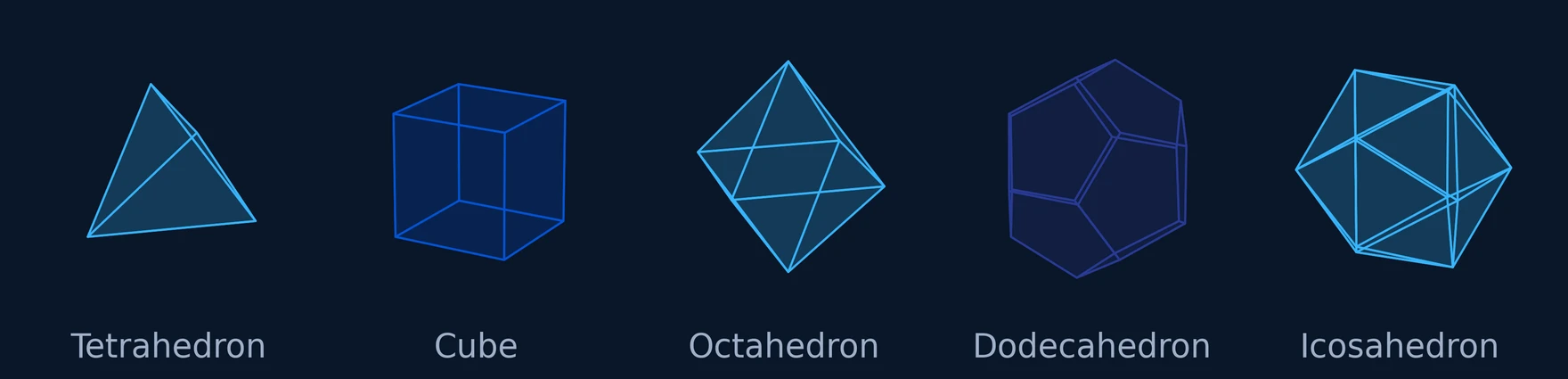
But the Platonic solids, and the entire tradition of sacred geometry in three dimensions, arise when these two-dimensional forms are folded and combined in the third dimension. The tetrahedron arises from the equilateral triangle. The cube arises from the square. The octahedron from the triangle folded at its edges. The icosahedron and dodecahedron from the pentagon and triangle in their more complex combinations. The three-dimensional forms are not separate from the two-dimensional ones — they are what the two-dimensional forms become when they are given the freedom of the third dimension.
The dot, the line, and the circle are therefore not just the beginning of sacred geometry. They are the architecture of dimensionality itself — the three elemental forms that between them describe how space can organise itself at each of its first three levels. To study them carefully, to understand how the line emerges from the dot and the circle emerges from the line, and to follow the geometric constructions that unfold from their interaction, is to trace the logic of how space becomes structured — and how structure becomes form, and form becomes the world.
In the next chapter, we explore The Circle — the first complete form, drawn by a single compass opening, and the foundation of everything that follows.
FAQ
Why is a dimensionless point the foundation of geometry?
The geometric point — pure position without extension — represents the concept of location itself, stripped of every physical attribute. It is the seed from which all form grows: it can be the centre of a circle of any radius, containing the potential for every geometric figure. The Pythagoreans placed it at the heart of the Monad — the circle-with-central-point, symbol of the One from which all multiplicity unfolds.
How does the line emerge from the dot in sacred geometry?
The line appears when the dot divides — when what was one becomes two. The first line is the radius, defined by the compass opening, and it is exactly ONE. All subsequent proportions in the construction derive from this single unit. The line represents the first dimension: the first act of distinction, direction, and relationship.
What are the three primordial elements of sacred geometry?
The dot (0D — pure position), the line (1D — direction and relationship), and the circle (2D — wholeness and enclosure). Each dimension arises when the previous element gains a new degree of freedom. Together these three elements constitute the complete toolkit from which every other form is constructed.
Is the dot the same as the circle in sacred geometry?
They are inverse expressions of the same principle. The circle is the dot expanded outward to encompass a radius — infinite expansion. The dot is the circle contracted to its limit — infinite compression. Together they represent the two extremes of the same form, much like a singularity and an expanding universe.