Two Instruments
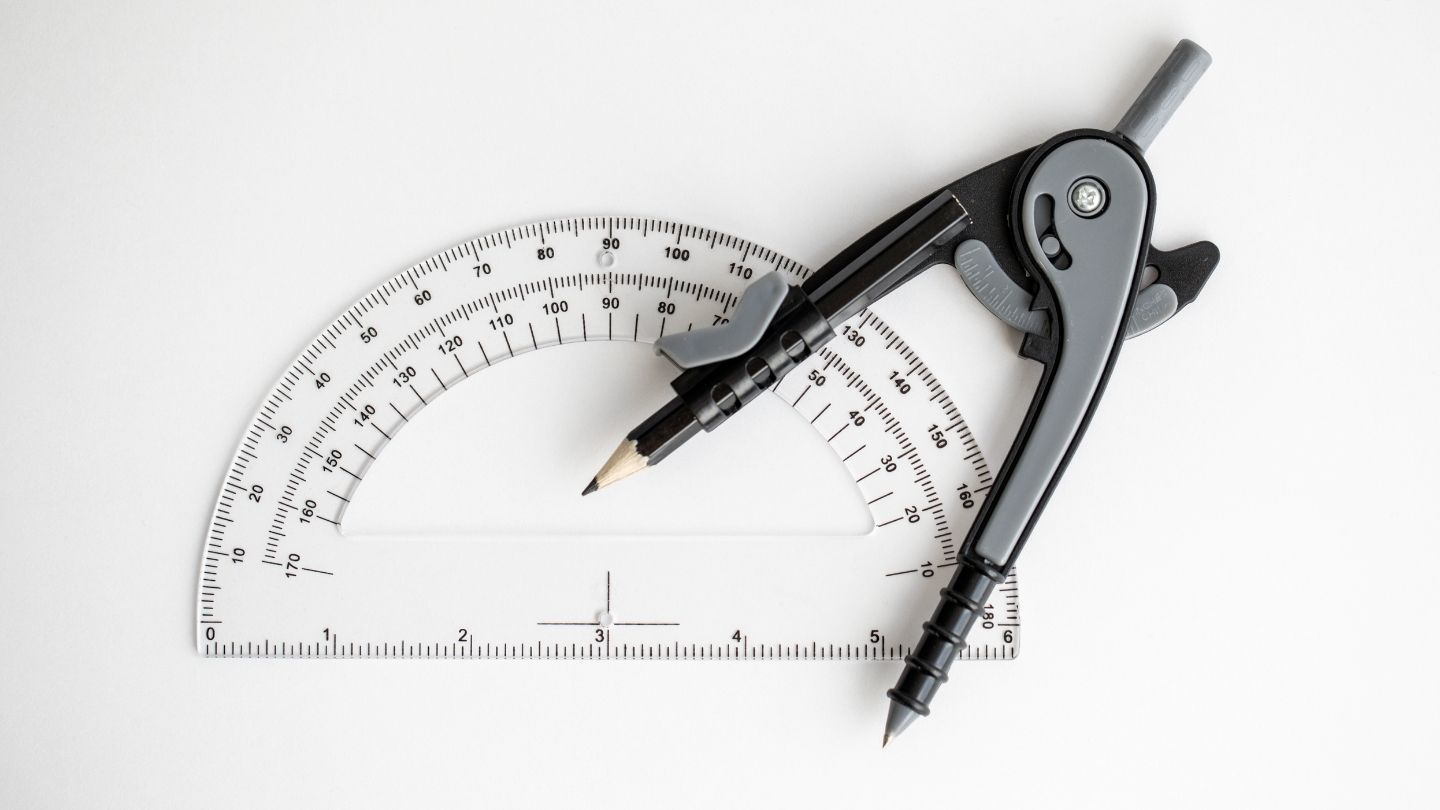
There is something almost audacious in the claim that two simple tools — a compass and a straightedge — are sufficient to generate the entire vocabulary of classical geometry. And yet this is precisely what Euclid demonstrated in his Elements, and what every practitioner of sacred geometry has confirmed through direct construction ever since. The mathematical theory of what can and cannot be built with these two instruments — bisecting angles, constructing regular polygons, and the limits of compass-and-straightedge construction — is covered in the Guide to Geometry: Constructions. The compass draws circles. The straightedge draws lines between two existing points. That is all. No protractor for measuring angles, no ruler graduated in centimetres, no calculator, no computer. From these two instruments alone, every regular polygon can be constructed, every irrational proportion embodied in form, every pattern that appears in the natural world recreated on the page. The apparent austerity is, in practice, an astonishing generative freedom.
The straightedge is not a ruler. This distinction is crucial and is frequently misunderstood by those encountering classical geometric construction for the first time. A ruler has markings — centimetres, inches, fractions thereof. A straightedge has none. It is simply an edge that is straight, used to extend a line through two existing points. Its only function is direction. It cannot impose a length, it cannot measure a distance. The only lengths and proportions that appear in a sacred geometry construction are those that arise from the interaction of circles with each other and with lines. This is not a limitation of the tool. It is a philosophical statement about where geometric truth comes from: not from human measurement, but from the inherent behaviour of the circle and the line when they are allowed to interact.
The compass, by contrast, does carry information — but only one piece of it: the radius of the circle it is currently set to draw. When you fix the compass at a certain opening and draw a circle, you have defined ONE — one unit, one radius, the foundational measure from which everything else in that construction will be derived. You need not know what that radius is in any external unit of measurement. It is simply one. All subsequent circles in a given construction are either drawn at the same radius — which establishes the equal-circle relationships that generate most of the forms in the classical tradition — or at a new radius defined by a node that has already been constructed. The compass is thus an instrument of pure ratio, and ratio is the language of sacred geometry.
Key takeaways
- Sacred geometry uses only two tools — a compass and an unmarked straightedge — yet from these alone every regular polygon, every irrational proportion, and every pattern found in nature can be constructed.
- Measurement is deliberately excluded because the important geometric relationships (φ, √2, √3) are ratios, not fixed lengths. A compass-and-straightedge construction embodies these proportions exactly, while any physical measurement is always an approximation.
- Five rules govern the practice: begin with a circle, derive all new elements from intersection points, define ONE by the first radius, surround every node with a circle, and draw the second circle centred on the first's circumference at equal radius.
Symbolic Meaning
The division of all geometric construction into two operations — circles and lines — is not arbitrary. These two operations represent two fundamentally different ways that space can be organised, and in the philosophical tradition of sacred geometry they carry meanings that extend far beyond the technical.
The compass — the circle — is associated with the feminine principle. This does not mean femininity in any reductive biological or social sense. It means the quality of enclosure, wholeness, and receptivity: the space that contains without imposing direction. A circle is symmetrical in every direction simultaneously. It has no preference for up or down, left or right, north or south. Every point on its circumference is equidistant from the centre. It is the form of pure equality, pure potentiality, the space within which all directions remain possible. The compass opens outward from a fixed centre: expansion without displacement, growth without the abandonment of origin. These qualities — wholeness, receptivity, equality, generative expansion — are associated throughout the world's philosophical and spiritual traditions with the principle of the feminine, the yin, the lunar, the containing. The circle is the womb of all geometric forms. Every other shape is born inside it or between circles.
The straightedge — the line — is associated with the masculine principle. Again, this is not a social statement but a geometric one. The line commits. It goes somewhere. It divides what was undivided, distinguishes here from there, establishes direction, creates asymmetry. Before the straightedge is placed, there is a field of equal possibility; after it is placed, there is a direction and two sides. The line is the first act of differentiation, the first decision, the first distinction. These qualities — directionality, decisiveness, division, the cutting of possibility into actuality — are associated across philosophical traditions with the principle of the masculine, the yang, the solar, the directed. And notice the relationship of the two tools: the straightedge can only act between two points that the compass has already defined. The line requires the circle as its prior condition. Direction requires a field to act within. The masculine principle of differentiation requires the feminine principle of wholeness as its matrix.
This polarity of circle and line — feminine and masculine, expansion and direction, wholeness and distinction — is one of the deepest structural insights in sacred geometry. It is not a mystical addition to the geometry. It is the geometry. Every construction in the tradition arises from the interplay of these two principles, and nothing can be constructed from either principle alone.
Why No Measurement
The rule against measurement is the feature of sacred geometry that most challenges the modern mind, trained from childhood to quantify everything. Why would you deliberately choose not to use a ruler? What is the value of working in ignorance of the actual dimensions of what you are drawing?
The answer begins with an observation about the nature of proportion. The most significant geometric relationships — the ones that recur throughout nature, that appear in biological growth and crystallography and orbital mechanics — are not defined by particular lengths but by ratios that are independent of scale. The golden ratio φ is not 1.618 centimetres. It is the ratio of a longer length to a shorter one such that the ratio of the whole to the longer equals the ratio of the longer to the shorter. It is a relationship, not a measurement. The square root of two is not 1.414 millimetres. It is the relationship between the side of a square and its diagonal — a relationship that holds for every square that has ever existed or ever will exist, regardless of its size. These are not quantities but proportions, and proportions are best understood by working with them as proportions rather than reducing them to approximate decimal numbers.
There is a second and deeper reason. The important proportions of sacred geometry — φ, √2, √3, √5, and others — are all irrational numbers. They cannot be expressed as exact fractions, and they cannot be exactly measured with any physical ruler, no matter how fine its gradations. Any measurement you take will be an approximation. But a compass-and-straightedge construction of the golden rectangle is not an approximation — it is exact, in the sense that the geometric relationship between the forms is precisely what it needs to be, regardless of any numerical representation. When you construct the golden ratio geometrically, you are not approximating it; you are embodying it. The form is the ratio. This is a completely different relationship to mathematical truth from the one we are accustomed to in numerical calculation, and it is worth sitting with the difference.
There is also a practical argument. When you remove measurement from a construction, you remove the possibility of accumulated error. Every physical measurement has a margin of error, and when measurements are built upon measurements — as in any complex calculation — errors accumulate. In a compass-and-straightedge construction, each step is derived directly from the previous step's intersection points, which are geometrically exact. The final result is as accurate as the first circle, because it is not built from accumulated numerical estimates but from the necessary relationships between forms.
The Five Rules
Sacred geometry as a practice is governed by a small set of rules that define not just what tools to use, but how to use them. These rules are not arbitrary — each one reflects a philosophical principle about the nature of form and the relationship between elements.
The first rule is: always begin with a circle. The circle is the first form, the form that establishes a centre, a radius, and a boundary, and from which all other forms are derived. You never begin with a line, because a line requires two points, and points are established by the intersections of circles. The circle comes first; everything else follows.
The second rule is: new circles and new lines can only be drawn from existing points — that is, from points established by the intersection of previous circles with each other or with existing lines. You may not choose a point arbitrarily on a line or within a circle. Every new element must arise from a previously constructed element. This rule is what makes sacred geometry a genuine derivation rather than a free-form arrangement of shapes. It ensures that every form that appears in a construction is genuinely generated by the logic of the construction, not inserted by the practitioner's will.
The third rule is: the radius of the first circle defines ONE, and no external measurement is used. All proportions arise internally from the relationships between constructed elements. This rule is what makes the tradition measureless and scale-invariant.
The fourth rule is: every node (intersection point) must be surrounded by a circle. The dot and the circle are inverse expressions of the same principle — the dot is infinite contraction, the circle is infinite expansion. Every point has the potential to become the centre of its own world of circles. When a new node is identified, placing a circle around it acknowledges this potential and extends the construction into new territory. This rule is often overlooked in classical treatments, but we consider it essential — it ensures that no point of geometric significance is left inert.
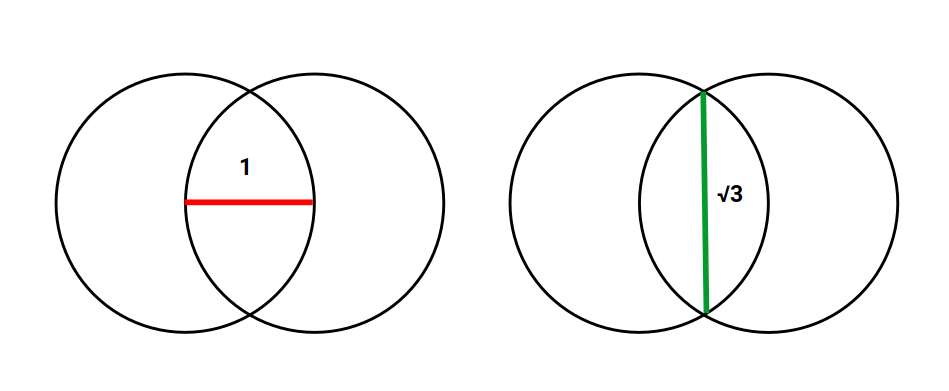
The fifth rule is: the second circle is drawn with its centre on the circumference of the first, at the same radius. This is the founding gesture of the entire tradition — the moment when two equal circles are brought into relationship, overlapping to create the Vesica Piscis and establishing the proportional system from which all further constructions proceed. Everything in sacred geometry flows from this single act of relationship between two equal circles.
Rope and Peg
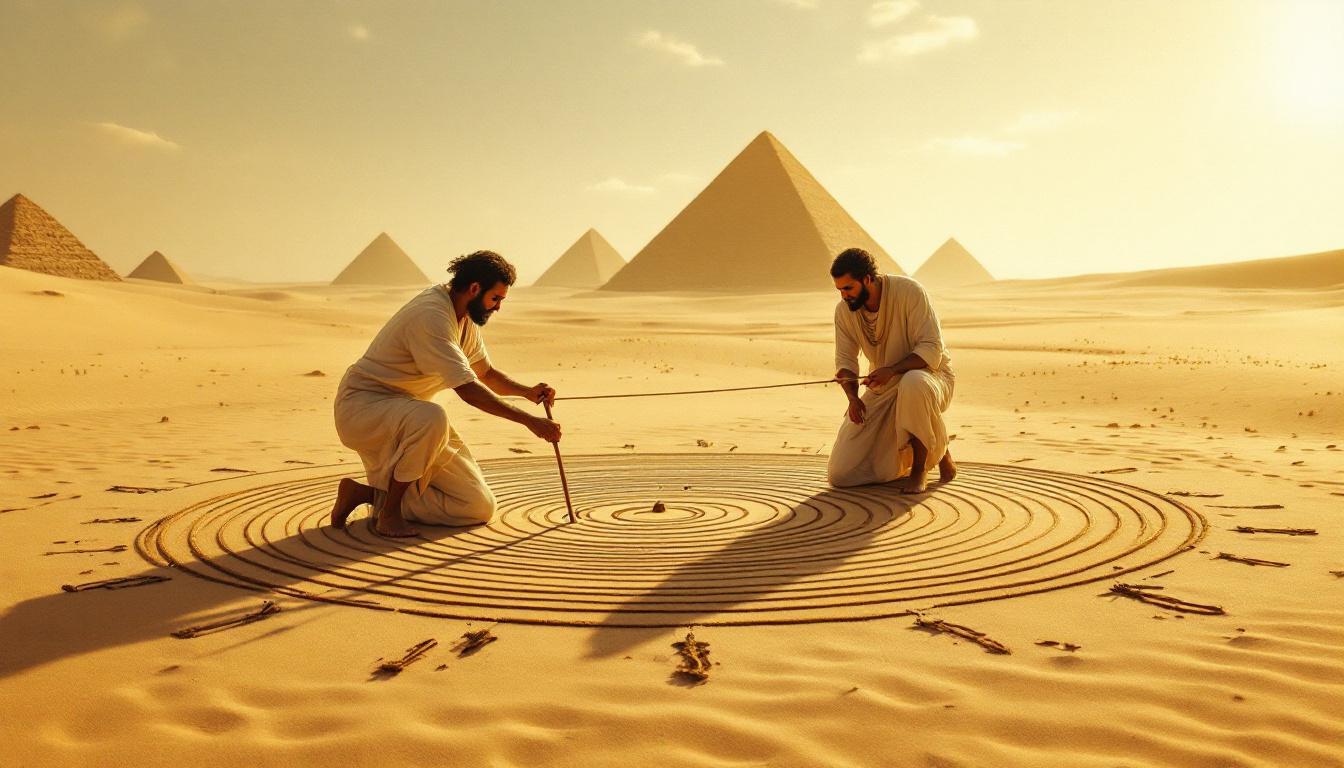
For large-scale constructions — the layout of a temple, the alignment of a stone circle, the surveying of a field — the ancient world used a direct physical equivalent of the compass-and-straightedge: the rope and peg. A peg was driven into the ground at the centre point. A rope of fixed length was attached to it. The other end of the rope was held taut and walked around the peg, marking a circle on the ground — a compass of human scale. A second peg could be placed on the circumference of that circle and used as the centre of an equal circle. Two ropes held by three people could establish a right angle using the 3:4:5 triangle relationship. A rope divided into twelve equal segments by knots, when formed into a closed loop and stretched into a right triangle, always produces a right angle at the corner opposite the longest side.
The Egyptian harpedonaptai — literally the rope-stretchers — were the professional surveyors who re-established field boundaries after the Nile's annual inundation washed away every marker. Their tools were ropes, pegs, and their knowledge of geometric construction. From these instruments alone they could establish right angles, bisect lines, construct circles of any required diameter, and divide areas into precise proportional relationships. The same tools, scaled down to the size of a drawing tablet, are the compass and straightedge of the sacred geometry practitioner. The transition from the rope-and-peg in the field to the compass-and-straightedge on the drawing surface is not a change of method — it is a change of scale. The geometry is identical.
This connection between the surveyor's practice and the sacred geometry tradition is not incidental. The word geometry itself derives from the Greek geo (earth) and metria (measurement): earth-measuring. The discipline was born from the practical need to re-establish the boundaries of the earth after they had been dissolved by flood — from the act of re-creating order from chaos, proportion from formlessness. The sacred geometer working on a small page with a compass is performing, in miniature, the same act that the Egyptian surveyor performed at the scale of a field: re-establishing the geometry of the world, revealing the order that was always latent in space.
Rules vs Decoration
There is a distinction that matters enormously to practitioners of sacred geometry, though it is often invisible to observers: the distinction between constructing sacred geometry correctly — following the rules, deriving each element from the previous one — and simply arranging geometric shapes in aesthetically pleasing patterns. The second is not without value; geometric decoration has produced beautiful art across every culture. But it is not sacred geometry in the traditional sense, and it reveals something quite different.
When you follow the rules — starting with a circle, deriving all subsequent elements from nodes, working without measurement — the construction has a logic that is not yours. You are not deciding where the next element goes. The geometry is deciding, and you are following. The forms that emerge are not the forms you chose; they are the forms that were already latent in the interaction of the first circle with its equal neighbour. This is the experience that practitioners across every tradition have described as revelatory: not the experience of creating something, but the experience of discovering something that was already there. The feeling of following the geometry wherever it leads, of being a conduit for a logic that is bigger than you, is qualitatively different from the experience of arranging shapes according to your own aesthetic preferences.
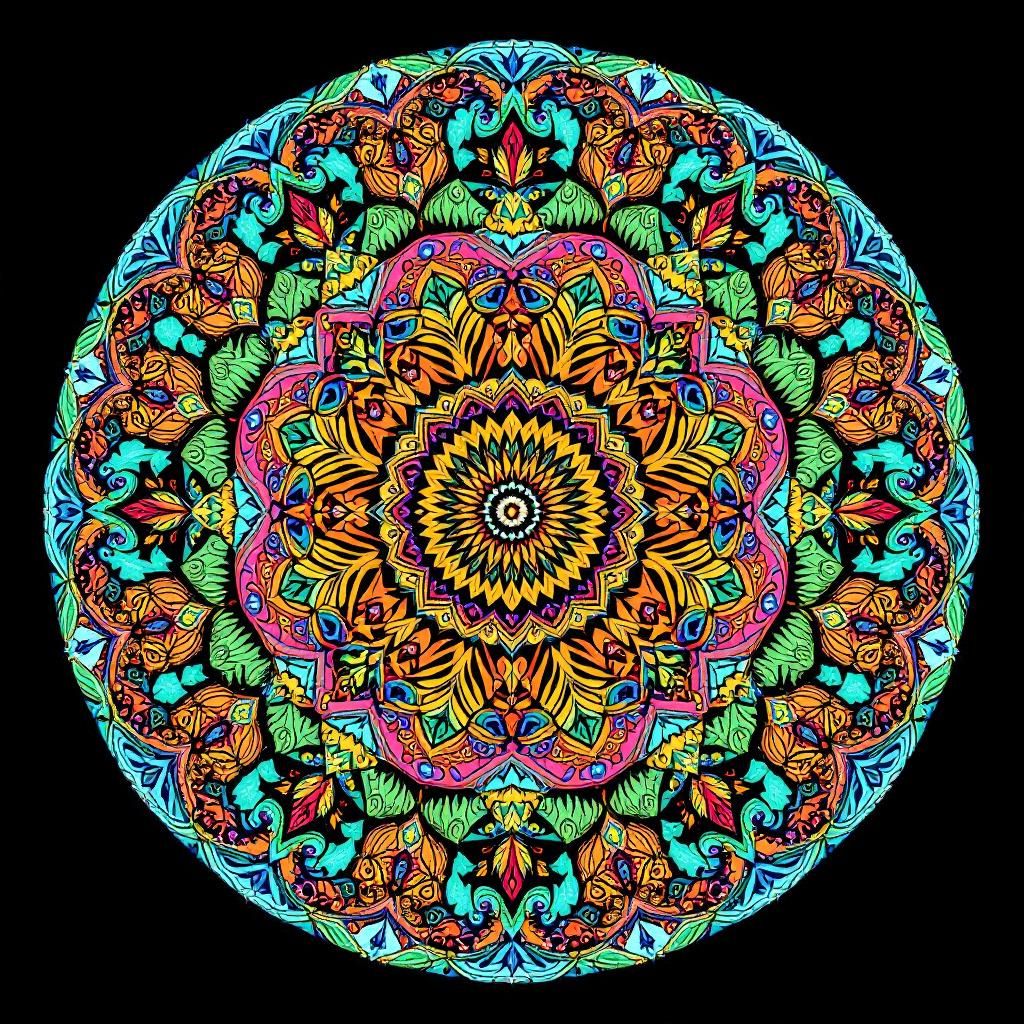
Departing from the rules produces pretty shapes, but it loses the underlying logic. The forms no longer arise necessarily from each other; they arise from the practitioner's choices. The construction becomes an artwork rather than a revelation. Both are valid things to make — but they are not the same thing, and confusing them misrepresents what the tradition is claiming. Sacred geometry is not claiming that any arrangement of circles and pentagons is significant. It is claiming that specific constructions, derived according to specific rules from specific starting conditions, reveal proportional and structural truths that are inherent in the nature of space itself. The rules are what make that claim valid. Abandon the rules and you abandon the claim.
What You Need
The barrier to beginning with sacred geometry is almost absurdly low. You need a compass — any compass will do, though a good quality one with a locking mechanism makes accurate circles easier. You need a straightedge — a ruler works perfectly well if you ignore the markings, or a strip of stiff cardboard if you have nothing else. You need a pencil, sharp enough to make precise marks. You need paper — plain white paper, ideally not too thin, so that repeated use of the compass point does not damage it. That is the entire material requirement.
With these four items, you have everything that every practitioner of sacred geometry in human history had when they worked at the scale of the page. Euclid had these tools. Leonardo da Vinci had these tools. The Islamic tile masters had these tools. The monks who illuminated manuscripts had these tools. The tradition is democratic in the deepest sense: it requires no wealth, no specialist equipment, no institutional affiliation, no technical background beyond the willingness to follow a set of simple but exacting rules. The knowledge that is available through these tools is the same knowledge that has been available to every human being who has ever picked up a compass and allowed themselves to follow where the geometry leads.
Begin with a circle. Place the compass point on the circumference of the first circle and draw a second circle of equal radius. Look at the lens-shaped region where they overlap — the Vesica Piscis, the womb of all form, the region from which the equilateral triangle, the square, the pentagon, the hexagon, and the entire flowering of sacred geometry will grow. You have just made the first gesture of creation. Everything that follows is already there, waiting for you to find it.
In the next chapter, we explore History of Sacred Geometry — tracing how these geometric principles shaped civilisations from ancient Egypt to the modern age.
FAQ
Why can't I use a ruler in sacred geometry?
A ruler imposes external measurement, reducing geometric relationships to approximate decimal numbers. Sacred geometry works with pure proportion — the golden ratio, √2, √3 — which are irrational numbers that cannot be measured exactly. A compass-and-straightedge construction embodies these proportions exactly, as they emerge from the geometry itself rather than being imposed from outside.
What are the five rules of sacred geometry?
1) Always begin with a circle. 2) New circles and lines can only be drawn from existing nodes. 3) The radius of the first circle defines ONE — no external measurement is used. 4) Every node must be surrounded by a circle. 5) The second circle is drawn with its centre on the circumference of the first, at the same radius, creating the Vesica Piscis.
What do the compass and straightedge symbolise?
The compass (circle) represents the feminine principle — wholeness, receptivity, and generative expansion. The straightedge (line) represents the masculine principle — direction, distinction, and differentiation. Together they form a complete creative polarity: the line requires the circle as its prior condition, and the circle requires the line to generate new forms.
What equipment do I need to start practising sacred geometry?
A compass (any quality, though a locking mechanism helps), a straightedge (a ruler with markings ignored, or any straight edge), a sharp pencil, and plain paper. That is the entire material requirement — the same toolkit used by Euclid, Leonardo da Vinci, and Islamic tile masters.