Introduction
Pick up a stone and you can feel its mass — the gravitational pull, the resistance when you try to throw it. Now imagine something that travels faster than anything else in the universe, crosses billions of light-years of empty space, and yet has absolutely no mass whatsoever. That something is light.
This is not a trivial puzzle. Mass is so central to physics that its absence in a photon (the particle of light) requires its own explanation — and that explanation turns out to expose cracks in the standard picture of reality.
The confusion often starts with Einstein's famous equation, E=mc². People reasonably assume: if mass is zero, plug in zero, and you get zero energy. But we can see light, feel warmth from the sun, and use solar panels to generate electricity — light clearly carries energy. So what is going on?
The answer is that E=mc² is the simplified form of a more complete equation, one that applies only to objects at rest. Light is never at rest. It always moves at c — the speed of light, a universal constant of approximately 300,000 km/s. Once motion enters the picture, momentum must be included, and that changes everything.
This article unpacks why light is massless, what momentum means for a particle with no mass, and how a 4th-dimensional geometric view of space offers a coherent solution to paradoxes that conventional physics has so far only papered over.
Key takeaways
- E=mc² is only the rest-mass form of Einstein's energy equation; the full version E²=(mc²)²+(pc)² shows that a massless photon carries all of its energy as momentum, giving the simpler relation E=pc.
- The classical momentum formula p=mv breaks down entirely for light — photon momentum is derived from energy divided by c, which is why sunlight can push a solar sail despite a photon having zero rest mass.
- A 4D geometric model resolves [wave-particle duality](/is-there-an-alternative-to-wave-particle-duality/) by treating the electromagnetic field as inherently 4-dimensional, making the photon's masslessness and the quantisation of light natural consequences of geometry rather than unexplained anomalies.
What is Matter — and Why is the Definition Harder Than it Looks?
You might expect that a property as fundamental as mass would have a clear, settled definition. Surprisingly, it does not. Mass was defined by Newton as a property of matter, but what matter is at the deepest level remains contested. The word "mass" itself carries at least two distinct meanings in physics: rest mass (the intrinsic mass of a stationary object) and relativistic mass (which increases with velocity and is now largely deprecated in modern physics).
The difficulty sharpens when we look inside the atom. Protons and neutrons have well-measured masses that underpin vast areas of scientific theory. Yet the quarks that make up those protons and neutrons appear, in isolation, to be essentially massless — their masses account for only about 1% of the proton's total mass. The rest comes from the binding energy of the strong nuclear force. Mass, then, is not simply a property sitting inside a particle like a number on a tag; it is an emergent quantity linked to energy and interaction.
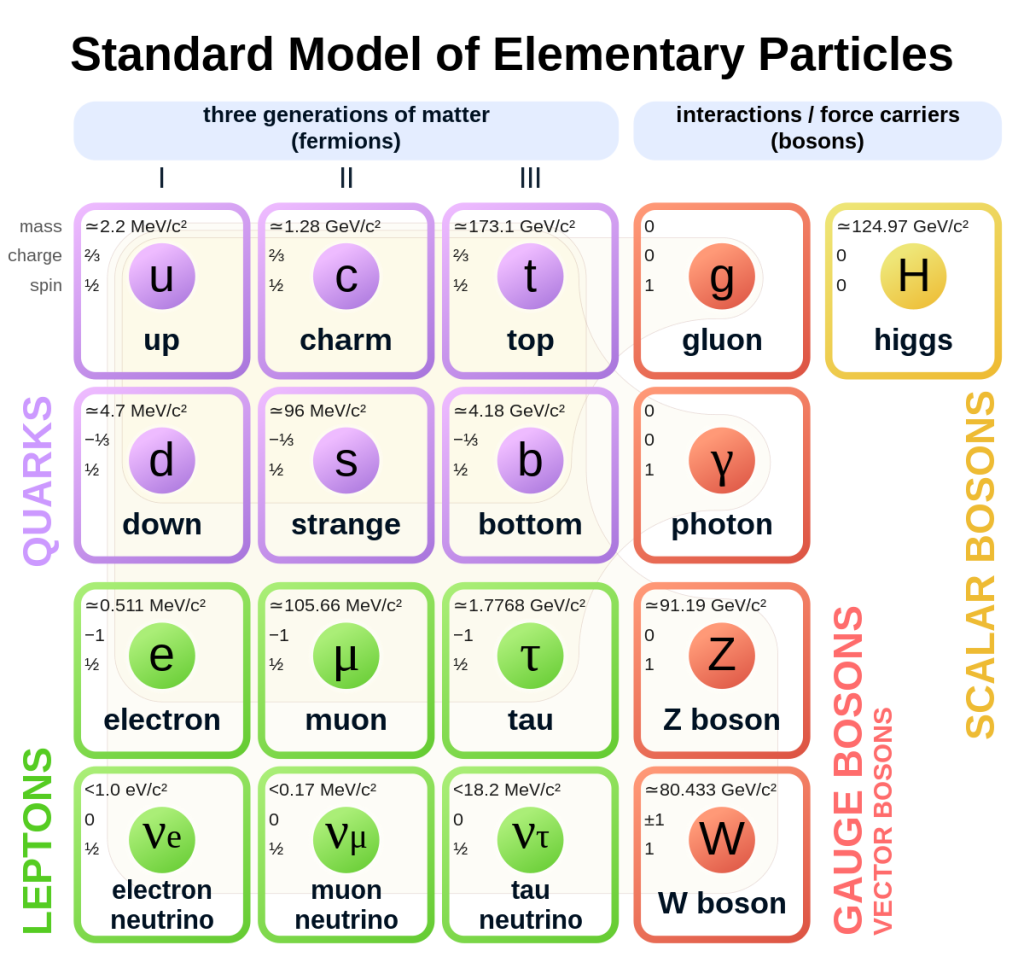
This distinction between matter particles (which have mass) and force-carrying particles called bosons (which can be massless) is where the photon sits. The photon is the boson of the electromagnetic force. It carries the electromagnetic interaction — light, radio waves, X-rays — yet it carries no rest mass.
Physicist L. B. Okun of the Institute for Theoretical and Experimental Physics in Russia has written directly about the confusion surrounding mass terminology in modern physics, noting that the boundary between matter and the electromagnetic field is not as clear-cut as textbooks imply.
The Full Energy Equation
The equation most people know is:
This is elegant and true — but only for an object that is completely at rest. The moment something moves, its total energy includes a contribution from its momentum (p — the quantity of motion). The full equation is:
This is, in structural terms, a Pythagorean equation (a² + b² = c²). One side of the right-angle triangle represents the rest-mass energy; the other represents the momentum energy; and the hypotenuse represents the total energy.
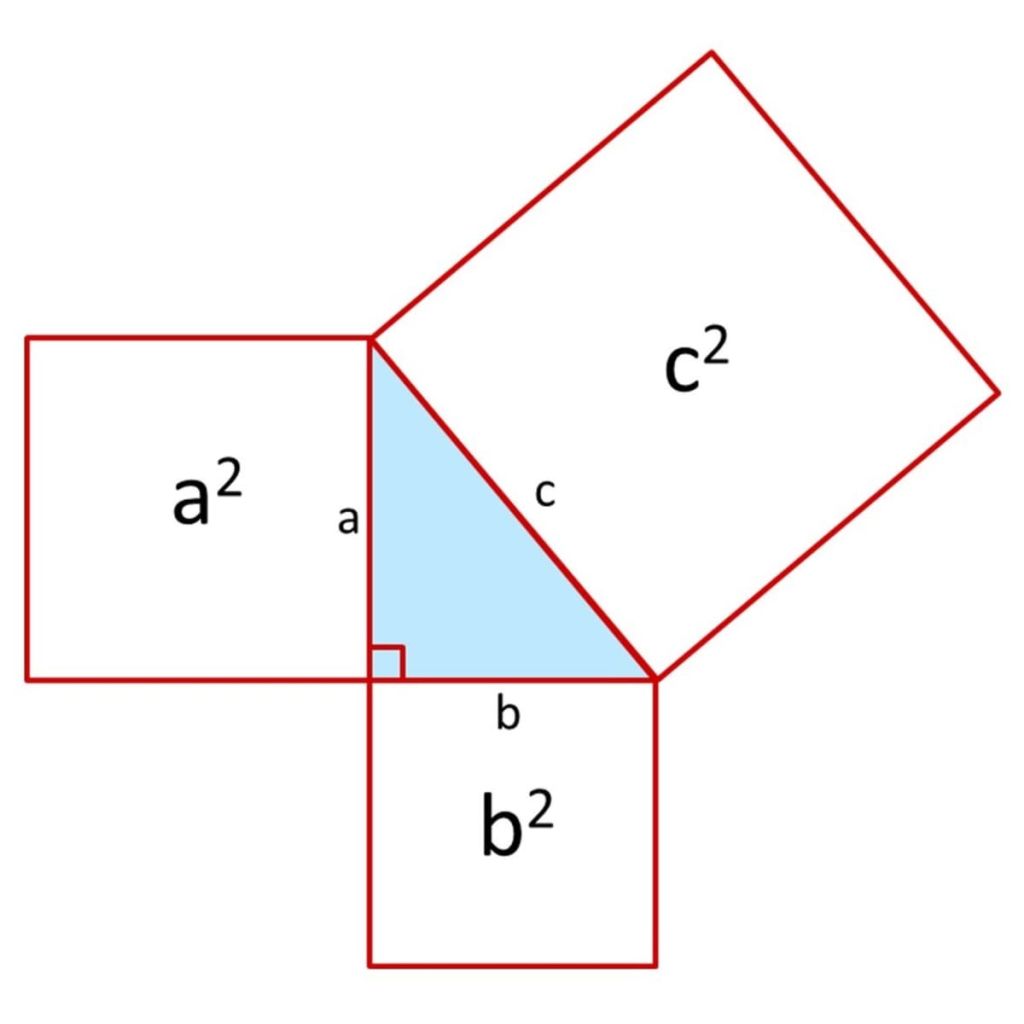
This geometric structure explains why no object with mass can ever reach the speed of light. As velocity increases, momentum increases, and so does the total energy required to keep accelerating. The rest-mass term (mc²) acts as an irreducible floor that the momentum term can never outrun. The hypotenuse is always longer than either side — meaning total energy always exceeds momentum energy, and you can never fully convert an object's mass into pure forward motion.
For a massless photon, the rest-mass term drops out completely (m=0, so mc²=0), and the equation simplifies to:
Energy equals momentum multiplied by the speed of light. Light has no mass, but it does have energy — and all of that energy is carried as momentum.
Moving Objects and Momentum
Before asking how a massless particle can carry momentum, it helps to build intuition about what momentum is.
Imagine pushing a stalled car. At first, the effort is enormous — the car feels impossibly heavy. But as the wheels start rolling, it becomes easier. The car has not lost any weight, but it has gained velocity, and the combination of mass and velocity gives it momentum (p). The standard formula is:
Momentum is the product of mass and velocity. The heavier the object or the faster it moves, the harder it is to stop. This intuition works perfectly for cars, cannonballs, and planets. But it breaks down completely for light.
Now here is the problem: a photon has no mass. According to p = mv, its momentum should also be zero. Yet we know experimentally that light exerts a measurable pressure — sunlight can push a solar sail. How can something with no mass have momentum?
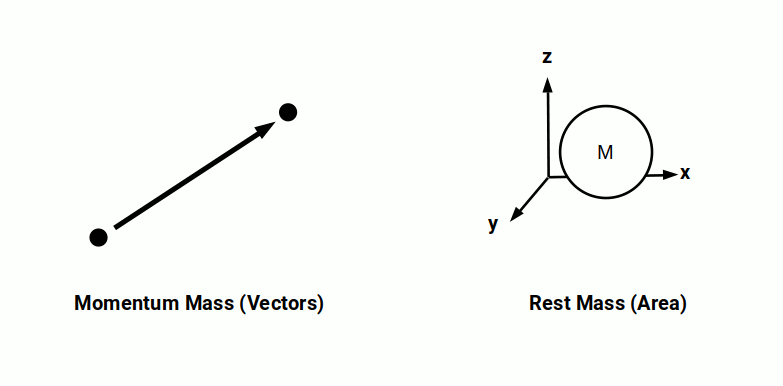
The resolution comes from treating light as a wave rather than a particle. A wave moving through water carries momentum without the water itself moving in the direction of travel — the wave is a pattern of energy propagation through a medium. For light, the momentum is:
A photon's momentum is its energy divided by the speed of light. The higher the frequency of the light, the more energy each photon carries, and therefore the more momentum it has. Blue light carries more momentum per photon than red light, which is why radiation pressure varies with wavelength.
Quantised Reality: Why Light Comes in Packets
There is another layer to the puzzle. Experimental results in the early twentieth century revealed that electromagnetic energy does not flow continuously like water from a tap; it is emitted and absorbed in discrete chunks. This is quantisation — energy comes in minimum-sized packets that cannot be subdivided.
This was famously resolved by Max Planck, who found that multiplying a wave's frequency (f) by a constant (h, now called the Planck constant) accurately predicted the energy of each light packet:
A photon of blue light (high frequency) carries more energy than a photon of red light (low frequency), and the ratio between them is set by h. Despite being one of the most precisely measured constants in all of science (h ≈ 6.626 × 10⁻³⁴ joule-seconds), physics has no fundamental derivation for why this value is what it is. We know the formula works; the theoretical reason remains an open question.
The quantisation of light posed a further philosophical problem. The original argument for treating light as a particle (the photon) was that no medium for a wave had ever been identified in empty space. A wave, by classical reasoning, needs something to wave through — as sound needs air, and water waves need water. In the vacuum of space, there is apparently nothing.
And yet, if light is a particle travelling in a single straight line, that contradicts the directly observed behaviour of light diffracting, interfering, and spreading as a sphere from its source. The uncomfortable compromise adopted by standard physics is wave-particle duality: light behaves as a wave in some experiments and as a particle in others, and we are told not to ask which it really is.
A 4D Geometric Solution
We propose a different route out of this impasse. Rather than treating wave-particle duality as an irreducible mystery, the 4th-dimensional geometric model reframes the question entirely.
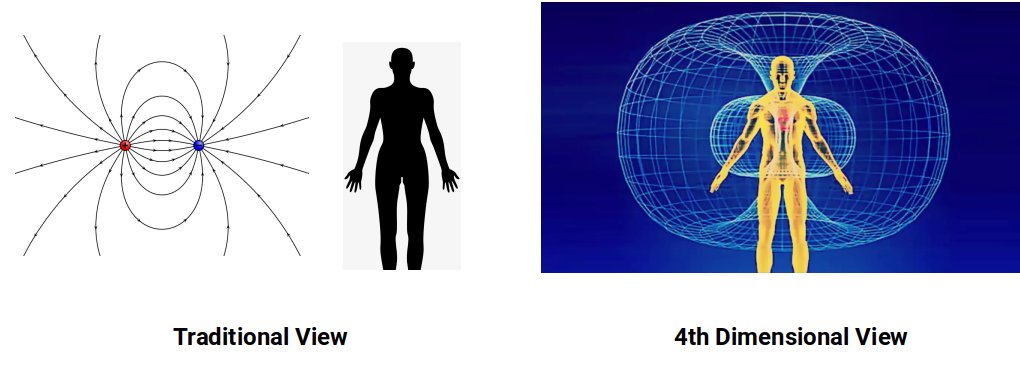
The core idea is that the electromagnetic field is a 4-dimensional phenomenon, not a 3-dimensional one. In the same way that a 2D shape can exist inside a 3D space (but a 3D object cannot fit inside 2D space), a 4D electromagnetic field naturally contains the 3D world of matter. Every piece of matter is, from this perspective, a region where the 4D field intersects or "passes through" 3D space.
This has a direct bearing on the mass question. In the 4D view, a stationary object is one where the surrounding electromagnetic field is in a state of rest relative to 3D space. Apply the standard E=mc² formula, and the inert field energy corresponds to rest mass. A photon, however, is never stationary in 3D space; it is a propagating ripple in the 4D field. It does not possess the "resting" condition that rest mass requires — which is precisely why its rest mass is zero.
Quantisation Through Nested Toruses
The torus (donut shape) plays a central role in this 4D model. A torus can be thought of as the 3D cross-section of a 4D sphere. By nesting toruses of different sizes inside each other, the model naturally produces the discrete energy levels observed in light and in electron orbitals — without needing to impose quantisation as an arbitrary external rule.
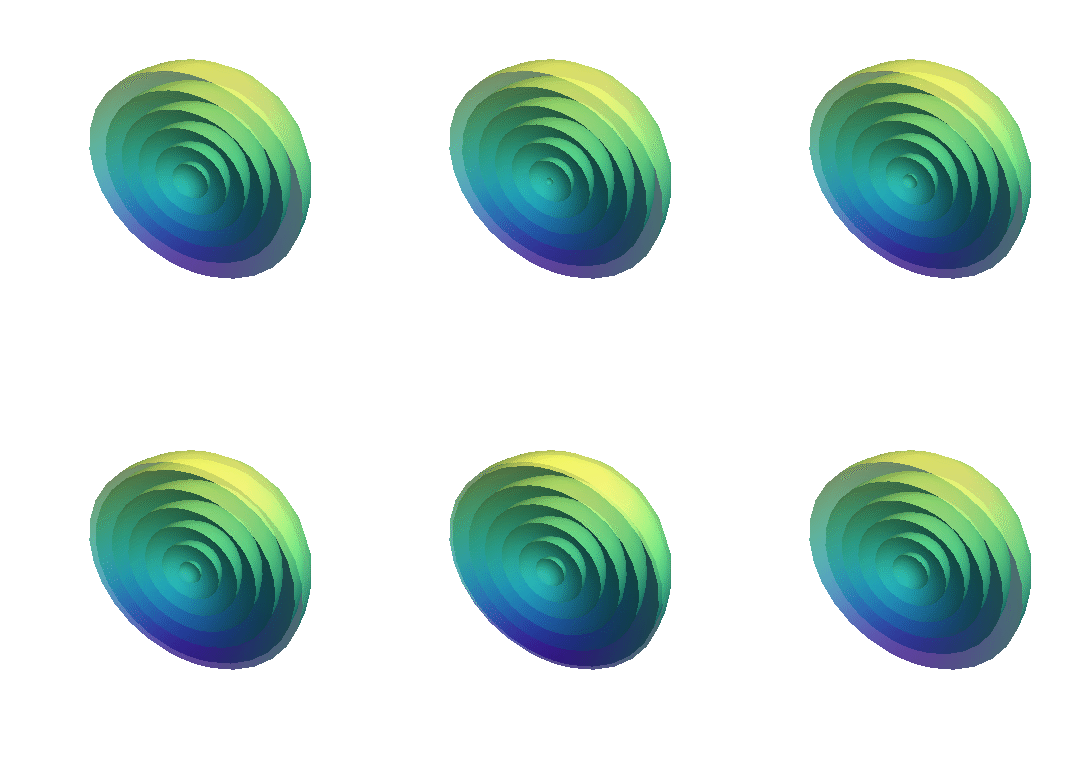
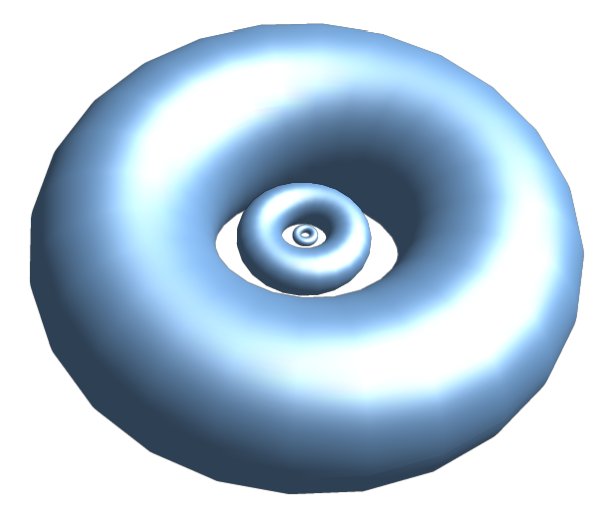
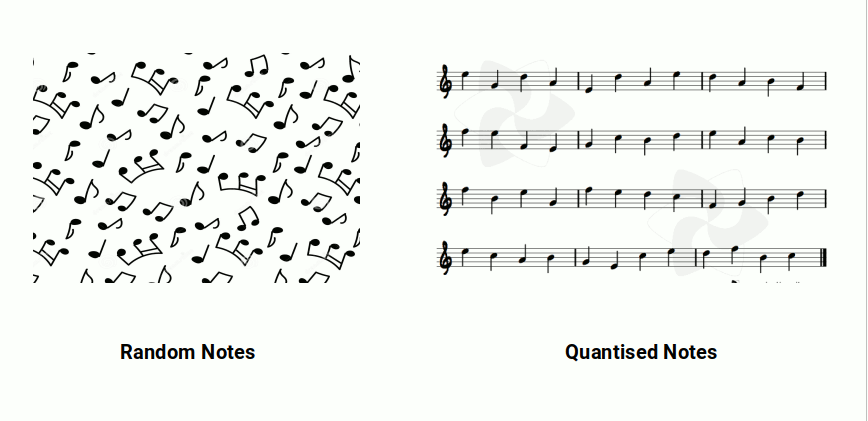
In this picture, the "medium" that carries the wave is 4-dimensional space itself — a 4D Aether that does not require a detectable wind (as the classical 3D Aether was wrongly assumed to do) and does not contradict the Michelson-Morley experiment. The medium propagates waves in quantised packets, which automatically satisfies the conditions Planck's constant describes — and explains why quantisation exists rather than merely asserting that it does.
The same nested-torus structure that produces quantised light also produces the discrete electron shells of atoms. This is not a coincidence in the 4D model; it is the same underlying geometry expressing itself at different scales. The Atomic Geometry framework develops this further, producing a geometric model of atomic radii that more closely matches experimental values than the Bohr model across all stable elements.
Conclusion
Light has no rest mass because it is never at rest. The familiar E=mc² applies only to stationary objects; for a moving object, momentum must be included via the full equation E²=(mc²)²+(pc)². When the rest-mass term is zero — as it is for the photon — all of the energy is carried as momentum, giving E=pc.
But this raises an immediate paradox: momentum classically requires mass. The wave interpretation resolves this, since a wave carries momentum through its medium. The puzzle then becomes: what is the medium in empty space?
The standard answer — wave-particle duality — sidesteps the question rather than answering it. The 4D geometric model offered here provides a more satisfying resolution. Treating the electromagnetic field as a 4-dimensional structure means that light is inherently massless (it never occupies the resting configuration that generates rest mass), that quantisation emerges naturally from nested-torus geometry rather than being imposed by an unexplained constant, and that the wave's medium is 4D space itself.
The zero mass of light is not an anomaly to be explained away. It is a direct signature of the 4-dimensional nature of electromagnetism — and one of the clearest pointers we have towards a deeper geometric understanding of reality.
For the companion articles in this series, see why the speed of light is constant, the speed of sound and light ratio in the primordial universe, and the secret of lasers. For the quantum story of how light and matter exchange energy, see the Ultraviolet Catastrophe and the Planck constant.
FAQ
I thought the Aether theory was disproven?
It was never proven to exist, but neither was it definitively disproven. The classical concept of the Aether expected a measurable 'Aether Wind', which experiments like Michelson-Morley failed to detect. A 4D Aether would not produce such a wind, and would transmit waves in quantised packets — neatly solving the ultraviolet catastrophe without the shortcomings of the 3D model.
How does 4D geometry unify matter and the electromagnetic field?
Just as a 2D surface can exist inside a 3D space (but not the reverse), a 4D electromagnetic field naturally contains the 3D world of matter. From this perspective, matter is a localised expression of the electromagnetic field — which is why energy and mass are interchangeable via E=mc².
Why does the full energy equation include momentum?
Einstein's famous E=mc² applies only to a stationary object. Once something is moving, its total energy includes a momentum contribution, giving the full equation E²=(mc²)²+(pc)². For a massless photon, the rest-mass term is zero, leaving E=pc — energy carried entirely by momentum.
What is the Planck constant and why does it matter for light?
The Planck constant (h ≈ 6.626×10⁻³⁴ J·s) sets the scale at which energy is bundled into discrete packets. Multiplying it by a wave's frequency gives the energy of a single photon: E=hf. Despite being one of the most precisely measured constants in physics, its theoretical origin remains unexplained by the standard model.