Introduction
We experience reality in three dimensions. But three dimensions are not enough to explain the atom, the behaviour of light, or the geometry of the quantum vacuum. 4D thinking is the practice of expanding our conceptual framework into the fourth dimension — treating time not as a linear sequence but as a geometric shape that participates in the structure of reality.
This is not an abstract exercise. Our 4D models of the atom, the aether, and the wave nature of light all begin with the same move: applying fourth-dimensional geometry to physical problems that three-dimensional models leave unresolved. The results are models that are simpler, more accurate, and more unified than their mainstream counterparts.
Key Takeaways
- 4D thinking treats time as a geometric shape — the torus — rather than a linear progression, unifying physics and geometry in a single framework
- The torus appears at every scale from the electron cloud to the galaxy, suggesting it is the fundamental geometry of space itself
- The hypercube (tesseract) models quantum discreteness: each moment in time is the tesseract cycling between its two states — matter and energy field
- The 4D aether resolves longstanding problems in physics — wave propagation through the vacuum, [wave-particle duality](/is-there-an-alternative-to-wave-particle-duality/), and the Aufbau anomalies — through geometry rather than additional mathematical postulates
- 4D thinking is both a scientific framework and a cognitive shift: thinking spatially and geometrically reveals structure that algebraic thinking conceals
What is 4D Thinking?
4D thinking is a new interpretation of how time and space are correlated. Normally, we think about reality in terms of 3D space. Yet time needs to be expressed as a shape as well — and that shape has consequences for how we understand physics, consciousness, and the nature of reality itself.
We base our understanding of 4D on the structure of the atom. The electron cloud is not a probabilistic blur but a 4D geometric structure — a torus field. By starting from the atom and working outward, 4D thinking opens the door to new perspectives in physics, chemistry, and ecology.

The Torus
The torus is the most fundamental and prevalent fourth-dimensional shape in nature. It appears at every scale — from the electron cloud of the atom to the magnetic field of the Earth to the structure of galaxies.
In simple terms, the torus can be described as a dot that expands into a circle, which then collapses back into a dot — a continuous self-referential motion. There are three main types of regular torus, each defined by the spacing between the two circles that form its ring.
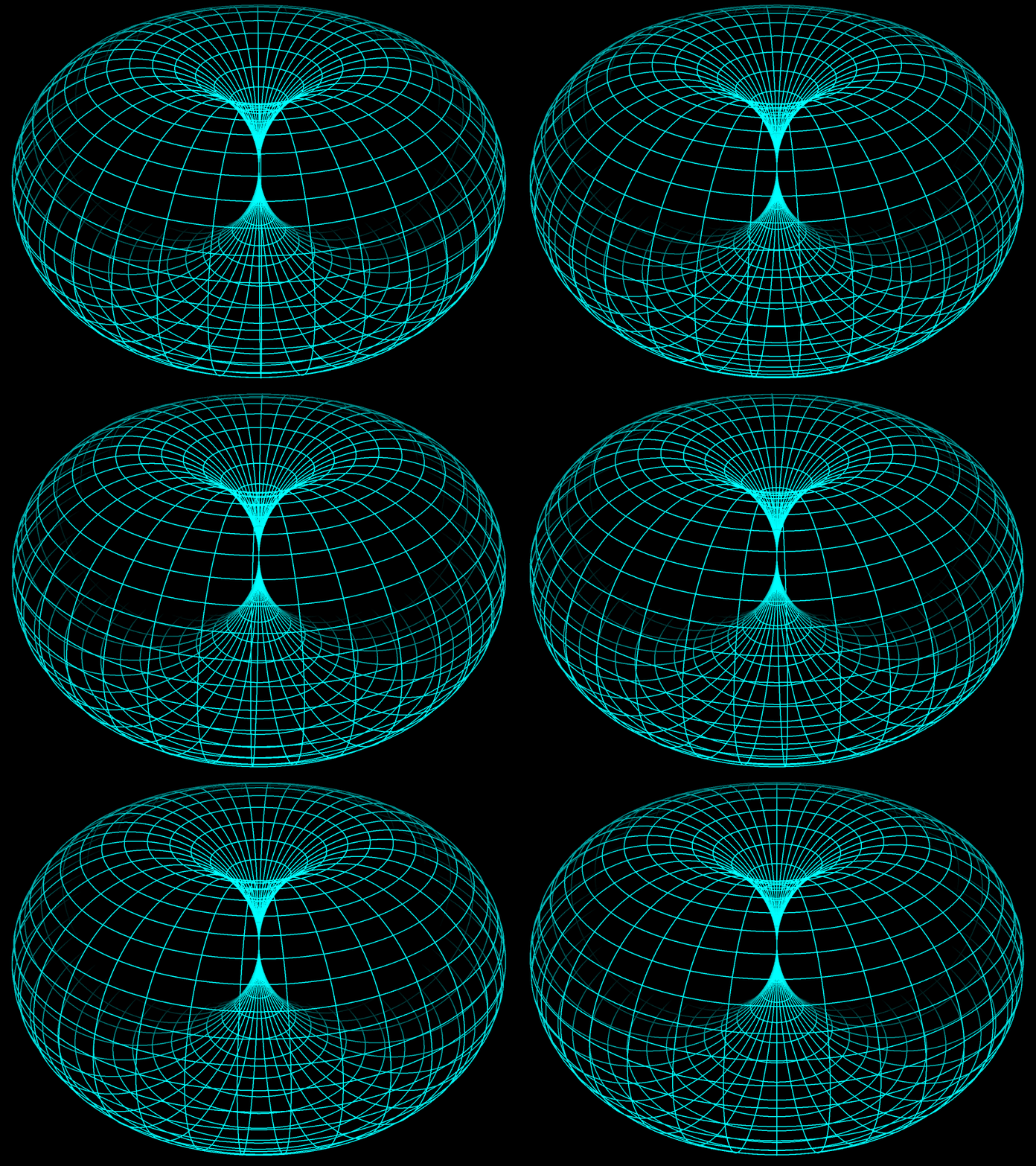
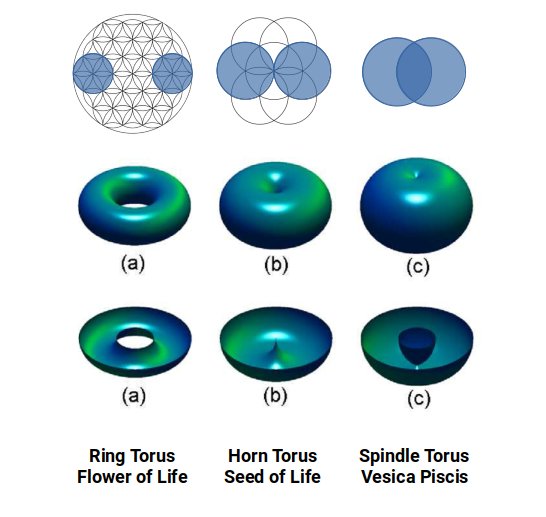
When the two circles of a torus are superimposed, they produce the 4D sphere — two spheres occupying the same 3D space and swapping places over time. As the circles are moved apart, the 4D sphere expands into the three torus types. In this way, the torus is a dynamic shape: it is not just a geometric form but a temporal process.
The Torus and the Universe
The Earth's electromagnetic field — generated by its rotating iron core — is the most visible example of a toroidal field in everyday experience. Birds and other animals navigate using this field. Mobile phone signals propagate through it. The near field around any antenna forms a torus; the signal must overcome this boundary before expanding as a wave at the speed of light.
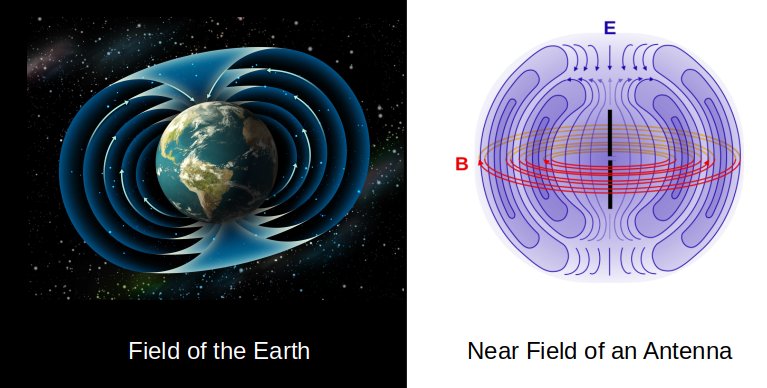
The torus appears at every scale of the universe: the electron cloud of the atom, the energy fields of biological cells, the magnetosphere of the Earth, the heliosphere of the solar system, and the structure of galaxies.
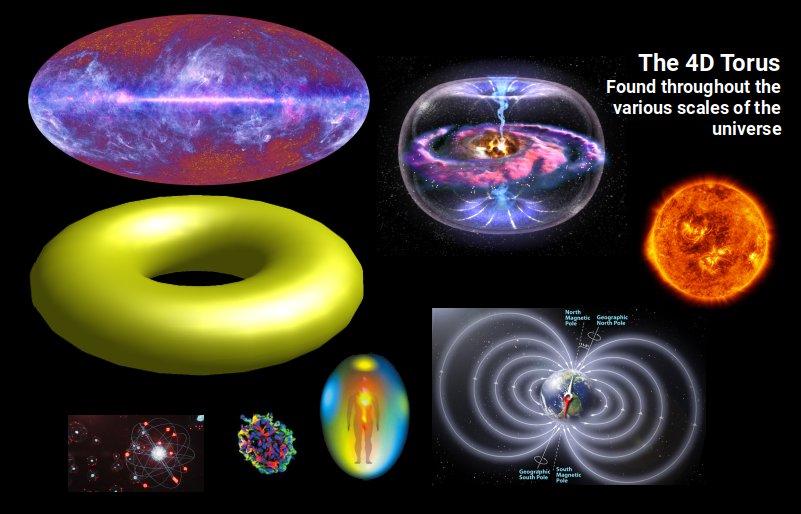
4D is Space and Time
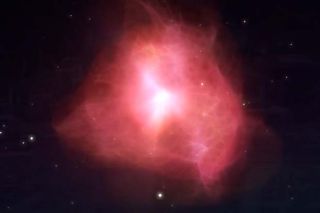
Science agrees that we live in three-dimensional space. This is observable in the behaviour of a compressed gas released into an environment: the molecules expand along the x, y, and z axes. The same three-dimensional expansion is visible at astronomical scales in the stellar nebulae from which stars and galaxies form.
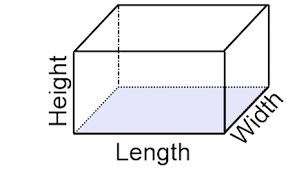
The dimensional sequence is well established: zero dimension (a point), first dimension (a line), second dimension (a plane), third dimension (a volume).
The fourth dimension is considered by mainstream physics to be time. But how is time expressed as a shape? The answer is found in the nature of 4D geometry. In the case of the torus, the shape is always in motion — switching between two states (dot and circle, contracted and expanded). This continuous self-transformation is what endows 4D shapes with both spatial and temporal qualities simultaneously.
What is Time?
Time is the change from one moment to the next — and this change can be explained geometrically by the nature of the torus. A dot at the centre of the torus field expands outward, circulates through the toroidal surface, and returns to collapse back into the dot. Each complete cycle is one moment.

This is precisely like a film rendered frame by frame: each frame is a complete moment, and the experience of time arises from their sequence. Reality is quantised in the same way — not a continuous flow but a rapid succession of discrete geometric states.
The Hypercube
The torus is not the only fourth-dimensional shape. The hypercube — or tesseract — is the 4D analogue of a cube, and it provides the geometric model for the quantisation of matter itself.
In 3D, the tesseract appears as a small cube nested inside a larger one. A 3D cube can be rotated on the x, y, and z axes; a 4D cube can additionally rotate on the w-axis — and when it does, the two cubes swap places.

In the reality model proposed by 4D thinking, the inner (smaller) cube represents matter — the things that can be touched and measured. The outer cube represents the energy field surrounding it. At the Planck scale, these two swap places at every quantum moment. We experience only one state at a time — matter is always surrounded by its field, and the field continuously returns to matter. Quantum discreteness is the geometric consequence of this 4D exchange.

The majority of solid compounds fall into crystal lattices based on the Cube, Octahedron, or Cuboctahedron — or combinations of these. These are precisely the forms that appear in the tesseract's transformation sequence, connecting the geometry of everyday matter to the 4D framework of time.
The 4th Dimensional Nature of Energy
Current quantum physics is built on the concept of vector particles moving through space. A vector is one-dimensional — and trying to map an infinite number of vectors to describe reality is inherently incomplete. Reality is not only one-dimensional: it is a nested structure of dimensions from zero to at least five, as described in the 4D Aether theory.
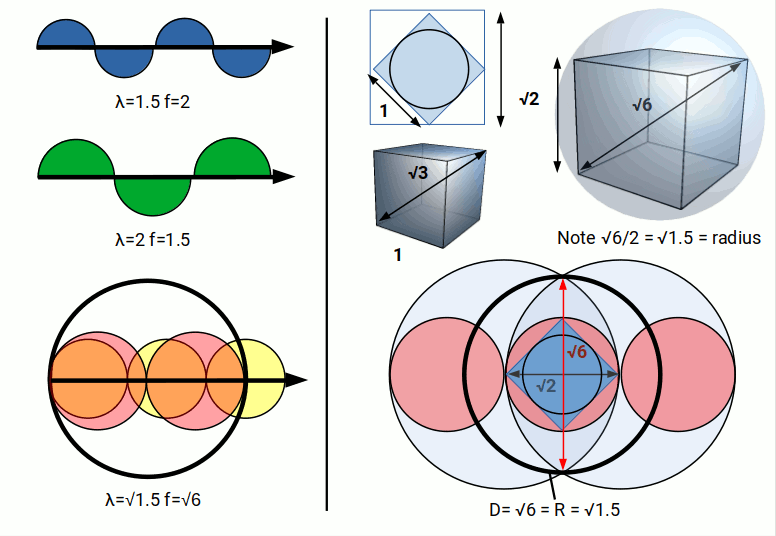
One of the central problems in physics is how light propagates through the vacuum of space. Einstein resolved this with the photon particle — reintroducing a particle concept that earlier wave theorists had explicitly rejected. Before Einstein, the aether was the accepted medium for wave propagation. Its apparent undetectability led to its dismissal.
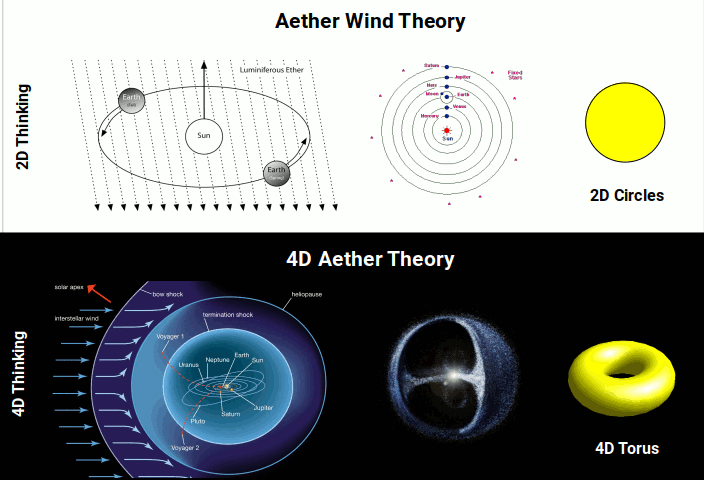
From the 4D perspective, the aether's undetectability is not a flaw but a consequence of its geometry: a 4D medium is incompressible in 3D space. The Quantum Foam, Zero Point Energy, and Cosmic Microwave Background are all descriptions of the same 4D geometric substrate — the field that carries energy through the vacuum without the need for particle postulates.
Transforming Shapes
The fundamental characteristic of the fourth dimension is transformation. The torus transforms from dot to circle; the tesseract shifts between its two cubic states. All 4D shapes are defined not by static form but by the motion between states.
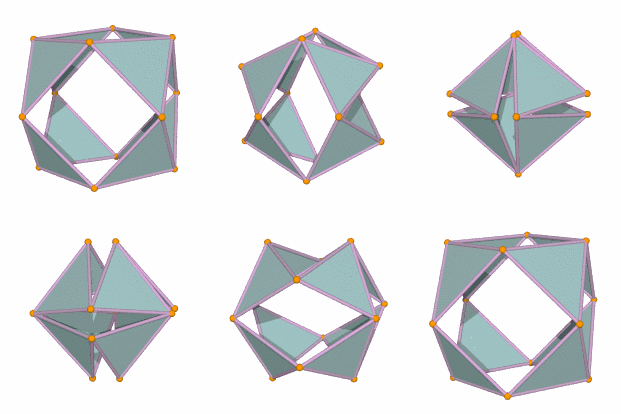
Buckminster Fuller identified the Jitterbug transformation — the collapse of the Cuboctahedron through the Octahedron to the Tetrahedron — as a fundamental geometric motion. We extend this model, proposing that the transformation continues beyond the Cuboctahedron through five stages.

The morphing of shapes from one state to another is the mechanism by which information is transferred between quantum shells without occupying the intermediate states. Electrons do not fall between shells because the spaces between them are geometrically forbidden — the 4D field has no intermediate stable states, only the discrete forms of the transformation sequence. For the full treatment of this mechanism, see Geo-Quantum Mechanics and 4D Aether.
Conclusion
4D thinking is a framework in which time is not a backdrop for events but a geometric participant in physical reality. The torus and the tesseract are not abstract mathematical objects — they are the forms that structure the atom, the moment, and the vacuum. By adopting 4D thinking, physics moves from a description of observed phenomena to an explanation of why those phenomena are what they are: geometry is the mechanism.
This framework connects naturally to Atomic Geometry, Geo-Quantum Mechanics, 4D Aether, and Geometric Thinking — together forming a unified geometric account of physical reality.
FAQ
What is 4D thinking?
4D thinking is a way of understanding reality that treats time not as a linear sequence but as a geometric shape — specifically the torus. By thinking in four dimensions, we can understand phenomena that 3D models leave unexplained: wave-particle duality, the structure of the quantum vacuum, and the geometric regularity of the periodic table. It is also a cognitive shift: thinking geometrically rather than algebraically reveals structural patterns that mathematics alone conceals.
What is a torus and why is it the key 4D shape?
A torus is a closed, self-referential surface — the shape of a doughnut. In four dimensions, the torus describes a continuous energy flow from one pole through the centre and back to the other. It is the geometry of the S-orbital electron cloud, the Earth's magnetic field, the solar wind, and galactic structure — the same shape appearing at every scale. This universality suggests that the torus is not merely a useful model but a fundamental feature of the geometry of space itself.
How does the torus explain the electron cloud?
In Atomic Geometry, the S-orbital — the simplest electron shell — is understood as a 4D torus rather than a sphere. The two electrons in each S-orbital pair correspond to the north and south poles of a toroidal energy flow: one electron sits at each pole, connected by the continuous circulation of the field through the nucleus. This resolves the mystery of why electron pairs always appear with opposite spins: they are the two poles of the same 4D field.
What is the hypercube (tesseract) and what does it represent?
The hypercube — or tesseract — is the four-dimensional analogue of a cube. In 3D, it appears as a small cube nested inside a larger one, with the two swapping places when rotated on the fourth (W) axis. In the 4D thinking framework, the hypercube represents the quantisation of reality: the inner cube is matter (the things we can touch and measure); the outer cube is the energy field surrounding it. Each moment in time is the tesseract shifting from one state to the other — a geometric model of quantum discreteness.
How does 4D thinking relate to the quantum vacuum and aether?
Modern physics acknowledges that the vacuum of space is not empty — it contains the Quantum Field, Zero Point Energy, and the Cosmic Microwave Background. The 4D Aether theory proposes that this energy is geometric: structured as a 4D field of torus and hypercubic forms. The reason the aether was historically undetectable is that it operates in the fourth dimension — incompressible in 3D space, but active as the geometric substrate through which matter and energy exchange occurs.