Introduction
Modern science is more powerful than ever. We split atoms, map galaxies, edit genes and build machines that write poetry.
And yet, at its very foundations, science has a problem it rarely talks about: it no longer speaks one language.
A dozen experts, a dozen languages
A biologist describes reality in molecules and pathways. A chemist in bonds and orbitals. A physicist in fields, forces and wave functions. A mathematician in sets, axioms and symbols. A philosopher in experience and meaning.
Each of them is an expert. Each sees something true. But their languages hardly translate into each other, and the deeper you go, the less they fit together.
Mathematics is supposed to be the common language of science. Galileo said the book of nature is written in it, "and its characters are triangles, circles, and other geometric figures." But somewhere along the way, mathematics lost the triangles and circles. It became symbols on a page: abstract, powerful, and invisible.
The cracks in the foundation
Look at where science stands today, in mainstream science's own words:
- Two theories that won't meet. General relativity describes gravity and the large-scale universe. Quantum mechanics describes the very small. Both are tested to extraordinary precision, and they flatly contradict each other. A theory of quantum gravity, the holy grail of physics, is still missing after a century.
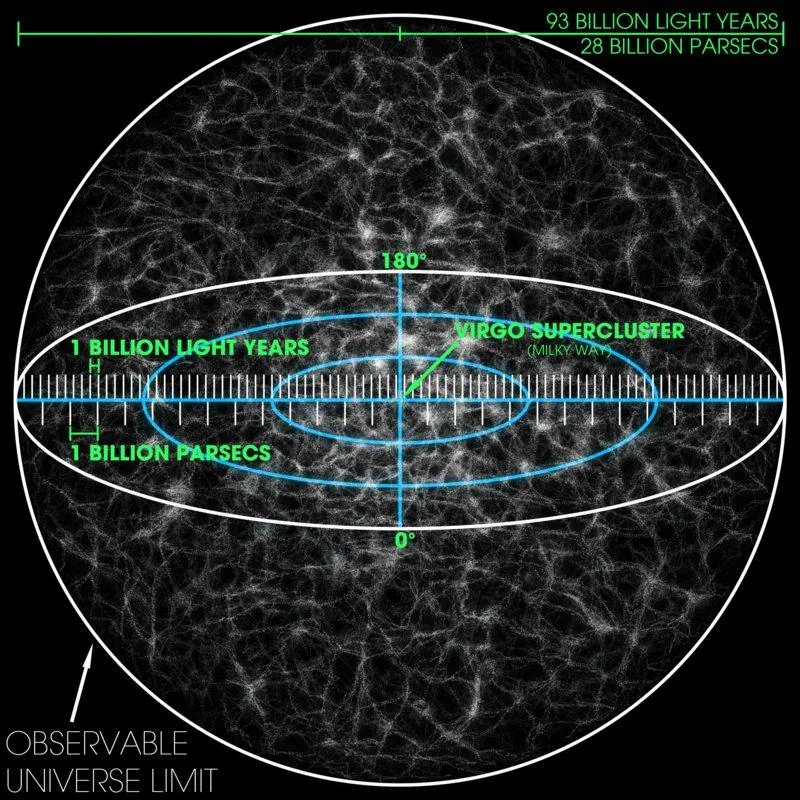
- 95% of the universe is "dark". According to the standard cosmological model, ordinary matter makes up only about 5% of the universe. The rest is dark matter (about 27%) and dark energy (about 68%): placeholders for things nobody has directly detected.
- The universe expands at two speeds. Measured from the early universe, the expansion rate (the Hubble constant) comes out at around 67 km/s per megaparsec. Measured from nearby stars, it's around 73. This "Hubble tension" has survived years of ever better data. New dark-energy results from the DESI survey have deepened the puzzle rather than solved it.
- Light is "both". A century after quantum theory, we still describe light as a wave and a particle, depending on how we look. Wave–particle duality works in practice, but it doesn't explain anything.
- The worst prediction in physics. Quantum theory's estimate of the energy of empty space is off from what astronomers observe by a factor of around 10¹²⁰.
- Even mathematics is incomplete. Russell's paradox (1901) shook the foundations of set theory. Gödel (1931) proved that any consistent mathematical system rich enough for arithmetic contains truths it cannot prove.
These are not fringe complaints. They're the open problems listed in textbooks. The usual response is to add something: a new particle, a new field, a new axiom, a new dimension curled up too small to see.
We think the problem lies deeper, in the picture of space itself.
How geometry was lost
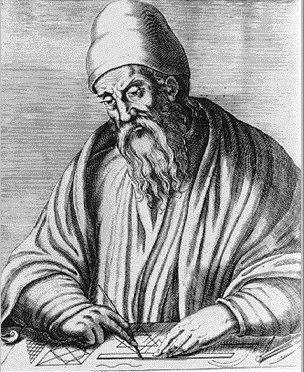
For about two thousand years, from Pythagoras and Plato to Euclid and Kepler, geometry was science. Euclid's Elements (around 300 BC) was the model of certain knowledge: start from a few simple axioms you can draw, and build everything from there.
Then, step by step, the picture disappeared:
- Calculus made science symbolic rather than spatial.
- In 1854, Bernhard Riemann laid out geometries of curved spaces that bend and stretch in ways no one can draw.
- In 1908, Hermann Minkowski merged space and time into one four-dimensional "spacetime": "Henceforth space by itself, and time by itself, are doomed to fade away into mere shadows."
- In 1915, Einstein built general relativity on that mathematics: gravity as curved spacetime.
Mathematically, this was brilliant, and its predictions are precise. But the universe became geometrically invisible. You can calculate Minkowski's spacetime, but you can't picture it. Its "fourth dimension" isn't a direction in space at all, it's time, entered with a minus sign.
Our proposal: Euclid, extended
In2Infinity takes a different route: go back to Euclidean geometry, and extend it into higher dimensions, applying it consistently, from the atom to the cosmos.
The universe is 99% space. That space has structure. And that structure is geometric.
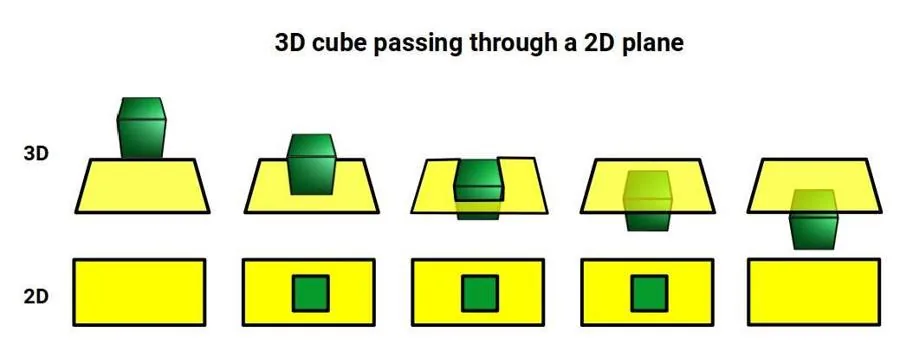
In this framework, the fourth dimension is a direction in space, as real as length, width and height, not a time coordinate. A flat 2D being would only see slices of a 3D cube passing through its world. In the same way, we see 3D "slices" of 4D forms.
From there, the old paradoxes start to look different:
- Time isn't a fourth axis. We propose that what we experience as time is the rate of rotation of a 4D object in 3D space, rendered in discrete frames. → 4D Aether
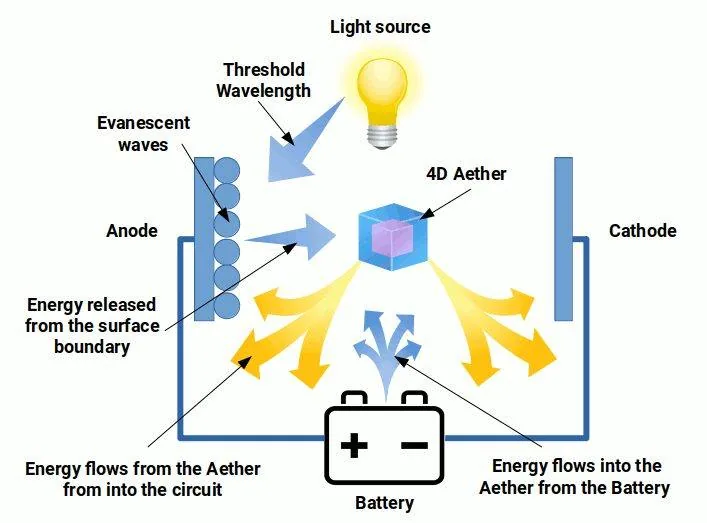
- Light doesn't have to be two things at once. In our model, light is always a wave in a structured 4D medium, the Aether, and its "particle-like" packets come from the geometry of that medium. → Is there an alternative to wave–particle duality?
- Empty space isn't empty. The vacuum has measurable properties (it sets the speed of light), which we read as the signature of a geometric medium. → Why is the speed of light constant?
- Cosmology may not need invisible ingredients. We propose a 4D geometric model of the universe that expands and contracts at once, without dark energy or inflation. → Did the Big Bang happen?
A new foundation for mathematics
If geometry is the language of nature, mathematics should be built on it, not the other way round.
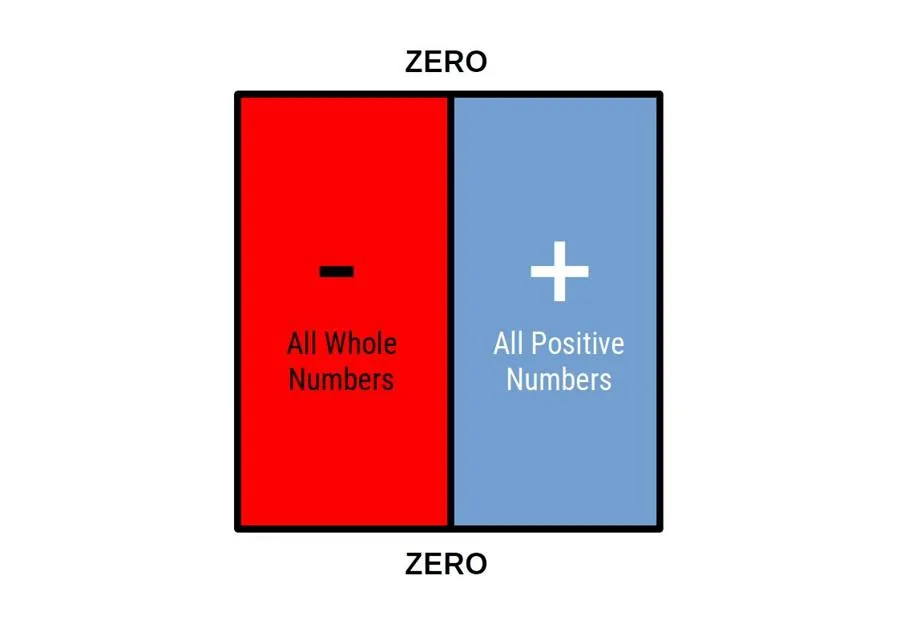
That's why we've proposed new axioms for mathematics, starting not from abstract sets but from a single point in infinite space. From that point, division creates polarity. Polarity gives rise to addition and subtraction, and numbers become positions and rotations you can draw. In this picture:
- zero and one are not just quantities but boundaries,
- the number line is really a square, and imaginary numbers are rotations within it,
- and paradoxes like Russell's can be explained geometrically, rather than banned by an extra axiom.
→ Geometric Maths: axioms and definitions · Theory of Geometric Maths
The same goes for physics. Strip away the human units (metres, seconds, kilograms) and many constants of nature turn into simple ratios that can be drawn with a compass. We call this Dimensionless Science: units are the scaffolding, ratios are the building.
Fractals: geometry returns through the computer
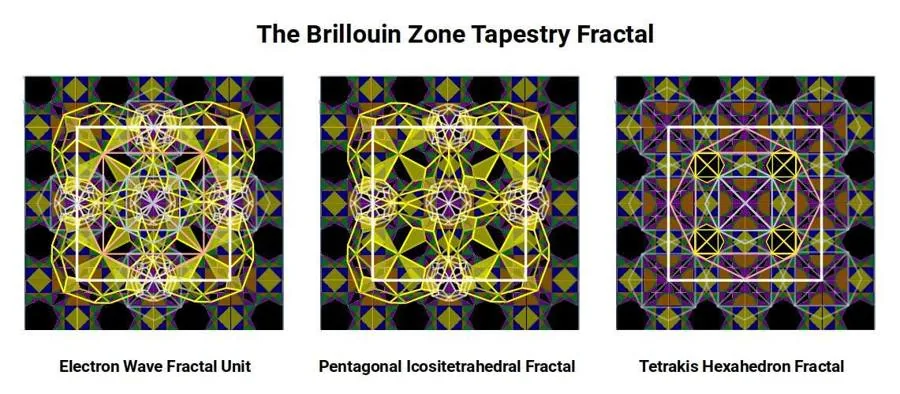
Interestingly, geometry already made a comeback, through the computer. In the 1970s, Benoît Mandelbrot used computers to reveal fractals: shapes that repeat themselves on every scale, from coastlines to clouds to blood vessels. It was a geometry that could only be seen once machines could draw it.
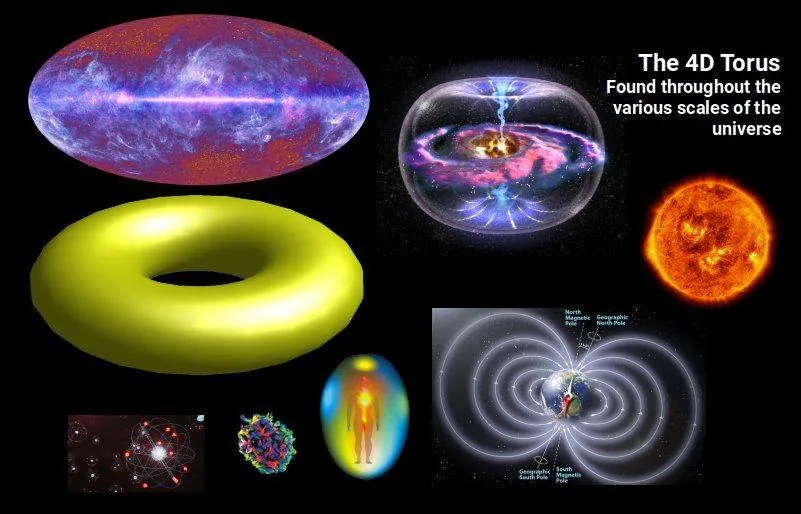
In our work, fractal patterns show up again and again: in the harmonic ratios of musical intervals, in the structure of crystals, and in the idea of the universe as a fractal, holographic whole, where the same geometry repeats from the atom to the cosmos.
And now: AI thinks in Euclidean space
Here's something most people don't realise. The AI systems everyone is talking about think in geometry.
A large language model turns every word, image and idea into a point in a Euclidean space with thousands of dimensions. Meaning becomes a position. Similar ideas lie close together. Relations between concepts become directions you can move along. The machine "understands" by measuring distances and angles in high-dimensional space.
In other words, the most powerful technology of our time quietly confirms the idea at the heart of our work: higher-dimensional Euclidean space is a natural language for describing complex reality. Not curved, invisible spacetime, but straight lines, distances and angles, just more of them than we can see.
We believe this is only the beginning. A science rebuilt on geometry would be one that humans and machines can share, and one we can picture again.
One language again
We don't ask anyone to throw away a century of measurements. The data is precious. What we question is the picture we've built around it.
Geometry is the one language every field already shares, because everything (an atom, a cell, a thought, a galaxy) exists in space. Bring the geometry back, and the biologist, the physicist, the mathematician and the philosopher might finally be talking about the same thing.
That is the aim of In2Infinity: one geometric framework, applied at every scale.
Where to go next: new here? Start with Start Here, explore the Theory, or read the full model in The Geometric Universe. Want to draw it with your own hands? → Da Vinci School