Congratulations
You have completed the Guide to Geometry. From the first line and angle to the elegant world of polyhedra, you now have a foundation in the geometric principles that have shaped mathematics, science, architecture, and art for thousands of years.
Key Takeaways
Part 1 — Foundations
Geometry begins with undefined terms — point, line, plane — and builds upward through axioms and postulates. The tools of classical construction, the compass and straightedge, impose constraints that reveal deep truths. Lines and angles form the vocabulary; parallel and perpendicular relationships form the grammar.
Part 2 — Plane Geometry
Triangles are the simplest polygon and the structural foundation of all geometry. Congruence and similarity give us tools for proving relationships. Quadrilaterals — parallelograms, rectangles, rhombi, trapezoids — extend triangular reasoning into four-sided territory. Regular polygons approach the circle as the number of sides increases. The circle itself introduces π and the elegant relationships between radius, diameter, and circumference. Compass-and-straightedge constructions bridge abstract reasoning and precise drawing, while loci reveal the geometric paths defined by constraints.
Part 3 — Coordinate Geometry
Placing shapes on a numbered grid unites geometry and algebra. The coordinate plane gives us equations for lines, distances, and midpoints. Transformations — reflections, rotations, translations, and enlargements — describe how shapes move and change while preserving key properties, connecting Euclidean proof to the language of modern mathematics.
Part 4 — Solid Geometry
The third dimension introduces prisms, pyramids, cylinders, cones, and the sphere. The five Platonic Solids — tetrahedron, cube, octahedron, icosahedron, and dodecahedron — are the only convex regular polyhedra. Their duals pair them elegantly: the cube with the octahedron, the icosahedron with the dodecahedron, and the tetrahedron with itself. The Archimedean and Catalan solids extend this family with semi-regular forms. Compound polyhedra reveal further symmetries by interpenetrating multiple solids.
Beyond 3D
The guide culminates in 4D geometry — the torus, the hypercube, and the polytopes that extend Platonic reasoning into higher dimensions. These are not abstract curiosities: they connect directly to the geometry of the electron cloud in Atomic Geometry and the structure of space itself.
The Core Insight
Geometry is not a collection of formulas — it is a way of seeing. Every theorem connects to something visible and constructible. The Greeks understood this: geometry was not calculation but demonstration, not numbers but relationships. The same triangle congruence rules that Euclid proved still hold in every engineering drawing, every computer graphics pipeline, every crystal structure. Geometry is the bridge between abstract reasoning and physical reality.
Further Reading
Books
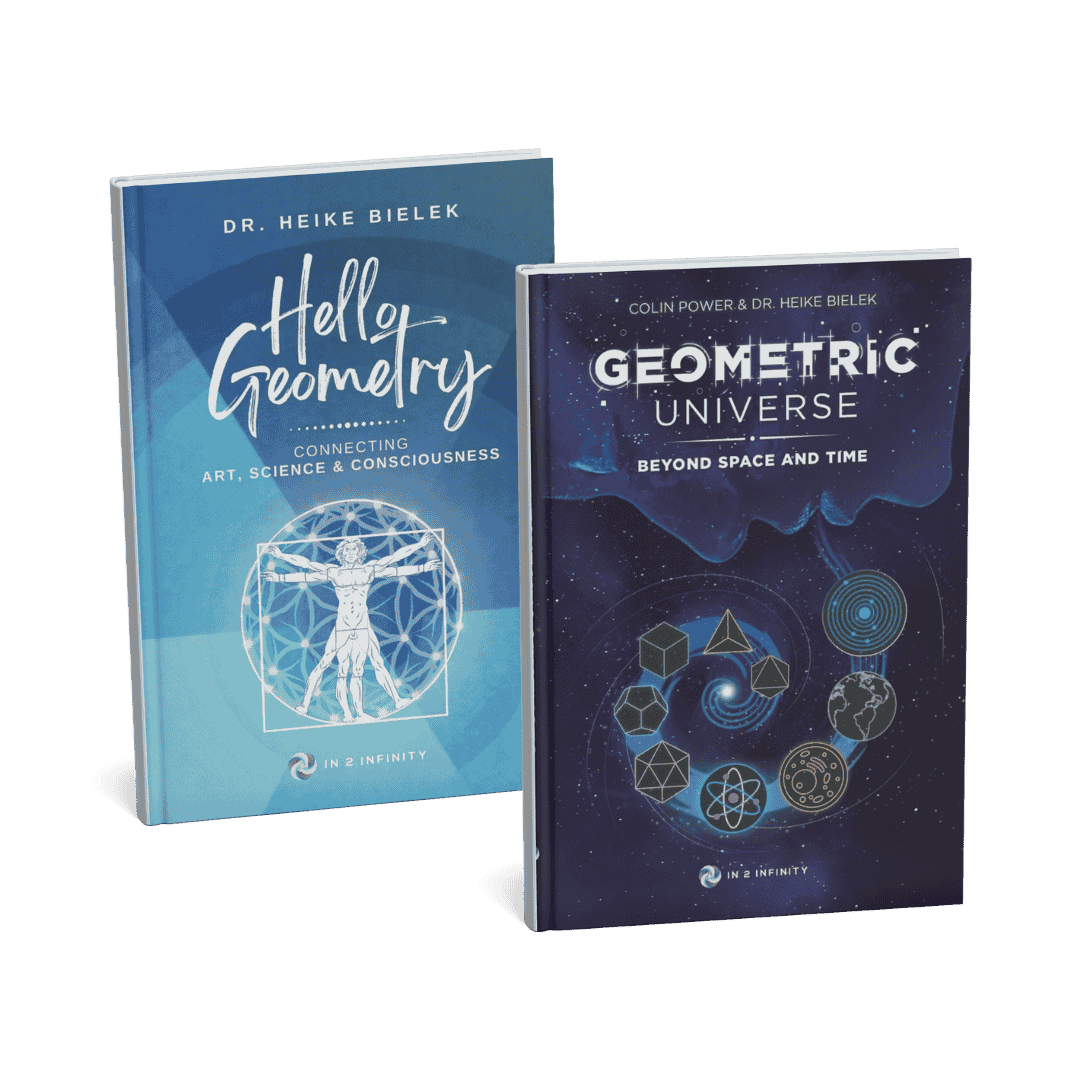
- The Geometric Universe — our complete theory, from number theory through atomic physics to the structure of the cosmos
- Euclid's Elements — the original, still the most rigorous treatment of plane and solid geometry
- Geometry Revisited by Coxeter & Greitzer — elegant problems and deeper theorems
- Regular Polytopes by H.S.M. Coxeter — the definitive text on regular figures in any number of dimensions
On This Site
- The Ultimate Guide to Sacred Geometry — explore the spiritual and philosophical dimensions of geometric form
- Theory Hub — articles on mathematics, physics, astrophysics, and philosophy
- Start Here — an overview of our approach to geometric science
Next Steps
- Construct by hand — use a compass and straightedge to bisect angles, inscribe polygons, and construct the Platonic Solids from nets. Physical construction builds intuition that reading cannot.
- Explore sacred geometry — take the Ultimate Guide to Sacred Geometry to see how the forms you have studied carry deeper meaning across cultures and scales.
- Study the theory — read our articles on number theory and atomic geometry to see how geometric reasoning applies to modern science.
- Look around you — geometry is everywhere. Architecture, crystals, honeycombs, snowflakes, planetary orbits. Once you know what to look for, you will see it in everything.