Introduction
Not all infinities are the same size. In the late nineteenth century, Georg Cantor proved that the set of natural numbers (1, 2, 3, …) and the set of real numbers (all points on a continuous number line) are both infinite, yet the real numbers are provably larger. He labelled the size of the natural numbers ℵ₀ (aleph-zero) — the smallest infinite cardinal — and the size of the continuum of real numbers 2^ℵ₀.
This raised an immediate question: is there an infinite set whose size sits strictly between ℵ₀ and 2^ℵ₀? Cantor believed not. His Continuum Hypothesis asserts that no such intermediate infinity exists — the real numbers are the very next size up from the natural numbers, with nothing in between. The hypothesis became the first on Hilbert's famous list of 23 unsolved problems in 1900. It was later shown by Gödel (1940) and Cohen (1963) that it can be neither proved nor disproved using the standard axioms of set theory — leaving it formally undecided for over a century.
What follows is a constructive counter-example. By systematically adding together the sequential whole-number fractions between zero and one, we produce an infinite set that progresses in half-steps — neither the integers nor the real numbers, but something in between. We call this set Aleph 0.5 (ℵ₀.₅).
Key Takeaways
- The Continuum Hypothesis — unsolved for over 120 years — claims no infinite set exists between the countable integers (ℵ₀) and the uncountable reals. Aleph 0.5 is a constructive counter-example.
- By summing sequential unit fractions row by row (1/1, then 1/2+2/2, then 1/3+2/3+3/3…), the running totals advance by exactly 0.5 at every step, producing the sequence 1, 1.5, 2, 2.5, 3…
- This can be verified algebraically: at step n, the sum equals (n+1)/2 — the half-step pattern holds universally, not just for small cases.
- The 2:1 density ratio between Aleph 0.5 and the whole numbers is the same ratio that explains the critical strip position in the Riemann Hypothesis.
For background on how the numbers between zero and one work, see our article on reciprocal number space.
Constructing Aleph 0.5
The construction is remarkably simple. Take the number line between zero and one, and divide it by successive whole-number fractions. At each step, sum all the fractions from the first part to the last, and record the running total:
| Step (n) | Fractions summed | Total |
|---|---|---|
| 1 | 1/1 | 1 |
| 2 | 1/2 + 2/2 | 1.5 |
| 3 | 1/3 + 2/3 + 3/3 | 2 |
| 4 | 1/4 + 2/4 + 3/4 + 4/4 | 2.5 |
| 5 | 1/5 + 2/5 + 3/5 + 4/5 + 5/5 | 3 |
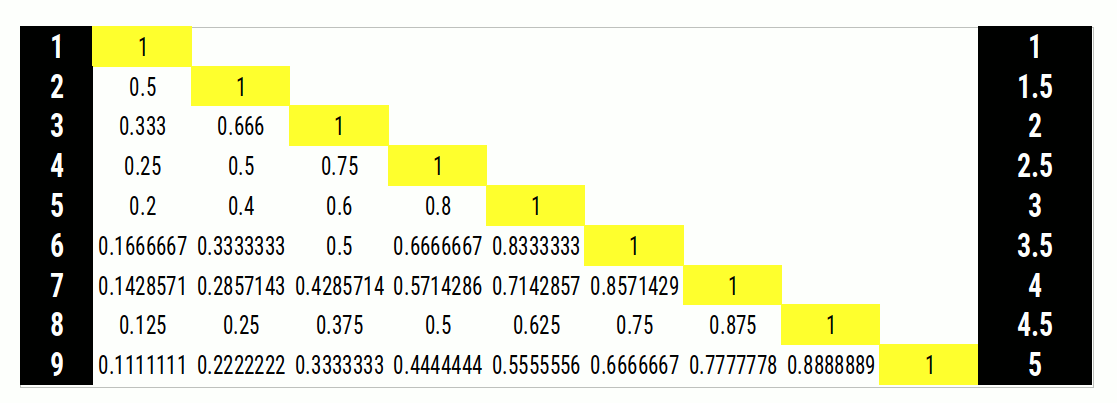
The totals advance by exactly one half at every step: 1, 1.5, 2, 2.5, 3, 3.5, … This is not a coincidence — it can be verified algebraically. At step n, the sum of all fractions from 1/n to n/n equals:
(1 + 2 + 3 + … + n) / n = n(n+1) / 2n = (n+1) / 2
The formula (n+1)/2 produces the half-step sequence for all n, without exception. The pattern is not an observation from a table — it is a mathematical identity.
This establishes a bijection (one-to-one correspondence) between the natural numbers and the Aleph 0.5 totals. The set is ordered, countably infinite — yet it contains exactly twice as many values as the natural numbers for any given interval.
This is ℵ₀.₅: an infinite set that sits between the cardinal numbers and the real numbers in terms of density, directly contradicting Cantor's conjecture that no such intermediate set can exist.
The Structure of the Set
The internal structure of Aleph 0.5 becomes clearer when viewed in two ways: as a fraction table and as successive divisions of the unit interval.
Fraction table
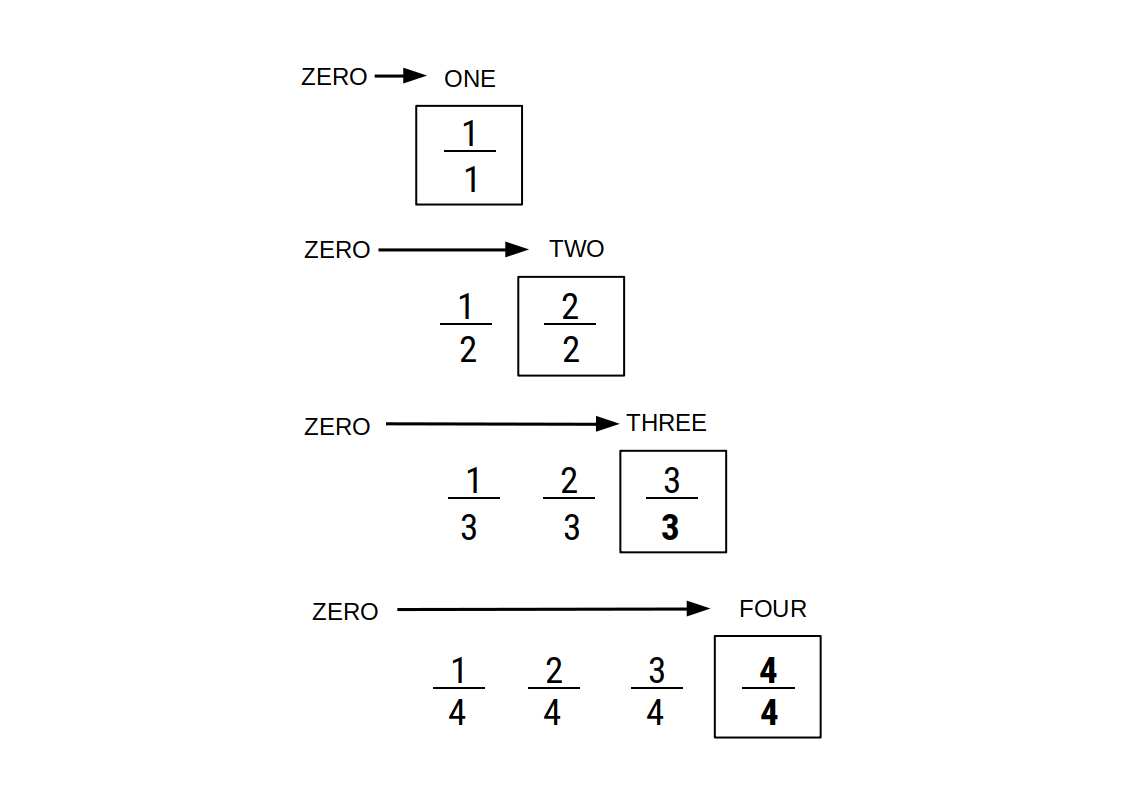
At each stage, the whole-number integer appears as the denominator, while the sequential cardinal numbers form the numerators. Summing all fractions in each row and doubling the result yields the next cardinal number — confirming the exact half-step relationship.
Divisions of reciprocal space
The numbers that constitute Aleph 0.5 live entirely within reciprocal number space — the infinite set of whole-number fractions between zero and one. At each step, the unit interval is partitioned into the next whole number of equal parts, and all parts are summed sequentially.
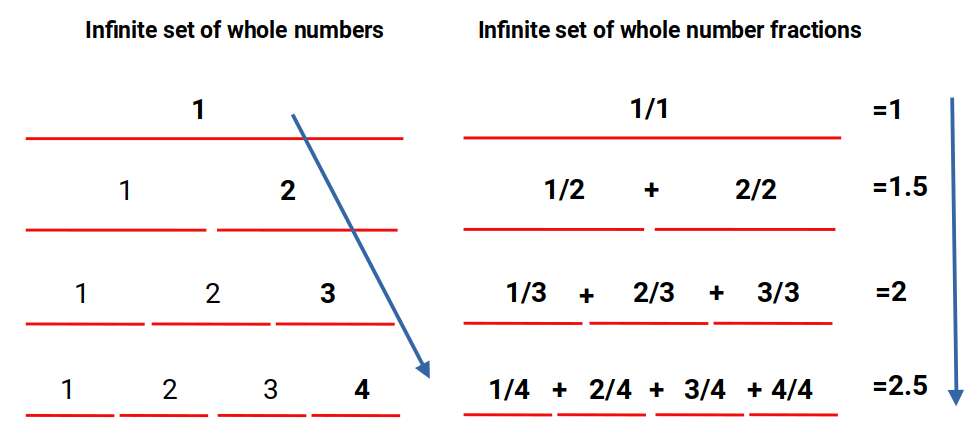
As the whole numbers increase, each individual fraction between zero and one becomes smaller — yet the cumulative sum continues to grow in precise half-steps, never skipping and never deviating. The density of reciprocal number space is exactly double that of whole number space, and it is this 2:1 ratio that drives the entire construction.
Connection to Triangle and Square Numbers
The structure of Aleph 0.5 connects naturally to two classical number series, revealing that it is not an isolated phenomenon but part of the deep architecture of number.
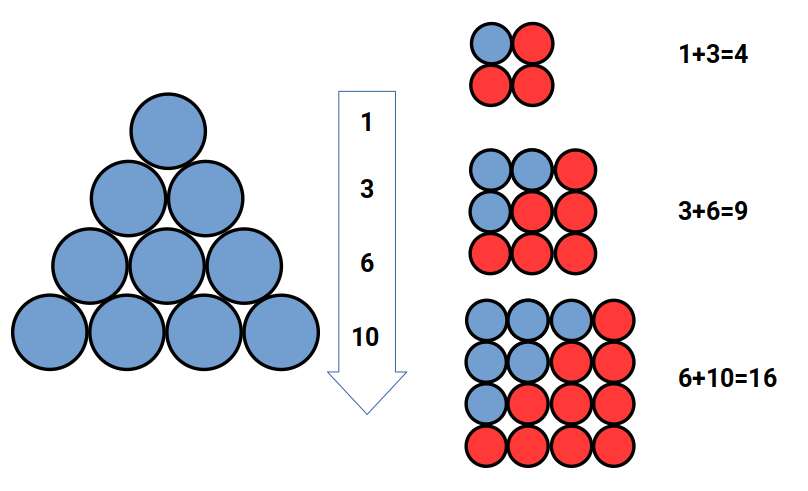
If instead of summing fractions we count how many individual terms have been used up to step n, the running totals form the triangular number series: 1, 3, 6, 10, 15, … — each being the sum of all natural numbers up to that point.
Adding consecutive pairs of triangular numbers produces the square number series: 1, 4, 9, 16, 25, … The square root of each gives back the original natural number. Triangles, squares, and half-steps — three expressions of the same underlying geometric structure.
The Geometric Picture: Bijection and the Metallic Ratios
The most revealing way to see Aleph 0.5 is geometrically, using Cantor's method of bijection on a square plane.
First, consider the 1:1 bijection of the whole numbers with themselves. Setting up two perpendicular axes and drawing diagonal lines between corresponding values fills exactly half of the unit square — a triangular region whose hypotenuse has length √2. This diagonal is the basis of the Silver Ratio (√2 ± 1).
Now perform the bijection between the whole numbers and Aleph 0.5. Because the Aleph 0.5 values are generated from fractions within reciprocal number space, the sequence starts at 1 and diminishes towards zero as the whole numbers increase towards infinity. The filled region is now a quarter of the square — a triangle whose hypotenuse has length √1.25. This shorter diagonal is the geometric basis of the Golden Ratio (√1.25 ± 0.5).
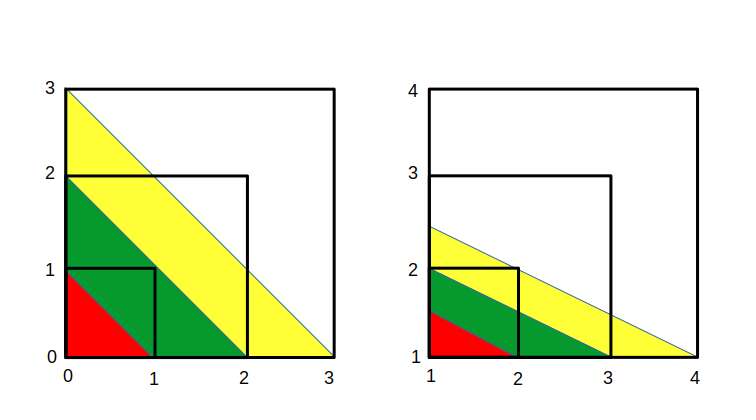
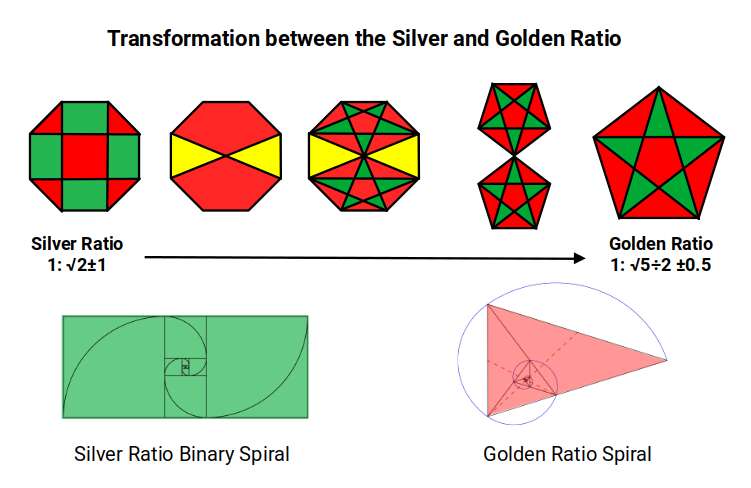
The transition from the Silver Ratio to the Golden Ratio is the geometric signature of the shift from whole number space to reciprocal space. It is the same transition that appears in our geometric solution to the Riemann Hypothesis, where the Silver and Golden Ratios govern the two halves of the analytic continuation that produces the critical strip at n = 0.5. The 2:1 density ratio of Aleph 0.5 is not just an arithmetic fact — it is a geometric one.
Conclusion
Whole-number fractions of sequential cardinal numbers create a numerical series that progresses through exact half-steps. The pattern is not empirical — it is algebraically guaranteed by the identity (n+1)/2. Because this is an ordered, countably infinite set in bijection with the natural numbers, yet demonstrably twice as dense, it constitutes a constructive counter-example to the Continuum Hypothesis.
But Aleph 0.5 is more than a solution to a famous problem. The 2:1 density ratio it reveals — between reciprocal number space and whole number space — turns out to be a fundamental structural property of number itself. It is the same ratio that explains why the critical line of the Riemann zeta function falls at exactly n = 0.5. It connects to the geometric transition from the Silver Ratio to the Golden Ratio — a transition that underpins the structure of the atom and the framework of Geometric Maths as a whole.
Aleph 0.5 is not an isolated curiosity. It is the density of reciprocal space made visible — and it changes how we understand infinity.
FAQ
What is Aleph 0.5 in simple terms?
It is an infinite set that sits between the whole numbers and the real numbers in terms of density. It is produced by summing sequential fractions (1/1, then 1/2+2/2, then 1/3+2/3+3/3, ...), which generates a series that advances in exact half-steps: 1, 1.5, 2, 2.5, 3, ...
How does Aleph 0.5 relate to the Continuum Hypothesis?
The Continuum Hypothesis claims no infinite set exists between the countable infinity of whole numbers (ℵ₀) and the uncountable infinity of real numbers. Aleph 0.5 is a constructive counter-example — a countably infinite set that is demonstrably twice as dense as the natural numbers.
When you say 'double the result, we create the whole number value for the next cardinal step' — can you explain?
Beginning with 1/1 = 1, we double it to get 2. Next we add 1/2 + 2/2 = 1.5, and doubling that gives 3, the next cardinal number. Then 1/3 + 2/3 + 3/3 = 2, which when doubled gives 4, and so on. Each step produces exactly the next cardinal number.
Isn't the result of 1/1 the same as 2/2?
Yes and no. 2/2 represents a line divided into two equal parts, whereas 1/1 is an undivided whole line. Although the numerical value is the same, the number of counted units differs — and it is the counting of units that defines the structure of the set.
How does Aleph 0.5 connect to the Riemann Hypothesis?
The 2:1 density ratio between reciprocal space (Aleph 0.5) and whole number space (Aleph 1) is the key ratio that explains why the critical strip of the Riemann zeta function forms at n = 0.5. See our geometric solution to the Riemann Hypothesis.