At first glance, square numbers and triangular numbers seem to be entirely different kinds of things. One is built from squares, the other from triangles. Yet when you arrange them geometrically, a striking relationship emerges: every square number is the sum of two consecutive triangular numbers. This is not a coincidence — it reflects something fundamental about how number space is structured in two dimensions.
What Are Triangular Numbers?
A triangular number is one that can be arranged as a filled equilateral triangle of dots. The sequence begins:
-
1 — a single point
-
3 — a row of 2 beneath a row of 1
-
6 — rows of 3, 2, 1
-
10, 15, 21, 28, 36...
Each triangular number T(n) is given by the formula: T(n) = n(n+1)/2. So T(1) = 1, T(2) = 3, T(3) = 6, T(4) = 10, and so on. These numbers have been known since antiquity — the ancient Greeks arranged pebbles into triangular patterns as part of their study of number properties.
What Are Square Numbers?
A square number is the result of multiplying any whole number by itself: 1, 4, 9, 16, 25, 36... They can be visualised as square grids of dots — hence the name. The formula is simply S(n) = n².
Note that 1 is both the first square number and the first triangular number — a fact that turns out to be significant rather than coincidental.
The Hidden Connection
Here is where it gets interesting. Take any two consecutive triangular numbers and add them together:
-
T(1) + T(2) = 1 + 3 = 4 = 2²
-
T(2) + T(3) = 3 + 6 = 9 = 3²
-
T(3) + T(4) = 6 + 10 = 16 = 4²
-
T(4) + T(5) = 10 + 15 = 25 = 5²
Every square number is the sum of two consecutive triangular numbers. This holds for all n: T(n−1) + T(n) = n²
This can be verified algebraically: T(n−1) + T(n) = (n−1)n/2 + n(n+1)/2 = n(n−1+n+1)/2 = n(2n)/2 = n². The proof is exact and holds without exception.
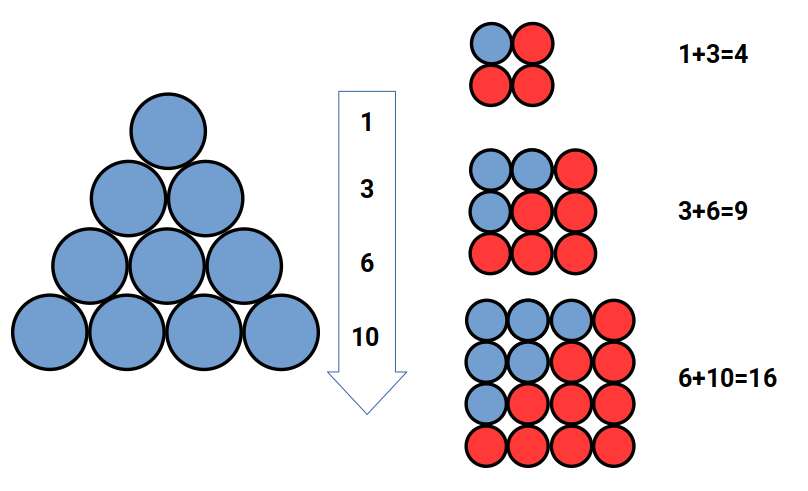
Two consecutive triangular numbers combine to form a square number — shown geometrically with dot arrangements (1+3=4, 3+6=9, 6+10=16).
This is not merely an arithmetic curiosity. It can be seen directly in geometry: if you take a square grid of dots and draw a diagonal line, you split it into two triangular arrangements. The square is literally composed of two triangles. The distinction between "square" and "triangular" is a matter of perspective — both descriptions refer to the same underlying arrangement.
What This Means in 2D Space
The relationship between square and triangular numbers is a property of the second dimension — it only becomes visible when numbers are expressed as geometric arrangements rather than points on a line.
In standard number theory, square and triangular numbers are categorised separately. But in a 2D geometric framework, they occupy the same space. A square number is two triangular numbers joined along a shared edge. The distinction we draw between them is a consequence of how we choose to count, not a feature of the numbers themselves.
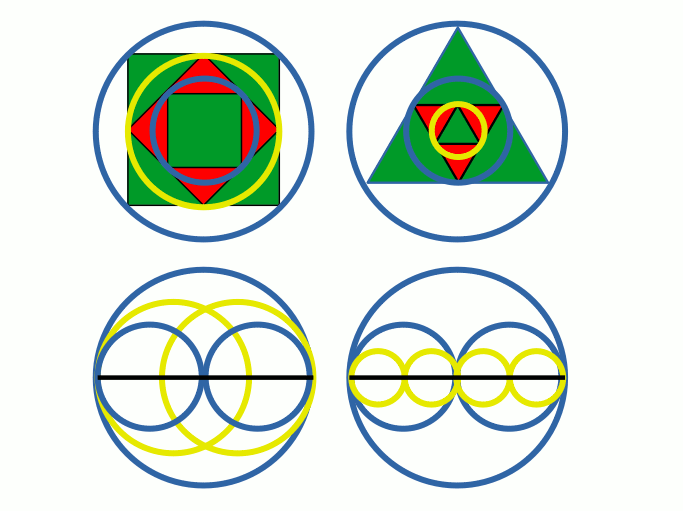
The square and triangle nested within a circle — two geometric forms that are fundamentally related rather than separate categories.
This has a wider implication: the categories we use to classify numbers are not fixed properties of those numbers. They are perspectives, or frameworks of observation. Changing the geometric arrangement changes the type of number we see.
The Number Line is Not Enough
Our intuition about numbers is largely one-dimensional: we picture them as points on a line, ordered from smallest to largest. But numbers have geometric structure that only reveals itself in two dimensions. The square-triangular relationship is one of the simplest demonstrations of this — a fact that is invisible on a number line but obvious the moment you arrange numbers in space.
The number square, or 2D number plane, allows both whole numbers and fractions to be represented simultaneously. Whole numbers appear on the horizontal axis, fractional values on the vertical — together they fill a surface rather than a line.
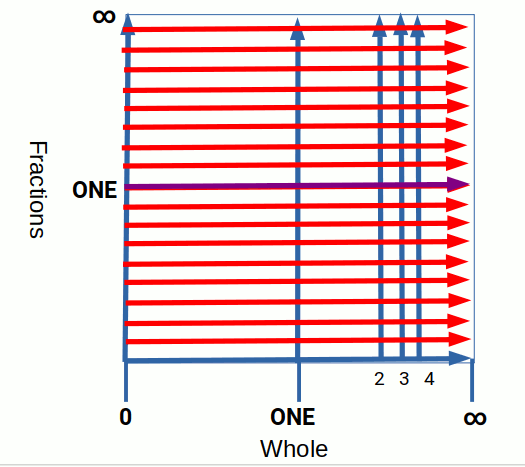
The 2D number square: whole numbers on the horizontal axis, fractional values on the vertical. Together they form a complete number surface.
Within this framework, the infinite nesting of squares within squares illustrates how number space can be self-similar — each unit containing the same structural pattern at a smaller scale.
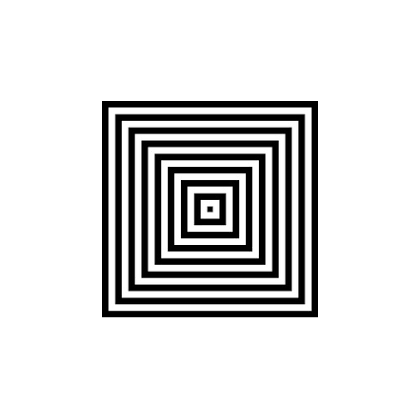
Squares nested within squares — a visual expression of self-similarity in 2D number space.
Extending into 3D: The Octahedron
The relationship between squares and triangles does not stop at two dimensions. In three dimensions, these two shapes unite in the octahedron — one of the five Platonic solids. An octahedron has 8 triangular faces, but when viewed from a corner it projects as a perfect square. The same 3D form simultaneously contains both geometries.
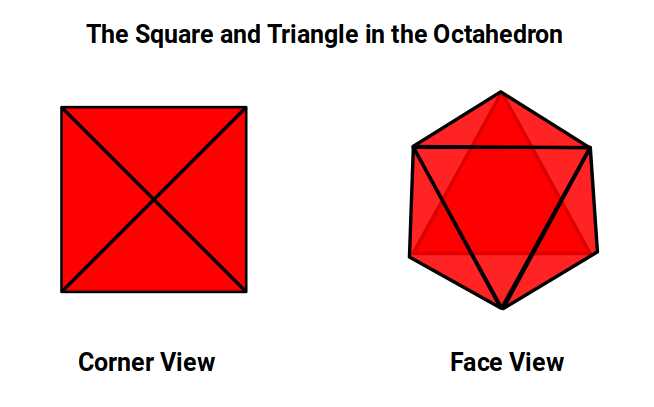
The octahedron: viewed from the corner it reveals a square; its faces are equilateral triangles. Squares and triangles are unified in 3D.
This is a direct 3D expression of the same principle seen in numbers: square and triangular forms are not opposites but complementary views of a single geometric reality. In Geometric Maths, this progression — from 1D number lines to 2D number planes to 3D solids — is understood as a natural unfolding of number structure through dimension.
The Musical Connection
Triangular and square numbers also appear in the structure of musical scales. The pentatonic scale (5 notes) and the heptatonic scale (7 notes) correspond to the triangular numbers T(2)+T(1) = 3+1 = 4 and T(3)+T(2) = 6+3 = 9 in ways that reflect the harmonic ratios underpinning all musical tuning. The geometry of the circle, divided into 5 and 7 equal parts, produces the same overlapping patterns of squares and triangles seen in the number relationships above.
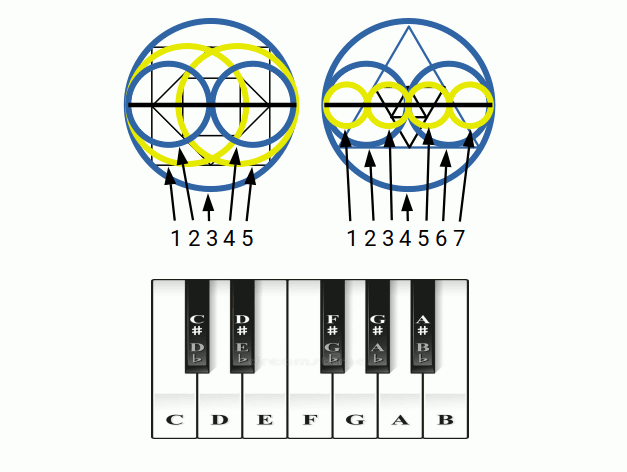
The pentatonic (5-note) and heptatonic (7-note) scales expressed as geometric divisions of the circle — showing the same square-triangle relationship present in number structure.
Conclusion
Square numbers and triangular numbers are not two separate categories of number — they are two ways of looking at the same geometric structure. Every square is two triangles. Every triangular number pair sums to a perfect square. In one dimension this relationship is invisible; in two dimensions it is self-evident.
This seemingly simple observation opens into a much larger framework. In Geometric Maths, numbers are understood not as abstract points on a line but as geometric objects with structure, dimension, and relationship. The square-triangular connection is one of the clearest entry points into that way of thinking.