Introduction
Most people think of infinity as a single, uniform thing — just a very large number that keeps going. In fact, mathematicians have known since the nineteenth century that there are different sizes of infinity: the infinity of whole numbers (1, 2, 3 …) is demonstrably smaller than the infinity of all decimal numbers. But Geometric Maths goes further. It proposes that infinity also has different shapes — and that these shapes are determined by two simple ratios: 2 and 3.
The ratio 2 is embodied in the square: doubling, halving, squaring, square-rooting. The ratio 3 is embodied in the triangle: tripling, thirding, cubing, cube-rooting. When either of these operations is repeated endlessly, the result is not just a large number — it is a structured infinite space with a definite geometry. And these two geometries are fundamentally different from each other.
This distinction is not merely aesthetic. It has direct consequences for some of the deepest unsolved problems in mathematics, including the Continuum Hypothesis and the Riemann Hypothesis. Understanding the two types of geometric infinity is, in a sense, the key to understanding the infinite structure of number space itself.
Why Does This Matter?
Standard mathematics treats the number line as a single, uniform object. All infinities that appear on it are handled by the same set of tools. This has left several foundational questions — including whether there is an infinity between the whole numbers and the real numbers — formally undecidable.
Geometric Maths proposes that the number line is not uniform. It has an internal structure produced by recursive operations, and that structure is geometric. Two of those geometric structures — the square and the triangle — correspond to the two most basic infinite processes in arithmetic. Recognising their distinctness does not just resolve a philosophical puzzle: it provides a concrete mathematical framework for comparing infinite sets.
The Square: Infinity Through Ratio 2
What the Square Encodes
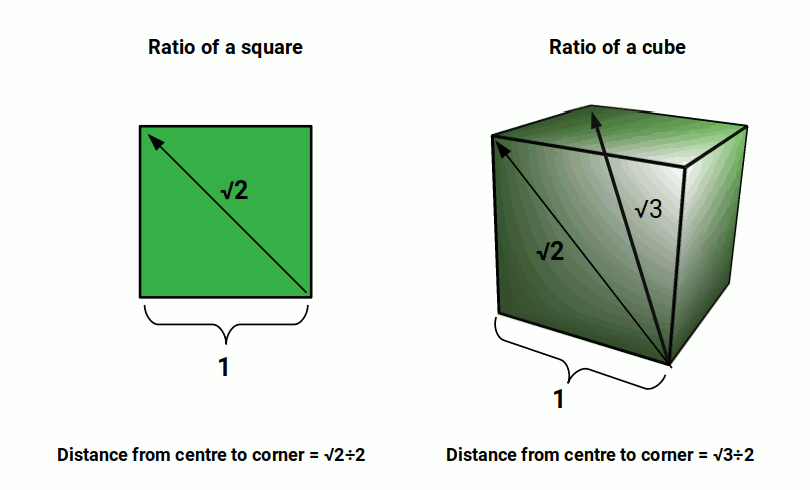
A square has four equal sides meeting at right angles. Its defining ratio — the relationship between its side and its diagonal — is √2, approximately 1.414. This ratio is everywhere in second-order arithmetic:
- Squaring a number (x²) produces an area — a square.
- Taking the square root (√x) recovers the side length.
- Halving and doubling are both second-order operations: multiplying or dividing by 2.
- The infinite boundary around the number ONE, approached by repeated square roots, is the infinite boundary of the square.
When the square root operation is iterated to infinity — applied to any positive number greater than ONE, again and again — the result converges towards ONE without ever reaching it. This is the Infinity of ONE: an infinite boundary defined by ratio 2. Similarly, infinite halving approaches ZERO without ever reaching it — the Zero Boundary.
Together, these two infinite boundaries — at ZERO and at ONE — define the four sections of the number line and, when folded, produce the number square. This is described in detail in our article on the 8 Infinities on the Number Line.
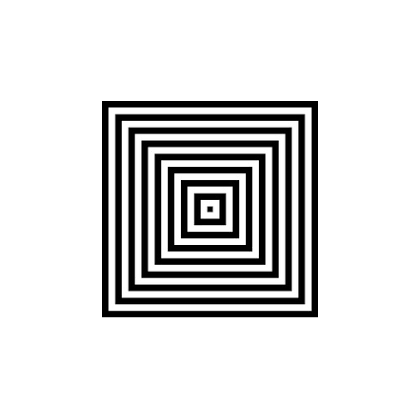
The Square Plane as Infinite Space
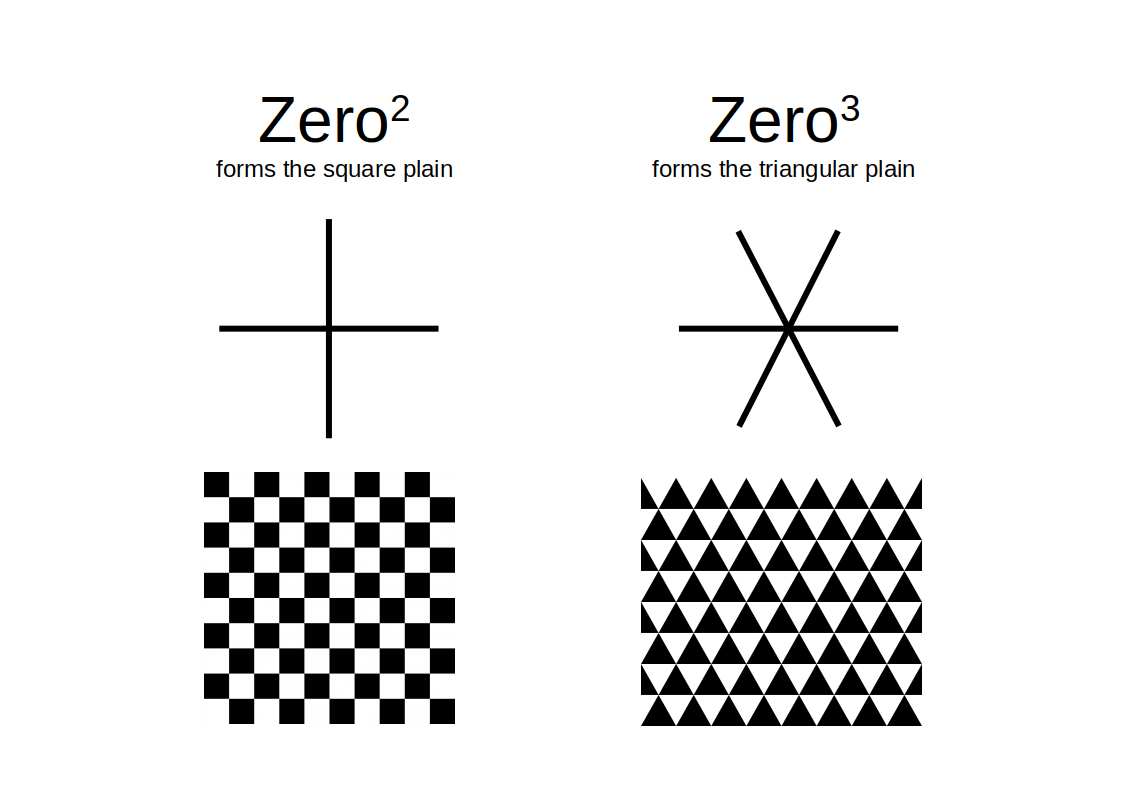
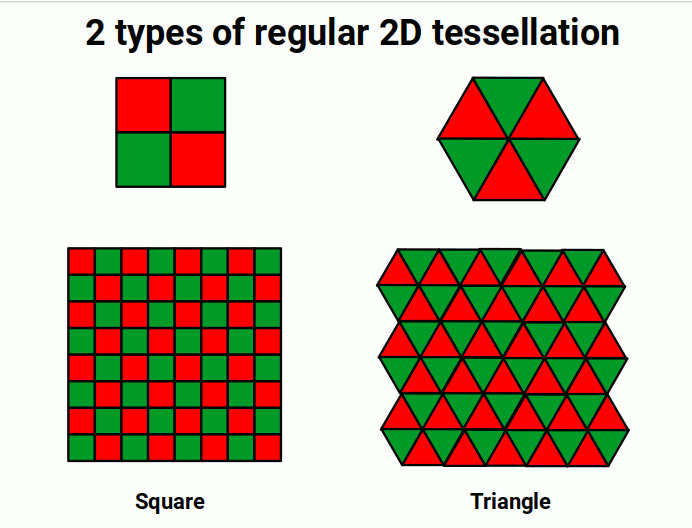
The square does not just define a single boundary — it tiles infinite space. Place squares edge to edge and they fill the plane completely, with no gaps and no overlaps. This is the unique property of the square: it is one of only two shapes (the other being the triangle-derived hexagon) that can tile an infinite flat plane using identical regular figures.
The square tiling covers infinite space using right angles exclusively. Every point in the plane can be located by two coordinates at 90° to each other — the basis of the familiar Cartesian grid (x, y axes). This is the geometry underlying the complex number plane, which in standard mathematics is constructed by placing the imaginary axis at 90° to the real axis. In Geometric Maths, this perpendicular relationship is not introduced artificially — it emerges from the square as the natural geometry of second-order infinite space.
The Infinite Density of Square Space
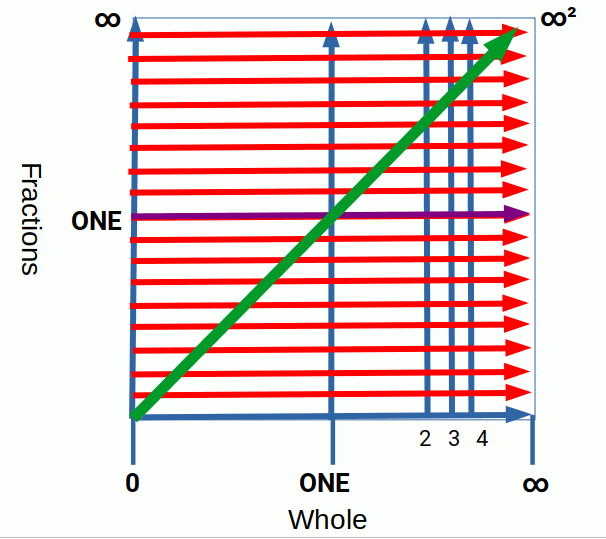
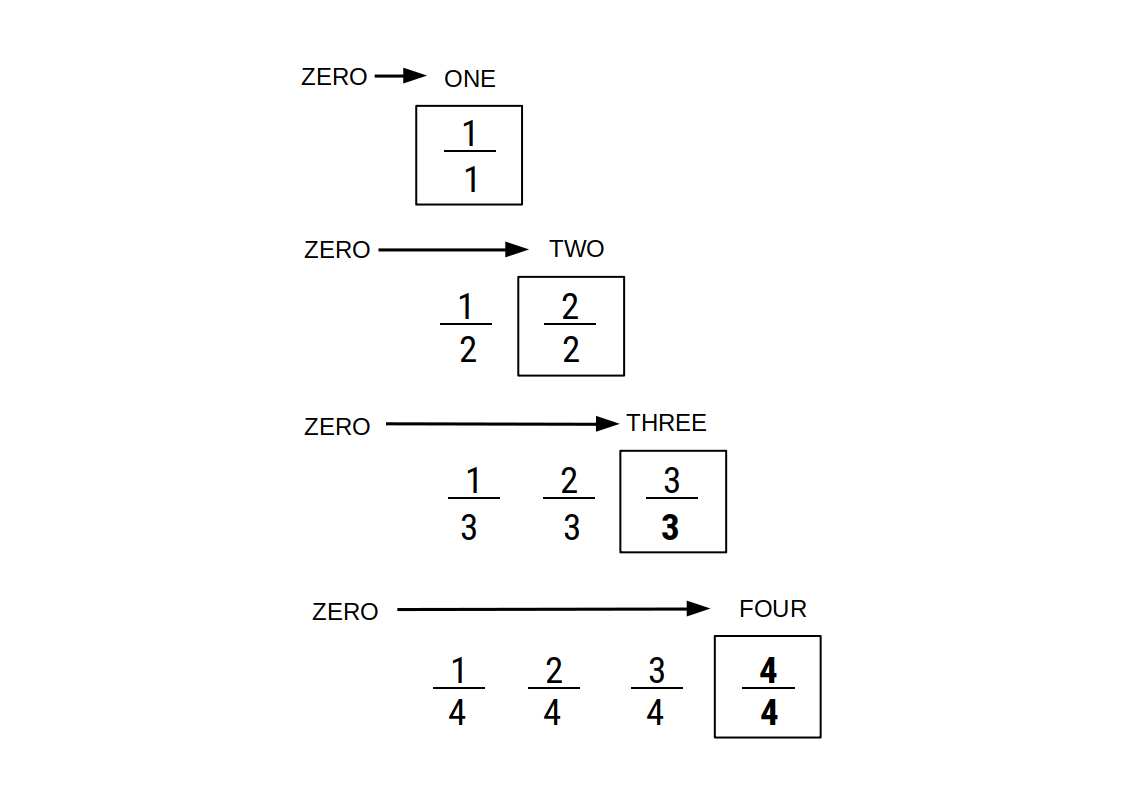
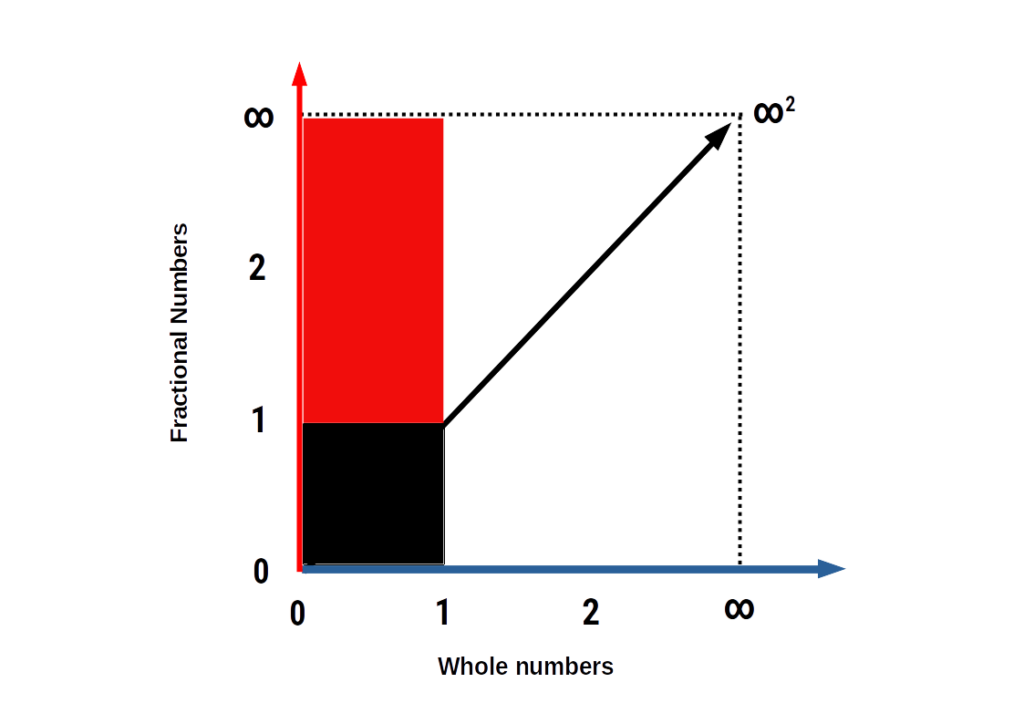
The square plane encodes the infinite set of whole numbers and their reciprocals — the fractional numbers between ZERO and ONE. In Solving Infinity, this relationship is formalised: the whole numbers correspond to Aleph 0 (ℵ0), and the fractional numbers between zero and one — when properly accounted for — form an intermediate infinity called Aleph 0.5 (ℵ0.5). Both of these are contained within the geometry of the square.
Aleph 0.5 is exactly half of Aleph 1 in terms of density. This halving — this factor of 2 — is the signature of the square-type infinity. It is the reason that, in the Riemann Hypothesis, the critical strip sits at n = 0.5: the infinite density of reciprocal space is precisely half that of whole number space, and this ratio is expressed geometrically by the square.
The Triangle: Infinity Through Ratio 3
What the Triangle Encodes
A triangle — specifically the equilateral triangle, with three equal sides — has a different defining ratio: the relationship between its side and its height is √3, approximately 1.732. This is the ratio of the third-order operations:
- Cubing a number (x³) produces a volume — a cube (whose cross-section is the square, but whose diagonal through the body is √3 times its side).
- Taking the cube root (∛x) recovers the side length of that cube.
- Multiplying or dividing by 3 produces the third-order harmonic relationships.
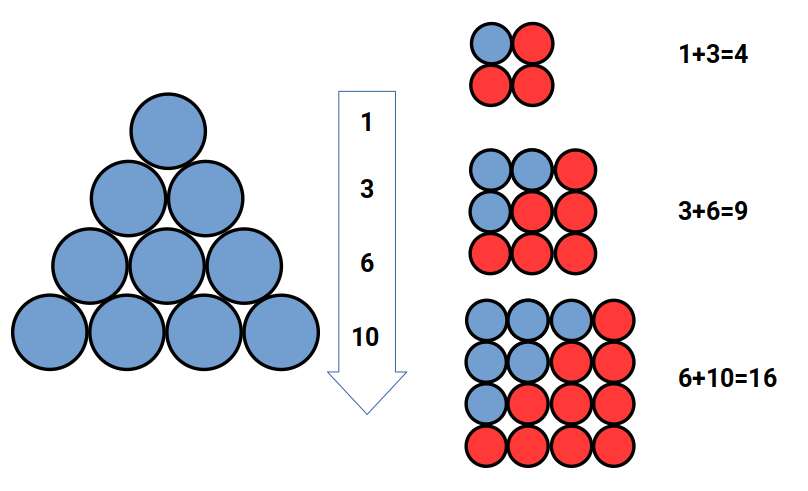
- ZERO³ — zero cubed in the geometric sense — generates the triangular number plane.
The triangle encodes a fundamentally different infinite process from the square. Where the square's recursion converges to ONE through the square root, the triangle's recursion produces a three-fold branching structure. Instead of the right angle (90°), it works in multiples of 60°. And where the square's diagonal is √2, the triangle's height is √3 — a different irrational number, not expressible in terms of √2 using whole-number arithmetic.
The Hexagonal Plane as Infinite Space
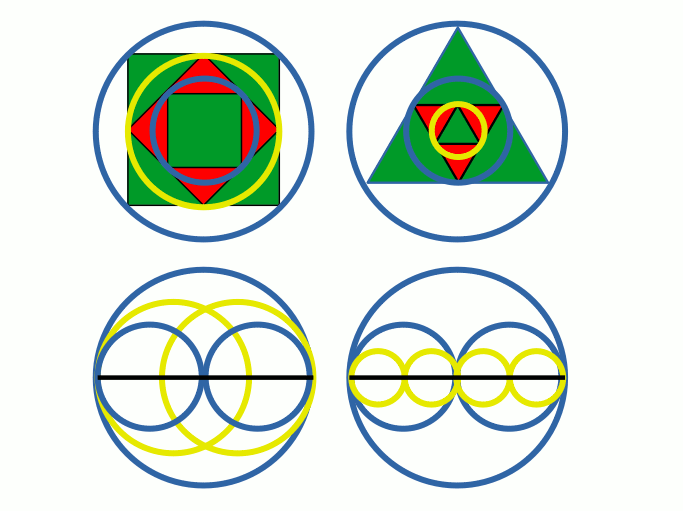
The triangle does not tile infinite space by itself in the most efficient way. Six equilateral triangles joined at a central point produce a hexagon — and it is the hexagon that tiles the infinite plane with ratio 3. The hexagonal tiling is the second of the two fundamental regular tilings, and it is generated by the geometry of the circle: the Vesica Piscis (two overlapping circles of equal radius, literally meaning "fish bladder" from the Latin, named for the lens shape formed by their intersection) naturally produces the hexagonal arrangement.
In the hexagonal plane, distances are measured using √3 rather than √2. Rotations occur in steps of 60° rather than 90°. The structure is denser than the square plane — six nearest neighbours instead of four — and it is this density difference that distinguishes the triangle-type infinity from the square-type infinity.
The Triangle Plane and the Number e
The infinite density of the triangular plane is connected to the number e (approximately 2.718) — the base of natural logarithms, which appears throughout physics wherever continuous growth or decay occurs (population growth, radioactive decay, compound interest). In Geometric Maths, e represents the accumulation of all reciprocal factorials — a sum over an infinite triangular-number series — and encodes the compression of infinite triangular space into a single point.
This is the geometric origin of e's role in the zeta function and in the relationship between the square and hexagonal number planes. The equation:
((2π − 6) × 2.25) × e = √3
expresses, in a single line, the connection between the circumference of the unit circle (2π), the perimeter of its inscribed hexagon (6), the infinite density constant of Geometric Maths (2.25), and √3 — the characteristic ratio of the triangular plane. The number e is the bridge between ratio 2 (the circle's deviation from the hexagon) and ratio 3 (the hexagonal plane itself).
Two Types of Infinity: A Comparison
The square and triangle are not just two shapes — they are two irreducibly different ways of extending a structure into infinite space. This table summarises the key contrasts:
| Property | Square (Ratio 2) | Triangle/Hexagon (Ratio 3) |
|---|---|---|
| Characteristic ratio | √2 ≈ 1.414 | √3 ≈ 1.732 |
| Angle | 90° | 60° |
| Tiling | 4 neighbours per point | 6 neighbours per point |
| Fundamental operation | Square / square root | Cube / cube root |
| Infinite boundary | ONE (via square root) | Generates via √3 density |
| Number plane | Complex number plane | Hexagonal number plane |
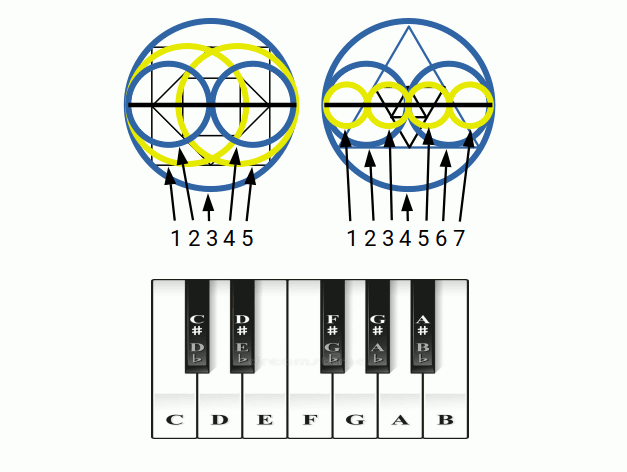
| Musical interval | Octave (×2) | Fifth / third (×3, ×3/2) |
| Infinity type | Aleph 0 / Aleph 0.5 | Aleph 1 (full continuum) |
The two types are not competing descriptions of the same thing. They are complementary structures that together account for the full infinite space of numbers. Ratio 2 generates the bounded internal structure of the number line — the reciprocal space between ZERO and ONE, the square tiling, the critical strip. Ratio 3 generates the extended structure — the hexagonal plane, the full continuum, the density function of e.
Why They Cannot Be Reduced to Each Other
The key to understanding why these are genuinely different types of infinity — not just two perspectives on the same infinity — is the incommensurability of √2 and √3.
Incommensurable means that no matter how many times you multiply √2 by itself, you will never exactly reach √3. They are both irrational numbers (non-terminating, non-repeating decimals), but they are irrational in different ways. Their ratio — √3 / √2 = √(3/2) ≈ 1.225 — is itself irrational, and this irrationality cannot be removed by any algebraic manipulation using whole numbers.
This is directly analogous to the fact that the square and hexagonal tilings of the plane cannot be continuously deformed into each other. You cannot gradually morph a square grid into a hexagonal grid without tearing the plane. The two tilings represent discrete, incompatible choices of infinite structure.
In terms of number theory, this incommensurability is what makes the Continuum Hypothesis difficult. The square-type infinity and the triangle-type infinity sit on different geometric levels. Asking whether one is larger than the other is like asking whether a line is longer than an area — the comparison requires a framework that accommodates both, which is precisely what Geometric Maths provides through its higher-dimensional number space.
Connecting Back to the Number Line
The eight infinite boundaries identified in 8 Infinities on the Number Line arise from the square-type infinity — they are all products of ratio 2 (square root and halving). The triangular-type infinity does not appear on the standard number line at all, because the standard number line is a one-dimensional object, and the hexagonal plane is inherently two-dimensional.
This is precisely why the Continuum Hypothesis cannot be resolved within standard set theory: the framework of a one-dimensional number line, even extended to the complex plane, only accommodates the square-type infinity. The triangle-type infinity requires a genuinely higher-dimensional number space — one in which the plane is not an add-on but a fundamental feature.
In the full picture of Geometric Maths, both types of infinity are required:
- The square provides the structure of reciprocal space, the four sections of the number line, and the geometric foundation for Aleph 0 and Aleph 0.5.
- The triangle provides the structure of the full real continuum, the hexagonal number plane, and the geometric foundation for Aleph 1.
Together, they account for the complete infinite space of numbers without paradox or undecidability.
Conclusion
Infinity is not one thing. The square and the triangle — embodying the fundamental ratios 2 and 3 — generate two structurally distinct infinite spaces. The square infinity is built on right angles, √2, and second-order operations (squaring, square root, halving, doubling). It produces the four-section structure of the number line, the reciprocal space between ZERO and ONE, and the intermediate infinity Aleph 0.5. The triangle infinity is built on 60° angles, √3, and third-order operations (cubing, cube root, tripling, thirding). It produces the hexagonal number plane, the full real continuum, and the density function of e.
These two types cannot be reduced to each other, because √2 and √3 are incommensurable — just as the square grid and the hexagonal grid are incompatible tilings of the infinite plane. Recognising this distinction does not complicate number theory; it simplifies it. The deepest open questions in mathematics — the Continuum Hypothesis, the Riemann Hypothesis, the foundations of imaginary numbers — all become tractable once the infinite is understood geometrically, through the complementary structures of ratio 2 and ratio 3.
The square and the triangle are not just shapes on a page. They are the two fundamental blueprints of infinite space.
For further reading, see 8 Infinities on the Number Line, Solving Infinity, Aleph 0.5, and The Infinity of ONE.
FAQ
What does it mean for the square and triangle to 'generate' infinity?
In Geometric Maths, geometric shapes are not just visual objects — they encode mathematical operations. The square encodes a second-order (×2, ÷2, x², √x) relationship, while the triangle encodes a third-order (×3, ÷3, x³, ∛x) relationship. When these operations are iterated to infinity, the square produces a closed 2D plane and the triangle produces a tiling of hexagons. Each gives rise to a structurally different infinite set — which is why we say they generate different types of infinity.
How is the infinity of the square different from the infinity of the triangle?
The square's infinity is built on binary division — halving, doubling, squaring, and rooting. Its characteristic ratio is √2, and it tiles plane space using right angles. The triangle's infinity is built on ternary division — thirds, cubing, and cube roots. Its characteristic ratio is √3, and it tiles plane space at 60°, producing the hexagonal pattern. These two ratios are incommensurable: you cannot get from one to the other using whole-number arithmetic, which is why they represent genuinely different infinite structures.
Is one type of infinity larger than the other?
Not in a straightforward sense. Both the square infinity and the triangle infinity are uncountably infinite. However, Geometric Maths proposes that they have different densities — specifically, the triangular (hexagonal) plane is denser than the square plane by a factor related to √3. This difference in density is what causes the offset of the critical strip in the Riemann Hypothesis from 0 to 0.5.
How does this connect to the Continuum Hypothesis?
The Continuum Hypothesis asks whether there is an intermediate infinity between the countable whole numbers (Aleph 0) and the full set of real numbers (Aleph 1). Geometric Maths proposes that the reciprocal numbers between ZERO and ONE form exactly this intermediate set — called Aleph 0.5 — and that its structure is encoded in the square geometry. The triangular plane then provides the framework for the full real continuum. The two types of infinity defined by ratio 2 and ratio 3 therefore correspond precisely to the two sides of the Continuum Hypothesis question.
What is the connection between these geometric infinities and music?
Music is built almost entirely from ratios 2 and 3. The octave is a doubling of frequency (ratio 2); the perfect fifth is a ratio of 3:2. The entire Western musical scale can be constructed by stacking fifths and folding them back into a single octave through octave equivalence (dividing by 2). This is the same mathematical structure that appears in the square and triangle number planes — the two fundamental geometric tilings of infinite space.