Introduction
A geometric transformation is a rule that maps every point in the plane to another point. The original figure is called the object; the result is called the image. Transformations allow us to describe movement, symmetry, and change of size in precise mathematical language. They underlie computer graphics, crystallography, and the study of symmetry in nature and art.
Key Takeaways
- Translation, reflection, and rotation are the three isometries — they preserve all distances and produce congruent images.
- Reflection reverses orientation; translation and rotation preserve it.
- Enlargement (dilation) preserves shape and angles but changes size; the image is similar (not congruent) to the object unless the scale factor is ±1.
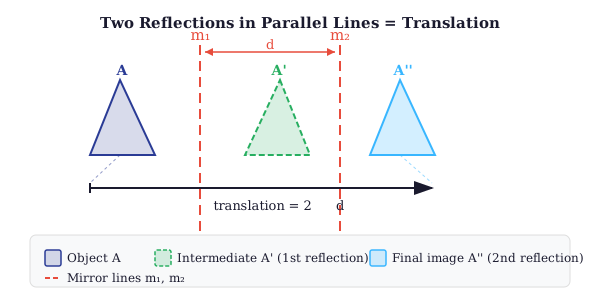
- Two reflections in intersecting lines are equivalent to a rotation through twice the angle between the lines; two reflections in parallel lines are equivalent to a translation.
- Every transformation has an inverse: the inverse of a reflection is itself; the inverse of a rotation by θ is a rotation by −θ.
The Four Main Transformations
1. Translation
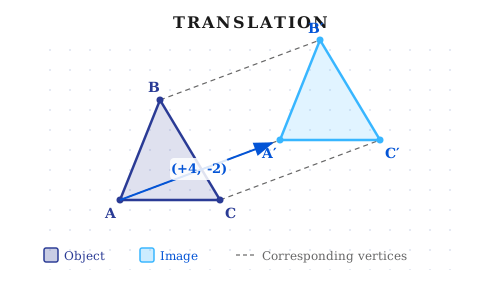
A translation moves every point of a figure the same distance in the same direction. It is described by a vector — an arrow with a specific length and direction, written as (a, b) meaning "move a units horizontally and b units vertically".
Every point (x, y) maps to (x + a, y + b). The shape, size, and orientation of the figure are all preserved. The image is congruent to the object and faces the same way. No point is fixed by a non-zero translation.
Example. Translating a triangle by vector (3, −2) moves every vertex three units right and two units down. The translated triangle is identical to the original, just repositioned.
2. Reflection
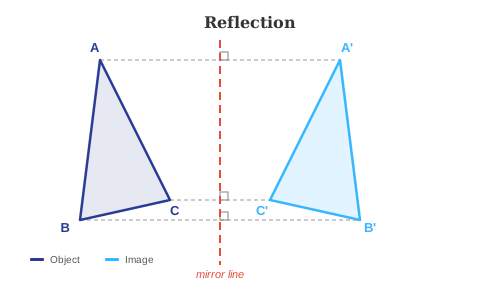
A reflection maps each point to its mirror image across a given line, called the mirror line or axis of reflection. Each point and its image are equidistant from the mirror line, on opposite sides.
Distances between points are preserved (the image is congruent to the object), but orientation is reversed — a figure traced anticlockwise becomes traced clockwise in its image.
Common mirror lines: - x-axis: (x, y) → (x, −y) - y-axis: (x, y) → (−x, y) - y = x: (x, y) → (y, x) - y = −x: (x, y) → (−y, −x) - x = a (vertical line): (x, y) → (2a − x, y) - y = b (horizontal line): (x, y) → (x, 2b − y)
Example. Reflecting the point (3, 5) in the y-axis gives (−3, 5). Reflecting in the line y = x gives (5, 3).
3. Rotation
A rotation turns every point of a figure through a given angle about a fixed point called the centre of rotation. The angle and direction (clockwise or anticlockwise) must be specified.
Distances and angles are preserved (the image is congruent), and orientation is also preserved (unlike reflection). The centre of rotation is the only fixed point.
Rotations about the origin: - 90° anticlockwise: (x, y) → (−y, x) - 90° clockwise: (x, y) → (y, −x) - 180°: (x, y) → (−x, −y) — same result clockwise or anticlockwise
For a rotation about a centre other than the origin, translate so the centre becomes the origin, apply the rotation formula, then translate back.
Example. Rotating the point (4, 0) by 90° anticlockwise about the origin gives (0, 4). Rotating it by 180° gives (−4, 0).

4. Enlargement (Dilation)
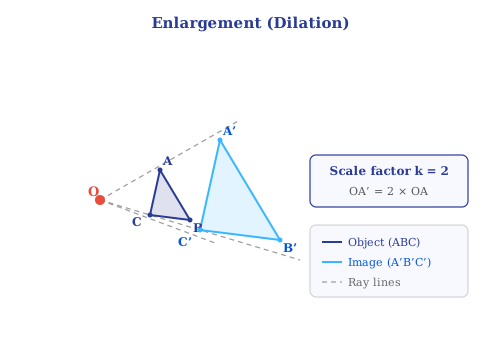
An enlargement (also called a dilation) scales a figure from a fixed point called the centre of enlargement, by a scale factor k.
Each point P maps to a point P' such that OP' = k × OP, where O is the centre of enlargement. The direction from O to P is preserved.
- k > 1: the image is larger than the object.
- 0 < k < 1: the image is smaller (a reduction).
- k < 0: the image is on the opposite side of the centre from the object; a negative scale factor also produces a rotation of 180°.
- k = −1: the image is the same size as the object but rotated 180° about the centre — equivalent to a point reflection through the centre.
Enlargement preserves shape and angles but changes size. The image is similar (not congruent, unless k = ±1) to the object.
Example. Enlarging the point (2, 3) by scale factor 2 from the origin gives (4, 6). Enlarging by scale factor −1 gives (−2, −3).
Isometries
An isometry is a transformation that preserves all distances. The image is always congruent to the object.
The three isometries are translation, reflection, and rotation. Enlargement is not an isometry (unless the scale factor is ±1).
- Translation and rotation preserve orientation — the image is a congruent copy facing the same way (directly congruent).
- Reflection reverses orientation — the image is a congruent copy that is a mirror image (oppositely congruent).
Congruence and Similarity Through Transformations
Two figures are congruent if one can be mapped to the other by a combination of translations, reflections, and rotations. Congruent figures are identical in shape and size.
Two figures are similar if one can be mapped to the other by an isometry followed by an enlargement. Similar figures have the same shape but may differ in size; all corresponding angles are equal and all corresponding lengths are in the same ratio.
Combining Transformations
When two transformations are applied in succession, the result is called a composite transformation. Some important results:
Two reflections in parallel lines produce a translation. The direction of the translation is perpendicular to both mirror lines, and the distance is twice the distance between the lines.
Two reflections in intersecting lines produce a rotation. The centre of rotation is at the point where the lines cross, and the angle of rotation is twice the angle between the lines.
A rotation followed by a translation (or vice versa) is generally another rotation — unless the angle is 180°, in which case it may be a translation or glide reflection.
These composition rules mean that all the symmetries of a plane figure can be described in terms of reflections alone — reflections are the most fundamental transformations.
Inverse Transformations
Every transformation has an inverse — the transformation that undoes it.
- The inverse of a translation by vector (a, b) is translation by (−a, −b).
- The inverse of a reflection in a line is the same reflection (reflections are self-inverse).
- The inverse of a rotation by angle θ about a point is rotation by −θ (i.e., the same angle in the opposite direction) about the same point.
- The inverse of an enlargement with scale factor k from centre O is an enlargement with scale factor 1/k from the same centre O.
Understanding inverses is important in computer graphics (where undoing a transformation must be as quick as applying it) and in abstract algebra (where transformations form groups under composition).
Conclusion
Transformations reframe geometry as the study of what stays the same — isometries preserve distance and shape; similarities preserve shape but not size; projections preserve collinearity but not distance. The composition rules for reflections, rotations, and translations reveal that all rigid motions of the plane reduce to reflections alone, a result that points toward the deep group-theoretic structure underlying symmetry. These ideas extend naturally into three dimensions, where the symmetry groups of the Platonic Solids govern their geometric properties.
The next chapter moves from the plane into three-dimensional space, establishing the foundational concepts — Lines, Planes and Solid Angles.