Introduction
Take a simple cone — the kind you might shape from a sheet of paper — and slice through it with a flat plane. Depending on the angle of your cut, four fundamentally different curves appear: a circle, an ellipse, a parabola, or a hyperbola. These are the conic sections, and they form one of the most elegant families in all of geometry. First studied systematically by the ancient Greeks, conic sections turn up everywhere — in the orbits of planets, the design of satellite dishes, the trajectories of thrown objects, and the geometry of light itself. This chapter explores each curve in turn, shows how a single parameter called eccentricity unifies them, and surveys their remarkable appearances in nature and science.
Key takeaways
- Slicing a double cone at different angles produces exactly four types of curve: circle, ellipse, parabola, and hyperbola.
- Each conic can be defined purely in terms of a focus, a directrix, and a single number called the eccentricity.
- Eccentricity smoothly transitions from circle (e = 0) through ellipse (0 < e < 1) and parabola (e = 1) to hyperbola (e > 1).
- Conic sections govern planetary orbits, reflective optics, and many other natural and engineered systems.
- Degenerate cases — a point, a single line, or a pair of intersecting lines — arise when the cutting plane passes through the apex of the cone.
What Are Conic Sections?
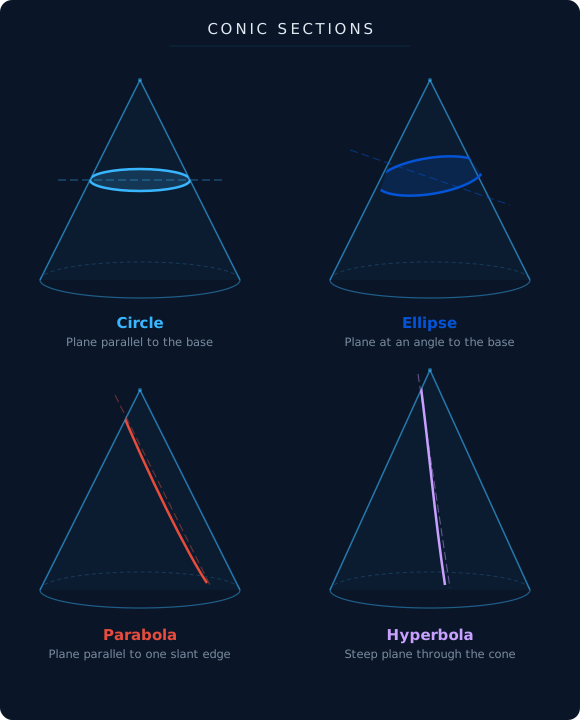
Imagine two identical cones joined at their tips, extending infinitely in both directions — a double cone (also called a nappe). Now pass a flat plane through this surface. The curve where the plane meets the cone is a conic section. The shape of that curve depends entirely on the angle between the cutting plane and the axis of the cone.
- If the plane is perpendicular to the axis, the cross-section is a circle.
- If the plane is tilted but still cuts through only one nappe of the cone, the result is an ellipse.
- If the plane is parallel to the slant of the cone (parallel to one generator), the curve is a parabola — it never closes.
- If the plane is steep enough to cut through both nappes, the result is a hyperbola — two separate, mirror-image branches.
This classification is exhaustive. Every possible angle of cut produces one of these four curves (or one of the degenerate cases discussed later). The beauty of conic sections lies in the fact that such different-looking shapes all belong to the same geometric family, connected by one continuous parameter.
The Circle
The circle is the simplest conic section and the one most familiar from everyday life. It arises when the cutting plane is exactly perpendicular to the cone's axis, and it is the only conic that is a closed curve with a single centre of symmetry.
We have already explored the circle in depth in The Circle, so here we simply note its place within the conic family. A circle of radius r centred at the origin satisfies:
x² + y² = r²
Its eccentricity is zero — the two foci of an ellipse have collapsed into a single point, the centre. In this sense the circle is a special case of the ellipse, the limiting case where the two axes are equal.
The Ellipse
Definition and Construction
An ellipse is defined as the locus of all points whose sum of distances from two fixed points (the foci, F₁ and F₂) is constant. If that constant sum is 2a, then for any point P on the ellipse:
PF₁ + PF₂ = 2a
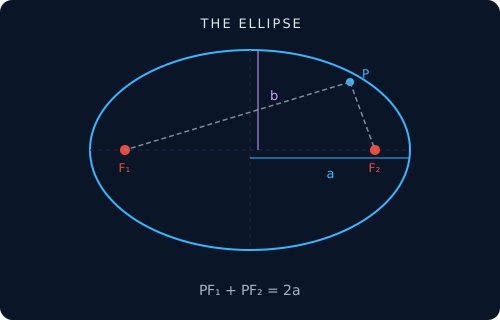
This definition leads directly to the classic string construction: fix two pins at the foci, loop a length of string around them, and trace the curve by keeping the string taut with a pencil. The result is a perfect ellipse. The longer the string relative to the distance between the pins, the more circular the ellipse becomes.
Axes and Eccentricity
The semi-major axis a is half the longest diameter; the semi-minor axis b is half the shortest. The two foci lie along the major axis, each at a distance c from the centre, where:
c² = a² − b²
The eccentricity of an ellipse is defined as:
e = c / a
Since c is always less than a (the foci lie inside the curve), the eccentricity of an ellipse satisfies 0 < e < 1. When e is close to 0 the ellipse is nearly circular; when e approaches 1 it becomes long and narrow.
Standard Equation
Placing the centre at the origin with the major axis along the x-axis, the equation of an ellipse is:
x² / a² + y² / b² = 1
This is a natural extension of the equation of the circle. Indeed, setting a = b = r recovers x² + y² = r². The coordinate geometry of the ellipse is explored further in Coordinate Geometry.
Reflective Property
An ellipse has a striking optical property: any ray of light (or sound) emanating from one focus will reflect off the curve and pass through the other focus. This is the principle behind whispering galleries — elliptical rooms where a whisper at one focus can be heard clearly at the other, even across a large space. The Capitol building in Washington, D.C. and St Paul's Cathedral in London both exhibit this effect.
The Parabola
Definition
A parabola is the locus of all points equidistant from a fixed point (the focus) and a fixed line (the directrix). For any point P on the parabola:
distance(P, focus) = distance(P, directrix)
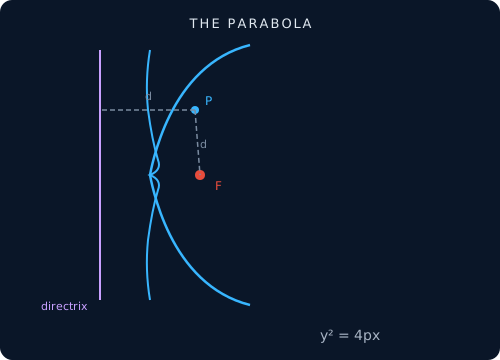
This elegant definition — equal distance from a point and a line — gives the parabola a unique character. Unlike the ellipse, the parabola is an open curve: it extends to infinity in both directions and never closes.
Equation
Place the focus at (0, f) and the directrix at y = −f. Then the standard equation of a parabola opening upward is:
y = x² / (4f)
or equivalently, in the familiar form y = ax² where a = 1/(4f). The parameter f is the focal length — the distance from the vertex (the lowest point of the curve) to the focus.
Eccentricity
The eccentricity of a parabola is exactly e = 1. It sits precisely at the boundary between the closed ellipses and the open hyperbolas. This is not a coincidence — the parabola is the transitional curve, the moment when the cutting plane becomes parallel to the slant of the cone and the curve just barely fails to close.
The Reflective Property
The parabola's most famous property is its reflective behaviour: any ray arriving parallel to the axis of the parabola reflects off the curve and passes through the focus. Conversely, a light source placed at the focus produces a perfectly parallel beam.
This principle is the basis of parabolic reflectors — satellite dishes, car headlamps, torch reflectors, radio telescopes, and solar concentrators all exploit the parabola's ability to focus parallel rays to a single point. The 305-metre Arecibo radio telescope (operational from 1963 to 2020) and the 500-metre FAST telescope in China both use parabolic dishes to gather radio waves from space.
The Hyperbola
Definition
A hyperbola is the locus of all points whose difference of distances from two fixed foci is constant. For any point P on the hyperbola:
|PF₁ − PF₂| = 2a
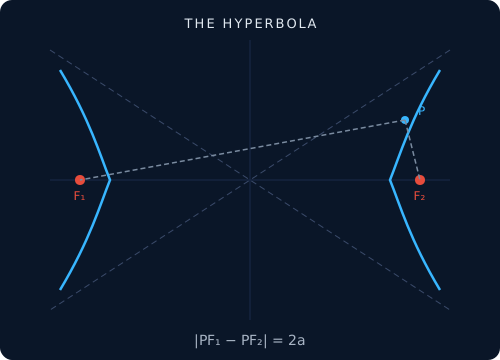
Note the absolute value — the hyperbola has two separate branches, one closer to each focus. Unlike the ellipse (sum of distances) or the parabola (equal distance from focus and directrix), the hyperbola uses the difference of distances.
Axes, Asymptotes, and Eccentricity
The semi-transverse axis a is half the distance between the two vertices (the closest points of the two branches). The semi-conjugate axis b is related to a and c (the distance from the centre to each focus) by:
c² = a² + b²
Notice the plus sign, in contrast to the minus sign for the ellipse. This reflects the fact that the foci of a hyperbola lie outside the curve.
The eccentricity is again e = c/a, but now since c > a, we have e > 1. The larger the eccentricity, the more "open" the branches become.
A defining feature of the hyperbola is its pair of asymptotes — straight lines that the branches approach but never touch. For a hyperbola centred at the origin with the transverse axis along the x-axis, the asymptotes are:
y = ±(b / a) · x
Standard Equation
The equation of a hyperbola centred at the origin with the transverse axis along the x-axis is:
x² / a² − y² / b² = 1
Compare this with the ellipse: the only change is a minus sign. That single sign difference transforms a closed oval into two infinite branches — a vivid illustration of how small algebraic changes can produce dramatically different geometry.
The Rectangular Hyperbola
When a = b, the asymptotes are perpendicular (y = ±x) and the hyperbola is called rectangular or equilateral. The equation simplifies to x² − y² = a², or equivalently, after rotation, to the familiar inverse relation xy = k. This is the curve you see whenever one quantity is inversely proportional to another — pressure and volume in Boyle's law, for instance.
Eccentricity: The Unifying Parameter
The most elegant aspect of conic sections is that a single number — the eccentricity e — determines which curve you get. Every conic can be defined using the focus-directrix property: for a fixed point F (the focus) and a fixed line d (the directrix), a conic is the locus of points P such that:
distance(P, F) / distance(P, d) = e
The value of e determines the shape:
| Eccentricity | Curve | Character |
|---|---|---|
| e = 0 | Circle | Closed, perfectly symmetric |
| 0 < e < 1 | Ellipse | Closed, two axes of symmetry |
| e = 1 | Parabola | Open, one branch |
| e > 1 | Hyperbola | Open, two branches |
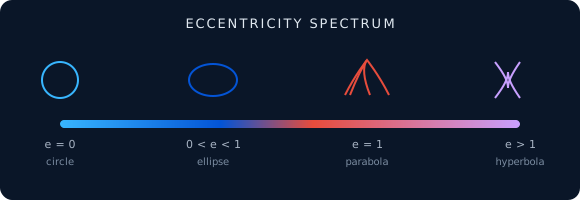
As e increases from 0, the circle stretches into an ever-thinner ellipse. At e = 1 the curve breaks open into a parabola. Beyond e = 1 it splits into the two branches of a hyperbola, which spread wider as e grows. This smooth progression — from a closed, symmetric shape to an ever more open one — is governed entirely by the tilt of the cutting plane relative to the cone.
The focus-directrix definition also reveals why the circle is special: its directrix is at infinity, so the ratio is trivially zero for every point. In a sense, the circle is the conic that has "forgotten" its directrix altogether.
Degenerate Conics
When the cutting plane passes through the apex of the double cone, the intersection degenerates into simpler geometric objects:
- A single point — the plane touches only the apex itself. This can be thought of as an ellipse (or circle) whose axes have shrunk to zero.
- A single straight line — the plane is tangent to the cone along one generator. This is a degenerate parabola.
- A pair of intersecting lines — the plane passes through the apex and cuts both nappes. This is a degenerate hyperbola; the two lines are in fact the asymptotes of a hyperbola that has collapsed to zero width.
Degenerate conics may seem like mere curiosities, but they play an important role in algebraic geometry and in understanding the boundaries between different types of curve. They are the transitional cases — what happens at the exact moment one type of conic transforms into another.
Conic Sections in Nature and Science
Planetary Orbits and Kepler's Laws
The most celebrated appearance of conic sections in science is in celestial mechanics. Johannes Kepler showed in 1609 that the planets move in elliptical orbits with the Sun at one focus. This was Kepler's first law, and it replaced two millennia of circular-orbit models. Isaac Newton later proved that any body moving under an inverse-square gravitational force must follow a conic section — an ellipse, parabola, or hyperbola depending on its energy.
- Bound orbits (planets, moons) are ellipses.
- Escape trajectories with exactly the critical speed trace parabolas.
- Faster-than-escape trajectories (some comets, interstellar objects like 'Oumuamua) follow hyperbolas.
The Earth's orbit, for instance, has an eccentricity of about 0.017 — very nearly circular. Mars is more eccentric at 0.093, and the dwarf planet Pluto reaches 0.25. Comets like Halley's comet have eccentricities close to 1 (Halley's is 0.967), making their orbits extremely elongated ellipses.
Parabolic Reflectors
As noted above, the parabola's reflective property makes it invaluable in engineering. Satellite dishes, radio telescopes, car headlamps, and solar furnaces all use parabolic surfaces to focus or direct energy. The world's largest solar furnace, at Odeillo in the French Pyrenees, uses a parabolic mirror to concentrate sunlight and reach temperatures above 3,500 °C.
Whispering Galleries and Elliptical Acoustics
The ellipse's reflective property — bouncing signals from one focus to the other — is exploited in architecture. In an elliptical room, sound waves from one focus converge at the other, allowing whispered conversations across distances of 20 metres or more. The Statuary Hall in the United States Capitol is a famous example.
Hyperbolic Navigation
Before GPS, ships and aircraft used hyperbolic navigation systems such as LORAN (Long Range Navigation). Two radio transmitters broadcast synchronised signals; a receiver measures the time difference between them. Each constant time difference defines a hyperbola with the two transmitters as foci. By using two or more pairs of transmitters, a navigator can pinpoint their position at the intersection of hyperbolas.
Cooling Towers and Structural Engineering
The hyperbola also appears in architecture. The curved profiles of nuclear power station cooling towers are hyperboloids of revolution — surfaces generated by rotating a hyperbola about its axis. This shape provides structural strength with minimal material, efficiently channelling air upward through the tower.
Historical Context
Apollonius of Perga
The systematic study of conic sections began with the Greek mathematicians. Menaechmus (c. 350 BC) is credited with discovering the curves while attempting to solve the problem of doubling the cube. But the definitive ancient treatment came from Apollonius of Perga (c. 262–190 BC), whose eight-volume work Conics earned him the title "The Great Geometer."
Apollonius was the first to derive all four curves from a single double cone — earlier mathematicians had used three separate cones with different vertex angles. He introduced the names ellipse (from the Greek for "falling short"), parabola ("placing beside" or "equal"), and hyperbola ("throwing beyond"), referring to a particular area comparison in his geometric constructions. These names, coined over two thousand years ago, remain in use today.
Kepler and the Elliptical Cosmos
For nearly two millennia after Apollonius, conic sections were regarded as beautiful but largely theoretical. That changed dramatically with Johannes Kepler (1571–1630), who spent years analysing Tycho Brahe's painstaking observations of Mars before concluding that the planet's orbit was an ellipse, not a circle. This was a revolutionary break from the ancient assumption of circular perfection in the heavens, and it placed conic sections at the very heart of astronomy.
Newton and the Inverse-Square Law
Isaac Newton (1642–1727) completed the picture. In his Principia Mathematica (1687), Newton proved that an inverse-square law of gravitation necessarily produces conic-section orbits. He showed that the type of conic — ellipse, parabola, or hyperbola — depends on the total energy of the orbiting body. With this result, conic sections ceased to be purely geometric objects and became the language of the physical universe.
The Algebraic Perspective
In the seventeenth century, Descartes and Fermat independently showed that every conic section can be expressed as a second-degree polynomial equation in two variables:
Ax² + Bxy + Cy² + Dx + Ey + F = 0
The discriminant B² − 4AC determines the type of conic: negative for an ellipse (or circle), zero for a parabola, and positive for a hyperbola. This algebraic classification beautifully mirrors the geometric one, and it connects conic sections to the broader world of Coordinate Geometry.
Conclusion
Conic sections are a masterclass in geometric unity. Four curves that look and behave very differently — the closed and symmetric circle, the oval ellipse, the open parabola, and the twin-branched hyperbola — all emerge from the same simple act of slicing a cone. A single parameter, the eccentricity, governs which curve appears and provides a smooth continuum from perfect closure to infinite openness.
Their story also illustrates how pure geometry can become applied science. For nearly two thousand years, conic sections were studied for their intrinsic beauty. Then Kepler, Newton, and their successors showed that these same curves describe the motions of planets, the paths of comets, and the behaviour of light and sound. Today they are embedded in technologies from satellite communications to medical imaging.
The circle, which we explored in The Circle, is only the beginning of this family. The ellipse, parabola, and hyperbola extend the story into richer territory — curves defined by foci and directrices, shaped by eccentricity, and woven into the fabric of the physical world. In three dimensions, these curves generate the surfaces explored in The Sphere and beyond: ellipsoids, paraboloids, and hyperboloids, each with its own geometry and its own applications.
The next chapter examines the symmetry operations that move figures around the plane — Transformations.