Introduction
Coordinate geometry — also called analytic geometry or Cartesian geometry — is the approach pioneered by René Descartes in the seventeenth century that unites algebra and geometry. By placing geometric figures on a grid of numbered axes, every point becomes a pair of numbers and every shape becomes an equation. This makes it possible to prove geometric results by calculation, and to visualise algebraic equations as curves. It is one of the most powerful tools in all of mathematics.
Key Takeaways
- The distance between two points (x₁, y₁) and (x₂, y₂) is √((x₂ − x₁)² + (y₂ − y₁)²), derived from Pythagoras' theorem.
- The gradient (slope) of a line through two points is m = (y₂ − y₁) / (x₂ − x₁); parallel lines have equal gradients, perpendicular lines have gradients with product −1.
- The equation of a straight line can be written y = mx + c (slope-intercept) or ax + by + c = 0 (general form).
- A circle with centre (a, b) and radius r satisfies (x − a)² + (y − b)² = r².
- The number of intersections of a line and a circle (0, 1, or 2) is determined by the discriminant of the resulting quadratic equation.
The Cartesian Plane
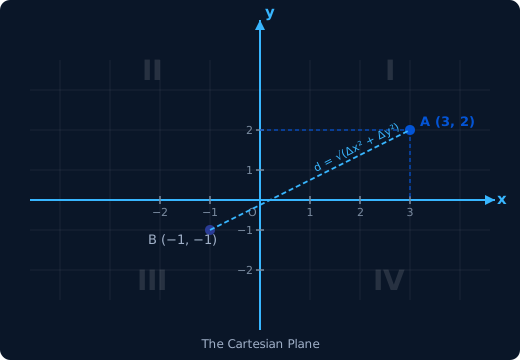
The Cartesian plane consists of two number lines — the x-axis (horizontal) and the y-axis (vertical) — crossing at right angles at the origin O = (0, 0).
Every point P in the plane is described by an ordered pair (x, y), where x is the horizontal distance from the origin (positive to the right, negative to the left) and y is the vertical distance (positive upward, negative downward).
The axes divide the plane into four quadrants: - Quadrant I: x > 0, y > 0 (top right) - Quadrant II: x < 0, y > 0 (top left) - Quadrant III: x < 0, y < 0 (bottom left) - Quadrant IV: x > 0, y < 0 (bottom right)
Distance Between Two Points
Given two points A = (x₁, y₁) and B = (x₂, y₂), the distance between them follows from Pythagoras' theorem applied to the right triangle with horizontal leg (x₂ − x₁) and vertical leg (y₂ − y₁):
Example. The distance from A = (1, 2) to B = (4, 6) is √((4−1)² + (6−2)²) = √(9 + 16) = √25 = 5.
Midpoint of a Segment
The midpoint M of the segment joining A = (x₁, y₁) and B = (x₂, y₂) is simply the average of the coordinates:
Example. The midpoint of the segment from (1, 2) to (5, 8) is ((1+5)/2, (2+8)/2) = (3, 5).
Gradient (Slope)
The gradient (or slope) of a line measures how steeply it rises or falls. For a line through two points A = (x₁, y₁) and B = (x₂, y₂):
The gradient is positive if the line rises from left to right, negative if it falls, zero if horizontal, and undefined if vertical (since x₂ − x₁ = 0 would give division by zero).
Special cases: - A horizontal line has gradient m = 0 (no rise). - A vertical line has an undefined gradient (infinite steepness).
Equation of a Straight Line
Slope-intercept form
The most common form is:
where m is the gradient and c is the y-intercept — the value of y where the line crosses the y-axis.
Example. The line y = 2x + 3 has gradient 2 and crosses the y-axis at (0, 3).
General form
Any straight line can also be written as:
where a, b, c are constants (not all zero). This form handles vertical lines naturally (when b = 0).
Finding the equation from two points
Given two points (x₁, y₁) and (x₂, y₂): 1. Calculate the gradient: m = (y₂ − y₁)/(x₂ − x₁). 2. Use the point-gradient form: y − y₁ = m(x − x₁), then rearrange to y = mx + c.
Example. Through (2, 1) and (6, 9): m = (9−1)/(6−2) = 8/4 = 2. Then y − 1 = 2(x − 2), so y = 2x − 3.
Finding the equation from a point and gradient
Given point (x₁, y₁) and gradient m, use directly: y − y₁ = m(x − x₁).
Parallel and Perpendicular Lines
Parallel lines have identical gradients. If two lines have equations y = m₁x + c₁ and y = m₂x + c₂, they are parallel if and only if m₁ = m₂ (and c₁ ≠ c₂, otherwise they are the same line).
Perpendicular lines have gradients whose product is −1:
This means perpendicular lines have gradients that are negative reciprocals of each other.
Example. A line with gradient 3 is perpendicular to any line with gradient −1/3.
A horizontal line (m = 0) is perpendicular to any vertical line (undefined gradient), consistent with the formula in the limiting sense.
Distance from a Point to a Line
Given the line ax + by + c = 0 and a point P = (x₀, y₀), the perpendicular distance from P to the line is:
This is particularly useful for finding the distance from a point to a line expressed in general form.
Example. Distance from (3, 4) to the line 3x + 4y − 10 = 0 is |3(3) + 4(4) − 10| / √(9 + 16) = |9 + 16 − 10| / 5 = 15/5 = 3.
The Circle in Coordinate Geometry
A circle with centre (a, b) and radius r consists of all points (x, y) at distance r from the centre. By the distance formula:
Example. A circle centred at (2, −1) with radius 4 has equation (x − 2)² + (y + 1)² = 16.
General form of a circle
Expanding (x − a)² + (y − b)² = r² gives:
where D = −2a, E = −2b, and F = a² + b² − r².
To recover the centre and radius from general form, complete the square for x and y separately: 1. Write x² + Dx = (x + D/2)² − (D/2)². 2. Similarly for y. 3. Rearrange to standard form; read off centre and radius.
Example. x² + y² − 6x + 4y − 3 = 0. Complete the square: (x − 3)² − 9 + (y + 2)² − 4 − 3 = 0, so (x − 3)² + (y + 2)² = 16. Centre = (3, −2), radius = 4.
Intersection of a Line and a Circle
To find where a straight line meets a circle, substitute the equation of the line into the equation of the circle to get a quadratic in one variable:
- Two solutions → the line is a secant (crosses the circle at two points).
- One repeated solution → the line is a tangent (touches the circle at exactly one point). The discriminant of the quadratic is zero.
- No real solutions → the line misses the circle entirely.
Example. Where does y = x + 1 meet (x − 2)² + (y − 3)² = 25? Substitute y = x + 1: (x − 2)² + (x − 2)² = 25, so 2(x − 2)² = 25, (x − 2)² = 12.5, x = 2 ± √12.5. Two solutions, so the line is a secant.
Coordinate geometry transforms geometric reasoning into algebraic calculation — and vice versa. The same mathematical objects can be approached from either direction, each illuminating aspects that the other might obscure.
Frequently Asked Questions
Who invented coordinate geometry?
René Descartes published the foundational ideas in his 1637 appendix *La Géométrie*, attached to his philosophical work *Discourse on Method*. Pierre de Fermat developed similar ideas independently around the same time. The system is called "Cartesian" after Descartes (Cartesius in Latin). Their insight — that a geometric point corresponds to a pair of numbers — unified algebra and geometry into a single subject and made calculus possible.What is the difference between gradient and slope?
None — they are the same thing. "Gradient" is the standard British term; "slope" is the standard American term. Both refer to the ratio of vertical change to horizontal change (rise over run) for a line: m = (y₂ − y₁)/(x₂ − x₁). A positive value means the line rises left to right; negative means it falls; zero means it is horizontal; undefined means it is vertical.How do you tell whether two lines are parallel, perpendicular, or neither?
Write both lines in slope-intercept form y = mx + c. If their gradients m₁ and m₂ are equal, the lines are parallel (or identical if the intercepts also match). If m₁ × m₂ = −1, the lines are perpendicular. If neither condition holds, the lines are simply intersecting at some other angle. A horizontal line (m = 0) is always perpendicular to any vertical line (undefined gradient).How do you find the intersection of two lines?
Set the two equations equal to each other (or solve the system simultaneously). For y = m₁x + c₁ and y = m₂x + c₂, set m₁x + c₁ = m₂x + c₂ and solve for x, then substitute back for y. Two parallel lines have no intersection (no solution); two identical lines intersect everywhere (infinite solutions).What does "completing the square" mean and why is it used for circles?
Completing the square is an algebraic technique that rewrites a quadratic expression x² + bx as (x + b/2)² − (b/2)². It is used to convert a circle equation from its expanded general form x² + y² + Dx + Ey + F = 0 into the standard form (x − a)² + (y − b)² = r², from which the centre (a, b) and radius r can be read off immediately. The same technique is used to solve quadratic equations and to derive the quadratic formula.Conclusion
Coordinate geometry is the bridge between Euclid's synthetic constructions and the algebraic methods of modern mathematics. By assigning numbers to points, every geometric relationship becomes an equation and every curve becomes a set of ordered pairs — a shift that makes geometry amenable to calculation, computation, and generalisation to any number of dimensions. The distance formula, midpoint rule, and gradient conditions for parallel and perpendicular lines are the algebraic translations of the most fundamental Euclidean theorems.
The next chapter explores a family of curves that emerges naturally from second-degree equations — Conic Sections.