Introduction
Geometry typically studies individual points, lines, and shapes — but a locus asks a different question: what is the complete set of all points that satisfy a given condition? This shift from individual cases to entire families of points is one of the most powerful conceptual moves in classical geometry, and it gives rise to many of the shapes studied throughout this guide.
Key Takeaways
- The locus of all points equidistant from a fixed point is a circle; equidistant from two fixed points is the perpendicular bisector of the segment joining them.
- The locus of all points equidistant from two intersecting lines is the pair of angle bisectors at the intersection.
- The locus of all points at a fixed distance from a line is two parallel lines, one on each side.
- Compound locus problems are solved by finding the intersection of two individual loci.
- In three dimensions, loci become surfaces: equidistant from a point gives a sphere; equidistant from a line gives a cylinder.
A locus (plural: loci) is the complete set of all points that satisfy a given geometric condition — and no points that do not satisfy it. The word comes from Latin for "place". Rather than specifying individual points, a locus describes the entire path or region they collectively form. This turns out to be a surprisingly powerful way to define geometric shapes: a circle, for instance, is the locus of all points at a fixed distance from a given centre.
The Standard Loci
Five standard loci appear repeatedly in geometry. Every student should know them by heart.
Locus 1 — Points Equidistant from a Fixed Point
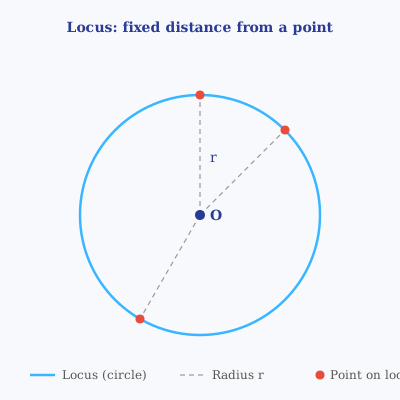
All points at a fixed distance r from a given point O form a circle with centre O and radius r. This is the definition of a circle, expressed as a locus. Every point on the circle is exactly r from O; every point inside is closer; every point outside is farther.
Locus 2 — Points Equidistant from Two Fixed Points
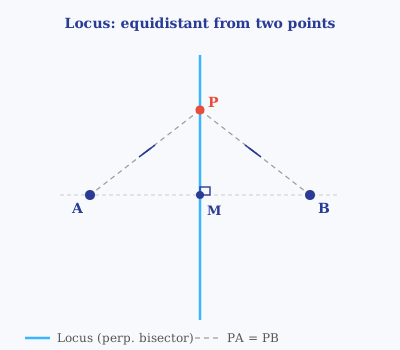
All points equidistant from two fixed points A and B lie on the perpendicular bisector of the segment AB. The perpendicular bisector passes through the midpoint M of AB at right angles to it. Any point P with PA = PB lies on this line; any point not on it has unequal distances to A and B.
This locus is a straight line — infinite in both directions — cutting AB exactly at its midpoint.
Locus 3 — Points Equidistant from Two Intersecting Lines
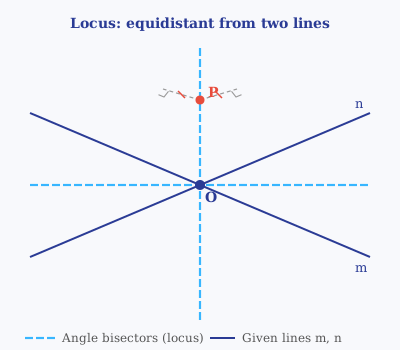
If two lines cross at a point, all points equidistant from both lines lie on the angle bisectors of the angles they form. Two lines crossing create four angles (two pairs of vertical angles), and their four bisectors reduce to two perpendicular lines through the crossing point.
Every point on either bisector is the same perpendicular distance from each of the two original lines.
Locus 4 — Points at a Fixed Distance from a Line
All points at a fixed perpendicular distance d from a given line l form two parallel lines — one on each side of l, each at distance d from it. Together they form a pair of lines equidistant from l and parallel to it.
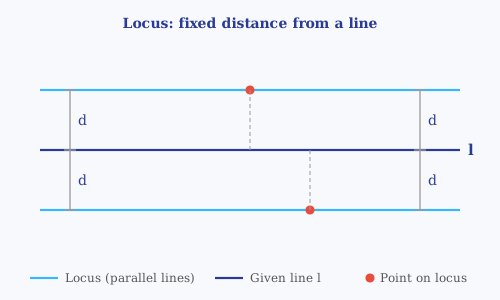
This locus is sometimes called the "parallel offset" of a line. It appears in road planning (centre lines), engineering tolerances, and buffer zones.
Locus 5 — Points on a Circle Equidistant from a Chord's Endpoints
Given a circle with centre O and a chord AB, all points P on the circle satisfying the condition that the angle APB is constant (Thales' theorem and its generalisation) trace arcs of the circle. In the special case where the chord is a diameter, all points on the semicircle form right angles with the endpoints of the diameter — the locus of the right angle vertex is the semicircle above the diameter.
Compound Loci
Many problems ask for the set of points satisfying two conditions simultaneously. The solution is the intersection of the two individual loci.
Example. Find all points that are 5 cm from point A and also equidistant from two given parallel lines l₁ and l₂ (which are 6 cm apart).
- Locus for "5 cm from A": a circle of radius 5 centred at A.
- Locus for "equidistant from l₁ and l₂": the line midway between them, parallel to both, at distance 3 from each.
The required points are wherever the circle intersects this midline. Depending on position, there may be 0, 1, or 2 such points.
Strategy for compound loci: 1. Describe each condition as a known standard locus. 2. Draw or describe each locus. 3. Find their intersection — these are the required points.
Loci in Three Dimensions
The same idea extends naturally into 3D space, and familiar solid shapes emerge.
Points at a fixed distance from a fixed point — a sphere with that centre and radius. This is the 3D analogue of the circle.
Points at a fixed distance from a fixed line — a cylinder (infinite, without end caps) with the given line as axis and the given distance as radius.
Points equidistant from two fixed planes — the plane midway between them, parallel to both.
Points equidistant from a fixed point and a fixed plane — a paraboloid of revolution (a bowl shape). This is not a standard school locus but shows the richness of the concept.
Points at a fixed angle from a fixed line — a cone with the given line as axis. The half-angle of the cone equals the fixed angle.
Practical Applications
Loci are not merely abstract — they arise throughout mathematics, science, and design.
Navigation. A ship's radar gives its distance from two fixed buoys. Each distance defines a circle. The ship is at the intersection of the two circles — one of two possible points, resolved by other information.
Engineering. The path traced by a point on a rotating crank arm is a circle (locus of fixed distance from the pivot). The path of a point on a connecting rod traces a more complex curve (an ellipse or elongated loop), found by compound locus reasoning.
Architecture. Vaulted ceilings and arched bridges follow circular arcs — each arc being the locus of points at a fixed distance from an axis.
Optics. The focus of a parabolic mirror is defined as the locus of points equidistant from the focal point and the directrix line — the parabola itself. All incoming parallel rays reflect through this single point, which is why parabolic mirrors concentrate light.
Understanding loci trains the geometric habit of thinking about entire sets of points at once, rather than individual cases — a shift in perspective that underlies much of advanced mathematics.
Conclusion
Loci reveal that geometric shapes are best understood as the answer to a question — what set of points satisfies this condition? — rather than as arbitrary figures. The five standard loci (circle, perpendicular bisector, angle bisectors, parallel lines, and arc) are the building blocks from which compound locus problems are assembled, and the same idea extends naturally into three dimensions where points, lines, and planes replace their two-dimensional counterparts. This habit of thinking in terms of constraint-defined sets is the foundation of analytic and algebraic geometry.
The next chapter places geometry on a coordinate system, opening the door to algebraic methods — Coordinate Geometry.