Introduction
Imagine standing at a beach. You can count the grains of sand — it would take a very long time, but in principle each grain is a distinct, countable thing. Now think about the water: between any two drops you can always find another drop. The water is, in a useful sense, denser than the sand.
Numbers work the same way. Mathematicians have known for well over a century that not all infinities are equal. The infinity of whole numbers (1, 2, 3, …) is genuinely smaller than the infinity of all points on the number line. What nobody has been able to determine — despite 150 years of effort — is whether anything exists in between those two infinities. That question is the Continuum Hypothesis.
It was declared the single most important open problem in mathematics by David Hilbert in 1900. By the mid-twentieth century the best result anyone could achieve was to show that the question cannot be answered using the rules mathematics currently runs on. The hypothesis sits at the boundary of what mathematical logic can reach — and for that reason it remains one of the most fascinating puzzles in all of science.
Infinity is not just an abstract curiosity. It lies at the foundations of calculus, analysis, physics, and computation. Understanding the structure of infinite sets shapes how we think about continuous space, motion, and even the nature of mathematical truth itself.
Key Takeaways
- The Continuum Hypothesis asks whether any infinity exists strictly between the countable whole numbers (ℵ₀) and the uncountable real numbers (ℵ₁) — a question Hilbert ranked as the most important open problem in mathematics in 1900.
- Gödel (1940) and Cohen (1963) together proved the hypothesis is independent of the standard ZF axioms — it can be neither proved nor disproved within the current rules of mathematics.
- Cantor's diagonal argument shows that the real numbers are fundamentally unlistable, placing them in a qualitatively different category of infinity from the integers.
- Our discovery of Aleph 0.5 — an intermediate infinity exactly twice as dense as the natural numbers — offers a constructive challenge to the hypothesis from the framework of Geometric Maths.
Types of Numbers
To understand why the hypothesis is so hard, we first need a clear picture of the different kinds of numbers that populate the number line.
Cardinal numbers
Cardinal numbers are the counting numbers: one apple, two apples, three apples. They answer the question how many? They are the most intuitive numbers, rooted in the ability to distinguish and tally separate objects.

Ordinal numbers
Ordinal numbers describe position or sequence: first, second, third. They answer the question in what order? rather than how many? Where cardinal numbers measure size, ordinal numbers measure rank or arrangement — think of finishing positions in a race.

Natural numbers and ℵ₀
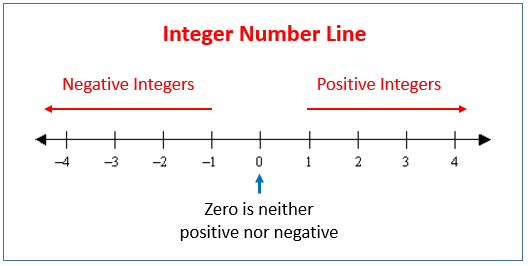
Together, cardinal and ordinal numbers give us the integers (from the Latin integer, meaning whole): the infinite sequence …, −2, −1, 0, 1, 2, 3, … These are numbers that can be expressed without any decimal or fraction.
The full infinite set of integers is given a special label: ℵ₀ (pronounced Aleph-null). Aleph (ℵ) is the first letter of the Hebrew alphabet; mathematicians use it to measure the size of infinite sets, called the cardinality of the set. ℵ₀ is the smallest infinite cardinality — the baseline against which all other infinities are measured.
Any sequence built from whole numbers by multiplication — the 2× table, the 3× table, and so on — is less dense than the integers: it skips more and more numbers as it grows. Yet each such sequence still stretches to infinity. Through a matching technique called bijection (explained below), Cantor showed all of these sequences have the same cardinality, ℵ₀. They are all, in a precise sense, the same size of infinity.
Real numbers and ℵ₁
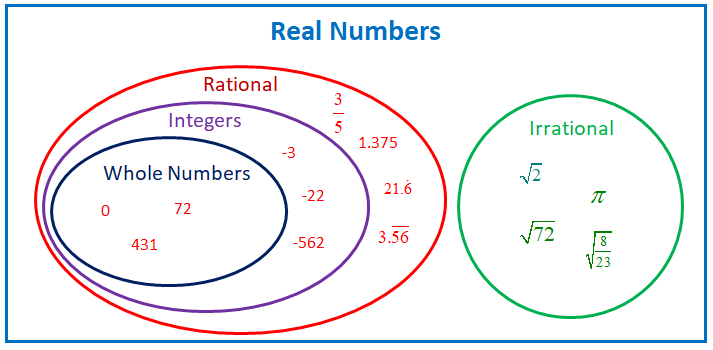
Beyond integers there are rational numbers — any value expressible as a fraction, such as ½ or −7/3. Then there are irrational numbers — values like √2 that cannot be written as any fraction. And beyond those are transcendental numbers — values like π that cannot be derived from any algebraic formula whatsoever.
All of these together — integers, rationals, irrationals, transcendentals — make up the real numbers: every point on the continuous number line. This set is labelled ℵ₁ (Aleph-one). Cantor proved that ℵ₁ > ℵ₀: the real numbers represent a strictly larger infinity than the integers. The Continuum Hypothesis asks exactly how much larger.
Measuring Infinity
Countability and Cantor's diagonal argument
How do you measure the size of an infinite set? You cannot simply count to the end. Cantor's ingenious approach was to ask a different question: can the set be listed?
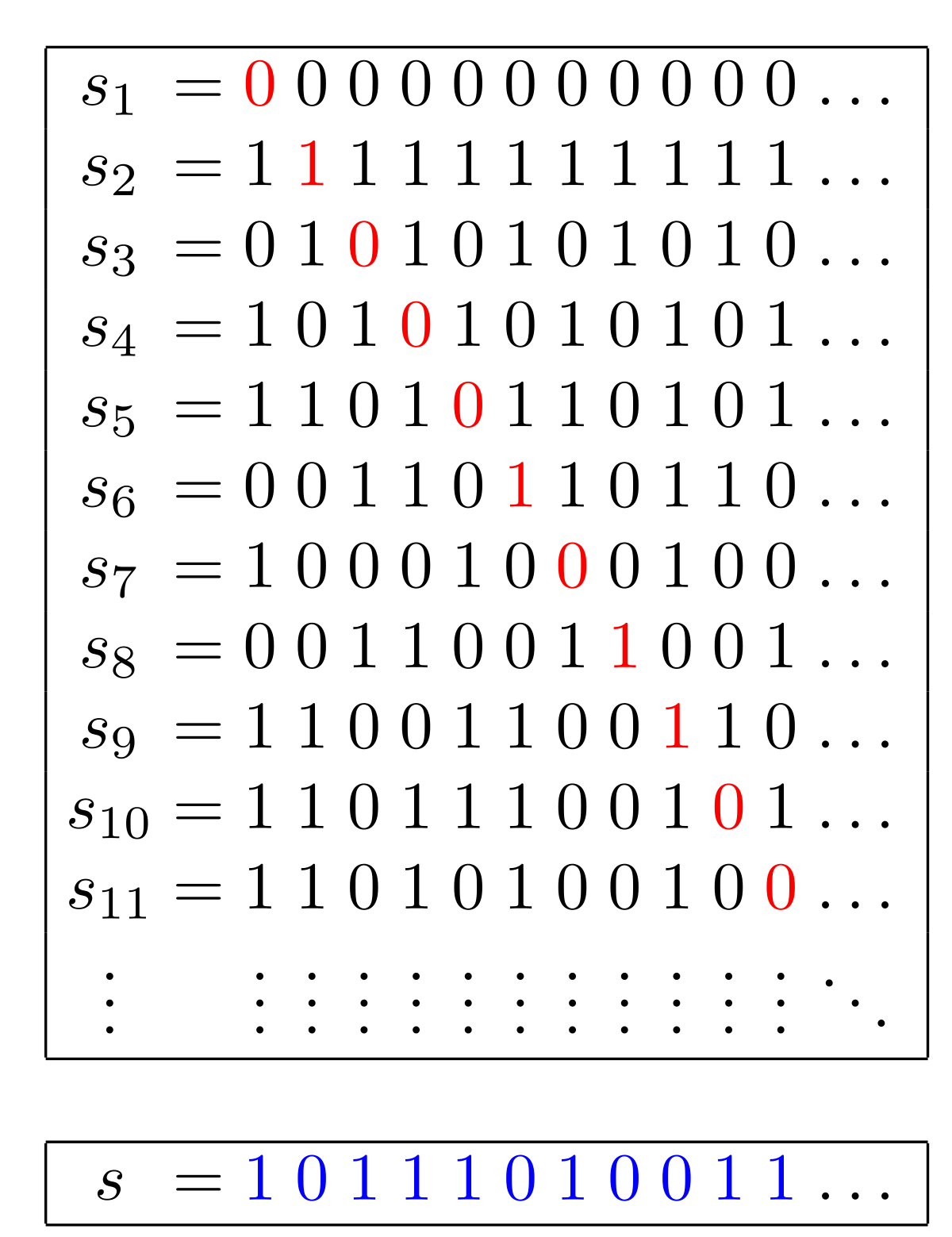
His famous diagonal argument shows that the real numbers cannot be listed — not even in principle. Imagine writing out an attempt: a numbered list of all real numbers between 0 and 1 in binary (strings of 0s and 1s). Now take the first digit of the first number, the second digit of the second number, and so on down the diagonal — then flip every digit (turn each 0 into 1, each 1 into 0). The result is a number that differs from every number on the list in at least one place. So the list was incomplete. No matter how clever the listing, this construction always produces an escapee, proving the real numbers are fundamentally unlistable, or uncountable.
The integers, by contrast, can be listed (1, 2, 3, …), making them a countable infinity. Uncountable infinity is irreducibly larger.
Infinite density
Rather than counting, another useful way to compare infinite sets is by their density — how thickly the numbers are packed.
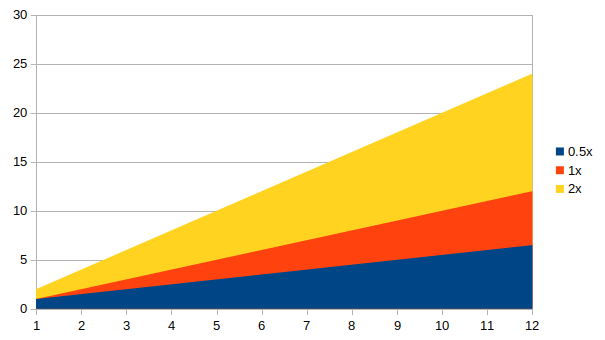
Think of the 2× multiplication table (2, 4, 6, 8, …) laid alongside all whole numbers (1, 2, 3, 4, …). Both sequences run forever, but the 2× table skips every odd number. It is, in a measurable sense, half as dense as the whole numbers. The 3× table is one-third as dense. As the multiplier grows, the sequence becomes sparser, with larger and larger gaps.
This density perspective lets us compare infinities without trying to count them — a crucial tool when infinity itself resists counting. It is also the foundation of our concept of Aleph 0.5, which uses the density of reciprocal number space to identify an intermediate infinity.
Bijection — the tool for comparing infinities
The formal mathematical tool for comparing infinite sets is bijection: establishing a one-to-one correspondence between every element of one set and every element of another. If each element of Set A can be paired with exactly one element of Set B, with nothing left over on either side, the two sets have the same cardinality — the same "size" of infinity.
Cantor used bijection to show rigorously that the 2× table and the whole numbers have the same cardinality (ℵ₀), even though the 2× table seems smaller. You simply pair 1↔2, 2↔4, 3↔6, and so on — the pairing never runs out on either side.

The Cantor set — removing density
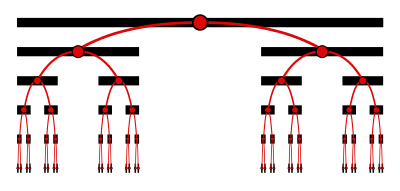
Cantor also explored what happens when you systematically remove parts of a continuous set. Start with a line segment. Remove the middle third. Then remove the middle third of each remaining piece. Repeat indefinitely. The result — the Cantor set — is an infinite collection of points with zero total length, yet still technically infinite. It is one of the earliest examples showing that infinite sets can have radically different internal structures.
Into Infinity
Why fractions explode the count
Up to now we have been comparing infinite sets all built from integers. Bijection showed these all share the same cardinality ℵ₀. But the moment we introduce fractions — the rational numbers — something dramatic changes.
Between any two whole numbers, no matter how close, you can always insert another fraction. Between 0 and 1 alone there are infinitely many: ½, ¼, ⅓, 1/5, 1/100, … Between 0 and 0.001 there are infinitely many more. There is no "next" fraction after 0 the way 1 is the "next" whole number after 0. This is what mathematicians mean when they say the real numbers are dense — not in the everyday sense of heavy or thick, but in the precise sense that between any two values, another always exists.
The bijection of real numbers — a 2D surface
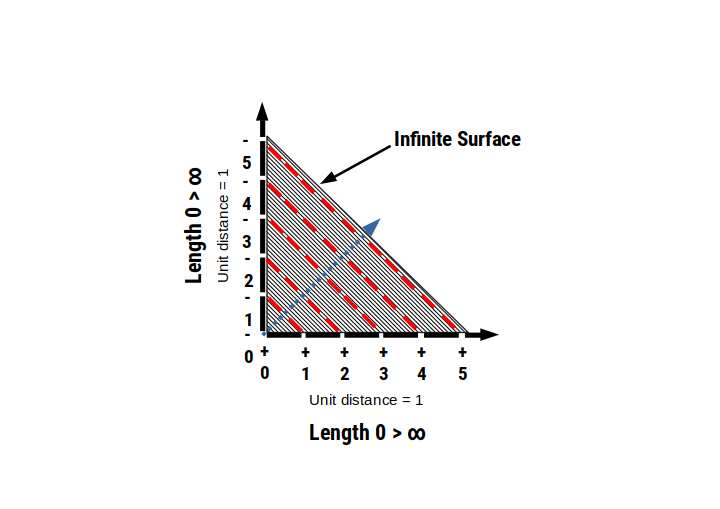
When Cantor tried to apply bijection to the real numbers he ran into something startling. To compare the real numbers against themselves, imagine placing two real number lines at right angles to each other. Every point on the resulting 2D plane corresponds to a pair of real numbers — one from each axis. The number of points on this plane is the same as on a single line. In other words, the "size" of the infinity of the plane equals the "size" of the infinity of the line. This result is deeply counterintuitive: adding a whole extra dimension does not increase the cardinality of a continuous set.
What it does show is that real numbers behave completely differently from integers. The cardinality of the real numbers is not ℵ₀ — it is something larger, and that larger cardinality is called the continuum.
The reciprocal paradox
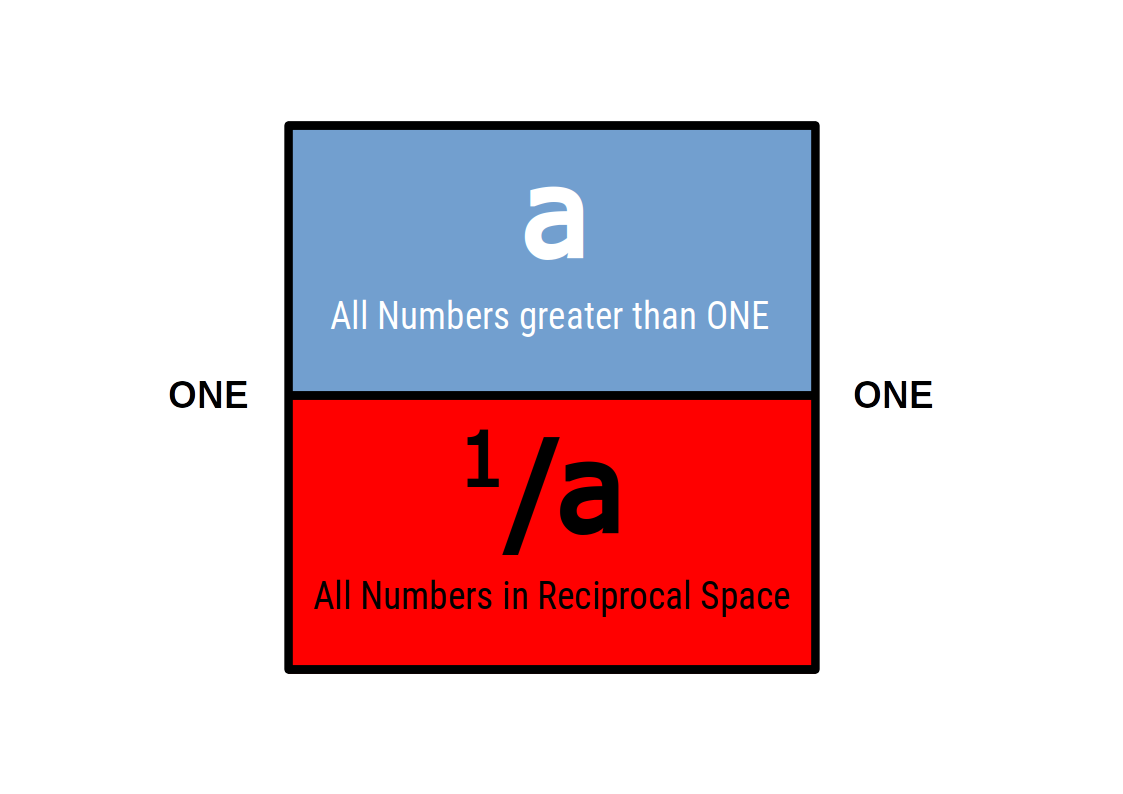
Here is the mind-bending consequence. Every real number greater than 1 has a reciprocal — a corresponding value between 0 and 1 (for example, 3 has reciprocal ⅓, and 1000 has reciprocal 0.001). This means every number on the entire number line above 1 maps one-to-one onto a number in the tiny interval between 0 and 1.
So the interval from 0 to 1 contains as many numbers as the entire infinite number line from 1 to infinity. It also contains as many numbers as the interval from 0 to 3 — three times the length, but the same cardinality. Length and cardinality come completely apart when we move into the real numbers.
This is not a paradox in the sense of a logical error — it is a precisely proved theorem. But it gives a vivid sense of why working with infinite sets of real numbers is so treacherous: our intuitions about size and proportion simply break down. For a deeper exploration of this space, see our article on reciprocal number space.
The Hypothesis
Hilbert's number one problem
In 1900, the German mathematician David Hilbert presented a list of 23 open problems that he believed would define mathematics for the coming century. He placed the Continuum Hypothesis first. The question, stated precisely, is this:
Is there an infinite set whose cardinality is strictly greater than ℵ₀ (the integers) and strictly less than the cardinality of the real numbers?
In other words: is there an infinity that sits between countable and uncountable? Or do the integers and the real numbers represent two consecutive rungs on the ladder of infinities, with nothing in between?
Cantor himself believed the answer was no — that there is no such intermediate infinity, and that the real numbers have exactly the cardinality ℵ₁. That belief is the Continuum Hypothesis. He could not prove it.
The unsolvable
The story of attempts to resolve the Continuum Hypothesis is one of the most dramatic episodes in mathematical history.
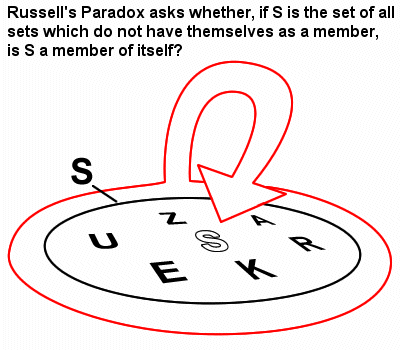
In 1908, Ernst Zermelo proposed a revised set of axioms — the foundational rules of set theory — partly to eliminate the contradictions that Russell's Paradox had exposed. These became the Zermelo–Fraenkel (ZF) axioms, the basis on which almost all of modern mathematics rests.
In 1940, Kurt Gödel showed that the Continuum Hypothesis is consistent with ZF set theory — you cannot disprove it from those axioms. In 1963, Paul Cohen showed it is also consistent to deny the Continuum Hypothesis — you cannot prove it either. Together, these results established that the Continuum Hypothesis is independent of the standard axioms: it can be neither proved nor refuted within the current framework of mathematics.
This directly undermined Hilbert's dream of finding a complete, consistent set of axioms for all of mathematics — a dream that Gödel's earlier incompleteness theorems had already severely wounded.
The question, restated
To sum up the problem in plain terms: we know that ℵ₀ < ℵ₁ (the integers are a smaller infinity than the real numbers). The Continuum Hypothesis asks whether those two infinities are consecutive — whether there is nothing in between — or whether some intermediate infinity exists that mathematics has not yet found a way to see.
The fundamental obstacle is that we cannot measure ℵ₁ precisely. The density of real numbers is infinite at every point, and the interval from 0 to 1 alone contains more numbers than all the integers combined. If we cannot pin down the size of ℵ₀ relative to the real numbers, we have no firm ground on which to search for anything in between.
Conclusion
The Continuum Hypothesis is not merely an unsolved puzzle — it is a precisely defined problem that has been proved to be unsolvable within the rules mathematics currently uses. That result is itself one of the most profound findings of twentieth-century thought. It tells us that mathematical truth is larger than any fixed set of axioms can capture.
What would it take to resolve the question? A genuinely new mathematical framework — one that can handle the density of infinite sets without collapsing into paradox. This is precisely what Geometric Maths provides. By examining the structure of reciprocal number space — the infinite set of fractions between zero and one — we have identified a constructive counter-example: Aleph 0.5, an intermediate infinity that sits between ℵ₀ and ℵ₁ with exactly double the density of the natural numbers.
The same 2:1 density ratio that defines Aleph 0.5 also turns out to explain the critical strip of the Riemann zeta function at n = 0.5. These are not separate discoveries — they are expressions of a single geometric structure underlying the number line.
The Continuum Hypothesis was unsolvable because the framework in which it was posed — flat, one-dimensional set theory — lacks the geometric structure to see the answer. The answer was always there, in the density of reciprocal space. It just needed the right geometry to make it visible.
For the full construction, see Aleph 0.5. For the geometric resolution to the paradoxes of self-referential sets, see A Geometric Solution to the Russell Paradox and the 2D geometric solution.
FAQ
What is the Continuum Hypothesis in simple terms?
It asks whether there is a size of infinity that sits strictly between the countable infinity of whole numbers and the larger infinity of real numbers. No one has been able to prove or disprove it within standard set theory.
Why can't mathematicians solve the Continuum Hypothesis?
Gödel and Cohen together showed that the hypothesis can neither be proved nor disproved from the standard axioms of set theory. It is what mathematicians call 'independent' of those axioms — meaning both answers are logically consistent.
What are Aleph numbers?
Aleph (ℵ) numbers are a way of measuring the size of infinite sets. ℵ₀ (Aleph-null) counts the whole numbers; ℵ₁ is the next larger infinity. The Continuum Hypothesis claims the real numbers have exactly the size ℵ₁.
What is bijection?
Bijection is a one-to-one pairing between two sets. If every element of one set can be matched to exactly one element of another, the two sets are the same size — even if both are infinite.
Is the Continuum Hypothesis related to Russell's Paradox?
Both problems strike at the same deep fault-line in mathematics: the paradoxes that arise when you try to work rigorously with infinite sets. Russell's Paradox forced a rethink of set theory itself, and that rethinking is part of why the Continuum Hypothesis has proved so resistant.
What is Aleph 0.5?
Aleph 0.5 is an intermediate infinity — a countably infinite set exactly twice as dense as the natural numbers — constructed by summing sequential whole-number fractions. Its existence directly challenges the Continuum Hypothesis.