Introduction
A Euclidean construction is a geometric figure drawn using only two tools: an unmarked straightedge and a compass. No rulers for measuring lengths, no protractors for measuring angles — only the purest geometric reasoning. This discipline goes back to Euclid's Elements, where every theorem is either proved from first principles or demonstrated through construction. Mastering these constructions develops geometric intuition and reveals how much can be achieved from almost nothing.
Key Takeaways
- With only a straightedge and compass, it is possible to bisect any segment or angle, erect a perpendicular, and draw a parallel through any point.
- A regular hexagon is particularly easy to inscribe in a circle: the side length equals the radius, so six steps around the circle complete it exactly.
- Constructing a regular pentagon requires the golden ratio: the side equals the distance from the midpoint of a radius to the end of a perpendicular diameter.
- Three famous constructions — squaring the circle, trisecting an arbitrary angle, and doubling the cube — are provably impossible with compass and straightedge alone.
- Every new construction step must be justified by a point at the intersection of two lines, two circles, or a line and a circle.
The Tools and Their Rules
The straightedge can draw a straight line through any two given points. It has no markings and cannot be used to measure or transfer lengths.
The compass can draw a circle with any given centre and any given radius. It can also be used to transfer a length — you set it to the distance between two points and then draw an arc of that same radius elsewhere.
The rules are strict: you may only mark a new point where two lines meet, where two circles meet, or where a line and a circle meet. Every step must be justified by these intersections.
Basic Constructions
1. Copying a Line Segment
Given a line segment AB, to construct a segment of the same length starting from a point P on another line:
- Open the compass to the distance AB.
- Place the compass point at P.
- Draw an arc intersecting the given line.
- Mark the intersection point Q. Then PQ = AB.
2. Bisecting a Line Segment
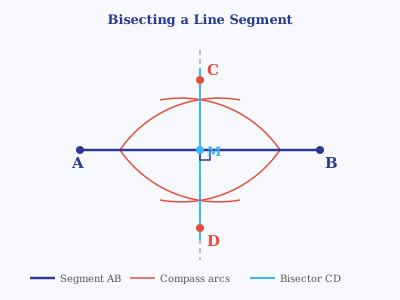
Given a segment AB, to find its midpoint M:
- Open the compass to more than half the length of AB.
- Place the compass point at A and draw an arc above and below the segment.
- Without changing the compass width, place it at B and draw arcs intersecting the first pair.
- Label the two intersection points C (above) and D (below).
- Draw the line CD. It crosses AB at the midpoint M, and is perpendicular to AB.
This also gives the perpendicular bisector of AB as a bonus.
3. Copying an Angle
Given an angle BAC, to construct an equal angle at a new vertex P:
- Draw a ray from P.
- Draw an arc centred at A crossing both sides of the angle; label the crossings D and E.
- Draw the same-radius arc centred at P; label where it crosses the ray as F.
- Set the compass to the chord length DE.
- Draw an arc from F with that radius; label the intersection G.
- Draw ray PG. The angle GPF equals angle BAC.
4. Bisecting an Angle
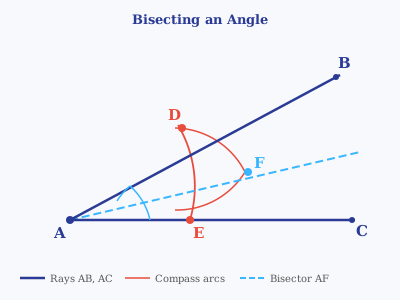
Given an angle BAC, to draw the ray that divides it into two equal angles:
- Draw an arc centred at A crossing both sides of the angle; label the crossings D and E.
- Draw equal-radius arcs centred at D and E; label their intersection F.
- Draw ray AF. This is the angle bisector.
5. Perpendicular from a Point to a Line
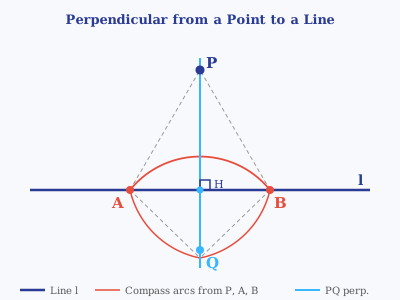
Given a line l and a point P not on it, to drop a perpendicular from P to l:
- Draw an arc centred at P that crosses l at two points A and B.
- Draw equal arcs centred at A and B on the far side of l from P; label their intersection Q.
- Draw the line PQ. It is perpendicular to l, and meets l at the foot of the perpendicular from P.
6. Perpendicular at a Point on a Line
Given a line l and a point P on it, to erect a perpendicular at P:
- Mark two points A and B on l equidistant from P (using a compass arc centred at P).
- Draw equal arcs centred at A and B above the line; label their intersection Q.
- Draw line PQ. It is perpendicular to l at P.
7. Parallel Line Through a Point
Given a line l and a point P not on it, to draw a line through P parallel to l:
- Draw a transversal — any line through P crossing l at a point A.
- Copy the angle that this transversal makes with l at the point A, positioning the equal angle at P on the same side.
- The new ray from P, making the same angle with the transversal, is parallel to l (by the converse of the equal alternate angles theorem).
Constructing Regular Polygons Inscribed in a Circle
All regular polygon constructions below assume a circle with centre O and radius r is already drawn.
Equilateral Triangle
- Mark any point A on the circle.
- Draw an arc of radius r centred at A; it crosses the circle at B and C.
- Draw an arc of radius r centred at B; it crosses the arc from A at a point D — but more directly: use the radius itself. Since the radius equals the chord, mark B at distance r from A. Then from B, mark C at distance r. A, B, and C form an equilateral triangle inscribed in the circle.
The cleaner method: mark point A. Keep compass at radius r. Step around the circle — each step marks the next vertex. Six steps return to A; take every other mark to get the triangle.
Square
- Draw a diameter AB.
- Construct the perpendicular bisector of AB; it meets the circle at C and D.
- Connect A, C, B, D in order — this is the inscribed square.
Regular Hexagon
The side of an inscribed regular hexagon equals the radius of the circle. Therefore:
- Mark point A on the circle.
- With compass set to the radius, step around the circle from A, marking six equally spaced points.
- Connect consecutive points to form the hexagon.

Regular Pentagon
Constructing a regular pentagon requires a few more steps, using the golden ratio:
- Draw diameters AB (horizontal) and CD (vertical), meeting at centre O.
- Find M, the midpoint of OB.
- Draw an arc centred at M with radius MC; it crosses the diameter at point E.
- The distance CE equals the side length of the inscribed pentagon.
- Step this length around the circle five times to mark the five vertices.
The Three Famous Impossible Constructions
For over two thousand years, geometers attempted three classical problems with compass and straightedge. In the nineteenth century, mathematics finally proved them all impossible.
Squaring the circle — constructing a square with the same area as a given circle — requires constructing a length of √π. Since π is transcendental (not a root of any polynomial with rational coefficients), this length cannot be constructed.
Trisecting an arbitrary angle — dividing any given angle into three equal parts — would require solving a cubic equation in general, which cannot be done with compass and straightedge (which can only solve linear and quadratic equations). Some specific angles can be trisected, but no general method exists.
Doubling the cube — constructing a cube with exactly twice the volume of a given cube — requires constructing the cube root of 2, which is algebraically impossible with these tools.
These impossibility results are not failures of ingenuity. They are profound theorems about what kind of numbers compass and straightedge arithmetic can produce — and what lies beyond its reach.
Conclusion
Euclidean constructions distil the whole of elementary geometry into two instruments — compass and straightedge — and reveal which geometric truths are accessible through finite, exact steps. The impossibility of squaring the circle, trisecting an arbitrary angle, and doubling the cube are not limitations of ingenuity but deep theorems about the algebraic nature of constructible numbers. Every construction in this chapter, from bisecting an angle to inscribing a regular pentagon, is a proof as much as a procedure.
The next chapter explores how shapes fill the plane without gaps — Tessellations and Tilings.