Introduction
This chapter covers two closely related topics: the general properties of regular polygons and how to calculate the areas of all common plane figures. A regular polygon is perfectly symmetrical — equilateral and equiangular — and can always be inscribed in or circumscribed about a circle. The area formulas derived here are among the most used results in all of geometry.
Key Takeaways
- A regular polygon is both equilateral and equiangular; each interior angle of a regular n-gon equals (n − 2) × 180° / n.
- Any regular polygon can be inscribed in and circumscribed about a circle; the apothem is the radius of the inscribed circle.
- The area of any regular polygon equals half the product of its apothem and its perimeter.
- The area of a triangle equals half its base times its height; for a circle, area = πr².
- Two regular polygons with the same number of sides are always similar; their areas are in the ratio of the squares of their sides.
General Properties of Regular Polygons
Definitions
Regular Polygon — a polygon that is both equiangular and equilateral. Familiar examples are the equilateral triangle and the square.
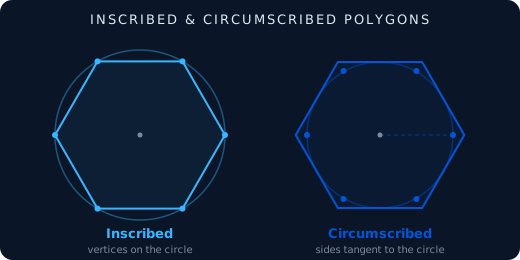
Inscribed Polygon — a rectilinear figure inscribed in a circle when each angle of the figure lies on the circumference.
Circumscribed Polygon — a rectilinear figure circumscribed about a circle when each side touches the circumference.
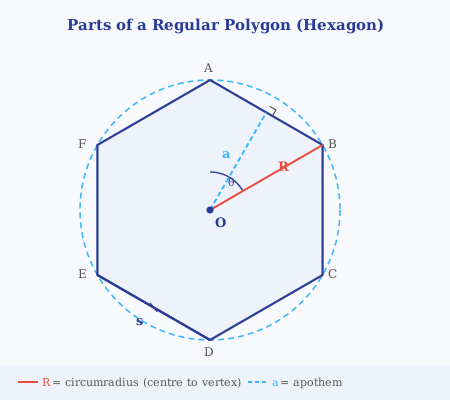
Radius — the radius of the circle circumscribed about a regular polygon.
Apothem — the radius of the circle inscribed in a regular polygon; perpendicular to each side.
Centre — the common centre of the circumscribed and inscribed circles of a regular polygon.
Angle at the Centre — the angle between radii drawn to the extremities of any side.
Theorems
Theorem 1 — A circle may be circumscribed about, and a circle may be inscribed in, any regular polygon. - Corollary: The radius drawn to any vertex bisects the angle at that vertex. - Corollary: The angles at the centre of any regular polygon are equal, and each is supplementary to an interior angle. - Corollary: An equilateral polygon inscribed in a circle is a regular polygon. - Corollary: An equiangular polygon circumscribed about a circle is a regular polygon.
Theorem 2 — If a circle is divided into any number of equal arcs, the chords joining successive points form a regular inscribed polygon; tangents at those points form a regular circumscribed polygon.
Theorem 3 — Two regular polygons of the same number of sides are similar. - Corollary: Their areas are to each other as the squares on any two corresponding sides.
Theorem 4 — The perimeters of two regular polygons of the same number of sides are to each other as their radii, and also as their apothems. - Corollary: Their areas are to each other as the squares on the radii of the circumscribed circles, and also as the squares on the apothems.
Theorem 5 — If the number of sides of a regular inscribed polygon is indefinitely increased, the apothem approaches the radius of the circle as its limit.
Theorem 6 — An arc of a circle is less than any line that envelops it on the convex side with the same extremities. - Corollary: A circle is less than the perimeter of any polygon circumscribed about it.
Theorem 7 — Two circumferences have the same ratio as their radii. - Corollary: The ratio of any circle to its diameter is constant — this constant is π (pi). - Corollary: In any circle, the circumference = 2πr.
Classic Euclidean Constructions
Problem 1: Inscribed Triangle
To inscribe a triangle equiangular with a given triangle in a given circle, draw a tangent at a point on the circle and construct angles equal to those of the given triangle. The construction uses the property that the angle between a tangent and a chord equals the inscribed angle in the alternate segment.
Problem 2: Inscribed Square
Draw two diameters of the circle at right angles to each other. Joining their four endpoints produces an inscribed square — equilateral because all four sides are equal (each is the hypotenuse of a right-isosceles triangle with equal legs equal to the radius), and right-angled because each angle is inscribed in a semicircle.
Problem 3: Inscribed Pentagon
Construct an isosceles triangle with each base angle double the apex angle. Inscribe this triangle in the circle and bisect the two double angles to obtain five equal arcs. Join the five division points to obtain a regular inscribed pentagon.
Problem 4: Inscribed Hexagon
The side of a regular hexagon inscribed in a circle equals the radius of the circle. Starting at any point, step off the radius around the circle six times to locate the six vertices. This construction works because each of the six triangles formed by two adjacent vertices and the centre is equilateral, so each central angle is exactly 60°.
Areas of Polygons
Definitions
Unit of Surface — a square whose side is a unit of length.
Area — the measure of a surface expressed in units of surface.
Triangle
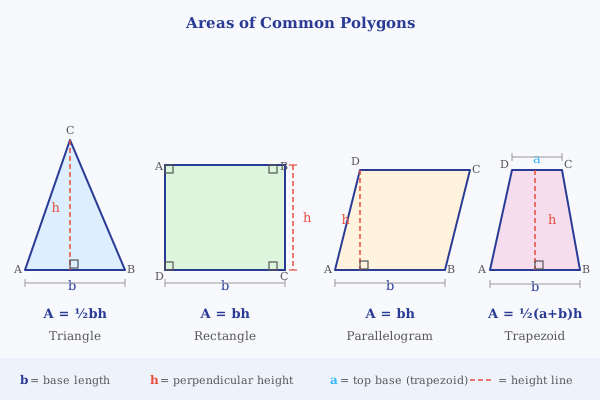
Theorem 1 — The area of a triangle equals half the product of its base by its altitude. - Triangles with equal bases and equal altitudes are equivalent. - Any two triangles are to each other as the products of their bases by their altitudes. - The product of the two legs of a right triangle equals the product of the hypotenuse by the altitude from the right-angle vertex.
Rectangles
Theorem 2 — Two rectangles with equal altitudes are to each other as their bases.
Theorem 3 — Two rectangles are to each other as the products of their bases by their altitudes.
Theorem 4 — Area of a rectangle = base × altitude.
Parallelogram
Theorem 5 — Area of a parallelogram = base × altitude. - Parallelograms with equal bases and equal altitudes are equivalent.
Rhombus
Theorem 6 — Area of a rhombus = ½ × product of its diagonals.
Trapezoid
Theorem 7 — Area of a trapezoid = ½ × (sum of bases) × altitude. - Corollary: Also equals the midsegment length × altitude.
Irregular Polygons
Theorem 8 — The area of an irregular polygon may be found by dividing it into triangles and summing their areas.
Circle
Theorem 9 — Area of a circle = ½ × radius × circumference. - Corollary: Area = πr². - Corollary: Areas of two circles are to each other as the squares on their radii. - Corollary: Area of a sector = ½ × radius × arc length.
Miscellaneous
Theorem 10 — Areas of two similar triangles are to each other as the squares on any two corresponding sides.
Theorem 11 — Areas of two similar polygons are to each other as the squares on any two corresponding sides.
Theorem 12 — Area of a regular polygon = ½ × apothem × perimeter.
Theorem 13 — Area of a circumscribed polygon = ½ × perimeter × radius of inscribed circle.
Conclusion
Regular polygons reveal how geometric regularity constrains area and perimeter in precise, predictable ways — the apothem formula and its corollaries apply uniformly across all regular polygons, from the triangle to the circle as a limiting case. Their constructibility conditions, rooted in the theory of Gaussian integers, connect elementary geometry to deep algebra. The area formulas developed here underpin the study of surfaces and volumes throughout the three-dimensional chapters to come.
The next chapter turns to the most important curve in geometry — The Circle.