Introduction
In this section, we explore the very beginnings of geometry. We begin with some definitions, then discuss the first few results as laid out originally by Euclid, and finish with some of the most elementary results of geometry.
Key Takeaways
- A straight line has no thickness and extends indefinitely; an angle is the opening between two rays from the same vertex.
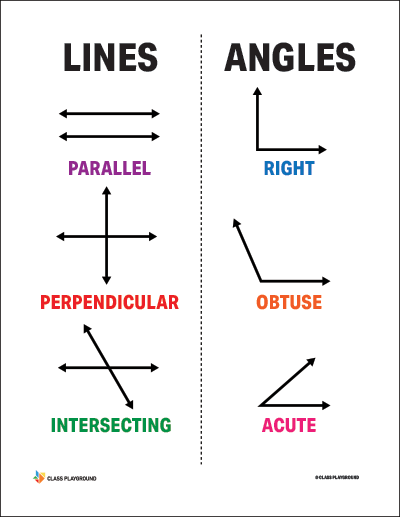
- A right angle is formed when a line meets another and makes two equal adjacent angles; a perpendicular is a line making right angles with another.
- When two parallel lines are cut by a transversal, corresponding angles are equal, alternate interior angles are equal, and consecutive interior angles are supplementary.
- Euclid's first three propositions establish how to copy a line segment and construct an equilateral triangle — entirely from first principles.
- Vertically opposite angles (formed when two lines cross) are always equal.
Rudiments of Geometry
Definitions and axioms are called the first principles of geometry. In this section we define some basic terms (with a more modern approach than Euclid's) and list some basic properties related to the most fundamental objects of geometry: lines and angles.
Definitions
Straight Line — A line such that any part placed with its ends on any other part must lie wholly in the line.
Curve Line — A line no part of which is straight is called a curve line, or simply a curve.
Broken Line — A line made up of two or more different straight lines.
Parallel Lines — Straight lines which, being in the same plane and produced indefinitely in both directions, do not meet one another in either direction.
Equality of Lines — Two straight-line segments that can be placed one upon the other so that their extremities coincide are said to be equal.
Rectilinear Figure — A plane figure formed by a broken line.
Curvilinear Figure — A plane figure formed by a curve line.
Angle — The opening between two straight lines drawn from the same point. The two lines are called the sides of the angle, and the point of meeting is called the vertex.
Size of Angle — The size of an angle depends upon the amount of turning necessary to bring one side into the position of the other.
Equality of Angles — Two angles that can be placed one upon the other so that their vertices coincide and the sides of one lie along the sides of the other.
Bisector — A point, line, or plane that divides a geometric magnitude into two equal parts.
Adjacent Angles — Two angles that have the same vertex and a common side between them.
Right Angle — When one straight line meets another and makes the adjacent angles equal, each angle is called a right angle.
Perpendicular — A straight line making a right angle with another straight line.
Circle — A closed curve lying in a plane, all of whose points are equally distant from a fixed point (the centre). The length of the circle is the circumference. Any portion of a circle is an arc. A straight line from the centre to the circle is a radius. A straight line through the centre, terminated at each end by the circle, is a diameter.
Straight Angle — When the sides of an angle extend in opposite directions, so as to be in the same straight line.
Acute Angle — An angle less than a right angle.
Obtuse Angle — An angle greater than a right angle and less than a straight angle.
Reflex Angle — An angle greater than a straight angle and less than two straight angles.
Oblique Angles — Acute and obtuse angles collectively; their sides are said to be oblique to each other.
Perigon — The whole angular space in a plane about a point; equal to four right angles.
Complements, Supplements, and Conjugates — If the sum of two angles is a right angle, each is the complement of the other. If the sum is a straight angle, each is the supplement. If the sum is a perigon, each is the conjugate.
Vertical Angles — When two angles have the same vertex, and the sides of one are prolongations of the sides of the other.
Theorem — A statement to be proved.
Problem — A construction to be made so that it shall satisfy certain given conditions.
Proposition — A statement of a theorem to be proved or a problem to be solved.
Corollary — A truth that follows from another with little or no proof.
Euclid's Propositions
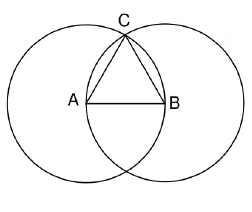
Proposition 1: Constructing an Equilateral Triangle
"On a given finite straight line to construct an equilateral triangle."
Given segment AB: 1. Construct circle c1 with centre A and radius AB (Postulate 3) 2. Construct circle c2 with centre B and radius BA (Postulate 3) 3. Let C be a point of intersection of c1 and c2 4. Construct segments AC, CB, and BA (Postulate 1) 5. Since AC and AB are radii of c1, and CB and AB are radii of c2, then AC = CB = AB (Common Notion 1) 6. Therefore triangle ABC is equilateral
This proposition is a beautiful exposition of deductive logic — Euclid takes care to justify every step in terms of the initial postulates and common notions.
Proposition 2: Placing an Equal Line Segment
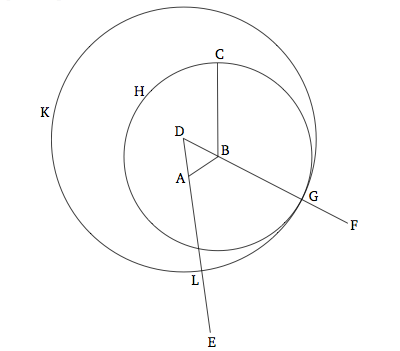
"To place a straight line equal to a given straight line with one end at a given point."
This is a clever construction to solve what seems a simple problem. One would like simply to slide the line BC so that one end coincides with point A — but there is no motion in Euclid's geometry. The only basic constructions Euclid allows are those of Postulates 1, 2, and 3. Euclid builds new constructions out of previously described ones. The construction effectively allows a "collapsing compass" postulate to transfer distances without assuming the compass retains its opening when lifted.
Proposition 3: Cutting Off an Equal Length
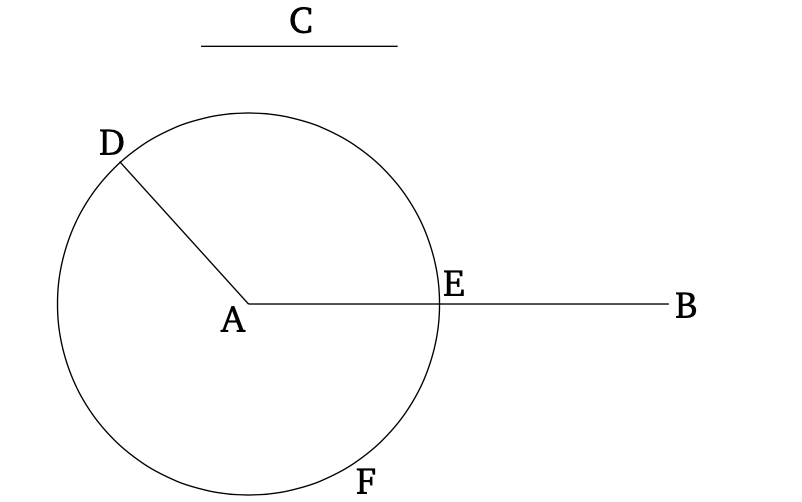
"To cut off from the greater of two given unequal straight lines a straight line equal to the less."
This proposition begins the geometric arithmetic of lines — allowing lines to be subtracted, compared for equality, and added. It is enabled by the construction of Proposition 2 and demonstrates how each new result builds directly on previous ones.
Lines and Angles
Lines and angles are among the most basic elements of geometry. All geometric figures either consist of, or can be understood through, the properties of lines and angles.
Basic Line and Angle Theorems
- If a straight line stands on a straight line, then it makes either two right angles or angles whose sum equals two right angles.
- If two straight lines not lying on the same side make the sum of the adjacent angles equal to two right angles, then the two straight lines are in a straight line with one another.
- If two straight lines cut one another, then they make the vertically opposite angles equal to one another.
Corollary: If two straight lines cut one another, then they make the angles at the point of section equal to four right angles.
Angles Formed by a Transversal
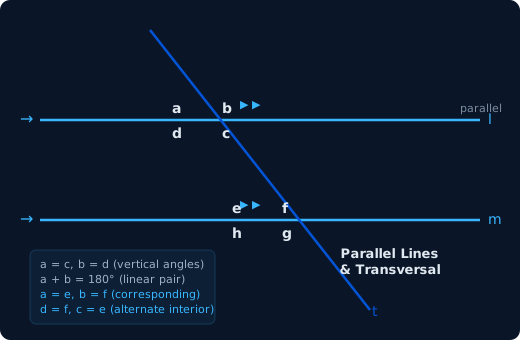
When two parallel lines are cut by a transversal, eight angles are formed. These group into pairs with special names:
- Corresponding angles — in matching corners
- Alternate interior angles — inner corners on opposite sides of the transversal
- Alternate exterior angles — outer corners on opposite sides of the transversal
- Consecutive interior angles — inside on the same side of the transversal
- Consecutive exterior angles — outside on the same side of the transversal
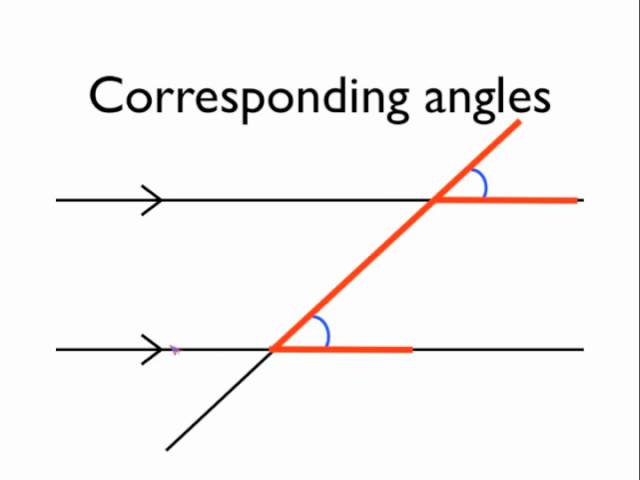
When two parallel lines are cut by a transversal: - Corresponding angles are equal
- Alternate interior angles are equal

- Alternate exterior angles are equal
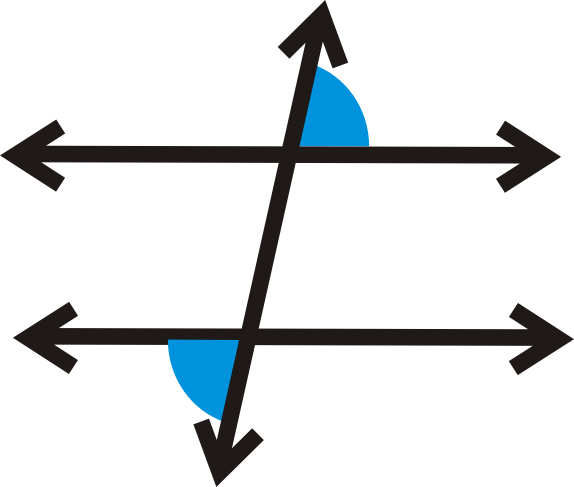
- Consecutive interior angles add up to 180°
- Consecutive exterior angles add up to 180°
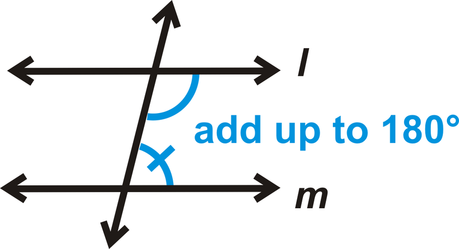
Conversely, if any of the above conditions hold, the two lines are parallel.
Conclusion
Lines and angles are the irreducible atoms of Euclidean geometry — every polygon, solid, and construction is ultimately made of them. The relationships between angles formed at intersections and by transversals cutting parallel lines reappear at every level of geometry, from the interior angle sums of polygons to the face angles of polyhedra. Mastering these relationships is the first essential step toward geometric fluency.
The next chapter turns to the simplest polygon — Triangles.