Introduction
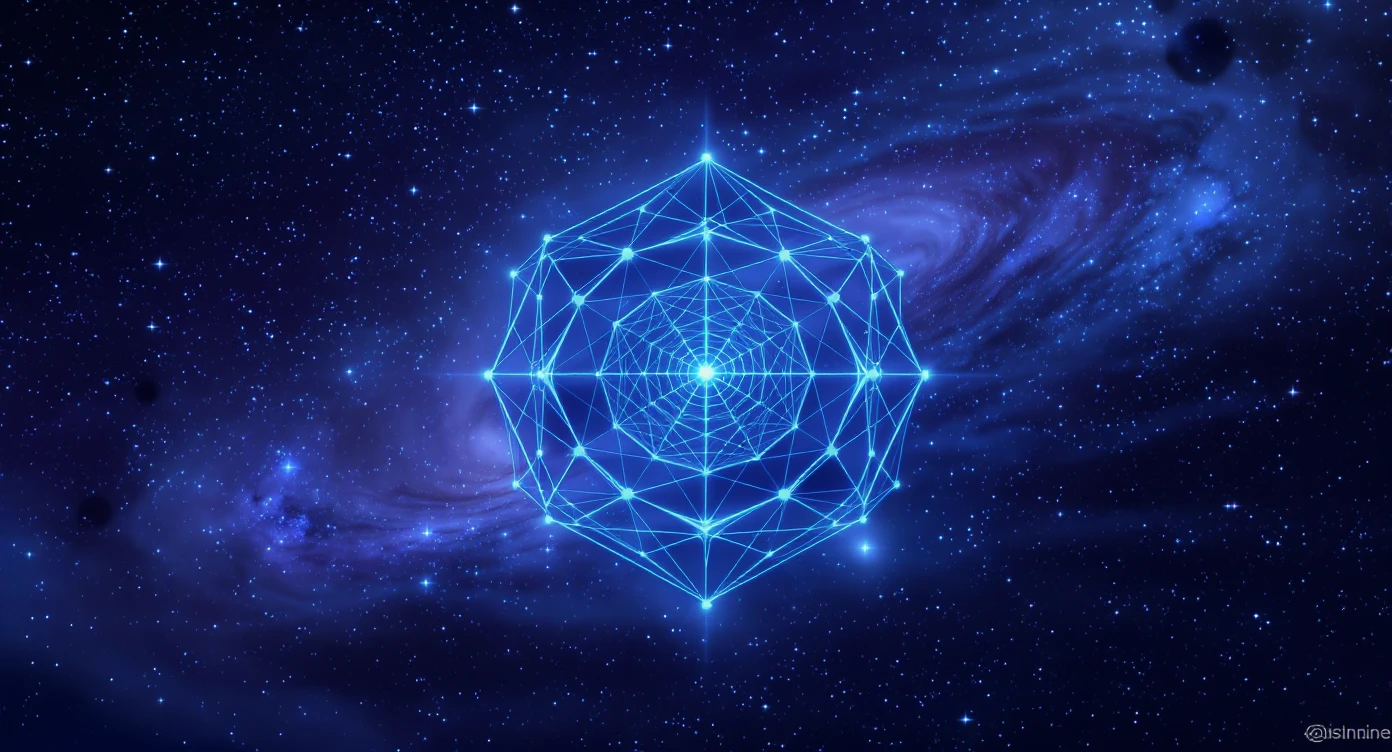
Geometry, as a branch of mathematics, offers more than numerical calculation. Its patterns and spatial relationships enable us to perceive the world in a structured, interconnected way. Through the study of geometry, we discover a profound link between mathematical concepts and the physical sciences — making learning an immersive and meaningful experience.
Geometric thinking is the application of this spatial awareness to the act of understanding itself. Rather than treating ideas as isolated facts, geometric thinking maps knowledge onto structure — and in doing so, reveals connections that linear thinking tends to obscure.
Key Takeaways
- Geometric thinking uses spatial patterns to organise knowledge — revealing structure that linear or algebraic thinking misses
- The Memory Palace, mind mapping, and scientific modelling are all forms of geometric thinking applied to cognition
- Science, business, and religious traditions all independently converged on geometric tools for understanding complex systems
- For us, geometric thinking is not just a method but a first principle: physical reality itself is geometric at its foundation
Expanding Consciousness Through Visualisation
Our innate visual nature enables us to understand and retain complex ideas more readily when they are associated with spatial representations. Just as memory champions utilise visual techniques for exceptional recall, geometric thinking taps into our natural inclination towards visualisation.

One of the most well-established memory techniques goes back to antiquity. The Roman Room — or Memory Palace — employs a virtual space within the mind. By assigning information to specific locations in the room, recall is significantly enhanced. Alternative approaches include using a familiar journey and placing objects along the route. What each of these techniques demonstrates is that when thoughts are compiled into a geospatial structure, the mind works far more effectively at retaining and retrieving them.
Forms of Geometric Thinking
Geometric thinking appears across a wide range of disciplines — from the formal models of science to the symbolic languages of religion. Here are three clear examples.
Science: The Role of Models
The scientific community employs geometric models to explain structures and phenomena that cannot be directly observed. These models allow scientists to represent complex relationships in a form that can be visualised, tested, and communicated. In our framework, the atom itself is a geometric object — the orbital shells are not probability clouds but precise polyhedral structures. See Atomic Geometry for the full treatment.
Business: Infographics and Mind Mapping
In the business world, infographics and mind maps enable the effective communication of information. Visualising data and concepts through geometric tools allows for better understanding and clearer decision-making. A mind map is, at its core, a geometric structure — a radial tree whose branching reflects the hierarchical relationships between ideas.
Philosophy and Religion: The Power of Symbolism
Philosophical and religious traditions have long used geometric symbols to represent abstract concepts. Whether it is the sacred geometry found in Hindu yantras, the geometric patterns of Islamic art, or the compass and square of Masonic tradition, symbolism conveys meaning through form in a way that language alone cannot. Harmonic Philosophy explores how this geometric symbolism connects to the physical structure of reality.
Empowering Minds with Geometric Thinking
Through compass construction and the development of geometric tools and techniques, we can unlock the potential of geometric thinking to enhance mental capacities. By embracing geometric thinking, individuals and institutions can:
Envision Outside the Box
Geometric thinking encourages creative problem-solving and the exploration of alternative perspectives. It liberates minds from conventional frameworks, allowing for innovative solutions and the discovery of connections that are invisible to linear analysis.
Foster Personal Development and Planning
Applying geometric thinking to self-development enables individuals to set goals, create structured plans, and visualise the steps needed to achieve their objectives. It provides a spatial framework for the organisation of thoughts and actions.
Understand Complex Subjects
Geometry's ability to simplify and visualise complex ideas makes it a valuable tool for tackling challenging subjects. By representing intricate concepts as geometric structures, learning becomes accessible and meaningful — whether the subject is quantum mechanics, molecular chemistry, or the history of mathematics.
Conclusion
Geometric thinking is a fundamental cognitive tool — one that science, business, and philosophy have each independently discovered. Its power lies in its ability to make abstract relationships visible. For us, geometric thinking is also a scientific first principle: the claim that physical reality is not algebraically structured but geometrically structured, and that adopting geometric thinking as a mode of enquiry leads directly to new and more accurate models of the universe.
For the geometric framework applied to physics, see Atomic Geometry, Geo-Quantum Mechanics, and 4D Thinking.
FAQ
What is geometric thinking?
Geometric thinking is the practice of using geometric patterns, shapes, and spatial relationships to organise and understand information. Rather than treating knowledge as a sequence of isolated facts, geometric thinking maps ideas onto visual and spatial structures — revealing connections and patterns that linear thinking tends to miss.
How does geometric thinking enhance memory and cognition?
Our brains are naturally visual. When abstract information is attached to a spatial or geometric structure — such as the rooms of a memory palace or the nodes of a mind map — it becomes easier to encode, retain, and retrieve. Memory champions have used geometric spatial techniques for millennia; modern neuroscience confirms that spatial encoding activates more of the brain than rote memorisation.
What is the Memory Palace technique?
The Memory Palace (also called the Roman Room or Method of Loci) is a mnemonic technique dating to antiquity. A practitioner assigns pieces of information to specific locations within a vividly imagined spatial environment — a house, a journey, a city. By mentally walking through the space, the information is recalled in sequence. It works because human memory is inherently geospatial.
How is geometric thinking used in science?
Scientists routinely use geometric models to represent structures and processes that cannot be observed directly — from the double helix of DNA to the orbital shells of atoms to the large-scale structure of the universe. Geometric models make abstract relationships concrete and testable. In our framework, geometry is not just a tool for representation but the fundamental language of physical reality.
How does geometric thinking relate to our broader theory?
Geometric thinking is the cognitive foundation for all of our work. Atomic Geometry, Geo-Quantum Mechanics, and the 4D wave model of matter all begin with the same principle: that the patterns of physical reality are geometric, and that thinking geometrically — rather than algebraically — reveals the structure that mathematics alone conceals.