Introduction
Einstein's Special Relativity is one of the most experimentally verified theories in physics. It describes how space and time are experienced differently by observers in relative motion — and does so with extraordinary precision for small numbers of observers in idealised conditions. But the Earth hosts billions of observers, all simultaneously experiencing their own frame of reference. How does relativity scale to that reality?
Geo-Relativity proposes an answer. By examining the Earth's spherical geometry and the role of π in the definitions of both space (the metre) and time (the day), it shows that the spacetime continuum is not merely a mathematical abstraction — it is encoded in the physical geometry of the planet we inhabit. The conclusion: π unifies space and time, and the 4D torus field provides the geometric medium through which this unification operates.
Key Takeaways
- Special Relativity describes a small number of observers; Geo-Relativity extends this to billions of simultaneous observers on the Earth's surface
- The metre is defined from the Earth's circumference and the day from its rotation — both space and time are encoded in circular geometry
- π unifies space and time: as an observer moves toward the poles, both the circle they traverse and their velocity diminish at the same geometric rate
- Each observer emits spherical light waves; the intersection of any two produces a Vesica Piscis with ratio 1:√3
- The 4D torus field provides the geometric framework within which unified time is rendered for all observers simultaneously
The Equations of Motion
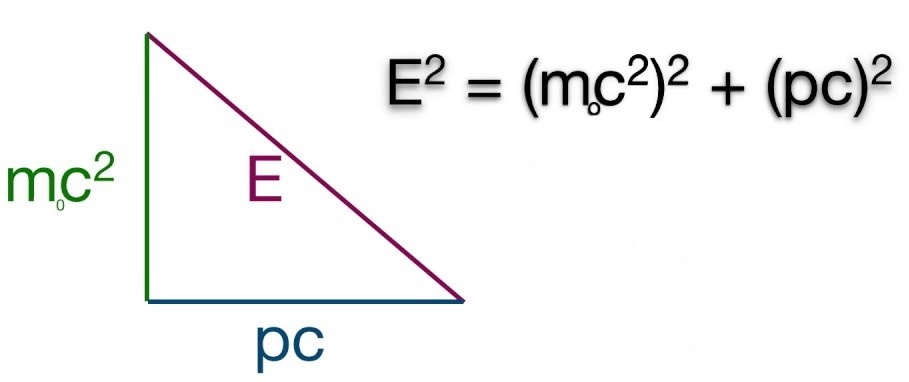
Einstein's mass-energy equivalence equation E = mc² describes the energy of a stationary object — one in an inert or non-moving frame of reference. To account for two bodies in relative motion, momentum (p) must be included, producing the full energy-momentum relation:
E² = (mc²)² + (pc)²
This is the relativistic extension of Pythagoras's theorem: a² + b² = c². The right-angled triangle is the geometric canvas on which relativistic mechanics is drawn — momentum and rest energy are the two legs; total energy is the hypotenuse.
Time Dilation and Length Contraction
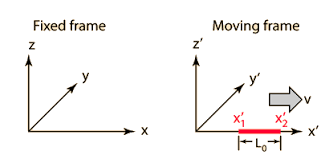
Because light travels at a finite speed, information cannot propagate instantaneously. Two observers in relative motion will assign different time coordinates to the same event — and will measure different lengths for the same object. These effects, time dilation and length contraction, are not mathematical artefacts: they have been confirmed experimentally.
The Hafele-Keating experiment of 1971 provided direct confirmation. Atomic clocks were flown around the Earth on commercial aircraft and compared to identical stationary clocks on the ground. The airborne clocks showed a measurable time discrepancy — precisely the magnitude predicted by Special Relativity. The effect is large enough that the GPS satellite network must correct for time dilation continuously to maintain positional accuracy.
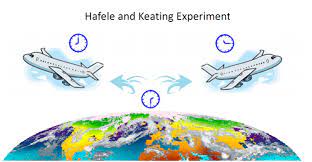
These experiments validate Special Relativity for small numbers of observers in controlled conditions. But the Earth carries billions of observers simultaneously — each at the centre of their own frame of reference. This is where the geo-relativistic extension begins.
The Earth's Circular Nature and π
The metre was originally defined as one ten-millionth of the distance from the equator to the North Pole — making the Earth's circumference exactly 40,000 km by definition (it has since been redefined in terms of the speed of light, but the circular geometric origin remains). The day is defined by one full rotation of the Earth on its axis — one complete circle. Both the fundamental unit of length and the fundamental unit of time are therefore derived from the same circular geometry of the same object.
Leon Foucault's pendulum experiment (1851) demonstrated the Earth's spherical rotation directly. As an observer moves from the equator toward either pole, the circle they traverse in a single day diminishes — and their velocity decreases proportionally. Space and time contract together, at the same rate, governed by the same geometry.
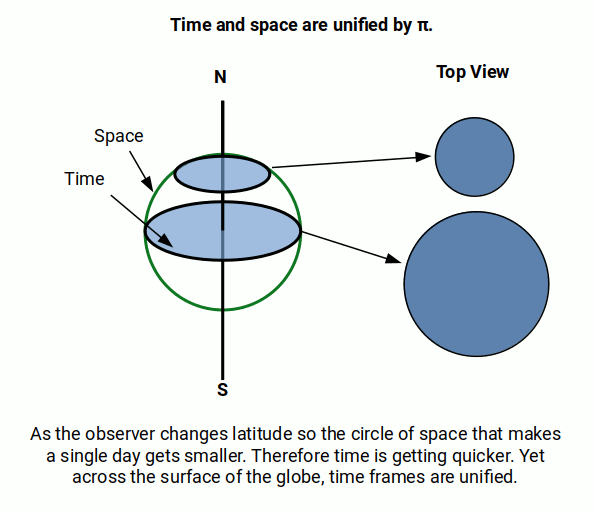
The rate at which the traversed circle diminishes is governed by π. This means π is not just a mathematical constant: it is the geometric quantity that maintains the unity of space and time across the Earth's surface. Two people conversing across the globe experience no time dilation in their exchange — unified time is a geometric property of the spherical surface they share, not a relativistic approximation.
This is the central claim of Geo-Relativity: the spacetime continuum is unified through π, encoded in the spherical geometry of the Earth itself. The remaining sections establish the geometric medium through which this operates, and how it scales to any number of observers.
The Fourth Dimension and the Torus
Special Relativity is formulated in three spatial dimensions. When extended to four dimensions, a different geometric structure emerges. The 4D torus field — a self-enclosing surface through which energy flows continuously — provides the geometric medium within which all observers on Earth simultaneously experience unified time.
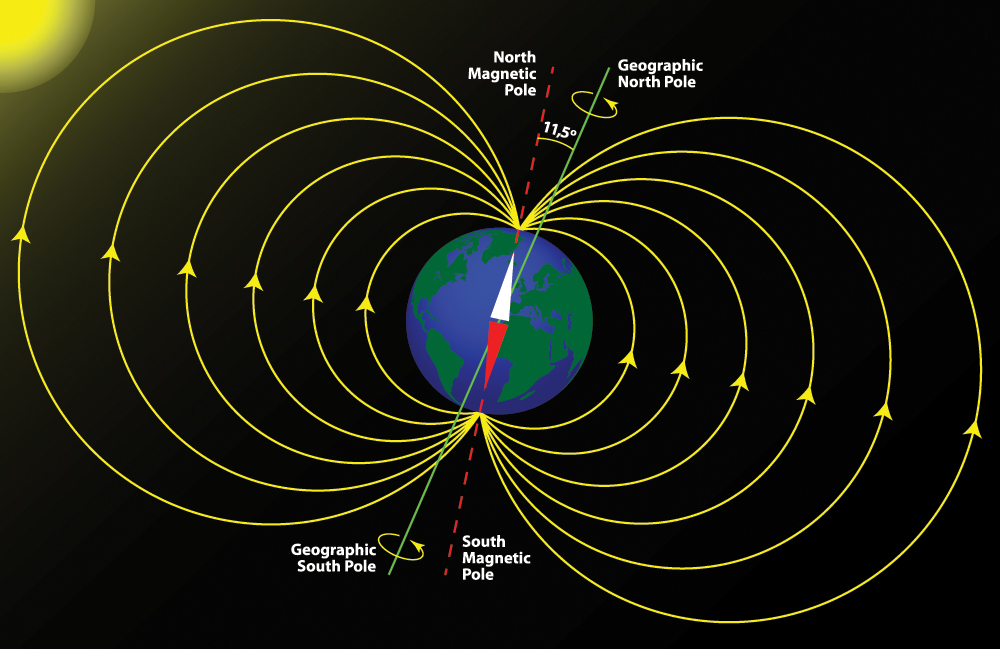
As the Earth rotates, every observer on its surface experiences the same cycle of a single day — regardless of their location. The torus provides the geometric explanation: its self-referential, looping structure renders the same temporal cycle for all points on the surface at once. This connects directly to the vacuum geometry described in 4D Aether Theory, where the torus is proposed as the fundamental structure of the space-filling medium.
The torus describes what the geometric medium is. The next question is how linear relativistic effects transform into circular ones when scaled to billions of simultaneous observers.
Multiple Observers and Buffon's Needle
The connection lies in a classical probability problem: Buffon's Needle.
Needles of length 1 are dropped randomly onto a grid of parallel lines spaced 2 units apart. The probability that a needle crosses a line converges to 1/π as the number of trials increases. What this demonstrates is that a random linear process — structurally identical to the Lorentz contraction of line lengths in Special Relativity — converges to circular geometry (π) when extended across a large number of simultaneous events.
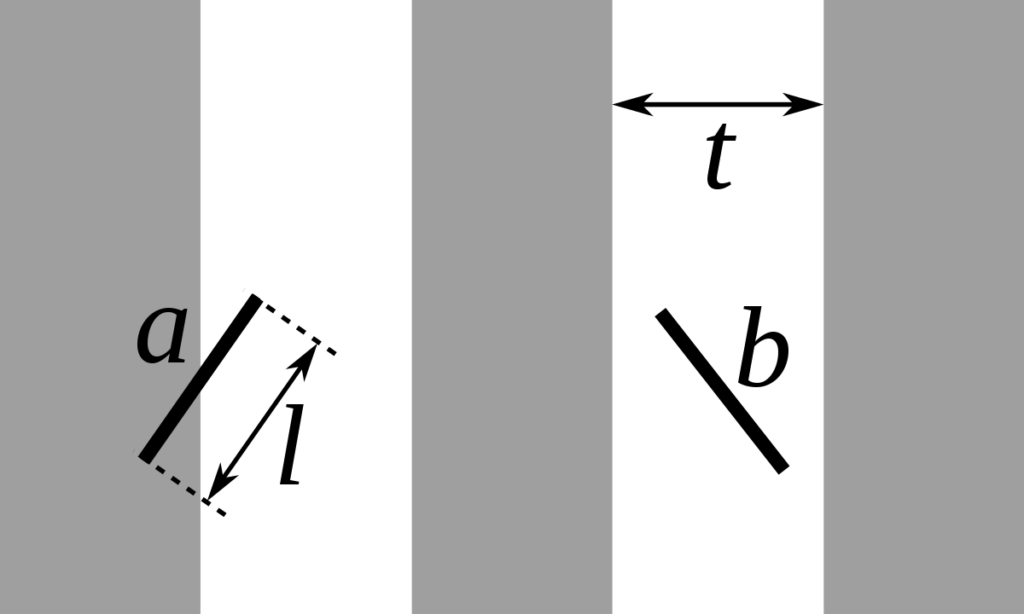
This is the geo-relativistic insight: the transformation from line to circle is not arbitrary. It is the mathematical consequence of scaling linear relativistic effects to a spherical surface with billions of simultaneous observers. The parallel between Lorentz contraction and Buffon's Needle is structural rather than a formal derivation — it points toward a deeper relationship between linear and circular descriptions of motion that Geo-Relativity proposes as worthy of rigorous investigation. The torus is the geometric medium; π is the ratio at which linear and circular descriptions converge.
The Vesica Piscis and Relative Distance
With the geometric medium established, we can examine what happens at the boundary between any two observers. Every observer continuously emits electromagnetic radiation — spherical waves of light expanding outward in all directions at speed c. When two observers are separated by a distance of ONE, their expanding light spheres intersect to form a Vesica Piscis — the lens-shaped overlap region at the intersection of two equal circles.
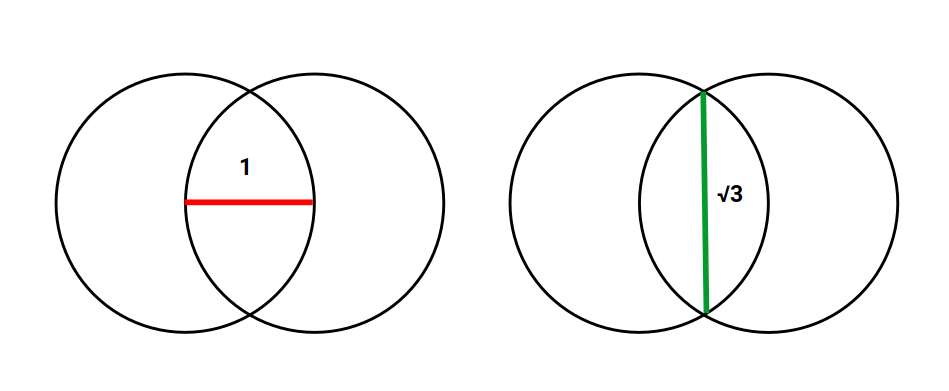
The midpoint between observers is defined by the vertical line connecting the two intersection nodes of the Vesica Piscis. This line has length √3, giving the ratio 1:√3 between observer separation and midpoint geometry. This is the same 1:√3 that appears in the space diagonal of the cube and in the electromagnetic constants of Dimensionless Science — a geometric coherence that suggests the same ratio structures reality at every scale.
Conclusion
Geo-Relativity does not contradict Special Relativity — it extends it. Where Einstein's framework treats a small number of observers in idealised relative motion, Geo-Relativity scales to the full complexity of billions of simultaneous observers embedded in a spherical, rotating, 4D geometric reality.
The result is a coherent geometric picture: the metre and the day are both derived from circular geometry; π is the constant that maintains their unity across all latitudes; the Vesica Piscis defines the geometric relationship between any two observers; and the 4D torus field is the medium within which unified time is rendered. Together these elements form a geometric account of relativity that complements 4D Aether Theory and whose mathematical language is provided by Dimensionless Science.
FAQ
What is Geo-Relativity?
Geo-Relativity is a geometric extension of Einstein's Special Relativity. Where Special Relativity considers a small number of observers in relative motion, Geo-Relativity scales the framework to billions of simultaneous observers distributed across the surface of the Earth — and proposes that π is the geometric constant that unifies their experience of space and time.
How does π unify space and time?
The definition of the metre is derived from the Earth's circumference (roughly 40,000 km), and the definition of a day is derived from a single rotation of the Earth. Both space and time are therefore encoded in the same circular geometry. As an observer moves from the equator toward a pole, the circle they traverse in a single day diminishes at a rate governed by π — and their velocity decreases proportionally. Space and time contract together, unified by the same geometric ratio.
What is the Vesica Piscis in this context?
Each observer emits spherical waves of light outward in all directions. When two observers are separated by a distance of ONE, the intersection of their expanding light spheres forms a Vesica Piscis. The midpoint between observers is defined by the vertical line between the two intersection nodes, which has a length of √3. The ratio 1:√3 is therefore the fundamental geometric relationship between any two observers in the geo-relativistic framework.
What is Buffon's Needle Problem and why is it relevant?
Buffon's Needle Problem is a probability experiment: needles of length 1 are dropped randomly onto a grid of parallel lines spaced 2 units apart, and the probability of a needle crossing a line is calculated — yielding π. This shows that random linear distributions converge to π when considered at sufficient scale. In Geo-Relativity, this demonstrates that the relativistic notion of line lengths (Lorentz contraction) naturally converges to circular geometry (π) when extended to a large number of simultaneous observers.
How does this relate to 4D Aether Theory?
Geo-Relativity and 4D Aether Theory share the same geometric foundation. The 4D torus field that renders unified time across the Earth's surface is the same toroidal geometry proposed as the structure of the vacuum in 4D Aether Theory. Both frameworks treat the fourth dimension as a geometric reality that resolves problems left open by three-dimensional physics.