Introduction
Most of us learn very early that zero means nothing. It is the empty slot, the absence of quantity, the number you get when you take away everything. So here is a surprising claim: zero is not nothing. It is a boundary — and a mathematically significant one at that.
This becomes clear the moment you ask a deceptively simple question: what happens when you keep dividing a number in half, over and over again? The answer is that the value shrinks and shrinks — but it never reaches zero. No matter how many times you divide, a remainder always survives. Zero acts like an invisible wall that the process of division can approach endlessly but never breach.
That wall is what this article calls the Zero Boundary.
Understanding it changes how you think about zero, about infinity, and about the four basic operations of arithmetic. Of those four operations — addition, subtraction, multiplication and division — only division produces this boundary effect. That distinction turns out to be important far beyond school mathematics.
Zero at the Centre of the Number Line
Picture a number line: an infinite ruler stretching left (negative numbers) and right (positive numbers), with zero sitting exactly in the middle. The positive side stretches toward infinity in one direction; the negative side stretches toward infinity in the other.
Zero divides those two infinite sets. That alone is worth pausing on — zero is not a member of either the positive or the negative set. It stands between them, marking the boundary where one ends and the other begins.

Zero in Geometry
This same idea extends into geometry. Every regular shape — a triangle, a square, a cube — has a centre point. We treat each of those centre points as its own kind of zero, defined by the number of lines (vectors) that meet there. A square has four lines meeting at its centre in 2D space; a tetrahedron has four lines meeting in 3D space. The centres are related, but not identical — each is shaped by the geometry of its surrounding form.
The number line is the simplest case: one-dimensional, with a zero whose properties we can examine cleanly before extending the concept to higher-dimensional shapes.
The Four Mathematical Operators
Every calculation in mathematics is built from four basic operations: addition, subtraction, multiplication, and division. Each one moves a value along the number line, but in very different ways. Looking at all four together reveals something unexpected about the nature of zero.
Addition and Subtraction
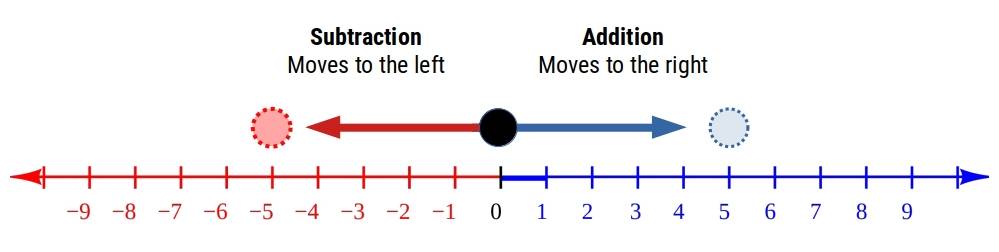
Addition moves a value to the right (toward the positive infinite). Subtraction moves it to the left (toward the negative infinite). Start at zero, add five, and you land at 5. Subtract three from there and you land at 2. The process is reversible — you can cross zero freely in either direction.
Multiplication
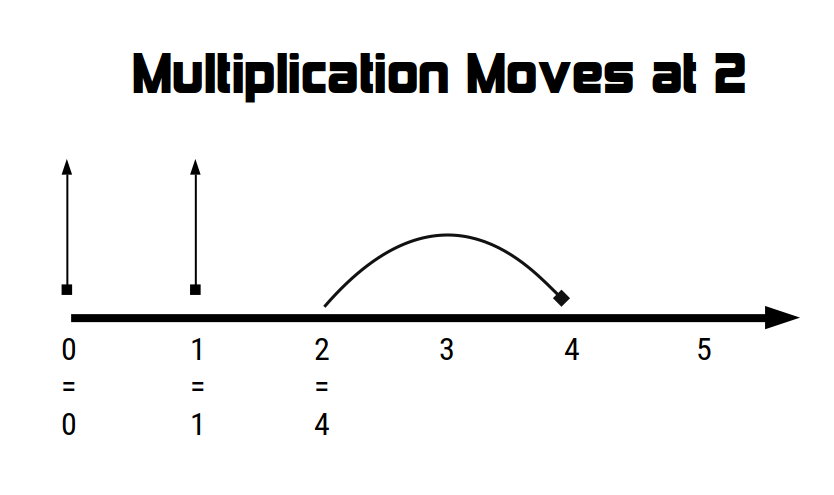
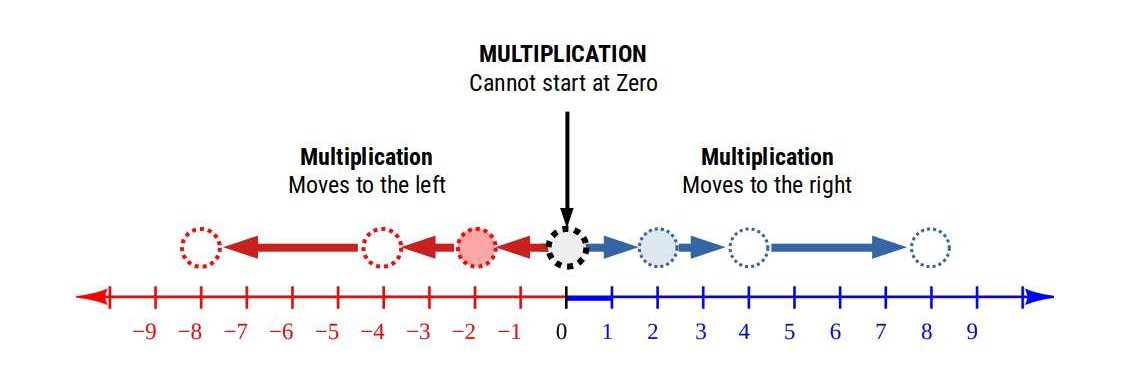
Multiplication scales a value outward. Start at 2 and multiply repeatedly: 2, 4, 8, 16 — the value races toward the positive infinite. Start with a negative number and it races toward the negative infinite. Either way, multiplication drives values away from zero toward the outer edges of the number line.
Note that multiplying by zero always returns zero, and multiplying by one leaves the value unchanged. For that reason the interesting behaviour of multiplication begins at 2 or above.
Division — and the Zero Boundary
Division is the mirror image of multiplication: where multiplication expands outward, division contracts inward. But contracts toward what?
Divide any number in half. Now halve the result. Keep going. The value gets smaller with every step — but it never reaches zero. There is always a remainder, however tiny. This is not a quirk of arithmetic; it is a fundamental property of division itself.
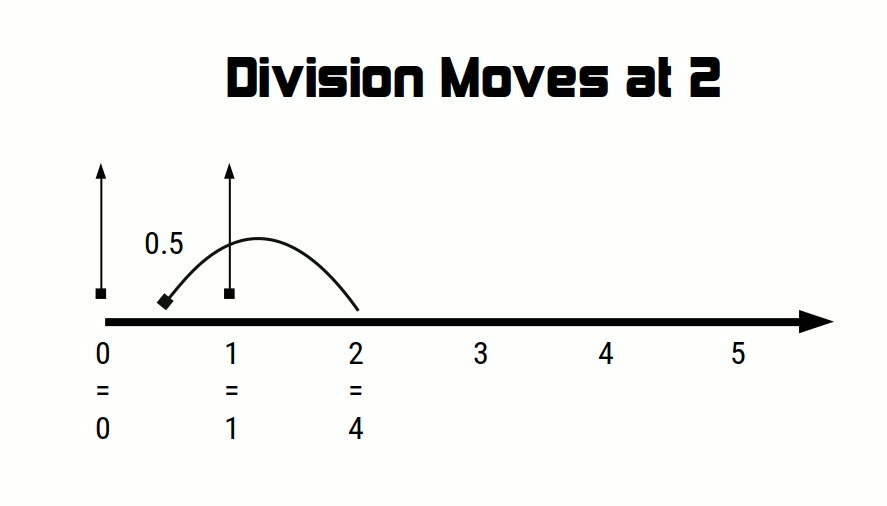

This is what distinguishes division from the other three operators. Addition, subtraction and multiplication can all, in various ways, cross zero or move away from it without restriction. Division alone creates a one-way compression that closes in on zero indefinitely.
We call this type of inward-compressing infinity 'Infinity IN' — a direction of infinity that moves toward ever smaller fractions of itself, rather than toward ever larger numbers.
Conclusion
The Zero Boundary is the first mathematical boundary: an invisible threshold that separates the infinite positive set from the infinite negative set, and that the process of division can approach but never cross.
This reframes what zero actually is. If zero were simply nothing — an empty placeholder — it could not act as a boundary. Yet division closes in on it from both sides indefinitely without ever breaking through. That behaviour implies that zero has genuine structural properties. The two infinities pressing in from either side suggest there must be something holding them apart — a boundary with a definite character, even if its thickness is infinitely small.
Of the four mathematical operations, only division reveals this property. That makes division unique, and it makes zero something richer and stranger than the empty symbol it is usually taken to be. Understanding the Zero Boundary is a first step toward a broader geometric view of number — one in which zero, infinity and the structure of space are all deeply connected.
FAQ
What about when you use a negative number as the operator — doesn't that change things?
When you use a negative number we call that 'changing polarity'. You can find out more on our post 'The Zero of Equilibrium and Balance'.
What exactly is a 'boundary' in mathematics?
A boundary is a limit — a point or line that a value can approach but never cross. Mathematics and physics are full of them: the speed of light is a physical boundary; the zero boundary is a numerical one. Division creates it because repeated halving always leaves a remainder, however small, that can never quite reach zero.
Does this mean zero is not really 'nothing'?
Exactly. If zero were simply nothing, it could not act as a boundary between two infinite sets. The fact that division closes in on zero from both sides without ever crossing it suggests zero has real structural properties — it is a boundary with finite thickness, even if that thickness is infinitely small.